
How Long Does It Take to Become a CNA? Complete Timeline 2026
📚 Get ready for your How Long Does It Take to Become a CNA? certification. Practice questions with step-by-step answer explanations and instant scoring.
CNA: upcoming dates and official changes
- Aug 1, 2026: Connecticut (Prometric) implements new exam pricing: $48 for written only, $48 for oral only, $125 for bundled written and clinical skills, effective August 1, 2026.[5]
- Jul 1, 2026: Idaho (Prometric) raises CNA exam fees to $34 each for written and oral exams, plus test site fees, effective July 1, 2026.[6]
- Passing score (written or oral): Set per state; no national percentage published.[1]
- Retake policy: Minimum 3 attempts required; aides must be told which areas they failed before each retake.[1]
- Validity: 2 years from issuance in most states.[2]
- Renewal: State-specific; typically 2-year cycles with continuing education requirements (12–24 hours per year) and paid-work requirements.[3]
- Delivery (in-person): In-person written or oral exam plus in-person skills demonstration at approved test centers.[1]
- Eligibility (training): Minimum 75 clock hours approved training (federal requirement); at least 16 hours supervised practical training.[1]
- Score release: Days to weeks; varies by state and vendor (no national standard).[4]
Numbers in brackets link to the official sources listed under Sources & last verified. Dates that have passed are removed automatically.
CNA Exam at a Glance
| Item | Detail | Source · Verified |
|---|---|---|
| Passing score (written or oral) | Set per state; no national percentage published[1] | Centers for Medicare & Medicaid Services · Oct 14, 2026 |
| Retake policy | Minimum 3 attempts required; aides must be told which areas they failed before each retake[1] | Centers for Medicare & Medicaid Services · Oct 14, 2026 |
| Validity | 2 years from issuance in most states[2] | archive.regulations.delaware.gov · Oct 14, 2026 |
| Renewal | State-specific; typically 2-year cycles with continuing education requirements (12–24 hours per year) and paid-work requirements[3] | cdph.ca.gov · Oct 14, 2026 |
| Delivery (in-person) | In-person written or oral exam plus in-person skills demonstration at approved test centers[1] | Centers for Medicare & Medicaid Services · Oct 14, 2026 |
| Eligibility (training) | Minimum 75 clock hours approved training (federal requirement); at least 16 hours supervised practical training[1] | Centers for Medicare & Medicaid Services · Oct 14, 2026 |
| Score release | Days to weeks; varies by state and vendor (no national standard)[4] | floridasnursing.gov · Oct 14, 2026 |
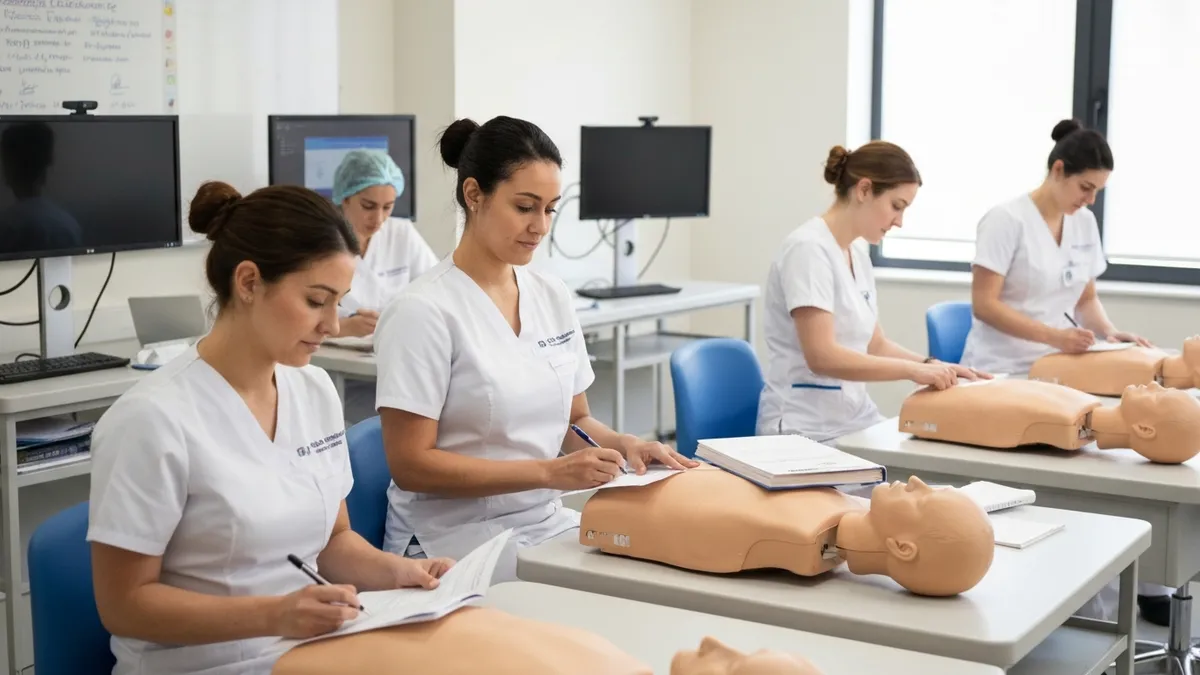
The answer to how long does it take to become a CNA depends on your state's minimum training hours and whether you choose full-time or part-time enrollment. According to the Bureau of Labor Statistics, nursing assistant employment is projected to grow 4% through 2033, with over 73,000 new positions opening annually. CNA training is one of the fastest entry points into healthcare — the federal minimum is just 75 hours, making completion possible in 2 to 4 weeks on an accelerated schedule. Practice with the free CNA practice test on PracticeTestGeeks (3,000+ questions with answer explanations).
Most students asking how long to become a CNA want three things: the fastest path, what the state exam involves, and what the total cost will be. This guide answers all three with specific timelines, program-type comparisons, and a state-by-state hour breakdown. If you want to start practicing right now, our CNA practice test covers all 70 exam question types with answer explanations.
Free CNA Study Tools
Interactive CNA resources on PracticeTestGeeks, free to start:
- CNA practice test — 3,000+ questions with instant scoring and answer explanations
- CNA flashcards — review key terms and concepts card by card
- CNA study guide — topic-by-topic overview of what the exam covers
- CNA cheat sheet — one-page printable summary for last-minute review
The fastest students complete all five steps in 3 to 5 weeks by choosing an accelerated full-time program in a state with 75-hour minimums. Students in states like Maine (180 hours) or states requiring separate clinical blocks will need 10 to 14 weeks even on a full-time schedule. For a detailed breakdown of what each step involves, our guide to CNA certification walks through every requirement.

No matter which format you choose, the certification you earn is identical. A CNA trained at a community college has the same state registry credential as one from a private school or hospital program. If cost is a concern, explore our guide to free CNA classes and CNA scholarships — many states have workforce training grants that cover 100% of tuition.
The total cost to become a CNA — including training, exam fees ($75–$150), and supplies — ranges from $0 to $2,500. This is significantly lower than LPN ($10,000–$15,000) or RN ($30,000–$75,000) programs. Once certified, the average CNA earns $33,000–$40,000 annually with upward mobility into LPN and RN roles. For salary data by state, see our detailed CNA salary.
How Long Does CNA Training Take by State
These states require only the federal minimum of 75 training hours — the fastest path to CNA certification:
- Arizona — 75 hours. Exam: Prometric. Typical program: 3–5 weeks full-time.
- Missouri — 75 hours. Exam: Prometric. Typical program: 3–5 weeks full-time.
- Montana — 75 hours. Exam: D&S Diversified. Typical program: 2–4 weeks accelerated.
- Wyoming — 75 hours. Exam: Prometric. Typical program: 3–5 weeks full-time.
- West Virginia — 75 hours. Exam: Prometric. Typical program: 3–5 weeks.
If you live in one of these states and enroll in a full-time accelerated program, you can complete training and schedule your exam in under 4 weeks.

How Long Is a CNA License Good For?
- ✓CNA licenses are valid for 2 years in most states before renewal is required
- ✓To renew, you must have worked a minimum of 8 hours as a paid CNA during the 2-year period
- ✓If you have not worked as a CNA for 24+ months, you must repeat training and retake the state exam
- ✓Some states (California, Texas, Florida) have their own renewal cycle — check your state registry
- ✓CNA licenses do not expire as long as you maintain active employment and renew on time
- ✓Continuing education requirements for renewal vary: some states require 12 CEU hours; others require none
- ✓CNA credentials do NOT automatically transfer between states — you must apply for reciprocity
- ✓For state-to-state transfer, see our guide on CNA reciprocity: most states accept your original certificate with no retesting required within 2 years
Keeping your CNA license active is simple if you maintain at least 8 paid hours of CNA work per 2-year renewal cycle. The most common reason CNAs lose certification is a gap in employment — if you stop working as a CNA for more than 24 months, you must retrain from scratch. For renewal procedures specific to your state, visit our CNA license renewal or check the CNA registry lookup tool.
Pros & Cons: Fast-Track vs Traditional CNA Training
- +Fast-track programs let you start earning in 2–4 weeks instead of 8–12
- +Same state certification whether accelerated or part-time — no difference on your resume
- +Employer-sponsored programs are completely free and include guaranteed job placement
- +Federal 75-hour minimum means states like Arizona and Missouri offer the fastest path in the US
- +CNA certification opens doors to LPN and RN pathways with bridge programs at community colleges
- +Community college programs offer financial aid, Pell Grants, and workforce development funding
- −Accelerated programs require 8–10 hour days — mentally and physically demanding
- −States with 150–180 hour requirements (California, Maine) significantly extend the timeline
- −Part-time evening programs take 8–12 weeks — longer if scheduling conflicts arise
- −Exam wait times can add 1–3 weeks after training completion depending on testing vendor availability
- −Employer-sponsored programs require 6–12 month work commitments after certification
- −CNA credentials do not automatically transfer between states — reciprocity applications take 2–6 weeks
Whichever path you choose, the state competency exam is the same challenge. Our guide on how to pass the CNA exam covers the written and skills portions in detail. For a structured study schedule, the CNA study guide maps out daily preparation starting from day one of training. Once certified, explore career advancement options through our CNA career paths guide — including pediatric, geriatric, and dialysis CNA specializations.
Sample CNA Practice Questions
Try these questions from our free CNA practice tests. The correct answer and an explanation follow each question.
A CNA with 10 years of experience in rehabilitation wants to become a restorative nursing assistant. What does this role primarily focus on?
- A. Administering physical therapy treatments
- B. Helping patients maintain or regain functional independence
- C. Performing surgical preparation tasks
- D. Managing patient insurance documentation
Answer: B. Helping patients maintain or regain functional independence
Restorative nursing assistants focus on programs that help residents maintain or regain the highest possible level of functional independence.
A resident has a PICC line in their left arm for long-term antibiotic therapy. What is the most critical precaution the CNA must take when preparing this resident for a shower?
- A. Ensure the resident's left arm is kept below the level of the heart.
- B. Apply a tight elastic bandage over the PICC line dressing to hold it in place.
- C. Cover the entire PICC line dressing and exit site with a waterproof, occlusive cover.
- D. Have the resident use their right arm exclusively for washing to avoid dislodging the line.
Answer: C. Cover the entire PICC line dressing and exit site with a waterproof, occlusive cover.
The primary risk associated with a PICC line during bathing is infection, which can occur if the insertion site gets wet. It is crucial to cover the entire dressing and the catheter's exit site with a waterproof cover to keep it completely dry. Submerging the line or allowing water to seep under the dressing can introduce bacteria and lead to a serious bloodstream infection. While being careful with the arm is important, preventing water exposure is the most critical safety measure.
A CNA is caring for a resident with a diagnosis of CVA. The CNA notices the resident has a new facial droop and is slurring their speech. What does CVA stand for, and what does it commonly refer to?
- A. Cardiovascular Accident, a heart attack.
- B. Chronic Venous Access, a type of IV line.
- C. Cerebrovascular Accident, a stroke.
- D. Complete Vertebral Assessment, a spinal check.
Answer: C. Cerebrovascular Accident, a stroke.
CVA stands for Cerebrovascular Accident, which is the medical term for a stroke. A stroke occurs when blood flow to a part of the brain is disrupted. The signs observed by the CNA (facial droop, slurred speech) are common symptoms of a stroke.
Which does NOT prevent or reduce odors?
- A. Using room deodorizers
- B. Placing fresh flowers in the room
- C. Emptying bedpans promptly
- D. Practicing good personal hygiene
Answer: B. Placing fresh flowers in the room
While fresh flowers can add a pleasant visual element, they do not actively prevent or reduce odors; they merely mask them with their own scent. In some cases, decaying flowers or stagnant water can even contribute to odors. Effective odor control involves eliminating the source, such as promptly emptying bedpans and ensuring good personal hygiene, or using deodorizers to neutralize smells.
Take the full CNA practice test
For more details, see our free cna practice test guide. For more details, see our prometric cna sample test guide. For more details, see our pennsylvania cna license lookup guide. For more details, see our cna vs caregiver guide. For more details, see our arizona rn license lookup guide. For more details, see our missouri cna registry guide. For more details, see our cna salary new jersey guide. For more details, see our cna classes near me guide. For more details, see our montana cna license lookup guide. For more details, see our CNA Practice Test 2026 - Certified Nursing Assistant Training guide. For more details, see our wisconsin nursing license lookup guide. For more details, see our certified nursing assistant salary guide. For more details, see our CNA Certifications guide. For more details, see our CNA Jobs guide. For more details, see our cna training guide. For more details, see our What is a CNA training program? guide. For more details, see our cna salary guide. For more details, see our CNA Courses Near Me & Online guide. For more details, see our CNA Programs guide. For more details, see our cna interview questions and answers guide. For more details, see our CNA Resume guide. For more details, see our CNA Resources guide. For more details, see our cna agency jobs near me guide. For more details, see our Tracheostomy & Ventilator Support CNA Practice Test Video Answers guide. For more details, see our Rehabilitation CNA Practice Test Video Answers guide. For more details, see our Pediatric CNA Practice Test Video Answers guide. For more details, see our Oncology CNA Practice Test Video Answers guide. For more details, see our Memory Care CNA Practice Test Video Answers guide. For more details, see our Maternal / Newborn CNA Practice Test Video Answers guide. For more details, see our FLOAT POOL CNA Practice Test Video Answers guide. For more details, see our ER CNA Practice Test Video Answers guide.CNA Training Duration Questions and Answers
Sources & last verified
- Centers for Medicare & Medicaid Services — passing score, retake policy, delivery, eligibility (official source). “The State shall establish the passing standard for the written or oral examination and for the skills demonstration.” Verified Oct 14, 2026.
- archive.regulations.delaware.gov — validity (official source). “CNA certification shall be effective for 2 years following the date of issue and shall expire 2 years following such date” Verified Oct 14, 2026.
- cdph.ca.gov — renewal (official source). “Certificates are renewed every two years, and the required training is 48 hours of in-service training or continuing education” Verified Oct 14, 2026.
- floridasnursing.gov — score release (official source). “After you pass both components and your application is fully processed, the Board adds you to the Registry and mails your certificate. The process can…” Verified Oct 14, 2026.
- prometric.com — other (official source). “Effective August 1, 2026, the following exam pricing will be implemented” Verified Oct 14, 2026.
- prometric.com — other (official source). “Effective July 1, 2026, the following exam pricing will be implemented: $34 written, $34 oral, plus test site fees” Verified Oct 14, 2026.
How we verify: editorial & fact-checking policy. Report an error: contact us.
How this page was made: written with AI tools. Exam facts are checked against the official sources listed below. Not reviewed by a subject-matter expert. Editorial policy
Sources & references
Exam facts on this page (fees, format, dates, passing scores) are checked against these official sources; the date is our last check. Editorial policy
- floridasnursing.gov — Eligibility, exam format · verified Oct 2026
- law.cornell.edu — Eligibility · verified Oct 2026
- law.cornell.edu — Test delivery · verified Oct 2026
- prometric.com — Exam information · verified Oct 2026