
Free CNA Training 2026 — How to Get Paid CNA Training Near You
Free CNA Training 2026 practice test with questions and answer explanations. Prepare for the 2026 exam with instant scoring. 🟢

CNA: upcoming dates and official changes
- Aug 1, 2026: Connecticut (Prometric) implements new exam pricing: $48 for written only, $48 for oral only, $125 for bundled written and clinical skills, effective August 1, 2026.[5]
- Jul 1, 2026: Idaho (Prometric) raises CNA exam fees to $34 each for written and oral exams, plus test site fees, effective July 1, 2026.[6]
- Passing score (written or oral): Set per state; no national percentage published.[1]
- Retake policy: Minimum 3 attempts required; aides must be told which areas they failed before each retake.[1]
- Validity: 2 years from issuance in most states.[2]
- Renewal: State-specific; typically 2-year cycles with continuing education requirements (12–24 hours per year) and paid-work requirements.[3]
- Delivery (in-person): In-person written or oral exam plus in-person skills demonstration at approved test centers.[1]
- Eligibility (training): Minimum 75 clock hours approved training (federal requirement); at least 16 hours supervised practical training.[1]
- Score release: Days to weeks; varies by state and vendor (no national standard).[4]
Numbers in brackets link to the official sources listed under Sources & last verified. Dates that have passed are removed automatically.
CNA Exam at a Glance
| Item | Detail | Source · Verified |
|---|---|---|
| Passing score (written or oral) | Set per state; no national percentage published[1] | Centers for Medicare & Medicaid Services · Oct 14, 2026 |
| Retake policy | Minimum 3 attempts required; aides must be told which areas they failed before each retake[1] | Centers for Medicare & Medicaid Services · Oct 14, 2026 |
| Validity | 2 years from issuance in most states[2] | archive.regulations.delaware.gov · Oct 14, 2026 |
| Renewal | State-specific; typically 2-year cycles with continuing education requirements (12–24 hours per year) and paid-work requirements[3] | cdph.ca.gov · Oct 14, 2026 |
| Delivery (in-person) | In-person written or oral exam plus in-person skills demonstration at approved test centers[1] | Centers for Medicare & Medicaid Services · Oct 14, 2026 |
| Eligibility (training) | Minimum 75 clock hours approved training (federal requirement); at least 16 hours supervised practical training[1] | Centers for Medicare & Medicaid Services · Oct 14, 2026 |
| Score release | Days to weeks; varies by state and vendor (no national standard)[4] | floridasnursing.gov · Oct 14, 2026 |

What Does Free CNA Training Actually Mean?
Free CNA training does not always mean zero strings attached. Most programs that advertise free training fall into one of three categories: employer-sponsored programs that pay for your training in exchange for a work commitment, government-funded grants that cover tuition with no repayment required, and subsidized programs where a third party covers costs on your behalf. Practice with the free CNA practice test on PracticeTestGeeks (3,000+ questions with answer explanations).
Understanding the difference matters. An employer-sponsored program might pay 100% of your training costs, but you agree to work for that facility for six to twelve months after certification. A WIOA grant covers tuition outright with no payback obligation. Knowing which type you are applying for helps you evaluate whether the offer actually meets your needs.
In all cases, free CNA training covers the same curriculum: classroom theory (anatomy, infection control, resident rights, safety) and hands-on clinical hours in a licensed facility. You still sit the same state competency exam at the end. The only difference is who pays for the program.
Free CNA Study Tools
Interactive CNA resources on PracticeTestGeeks, free to start:
- CNA practice test — 3,000+ questions with instant scoring and answer explanations
- CNA flashcards — review key terms and concepts card by card
- CNA study guide — topic-by-topic overview of what the exam covers
- CNA cheat sheet — one-page printable summary for last-minute review
Employer-Sponsored Free CNA Training
Nursing homes, long-term care facilities, and home health agencies are the single largest source of free CNA training in the United States. Because the demand for certified nursing assistants consistently outpaces supply, many facilities have built in-house training programs to recruit and retain staff.
How it works: the employer enrolls you in a state-approved CNA program, covers tuition and sometimes textbooks and uniforms, and pays you a training wage while you complete classroom and clinical hours on-site. After you pass the state competency exam and become certified, you begin working as a full CNA at the facility — usually at a higher pay rate.
Most employer-sponsored programs include a service agreement. You commit to working at the facility for a defined period, typically six to twelve months. If you leave before the commitment period ends, you may be required to repay some or all of the training costs. Read the agreement carefully before signing.
Where to find these programs:
- Local nursing homes and skilled nursing facilities — call the HR department directly and ask if they offer a CNA training program
- Home health agencies — companies like Amedisys, LHC Group, and Addus HomeCare run training programs in many states
- Hospital systems — large hospital networks sometimes run entry-level CNA pipelines for future employee recruitment
- Assisted living communities — memory care and assisted living facilities often sponsor training for care staff
For a broader look at training options near you, see cna classes near me.
Government-Funded Free CNA Training Programs
Federal and state governments fund several workforce development programs that can cover CNA training costs entirely. These programs prioritize low-income individuals, displaced workers, veterans, and others who face barriers to employment. Unlike employer-sponsored programs, government-funded training typically has no service commitment — you get certified and are free to work wherever you choose.
The primary federal programs that fund CNA training include:
- Workforce Innovation and Opportunity Act (WIOA) — the largest federal workforce development program, administered through American Job Centers
- Medicaid workforce development initiatives — states use Medicaid waiver funding to train direct care workers for home and community-based services
- Trade Adjustment Assistance (TAA) — available to workers displaced by foreign trade, covers retraining including healthcare programs
- Veterans Employment and Training Service (VETS) — helps veterans transition into civilian healthcare careers
- Community Services Block Grant (CSBG) — administered locally, funds vary by community action agency
State governments also run independent workforce programs. Some states have dedicated CNA pipeline initiatives specifically to address nursing home staffing shortages. Check your state department of labor or health and human services website for current programs.
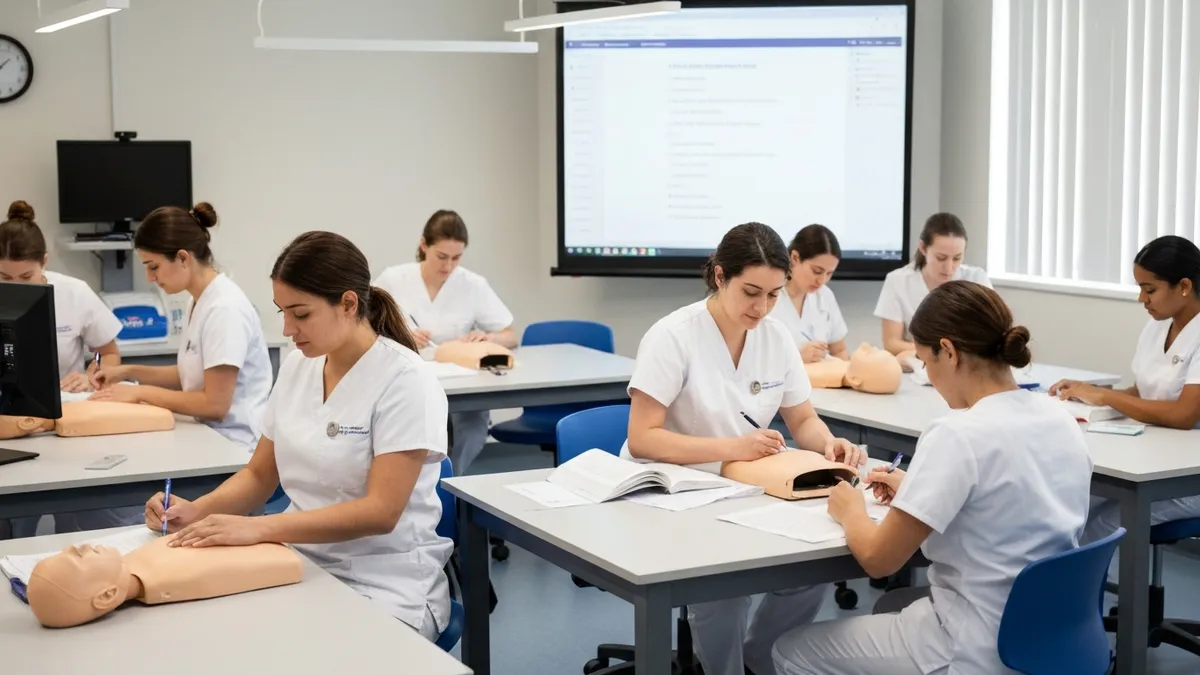
American Job Centers and CareerOneStop
American Job Centers (AJCs) are federally funded one-stop employment service centers located in every state. They are the on-the-ground delivery point for WIOA funding and many other workforce programs. There are approximately 2,500 AJC locations nationwide.
Services available at an American Job Center:
- Career assessment and counseling
- Eligibility screening for WIOA and other training grants
- Referrals to approved CNA training programs in your area
- Resume help and interview preparation
- Connections to local nursing homes and healthcare employers
- Support services including transportation and childcare assistance in some locations
To find your nearest American Job Center, visit careeronestop.org/localhelp or call 1-877-872-5627. Bring identification, proof of residency, and income documentation to your first appointment to speed up the eligibility process.
CareerOneStop, the online portal run by the U.S. Department of Labor, also has a training finder tool that lets you search for state-approved CNA programs by zip code, including programs that accept WIOA funding.
Red Cross CNA Training Programs
The American Red Cross runs one of the largest and most recognized CNA training programs in the country. The Red Cross certified nurse assistant Training program is state-approved and offered in blended format — online theory coursework combined with in-person clinical hours at affiliated facilities.
The Red Cross program is not free by default, but financial assistance is available through several channels:
- WIOA funding — Red Cross programs are approved training providers in most states, meaning your WIOA ITA can pay for the program
- Scholarships — the Red Cross periodically offers scholarships for CNA training, particularly in high-need geographic areas
- Employer partnerships — some nursing facilities sponsor employees through the Red Cross program
- Payment plans — for those who do not qualify for grants, the Red Cross offers low-cost payment plans
The Red Cross program is particularly strong for people with scheduling constraints. The blended format allows you to complete theory modules at your own pace online before attending in-person clinical sessions. Total program length is typically four to six weeks.
State-Specific Free CNA Training Programs
Many states run their own free or subsidized CNA free cna often in response to nursing home staffing crises or as part of broader healthcare workforce initiatives. These programs are separate from federal WIOA funding and may have different eligibility requirements and application processes.
Examples of state-level programs include:
- California — the Employment Development Department (EDD) funds CNA training through its Employment Training Panel (ETP), which partners directly with healthcare employers
- Texas — the Texas Workforce Commission (TWC) funds CNA training at community colleges and technical schools through Skills Development Funds
- New York — the SUNY system offers subsidized CNA programs at community colleges, and the state Workforce Development Initiative funds training for unemployed workers
- Florida — the CareerSource Florida network funds CNA training for eligible individuals through Quick Response Training and incumbent worker programs
- Illinois — Illinois Works provides free CNA training specifically targeting individuals entering the healthcare workforce for the first time
- Ohio — the OhioMeansJobs network connects workers to free CNA training at community colleges and approved private schools
To find your state specific programs, search for your state name plus department of labor workforce development or free CNA training and look for .gov domains. State program availability changes frequently, so verify current offerings directly with the administering agency.
CNA Checklist
- ✓Research the free training options in your area: employer-sponsored, WIOA, and state programs
- ✓Visit your nearest American Job Center or go to careeronestop.org to check WIOA eligibility
- ✓Gather required documents: photo ID, Social Security card, proof of income, and proof of residency
- ✓Meet with a career counselor to get approved for an Individual Training Account (ITA) if using WIOA
- ✓Search for state-approved CNA programs in your area using the CareerOneStop training finder
- ✓Contact nursing homes, home health agencies, and assisted living facilities directly about employer-sponsored programs
- ✓Compare program length, clinical hours, exam pass rates, and post-training job placement rates
- ✓Submit your application to your preferred program — get confirmation of funding before enrolling
- ✓Complete the classroom theory portion and the required clinical hours
- ✓Register for your state CNA competency exam through your state nurse aide registry
- ✓Pass the written and skills portions of the exam to become certified
- ✓Apply to full-time CNA positions — use your exam pass as proof of certification while waiting for the official registry listing

Online Free CNA Theory Resources
A number of online platforms offer free or low-cost CNA theory content. These resources are useful for building foundational knowledge, but they cannot replace a state-approved CNA program with clinical hours. You cannot become a licensed CNA through online-only training — every state requires in-person clinical practice.
That said, free online resources are excellent for:
- Building background knowledge before starting a paid or funded program
- Reviewing anatomy, medical terminology, and infection control
- Preparing for the written portion of the state competency exam
- Supplementing your enrolled program coursework
Free online CNA theory resources:
- Khan Academy — free health and medicine modules covering biology, anatomy, and healthcare concepts relevant to CNA work
- Coursera — some universities offer free audited healthcare courses that cover CNA-relevant content
- YouTube — numerous nursing educators publish free CNA exam prep and skills demonstration videos
- CNA Plus Academy — free practice tests and study guides organized by exam domain
For structured exam preparation, CNA Classes Near Me lists state-approved programs, and our CNA practice tests cover all major exam domains including basic nursing skills, personal care, mental health, and safety procedures.
After Free CNA Training: What to Expect
Completing a free CNA training program and passing your state competency exam opens the door to immediate employment. The certified nursing assistant role is consistently one of the fastest-hiring healthcare positions in the country, with most certified CNAs receiving job offers within two to four weeks of passing their exam.
Starting wages vary by state and setting. Hospital CNAs typically earn more than nursing home CNAs, and home health CNAs earn rates that depend on the agency and patient volume. For a detailed look at current compensation, see CNA Pay 2026 — How Much Do CNAs Make?.
Many CNAs use the role as a stepping stone. The clinical experience you gain as a CNA is directly applicable to LPN and RN programs. Some employers offer tuition assistance for nurses who started as CNAs — making CNA training the first link in a long-term healthcare career. See How Long Does It Take to Become a CNA? for the complete certification timeline.
CNA Pros and Cons
- +CNA has a defined, publicly available content blueprint — candidates know exactly what to prepare for
- +Multiple preparation pathways (self-study, courses, coaching) accommodate different learning styles and schedules
- +A growing ecosystem of study resources means candidates at any budget level can access quality preparation materials
- +Clear score reporting allows candidates to identify specific strengths and weaknesses for targeted remediation
- +Professional recognition associated with strong performance provides tangible career and academic benefits
- −The scope of tested content requires substantial preparation time that competes with existing professional or academic commitments
- −No single resource covers the full content scope — candidates typically need multiple study tools for comprehensive preparation
- −Test anxiety and exam-day performance variability mean preparation effort does not always translate linearly to scores
- −Registration, preparation, and potential retake costs accumulate into a significant financial investment
- −Content and format can change between exam versions, making older preparation materials less reliable
Pros and Cons at a Glance
| Pros | Cons |
|---|---|
| CNA has a defined, publicly available content blueprint — candidates know exactly what to prepare for | The scope of tested content requires substantial preparation time that competes with existing professional or academic commitments |
| Multiple preparation pathways (self-study, courses, coaching) accommodate different learning styles and schedules | No single resource covers the full content scope — candidates typically need multiple study tools for comprehensive preparation |
| A growing ecosystem of study resources means candidates at any budget level can access quality preparation materials | Test anxiety and exam-day performance variability mean preparation effort does not always translate linearly to scores |
| Clear score reporting allows candidates to identify specific strengths and weaknesses for targeted remediation | Registration, preparation, and potential retake costs accumulate into a significant financial investment |
| Professional recognition associated with strong performance provides tangible career and academic benefits | Content and format can change between exam versions, making older preparation materials less reliable |
Sample CNA Practice Questions
Try these questions from our free CNA practice tests. The correct answer and an explanation follow each question.
A resident expresses a significant fear of falling after a recent near-miss event and is now refusing to participate in their prescribed physical therapy. Which action by the CNA is most appropriate?
- A. Insist that the resident must attend therapy because the doctor ordered it.
- B. Tell the resident their fear is irrational and they will be fine.
- C. Ask the nurse or physical therapist to discuss alternative, less intimidating exercises with the resident.
- D. Document the refusal and take no further action.
Answer: C. Ask the nurse or physical therapist to discuss alternative, less intimidating exercises with the resident.
Fear of falling is a legitimate concern that can impede recovery and increase fall risk. The CNA should report this to the nurse or therapist. They can then work with the resident to find alternative exercises, perhaps starting with chair-based exercises, to build confidence and strength without causing distress, which is a key part of patient-centered care.
While caring for a resident with dementia who has a history of wandering, the CNA notices the resident is dressed in outdoor clothing and pacing near the exit. Which of the following actions is the best immediate safety intervention?
- A. Lock the resident in their room to prevent elopement.
- B. Gently approach the resident and redirect them to a supervised activity or common area.
- C. Alert security immediately without approaching the resident.
- D. Tell the resident firmly that they are not allowed to leave.
Answer: B. Gently approach the resident and redirect them to a supervised activity or common area.
Redirecting a resident with dementia is a key de-escalation and safety technique. A calm, gentle approach that shifts their focus to a different, safe activity can prevent an elopement attempt without causing distress or agitation.
A resident on a bowel training program should be offered toileting assistance at which time?
- A. Only when the resident specifically requests it
- B. At the same scheduled times each day, especially after meals
- C. Randomly throughout the shift to prevent accidents
- D. Only at bedtime to establish a nighttime routine
Answer: B. At the same scheduled times each day, especially after meals
Bowel training programs rely on consistent, scheduled toileting — particularly after meals when the gastrocolic reflex is active.
Which of the following is a core competency area covered in federally mandated CNA training programs?
- A. Pharmacology and drug administration
- B. Infection control and prevention
- C. Surgical wound closure
- D. Anesthesia monitoring
Answer: B. Infection control and prevention
Federal regulations require CNA training to include infection control as one of the core competency areas.
Take the full CNA practice test
Many readers pair this guide with the prometric cna practice test to check their readiness before exam day.
Many readers pair this guide with the prometric cna practice test to check their readiness before exam day.
Many readers pair this guide with the point of care for cna to check their readiness before exam day.
Free CNA Training Questions and Answers
Sources & last verified
- Centers for Medicare & Medicaid Services — passing score, retake policy, delivery, eligibility (official source). “The State shall establish the passing standard for the written or oral examination and for the skills demonstration.” Verified Oct 14, 2026.
- archive.regulations.delaware.gov — validity (official source). “CNA certification shall be effective for 2 years following the date of issue and shall expire 2 years following such date” Verified Oct 14, 2026.
- cdph.ca.gov — renewal (official source). “Certificates are renewed every two years, and the required training is 48 hours of in-service training or continuing education” Verified Oct 14, 2026.
- floridasnursing.gov — score release (official source). “After you pass both components and your application is fully processed, the Board adds you to the Registry and mails your certificate. The process can…” Verified Oct 14, 2026.
- prometric.com — other (official source). “Effective August 1, 2026, the following exam pricing will be implemented” Verified Oct 14, 2026.
- prometric.com — other (official source). “Effective July 1, 2026, the following exam pricing will be implemented: $34 written, $34 oral, plus test site fees” Verified Oct 14, 2026.
How we verify: editorial & fact-checking policy. Report an error: contact us.

How this page was made: written with AI tools. Exam facts are checked against the official sources listed below. Not reviewed by a subject-matter expert. Editorial policy
Sources & references
Exam facts on this page (fees, format, dates, passing scores) are checked against these official sources; the date is our last check. Editorial policy
- floridasnursing.gov — Eligibility, exam format · verified Oct 2026
- law.cornell.edu — Eligibility, test delivery · verified Oct 2026
- prometric.com — Exam information · verified Oct 2026