
CNA Test Online 2026 September: Free Practice Tests, Testing Sites Near You & Exam Day Walkthrough
CNA test online: ✅ free 2026 September practice tests, Credentia & Prometric testing sites near you, step-by-step scheduling, and a full exam-day walkthrough.

The phrase "CNA test online" covers three very different things — practicing online, scheduling online, and (in a handful of states) sitting a written test on a computer at a testing site. Search results blur all of them together.
This 2026 guide untangles the three meanings, shows you exactly how to use the free CNA practice test you can take online right now, and walks you through scheduling at a Credentia, Prometric, or Headmaster testing center near you.
You will leave with a clear, repeatable plan: which practice tests to take this week, how to register on the official portal, where to drive on exam day, and what happens during the skills evaluation that no online test can replace.
CNA Test Online — 2026 At a Glance
What "CNA Test Online" Actually Means in 2026
People type "cna test online" for at least three jobs: studying with practice questions on a phone, signing up for the real state exam, or hoping to take the whole thing from a laptop. Only the first two are real today.
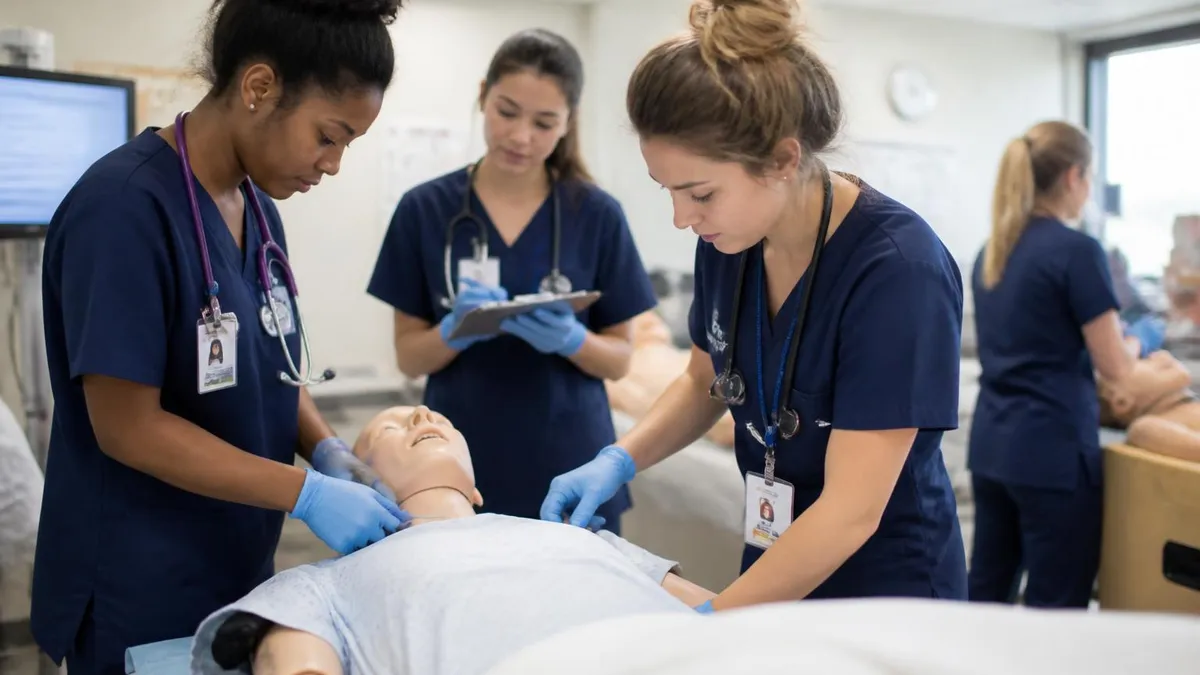
No US state lets you take the full Certified Nursing Assistant exam from your home computer. The exam has two parts — a written (or oral) knowledge test and a hands-on skills evaluation — and the skills portion must be observed in person by a nurse aide evaluator. That is set in 42 CFR 483.154 and every state nursing aide registry follows it.
What you can do online: study with practice questions, schedule your exam date, watch skills demonstration videos, and check your results. The actual test happens at an approved testing site. If you are still figuring out the credential basics, the CNA certification guide covers state-by-state requirements before you commit to a test date.
Three Testing Providers — Which One Is Yours?
Credentia is the largest testing provider and runs the NNAAP exam used by California, Texas, Florida, New York, Illinois, North Carolina and many other states. Candidates schedule, reschedule, and view results through the Credentia 365 portal at credentia.com/students. Combined written and skills fees typically run between $93 and $130 depending on the state.
Prometric administers an NNAAP-style test in roughly 20 states including Pennsylvania, Maryland, Tennessee, Massachusetts, and Virginia. Registration is at prometric.com/nurseaide. Prometric typically offers written and skills appointments on the same day, though they are sometimes split across two dates depending on site capacity.
Headmaster (D&S Diversified Technologies) operates the Nurse Aide Testing Service (NATS) in states such as Idaho, Montana, Wyoming, and Utah. Online scheduling is available at hdmaster.com via the NACES Plus portal, but Headmaster usually requires a mailed paper application before online scheduling becomes active for new candidates.
There is no fully online CNA test in any US state — the skills portion must be observed in person by an approved evaluator. Everything labeled 'CNA test online' is either practice, scheduling, or computer-based written testing at an approved site. Practice tests are free and excellent. Plan in-person travel for the real thing.
Taking a CNA Test Online: Free Practice This Week
The fastest, cheapest way to use "cna test online" is to grind through free practice questions. Mock tests built from past NNAAP and NATS pools train you on the exact phrasing the real exam uses — short stems, three or four answer choices, and a clinical reasoning twist on most questions. Phone screens work for quick five-question bursts, but you should sit at a desk with a full keyboard for any timed practice longer than 25 questions.
Start with our free CNA practice test for 2026, which covers all six NNAAP content areas. Each quiz is timed, scored, and includes a rationale on every answer so you learn instead of just clicking. Then move to the Prometric CNA practice test with answers if your state uses Prometric — the wording style is closer to what you will see on test day.
The goal is volume with feedback: 300 to 500 reviewed questions before you sit the real test. Studies of allied-health test-takers consistently show that two or three full timed practice exams beat ten hours of passive reading. Mix the format — alternate between 70-question full tests and short focused sets on your weakest content area so you build endurance and target weaknesses at the same time.
Using a Diagnostic Test to Plan Your Study Hours
Before you book a real exam date, take one full-length online CNA practice test cold — no notes, no phone, timer running, single sitting at a real desk. Whatever you score becomes your baseline, and it will be honest in a way that scrolling through flashcards on the couch never is.
Score 80% or higher and you are likely two or three weeks away from a confident pass. Score 60–79% and plan four to six weeks of structured review focused on your weakest content areas. Below 60% means you have not yet absorbed the curriculum and should revisit your training program materials or our online CNA classes guide before any more testing.
The six NNAAP content areas — Physical Care Skills, Psychosocial Care Skills, Role of the Nurse Aide, Restorative Skills, Promotion of Function, and Mental Health and Social Service Needs — are weighted unevenly. Physical Care Skills alone is roughly 64% of the written exam (April 2024 NNAAP outline), so any diagnostic weakness there gets priority. Track your score by content area, not just the total. A 75% overall hides a 50% in Physical Care.
Take another full practice test every five to seven days as you study. If your score does not move after two weeks of focused review, the problem is usually how you are practicing rather than how much. Switch from passive reading to drilling timed sets of 25 questions with same-day review of every miss.
Before You Book Your CNA Test Date
- ✓Finish your state-approved CNA training program (hours vary, typically 75 to 180 hours).
- ✓Take one full online CNA practice test cold for a real baseline score with no notes and a timer running.
- ✓Score 80% or higher on three consecutive practice tests across mixed content areas.
- ✓Confirm which provider (Credentia, Prometric, or Headmaster) runs your state and create your candidate account.
- ✓Have your eligibility ID from your state nurse aide registry ready before you log in to schedule.
- ✓Drill the skills checklist out loud with a partner at least three times — speak every step.
- ✓Drive to your testing site on a non-test day for a parking, entrance, and check-in scout.
- ✓Pack two forms of ID, comfortable scrubs, and a printed admission ticket the night before.
How to Schedule the CNA Test Online (Step by Step)
Once your practice scores are stable above 80%, schedule. The flow is similar across providers but the URLs differ.
For Credentia 365, create an account at credentia.com, verify your eligibility (your training program submits this for you in most states), pick a testing site, and choose a date. Credentia charges between $93 and $130 for the combined test, depending on the state.
For Prometric, visit prometric.com/nurseaide, select your state, and follow the NNAAP scheduling flow. You will need your eligibility ID from your state nurse aide registry. Prometric usually offers written and skills on the same day, sometimes split.
For Headmaster, go to hdmaster.com, click the NACES Plus Online Scheduling option, and pick from approved regional testing centers. Headmaster sometimes requires a mailed application before online scheduling opens.
How to Schedule by Provider
Log in at credentia.com/students. Your training program uploads eligibility — you cannot schedule until they do. Pick a regional testing center, choose written + skills together or split across two appointments, pay the combined fee, and download your admission ticket. Rescheduling is allowed up to 48 hours before the appointment without a fee.
Finding a CNA Testing Site Near Me
"CNA testing near me" is the most common follow-up search and the providers all have site locators built into their portals. Use them — third-party lists go stale fast as community college sites open and close, and mobile testing units shift on a quarterly schedule.
For Credentia states, the site finder is inside your candidate dashboard once you log in. For Prometric, every state has a public list of regional testing centers (RTCs) plus their state-specific resource page. Headmaster's site lists state-approved testing locations alongside scheduled dates, which is helpful in rural states where the same site might host the test only four times a year.
Most candidates have a testing site within 30 to 60 miles. Rural states have fewer permanent sites but rely on mobile units that visit community colleges and skilled nursing facilities on rotating schedules. Drive to your testing site on a non-test day if you can — a 20-minute scouting trip removes the biggest pre-exam stressor on the morning of the real thing. If you live near a state line, check whether reciprocity allows out-of-state testing; most states do not, but a few have arrangements with neighbors.
Inside the Written CNA Exam
The written portion is 60 to 75 multiple-choice questions, depending on your state and provider. Credentia's NNAAP gives you 70 questions in 2 hours. Prometric typically gives 60 questions in 90 minutes, with 10 unscored pilot items mixed in. Headmaster NATS varies between 60 and 100 items.
Question stems are short — usually one or two sentences describing a resident situation — followed by four answer choices. There is no partial credit and no penalty for guessing, so answer every question. Many states let you take the written test orally if English is not your first language or you have a documented reading difficulty.
NNAAP publishes no fixed passing percentage; the passing score is set by your state. A few states use scaled scores between 70 and 80. You usually know whether you passed the written portion the same day, either on the screen or printed on your score report at the testing site. For deeper format details, our CNA exam prep hub maps every content area to free practice sets.
All three testing providers will turn you away without two acceptable IDs: a government photo ID (driver's license, state ID, or passport) plus a secondary ID such as a Social Security card, insurance card, or debit card. A printed admission ticket alone is not enough. Photos of IDs on a phone are never accepted. Expired IDs are never accepted, including documents that expired the day before your test.
The Skills Evaluation: What an Online Test Cannot Replace
This is the part no website can simulate. A nurse aide evaluator hands you three to five randomly selected skills from a pool of around 25, and you perform them on a live volunteer or a manikin. Handwashing is mandatory and always one of the five. The other four come from skills like measuring blood pressure, providing perineal care, transferring a resident with a gait belt, or assisting with ambulation.
You have 30 to 40 minutes total. Every skill has 8 to 20 graded steps and you must pass each one — miss a "critical" step on any skill and the entire skills portion is a fail, even if you got the other four perfectly. Evaluators do not coach during the test. They read each skill aloud once, you confirm, and you begin. If you forget a step partway through, finish the skill anyway — the cleanup at the end of each task is also graded.
The good news: the skills are public and identical across attempts. Our CNA skills checklist lists every graded step exactly as evaluators score them, and the broader CNA skills guide walks through the test format step by step. Drill those checklists out loud with a practice partner. Muscle memory matters here far more than reading comprehension — your hands need to know the sequence even when your brain is rattled by adrenaline.
Computer-Based vs Paper Written Test
- +Most sites use computers, with the same screen layout you saw in practice apps.
- +Instant pass/fail on the written portion at most centers — no waiting weeks for a score.
- +Built-in review screen lets you flag questions and revisit them before submitting.
- +Larger font option for candidates with vision issues, set in your candidate profile.
- −A few rural sites still use paper — confirm with your site beforehand.
- −No scratch paper unless requested; mental math only on a CNA exam.
- −Computer freezes happen occasionally — proctor restarts the session, time is preserved.
- −Touch screens are rare; you will use a mouse and keyboard at almost every site.
Pros and Cons at a Glance
| Pros | Cons |
|---|---|
| Most sites use computers, with the same screen layout you saw in practice apps. | A few rural sites still use paper — confirm with your site beforehand. |
| Instant pass/fail on the written portion at most centers — no waiting weeks for a score. | No scratch paper unless requested; mental math only on a CNA exam. |
| Built-in review screen lets you flag questions and revisit them before submitting. | Computer freezes happen occasionally — proctor restarts the session, time is preserved. |
| Larger font option for candidates with vision issues, set in your candidate profile. | Touch screens are rare; you will use a mouse and keyboard at almost every site. |
Exam Day Walkthrough: Arrival to Results
Arrive 30 minutes before your appointment. Late candidates are usually rescheduled and forfeit the fee. Bring two forms of ID — a government photo ID plus a secondary (Social Security card, debit card, or insurance card). You will sign in, lock your phone in a locker, and receive a calculator if your provider allows one (most do not for the CNA test). Wear comfortable scrubs or business-casual clothing that lets you bend, kneel, and reach — you will be doing all three on the skills portion.
You sit the written test first. Computer-based testing is standard; a few rural sites still use paper. After the written, you wait briefly while staff set up the skills station, then perform your assigned skills in front of the evaluator. The evaluator reads each skill aloud, you confirm, and you begin. Treat the evaluator as you would treat a resident — say hello, introduce yourself, and explain what you are about to do before you do it.
Most candidates finish in three to four hours including check-in and breaks. Your written score is usually available immediately. Skills results take longer — anywhere from later that day to three weeks, depending on the state's registry processing time. Passing both portions sends your results to the state registry, which then issues your CNA license within 30 days in most states.
Six NNAAP Content Areas to Study
About 39% of the written exam — the biggest section by far. Covers hygiene, nutrition and hydration, elimination, vital signs measurement, emergency response, and skin care. Master this first.
Roughly 11%. Focuses on emotional needs, end-of-life care, cultural sensitivity, resident dignity, and adapting communication style to the resident's mental and emotional state.
About 26% — the second-largest section. Covers communication, ethics, resident rights, legal scope of practice, infection control, safety, and working as part of a multidisciplinary team.
About 8%. Range of motion exercises, ambulation aids like canes and walkers, prosthetic devices, and rehabilitative care that helps residents regain function after illness or injury.
About 9%. Activity scheduling, sleep hygiene, mobility support, and the assistive devices that help residents complete activities of daily living independently for as long as possible.
About 7%. Dementia care, behavior management techniques, mental health terminology, depression in elderly residents, and the social support systems that help residents stay connected.
Failing a Section, Retaking, and Life After the Test
If you fail one part — written or skills — you retake only that part. Most states give you three attempts within the validity window of your training, usually two years. After three failures you must retake the full nurse aide training program. Retake fees range from $30 to $60 for a single section.
Do not let a failed first attempt rattle you. NNAAP pass rates for first-time candidates hover around 75%, which means roughly one in four people retake at least one part. The retake pass rate climbs above 85% because candidates know what to expect.
Once you pass, you land on your state nurse aide registry and can legally work in long-term care, hospitals, hospices, and home health agencies. National CNA pay in 2026 averages between $17 and $22 per hour — see our CNA hourly pay breakdown for state-by-state numbers. You will renew every one to two years through the same registry portal, with no retesting required as long as you keep working.
Common Mistakes With Online CNA Testing
Three avoidable mistakes account for the bulk of failed CNA test attempts. Skipping handwashing or any infection-control step on the skills portion is the single biggest one — evaluators are required to fail any candidate who breaks asepsis, no matter how the rest of the skills look. Wash for at least 20 seconds, use a paper towel to turn off the faucet, and verbalize what you are doing as you do it.
Rushing the written test is the second. Candidates who finish in 25 minutes flat fail at a much higher rate than those who use 60 to 80 minutes and review their flagged questions. The exam is not designed to be raced. Use every minute — if you have time at the end, go back to the flagged questions and rework them from scratch instead of trusting your first instinct on every one.
The third is treating practice tests like a checkbox. A practice test you breezed through without reading the rationales taught you almost nothing. Always read the explanation on missed questions and on lucky guesses — the rationale is where the learning lives. A fourth, sneaky pitfall is showing up at the wrong testing site. Credentia, Prometric, and Headmaster sometimes share buildings with community college testing centers, so confirm the exact room and entrance the day before.
Finally, do not over-study. The night before your exam, stop reviewing by 7 pm, eat a real meal, and sleep eight hours. Cramming the morning of a CNA test consistently produces lower scores than the same candidate would have hit after a normal night of sleep.
If you do not know which provider runs your state, your training program coordinator will. Ask before you create any accounts. The wrong portal will not let you schedule and accidentally creating duplicate accounts on the right one slows things down.
State-by-State Notes That Trip Candidates Up
Every state writes its own rules within the federal CNA framework, and a few quirks come up over and over in searches. Knowing the quirks of your specific state can save you weeks of waiting and an avoidable retake fee.
California uses a combined written and skills test through Regional Testing Centers (RTCs). Read our California CNA page for the RTC list and the fingerprint Live Scan steps that catch first-timers. Texas requires a separate jurisprudence component for some pathways. Florida uses Prometric and adds a background check that can take three weeks. Arizona uses Headmaster and asks for fingerprint clearance before scheduling — start that early.
Pennsylvania and New York test through different providers in different regions, so confirm with your training program which portal you should be on before you create accounts. Spanish-language testing availability also varies more than candidates expect — California, Florida, Texas, New York, and Arizona offer Spanish at most sites; other states may need advance notice and a longer scheduling window. Assistive accommodations like extended time, a reader, or a private testing room must be requested when you schedule, not on exam day.
CNA Questions and Answers
Your Next Three Actions
Open our free CNA practice test, set a timer for 90 minutes, and finish one full set with no notes. Your score is your starting line, not your ending one. Save it so you can measure progress against your next attempt one week from now.
Identify whether your state uses Credentia, Prometric, or Headmaster and create your candidate profile on the correct portal. You do not have to schedule yet, but the account setup catches missing eligibility paperwork early — usually the slowest part of the whole process.
Print our CNA skills checklist and run through three skills out loud tonight with a friend or family member playing the resident. Handwashing should be one of them. The skills portion is where most candidates fail and it is the only part you cannot study with a screen.
About the Author

Registered Nurse & Healthcare Educator
Johns Hopkins University School of NursingDr. Sarah Mitchell is a board-certified registered nurse with over 15 years of clinical and academic experience. She completed her PhD in Nursing Science at Johns Hopkins University and has taught NCLEX preparation and clinical skills courses for nursing students across the United States. Her research focuses on evidence-based exam preparation strategies for healthcare certification candidates.
Join the Discussion
Connect with other students preparing for this exam. Share tips, ask questions, and get advice from people who have been there.
View discussion (8 replies)