
CNA Practice Test 2026 September: Free Questions, Skills Checklist & State Exam Prep
🔎 Free CNA practice test 2026 September with 100+ questions on skills, infection control, ADLs and care. Updated for the Headmaster, Prometric and Pearson VUE
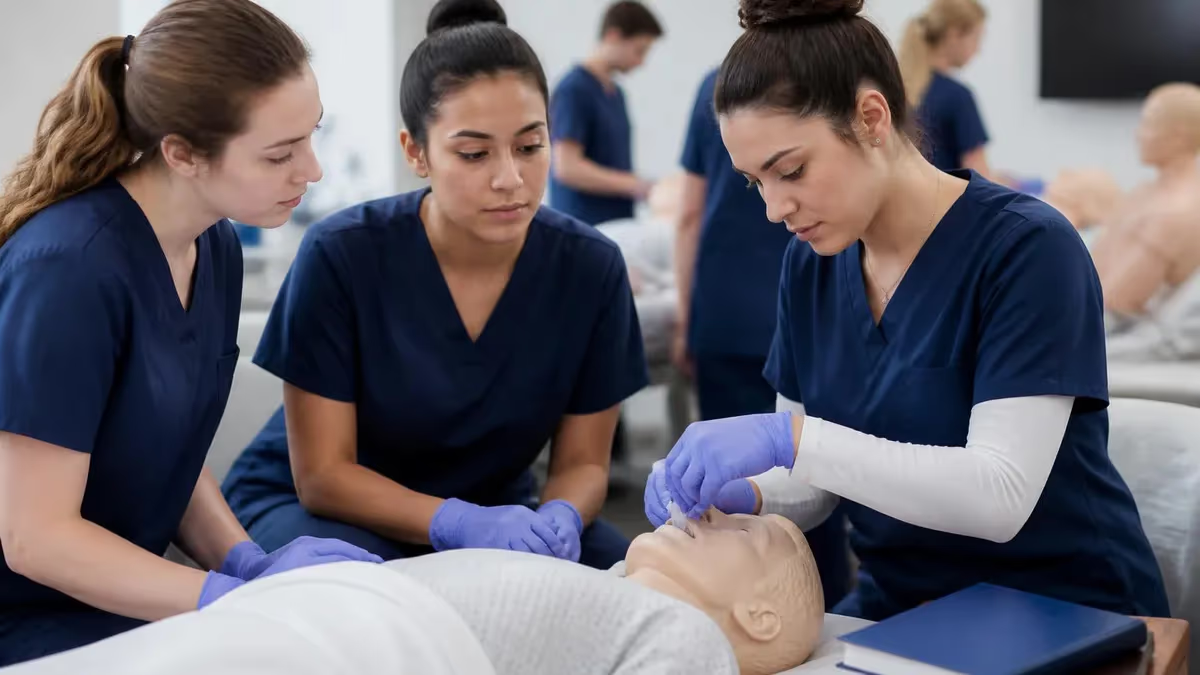
The 2025 CNA practice test is the fastest way to figure out whether you are ready for the state competency exam, and whether your textbook prep is wasting your time. Most candidates fail because they study the wrong material, not because they are not smart enough. The test format changed slightly this year, scoring rubrics tightened, and the skills checklist grew in several states. If you are testing in the next 30 days, the best thing you can do this week is take a realistic mock exam, score it honestly, and rebuild your study plan around the gaps.
This guide gives you a free CNA practice exam, a breakdown of what changed in 2025, state-by-state exam vendors, and the exact topics you must drill before test day. Use it like a syllabus, not a blog post. Every section that follows is built around the four federal competency domains and the 25-skill federal pool, so by the time you reach the FAQ at the bottom, you should know exactly where you stand and what to fix.
CNA Exam at a Glance
Key Facts at a Glance
| Item | Value | Details |
|---|---|---|
| Scored written questions | 60 | |
| Passing score (most states) | 75% | |
| Retake attempts allowed | 3x |
What Changed on the CNA Exam in 2025
Two updates matter this year. First, several state registries moved between Headmaster, Prometric and Credentia, which changes the booking flow and the way your skills are scored. Second, the federal minimum training hours for CNAs working in Medicare-certified facilities held at 75 hours, but 23 states now exceed that minimum. Florida, California, and Maine require 120 or more hours of combined classroom and clinical time. Always confirm your state's requirement on the official registry, not on third-party sites that may be a year or two out of date.
The written exam uses 70 multiple-choice questions (60 scored + 10 unscored pretest) on the Credentia NNAAP and 55–80 in Prometric and Headmaster states, with the passing threshold set by your state. The skills test still requires you to complete five randomly assigned skills under direct observation. Handwashing remains a required skill in every single state, and it is the most commonly failed item in the country.
If you trained before 2023, the biggest practical change you will notice is the indirect-care critical steps. Examiners now expect you to introduce yourself, identify the resident, explain the procedure, and provide privacy before any direct-care skill. Skip one of those steps and you can fail an otherwise perfect performance. Build the habit during your skills practice so it becomes automatic rather than a conscious checklist on test day.
The 25 CNA Skills Pool (2025)
- ✓Handwashing (required on every test)
- ✓Putting on and removing personal protective equipment
- ✓Measuring and recording radial pulse
- ✓Measuring and recording respirations
- ✓Measuring and recording blood pressure
- ✓Measuring and recording urinary output
- ✓Measuring and recording weight of an ambulatory client
- ✓Counting and recording temperature using electronic thermometer
- ✓Feeding a client who cannot feed themselves
- ✓Providing mouth care
- ✓Cleaning and storing dentures
- ✓Providing perineal care for a female client
- ✓Providing catheter care for a female client
- ✓Giving a partial bed bath including face, one arm, hand and underarm
- ✓Giving modified bed bath of a back
- ✓Providing foot care on one foot
- ✓Providing fingernail care
- ✓Dressing a client with an affected (weak) right arm
- ✓Assisting with the use of a bedpan
- ✓Positioning a client on their side
- ✓Transferring a client from bed to wheelchair using a transfer belt
- ✓Ambulating a client using a transfer belt
- ✓Performing passive range of motion exercises for one knee and one ankle
- ✓Performing passive range of motion exercises for one shoulder
- ✓Making an occupied bed
CNA Practice Test 2025 Format
A realistic 2025 CNA practice test mirrors the real state exam in three ways: question count, content distribution, and timing. The written section has 60 scored questions plus a handful of unscored research items that you cannot identify. You get 2 hours for 70 questions on the NNAAP, which works out to more than 90 seconds per question. That is more time than most candidates think, and rushing is the second most common cause of a failed written exam.
The content distribution shifts by state vendor, but a typical breakdown looks like the four federal domains shown below. Practice tests that ignore the weighting are not realistic preparation. Spend your study time in proportion to the test weighting and you will see your scores climb much faster than blanket review. Treat every wrong answer as a clue: it tells you which domain still needs work.
Four Federal Competency Domains
Roughly 39% of the test. Covers ADLs, vital signs, infection control, body mechanics, restorative care, and basic nursing skills.
About 11%. Mental health, social service needs, cultural sensitivity, spiritual needs, end-of-life care, and behavioral responses.
Around 23%. Communication, legal and ethical behavior, member of the healthcare team, and resident rights.
About 27%. Restorative care, ADLs, ROM exercises, ambulation, transfers, and assistive equipment.
CNA Skills Test 2025: The 25 Skills You Must Know
Every state pulls from the same federal pool of around 25 skills, then assigns five to you on test day. One of those five is almost always handwashing. The remaining four are random. You will not know which skills you receive until you arrive at the testing site, so you must be ready to perform all of them at competency level. That is the whole point of the federal pool: it eliminates cherry-picking and forces you to learn the full range of bedside basics.
Most failed skills tests come down to four root causes: forgetting indirect-care critical steps, breaking sterile technique, failing to provide privacy, or finishing without the closing checks (call light in reach, bed in low position, side rails per care plan). Drill those closing steps until they are automatic. Examiners are looking for them every single time. Build muscle memory with a full practice exam before you walk in, and recruit a study partner who will hold you accountable to the small details.
Most candidates lose points on three steps: (1) failing to keep hands lower than elbows, (2) friction time under 20 seconds, and (3) touching the faucet handle with bare hands after washing. Use a fresh paper towel to turn off the faucet, and use a separate towel for drying. Score these three steps perfectly and you have already cleared the most common failure point on the entire skills test.
Handwashing: The Skill You Cannot Afford to Fail
If you take only one skill seriously before your CNA practice test 2025 attempt, make it handwashing. Examiners count specific steps and many candidates lose points because they skip the friction time, contaminate the faucet, or use a single paper towel for both drying and turning off the faucet.
The skill seems trivial, which is exactly why it is the single most failed item nationally. Slow it down on test day and treat it like the highest-stakes skill on your list. Most testing sites place the sink in a position that tempts you to splash water onto your scrubs, so be deliberate about your stance.
Practice the full sequence three or four times the night before your exam. Time yourself with a stopwatch so you know what 20 seconds of friction actually feels like. The most common mistake is finishing in 8 to 12 seconds because your brain treats handwashing as a daily reflex rather than a graded skill. On test day it is a graded skill. Treat the friction phase like the most important 20 seconds of your career, because in scoring terms it absolutely is.
Vital Signs: The Numbers You Must Memorize
Vital signs questions show up on every CNA practice test, and you should know the normal ranges cold. Examiners want to see you take an accurate reading and report any value outside the normal range to the nurse. Do not adjust readings to look more normal. Honest recording is part of legal and ethical behavior, which is its own scored domain. Fabricating a reading is grounds for immediate failure and, in real-world practice, for losing your certification.
Memorize the normal ranges and know the abnormal triggers that require immediate nurse notification. The tabs below summarize the numbers that come up most often on the 2025 written test, and the reporting thresholds your examiner will expect you to know. Pay particular attention to the report-immediately triggers; they are favorite question stems on every vendor's exam.
Normal Vital Sign Ranges
Normal adult range: 60 to 100 beats per minute. Take radial pulse for a full 60 seconds. Report under 60 (bradycardia) or over 100 (tachycardia) to the nurse. Irregular rhythm always requires reporting regardless of rate.
Infection Control on the 2025 Exam
Infection control is the highest-yield topic outside of basic care, and it has grown more important since 2020. The 2025 CNA practice test will ask you about standard precautions, transmission-based precautions, the order of putting on and removing PPE, and what to do if you experience a sharps exposure or splash. Expect at least five or six questions on this domain alone, and several of them will be scenario-based rather than fact recall.
You must know the difference between contact, droplet, and airborne precautions. You must know which PPE is required for each, and you must know the correct order of donning and doffing. Mixing up these orders is one of the fastest ways to fail a written question or contaminate yourself during a skills test. If you have ever doffed gloves last instead of first, retrain the sequence tonight; that single habit fails more candidates than every other PPE error combined.
Order of PPE Donning and Doffing
1. Gown 2. Mask or respirator 3. Goggles or face shield 4. Gloves. Gloves go on last and cover the cuff of the gown.
1. Gloves 2. Goggles or face shield 3. Gown 4. Mask. The mask comes off last, after you exit the room, and is removed by the ties or ear loops only.
Gown and gloves required. Used for C. difficile, MRSA, VRE, and other contact-spread pathogens. Soap and water for C. diff, not alcohol-based rub.
Droplet uses a surgical mask within 3 to 6 feet. Airborne requires an N95 respirator and a negative-pressure room. TB, measles, and varicella are airborne.
ADLs and Restorative Care
Activities of daily living are the foundation of every shift in long-term care, and they are heavily tested. You should know the six classic ADLs cold: bathing, dressing, eating, transferring, toileting, and continence. Beyond knowing what they are, you should be able to identify when a resident needs cueing versus full assistance, and how to document the difference accurately on a charting flowsheet. Documentation accuracy is more than a paperwork exercise: it triggers staffing decisions, care plan updates, and reimbursement codes downstream.
Restorative care goes hand in hand with ADLs. The goal of restorative care is to help residents regain or maintain function rather than simply doing tasks for them. Encouraging a resident to brush their own teeth, even slowly, is restorative care. Doing it for them when they are capable is not. For deeper coverage of documentation, see CNA charting. The shift in mindset, from doing for to doing with, separates skilled CNAs from the rest of the workforce, and it shows up directly in scenario-based written questions where you must identify the most restorative answer choice.
Which Exam Vendor Does Your State Use in 2025?
Knowing your state vendor matters because each one structures the test slightly differently. Headmaster Pro (D&S Diversified) is still the largest, used in roughly 18 states. Credentia (NNAAP) handles Pennsylvania, North Carolina, Virginia, Washington and a dozen other states and territories. Prometric runs the Nurse Aide Assessment in about a dozen states. Credentia took over the New York exam in mid-2024 and continues in 2025.
Your state vendor determines your booking system, the practice test format that most closely mirrors yours, and in many cases the skills scoring rubric. Always check your state registry before paying for any third-party prep program. State-by-state guides are available for California, Arizona, Florida, and Texas. Vendors update their checklists once or twice per year, so what was true in your textbook may not match the rubric your examiner is holding.
2025 CNA Exam Vendors by Region
Used in 18+ states including Texas, Arizona, Indiana, Colorado, and Montana. Online booking, computer-based written test, in-person skills.
California uses Credentia (NNAAP) or Headmaster for the CDPH state competency exam. Strict skills timing, electronic test administration.
Used in Florida, Maryland, North Carolina, Oklahoma, and others. Written exam can be paper or computer depending on test site.
New York Nurse Aide program runs through Credentia. Online booking, separate written and clinical skills appointments.
A Two-Week Study Plan Using This Practice Test
You do not need months to pass the CNA exam if you have completed approved training. Two weeks of focused review is enough for most candidates. The key is structured repetition, not volume. Take a full practice test on day one, see where you stand, then drill the topics where you scored below 80 percent. Burning a week on topics you already know is the most common form of study procrastination, and it is easy to fix once you have a baseline score on paper.
The plan below assumes about an hour per day. If you have more time, expand the skills practice on weekends. Real-life skill rehearsal with a partner is worth ten times more than reading another textbook chapter. The plan works best when paired with the full certification guide so you understand the regulatory steps alongside the testing, and so you can book your retake quickly if the first attempt does not go your way.
14-Day CNA Study Plan
Days 1-2: Baseline
Days 3-6: Weak Topics
Days 7-10: Skills Practice
Days 11-13: Full Mocks
Day 14: Rest and Logistics
Test-Day Logistics in 2025
Test day is largely about doing the small things right and not adding new variables at the last minute. Bring two forms of ID, including one government-issued photo ID. Wear scrubs and closed-toe non-skid shoes. Pull long hair back, remove jewelry except a plain wedding band, and bring a watch with a second hand if your state allows it. Some sites prohibit watches, so check first. Eat a real breakfast even if you are nervous; low blood sugar costs more candidates points than any single skills gap.
Arrive at least 30 minutes early. Late arrivals are turned away with no refund in most states. Bring your admission letter or candidate confirmation email printed out. Phones are not allowed in the testing area. Leave them in your car. Once you check in, you will be photographed, fingerprinted in some states, and walked through the testing rules. Listen carefully, even if you have heard them before. Examiners do read the rules slightly differently from site to site, and the differences can matter.
Plan your route the day before and account for parking. Many test sites are inside larger hospitals or college campuses where parking can take ten minutes longer than you expect. Bring a light snack and a water bottle for the break between the written and skills sections. Most importantly, treat the wait time before your turn as part of the test. Stay calm, review the closing steps one last time, and avoid chatting with other candidates about content. Their nerves can amplify yours, and last-minute discussions rarely add anything useful.
Online vs Paper CNA Practice Tests
- +Instant scoring and explanations
- +Mirrors the real computer-based exam format
- +Can repeat unlimited times without printing
- +Tracks progress over multiple attempts
- +Free and accessible from any device
- −Requires reliable internet access
- −Less effective for skills practice rehearsal
- −Can encourage clicking through too fast
- −Quality varies wildly between websites
- −Some sites are outdated and use 2019 content
What Happens If You Fail
Failing is common and not the end of the road. Most states allow three attempts within two years of completing your approved CNA training program. If you fail the written portion, you usually keep your skills pass and only retake the written, and vice versa. Retake fees are typically lower than the original exam fee, although the booking process is otherwise identical to the first attempt and you will be back on the same vendor's calendar.
If you fail all three attempts, you must repeat an approved training program before testing again. That is why drilling with a realistic 2025 practice test before your first attempt matters so much. The cheapest path to passing is passing the first time. If you do retake, target the exact section you failed and avoid wasting time on the part you already cleared. Many states require you to wait at least 30 days between attempts, so use that time wisely rather than panicking.
Many candidates make the mistake of cramming harder for the retake while ignoring the specific reason they failed the first time. Pull the score report, look at which domains pulled you under 75 percent, and rebuild your plan around those exact subdomains. Skill failures usually trace back to one missed step that you can fix in a single afternoon of focused practice. Written failures usually trace back to one or two domains that you underestimated. Either way, a calm, targeted second attempt almost always succeeds.
The 2025 CNA exam still has 60 written questions and 5 live skills. Handwashing is on almost every test. Indirect-care critical steps are the biggest skills test failure point. Know your state vendor, drill weak domains, and use a structured two-week plan. Most candidates who fail simply did not practice realistically.
CNA Questions and Answers
About the Author

Registered Nurse & Healthcare Educator
Johns Hopkins University School of NursingDr. Sarah Mitchell is a board-certified registered nurse with over 15 years of clinical and academic experience. She completed her PhD in Nursing Science at Johns Hopkins University and has taught NCLEX preparation and clinical skills courses for nursing students across the United States. Her research focuses on evidence-based exam preparation strategies for healthcare certification candidates.
Join the Discussion
Connect with other students preparing for this exam. Share tips, ask questions, and get advice from people who have been there.
View discussion (8 replies)