
How to Become a CNA 2026 — Step-by-Step Guide
⏳ Get ready for your How to Become a CNA 2026 certification. Practice questions with step-by-step answer explanations and instant scoring.
CNA - Certified Nursing AssistantOct 15, 202613 min readFacts verified Oct 14, 2026 against Centers for Medicare & Medicaid Services (federal nurse aide competency rules, 42 CFR 483); each state's nurse aide regi
What Is a CNA?
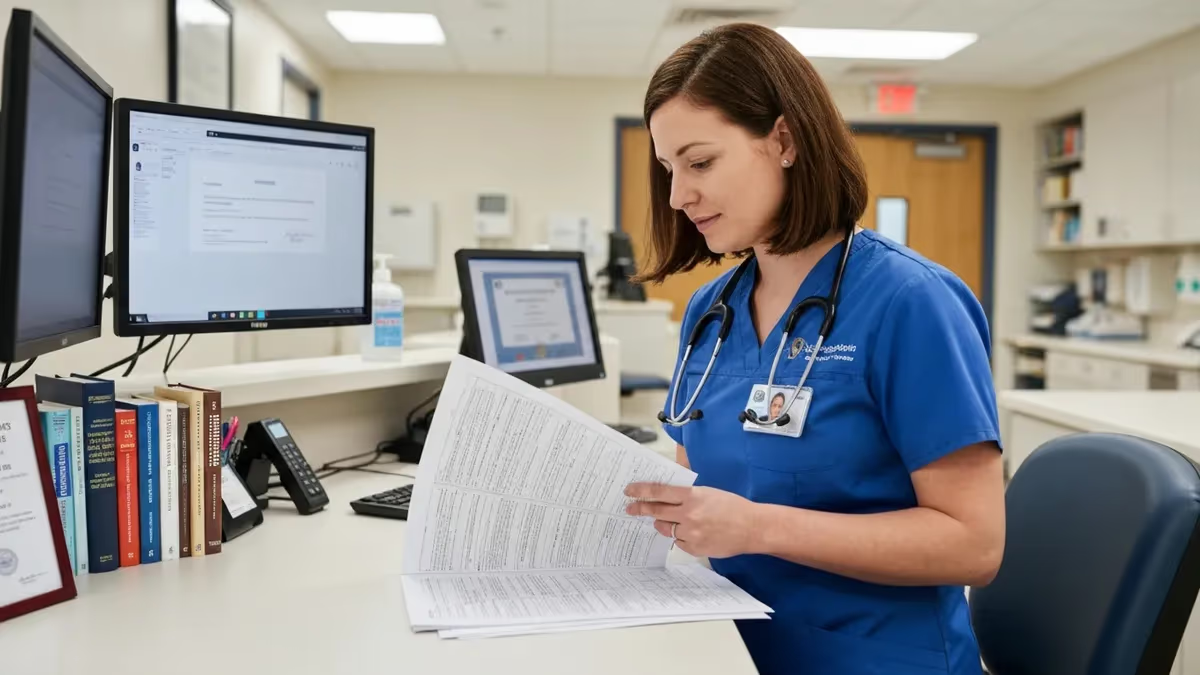
A Certified Nursing Assistant (CNA) provides direct patient care under the supervision of a licensed nurse. CNAs assist patients with daily activities such as bathing, dressing, feeding, and vital sign monitoring in hospitals, nursing homes, assisted living facilities, and home health settings. Becoming a CNA is one of the fastest routes into the healthcare profession. The entire process — from enrolling in a training program to receiving your certification — typically takes 6 to 12 weeks. The demand for CNAs remains strong, with the U.S. Bureau of Labor Statistics projecting steady growth through 2033.CNA: upcoming dates and official changes
- Aug 1, 2026: Connecticut (Prometric) implements new exam pricing: $48 for written only, $48 for oral only, $125 for bundled written and clinical skills, effective August 1, 2026.[4]
- Jul 1, 2026: Idaho (Prometric) raises CNA exam fees to $34 each for written and oral exams, plus test site fees, effective July 1, 2026.[5]
- Passing score (written or oral): Set per state; no national percentage published.[1]
- Retake policy: Minimum 3 attempts required; aides must be told which areas they failed before each retake.[1]
- Validity: 2 years from issuance in most states.[2]
- Renewal: State-specific; typically 2-year cycles with continuing education requirements (12–24 hours per year) and paid-work requirements.[3]
All verified CNA facts and sources
Numbers in brackets link to the official sources listed under Sources & last verified. Dates that have passed are removed automatically.
Step 1: Meet Basic Requirements
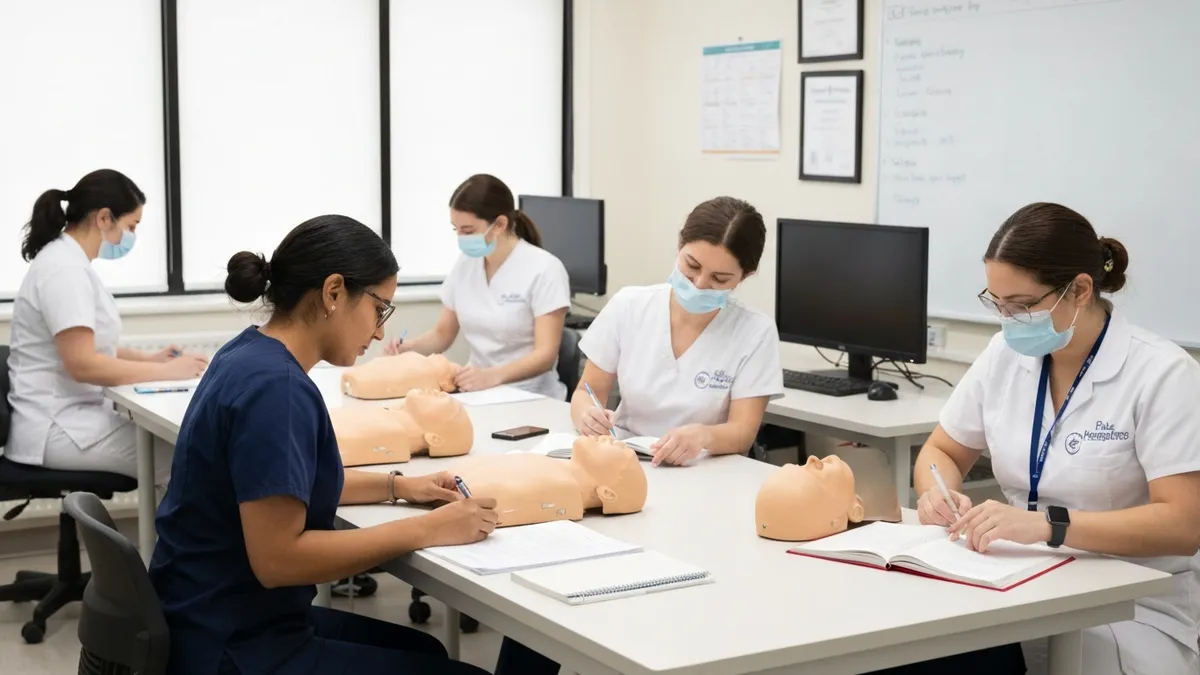
Before enrolling in a CNA training program, you must meet a set of baseline requirements. These vary slightly by state, but most states require the following: Age: You must be at least 18 years old in most states. Some states permit 16- or 17-year-olds to train with parental consent, but employment at most facilities requires age 18. Education: A high school diploma or GED is the standard requirement. Some programs may accept applicants who are currently enrolled in high school if they are in a vocational track. Background Check: All states require a criminal background check before you can be placed on the nurse aide registry. Certain felony convictions — particularly those involving abuse, neglect, or exploitation — may permanently disqualify candidates. Minor offenses are evaluated case-by-case. Health and Immunizations: Most training programs and employers require proof of immunizations (TB test, hepatitis B, MMR, varicella), a physical exam, and drug screening. Requirements vary by facility type. English Proficiency: The state competency exam is administered in English, so reading comprehension at a basic level is necessary. Some testing vendors offer limited language accommodations — contact your state's testing vendor for details.CNA Checklist
- ✓Age 18 or older (check your state's specific rule)
- ✓High school diploma or GED
- ✓Valid government-issued photo ID
- ✓Clear criminal background check
- ✓Up-to-date immunizations (TB, hepatitis B, MMR, varicella)
- ✓Physical exam clearance
- ✓Drug screening (required by most employers and programs)
- ✓Social Security Number (required for registry)
Step 2: Complete an Approved CNA Training Program
Federal law (the Omnibus Budget Reconciliation Act of 1987) requires that CNA training programs include a minimum of 75 hours of instruction, with at least 16 hours of supervised clinical practice. Most states set their own higher minimums — many require 120 to 175 hours total. Only state-approved programs qualify you to sit for the competency exam. You can find approved programs through your state's health department or Department of Health and Human Services website.
Step 3: Pass the State Competency Exam
After completing your state-approved training program, you must pass the CNA State Competency Exam to earn certification. This exam is administered by one of two national testing companies depending on your state: Prometric or Pearson VUE. The exam has two parts — both must be passed to receive certification:Exam Tips and Retake Policy
Most states allow candidates to take the exam up to three times within 24 months of completing training. If you fail after three attempts, you must repeat the CNA training program before retesting. To maximize your chances of passing on the first attempt: - Use official state skills checklists during practice — evaluators score each step - Practice verbal communication during skills (announce each action out loud) - Review infection control procedures, especially handwashing technique - Take multiple practice exams to prepare for the written portion Our cna classes near me includes tips for finding programs with strong first-time pass rates.Step 4: Get Listed on the State Nurse Aide Registry
Once you pass both parts of the competency exam, your name is submitted to the State Nurse Aide Registry. This registry is a public database maintained by each state that records all CNAs who are authorized to work. Employers are required by federal law to verify that any CNA they hire is listed on the registry and has no findings of abuse, neglect, or misappropriation of property. Being listed on the registry is your official proof of certification — it is more important than any paper certificate. How the process works: 1. Pass the state competency exam (both parts) 2. Your testing vendor (Prometric or Pearson VUE) reports your results to the state 3. The state adds your name to the registry, usually within 7–14 business days 4. You receive a registry number or certificate confirmation 5. You can verify your status online through your state's health department portal Renewal: CNA certification must be renewed every two years in most states. To renew, you must have worked a minimum number of hours as a CNA (commonly 8 hours of paid nursing-related work) during the renewal period. Some states also require continuing education.
Step 5: Apply for Your First CNA Job
With your name on the state registry, you are legally qualified to work as a CNA. Most new CNAs find their first position within two to four weeks of completing certification. Where CNAs work: - Skilled nursing facilities (nursing homes): The largest employer of CNAs. High demand, entry-level positions widely available, opportunities for full-time work and benefits. - Hospitals: CNAs work as patient care technicians (PCTs) in med-surg, ICU, and ED units. Usually pays higher than nursing homes. - Assisted living facilities: Lower acuity than nursing homes; residents are more independent. Commonly hires new CNAs. - Home health agencies: CNAs visit patients in their homes. Higher independence, flexible scheduling, lower patient-to-CNA ratios. - Hospice care: Specialized end-of-life support. Emotionally demanding but meaningful work with a defined patient population. Starting salary: Entry-level CNAs earn between $15 and $20 per hour in most states, with higher wages in urban areas and for night or weekend shifts. See our full CNA Pay guide for state-by-state salary data.Preparation Checklist
- ✓Proof of registry listing (registry number or printout)
- ✓Copy of your training completion certificate
- ✓Immunization records (up to date)
- ✓Current CPR/BLS certification (required by most employers)
- ✓Two professional references (training program instructor and clinical supervisor)
- ✓Resume highlighting clinical hours and any prior healthcare experience
- ✓Completed background check authorization form (employers re-run checks independently)
How Long Does It Take to Become a CNA?
The full timeline from starting your training program to receiving your first paycheck typically runs 8 to 16 weeks. Here is a realistic breakdown: - Training program: 4–16 weeks depending on program intensity and your schedule - Exam scheduling wait: 1–3 weeks (Prometric and Pearson VUE testing centers book quickly) - Registry processing: 1–2 weeks after passing your exam - Job search and hiring: 1–4 weeks The fastest route — an intensive vocational program with an available exam slot — can place you in your first job in as little as 6 weeks. Part-time evening programs at community colleges may stretch the training phase to 4 months. For a detailed breakdown by program type, see our guide: How Long Does It Take to Become a CNA?Career Progression After CNA Certification
CNA certification is often the first step on a longer healthcare career path. Many nurses, nurse practitioners, and healthcare administrators began as CNAs. The hands-on patient care experience you gain as a CNA provides a foundation that formal nursing education alone cannot replicate. Common advancement paths from CNA:CNA Pros and Cons
✅Pros
- +CNA has a defined, publicly available content blueprint — candidates know exactly what to prepare for
- +Multiple preparation pathways (self-study, courses, coaching) accommodate different learning styles and schedules
- +A growing ecosystem of study resources means candidates at any budget level can access quality preparation materials
- +Clear score reporting allows candidates to identify specific strengths and weaknesses for targeted remediation
- +Professional recognition associated with strong performance provides tangible career and academic benefits
❌Cons
- −The scope of tested content requires substantial preparation time that competes with existing professional or academic commitments
- −No single resource covers the full content scope — candidates typically need multiple study tools for comprehensive preparation
- −Test anxiety and exam-day performance variability mean preparation effort does not always translate linearly to scores
- −Registration, preparation, and potential retake costs accumulate into a significant financial investment
- −Content and format can change between exam versions, making older preparation materials less reliable
How to Become a CNA Questions and Answers
Sources & last verified
- Centers for Medicare & Medicaid Services — passing score, retake policy (official source). “The State shall establish the passing standard for the written or oral examination and for the skills demonstration.” Verified Oct 14, 2026.
- archive.regulations.delaware.gov — validity (official source). “CNA certification shall be effective for 2 years following the date of issue and shall expire 2 years following such date” Verified Oct 14, 2026.
- cdph.ca.gov — renewal (official source). “Certificates are renewed every two years, and the required training is 48 hours of in-service training or continuing education” Verified Oct 14, 2026.
- prometric.com — other (official source). “Effective August 1, 2026, the following exam pricing will be implemented” Verified Oct 14, 2026.
- prometric.com — other (official source). “Effective July 1, 2026, the following exam pricing will be implemented: $34 written, $34 oral, plus test site fees” Verified Oct 14, 2026.
How we verify: editorial & fact-checking policy. Report an error: contact us.



How this page was made: written with AI tools. Exam facts are checked against the official sources listed below. Not reviewed by a subject-matter expert. Editorial policy
Sources & references
Exam facts on this page (fees, format, dates, passing scores) are checked against these official sources; the date is our last check. Editorial policy
- floridasnursing.gov — Eligibility, exam format · verified Oct 2026
- law.cornell.edu — Eligibility · verified Oct 2026
- law.cornell.edu — Test delivery · verified Oct 2026
- prometric.com — Exam information · verified Oct 2026