
C A B CPR: The Complete Guide to Compressions, Airway, and Breathing in 2026 October
Master c a b cpr — the compressions-airway-breathing sequence used in adult, child, and infant CPR. Step-by-step guide, rates, depths, and practice ✅
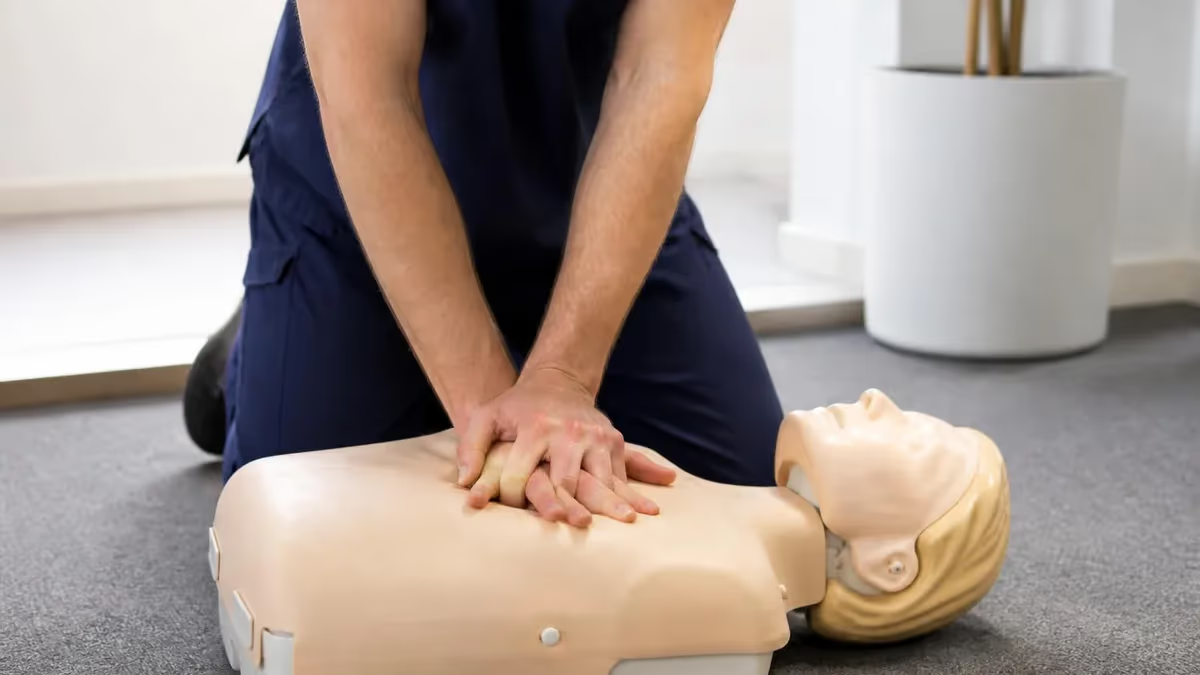
The c a b cpr sequence — Compressions, Airway, Breathing — is the modern resuscitation framework adopted by the American Heart Association in 2010 and reaffirmed in every guideline update since. It replaced the older A-B-C order because emerging evidence showed that delays in starting chest compressions were the single biggest preventable cause of poor outcomes in cardiac arrest. By beginning with compressions, rescuers restore some circulation to the brain and heart within seconds rather than spending precious time on airway maneuvers.
This change reflects a deeper truth about sudden cardiac arrest in adults: the lungs and blood usually still contain enough oxygen to sustain life for several minutes if that oxygen can be pushed to the brain. Compressions do exactly that. The acls algorithm, infant cpr protocols, and basic life support sequences all now start with compressions first, with very narrow exceptions for drowning victims and infants where a primary respiratory cause is suspected.
Understanding the c a b cpr order is not just about memorizing letters. Each component has specific targets: compression rate, depth, recoil, ventilation tidal volume, and pause minimization. Getting these right roughly doubles survival to hospital discharge compared with poor-quality CPR. National CPR Foundation, the American Red Cross, and the AHA all teach essentially the same physiology — the difference is in course branding, not the science.
This guide walks through every element of the c a b cpr sequence for adults, children, and infants. You will learn the exact compression depths, the recommended respiratory rate during rescue breathing, when to integrate an AED, and how the sequence fits into broader life support algorithms. We also cover common mistakes — like over-ventilating or interrupting compressions too long — that quietly cut survival odds in half.
Whether you are preparing for a BLS card, refreshing skills for the workplace, or studying for pals certification, the c a b cpr framework is the foundation. Master it once and the rest of resuscitation training — choking management, two-rescuer technique, post-arrest care — clicks into place naturally. The letters are simple. The execution under stress is what separates competent rescuers from confident ones.
Throughout this article we use the 2025 AHA guideline targets and reference real-world data from out-of-hospital cardiac arrest registries. Survival numbers are sobering — only about 10 percent of adults survive an out-of-hospital arrest — but bystander CPR roughly doubles that figure. That is why the c a b cpr sequence matters: it is the most effective intervention any untrained or lightly trained person can perform in the first critical minutes.
Before you continue, anchor one idea: push hard, push fast, push in the center of the chest, and minimize pauses. Everything else in this guide refines that core action. The c a b cpr sequence is engineered around that single biological reality — the brain needs blood flow now, not in two minutes after someone finishes setting up an airway.
C-A-B CPR by the Numbers

The C-A-B CPR Sequence Step by Step
Scene Safety and Response Check
Activate EMS and Get an AED
C — Compressions
A — Airway
B — Breathing
Continue Cycles and Use AED
For decades, CPR began with A-B-C: Airway, Breathing, Circulation. The logic seemed obvious — oxygen first, then circulation. But by the late 2000s, a growing pile of evidence showed that this order was actually killing people. Rescuers spent 20, 30, sometimes 60 seconds clearing airways and giving breaths before ever pushing on the chest. Meanwhile, the brain was starving. In 2010, the American Heart Association formally flipped the sequence to c a b cpr.
The biology behind the switch is straightforward. In sudden cardiac arrest, the blood is already oxygenated. The problem is not a lack of oxygen molecules — it is a lack of circulation to move them. Starting with compressions immediately restores some forward blood flow, generating roughly 20-30 percent of normal cardiac output. That is enough to keep neurons alive while you set up the next steps. Delaying compressions to focus on airway maneuvers wastes the oxygen reserve the victim still has.
This contrasts sharply with respiratory arrest, where the primary problem is oxygen deprivation — for example, drowning, choking, or opioid overdose. In those scenarios, a brief airway-first approach can be appropriate, which is why infant cpr guidelines still emphasize ventilation and why drowning protocols include initial rescue breaths. But for the typical witnessed adult collapse, c a b cpr is the right answer almost every time.
The c a b cpr sequence also solved a practical problem: untrained bystanders were reluctant to perform mouth-to-mouth on strangers. By moving compressions to the front of the sequence, the AHA made it easier to teach hands-only CPR. Studies in cities that adopted hands-only training saw bystander CPR rates rise significantly, and survival rates climbed in parallel. The same compression-first philosophy underpins the acls algorithm for in-hospital teams.
Another benefit: c a b cpr is easier to remember under stress. Compressions are the universal first move, regardless of the victim's age or the cause of arrest. Once compressions are started, rescuers can layer in airway and breathing as skill and equipment allow. This simplicity matters because adrenaline shrinks working memory — the more decisions you eliminate, the more likely the rescuer is to act at all.
The 2020 and 2025 guideline updates reinforced c a b cpr without major changes. Researchers continue to study whether certain populations — pediatric arrests, asphyxial arrests — benefit from earlier ventilation, but the headline finding is unchanged: starting with compressions saves more lives across the broad population of cardiac arrest victims than starting with anything else.
Critics initially worried that c a b cpr would lead to under-ventilation, especially in long arrests. In practice, advanced providers transition to asynchronous compressions and breaths once an advanced airway is in place, delivering one breath every six seconds while compressions continue uninterrupted. The system is designed to scale from a single bystander with no equipment to a full ACLS team — and the c a b cpr sequence remains the entry point at every level.

CPR Practice Test Questions
Prepare for the CPR Cardiopulmonary Resuscitation Practice exam with our free practice test modules. Each quiz covers key topics to help you pass on your first try.
CPR Basic CPR
CPR Exam Questions covering Basic CPR. Master CPR Test concepts for certification prep.
CPR and First Aid
Free CPR Practice Test featuring and First Aid. Improve your CPR Exam score with mock test prep.
CPR (Cardiopulmonary Resuscitation) Adult ...
CPR Mock Exam on (Cardiopulmonary Resuscitation) Adult CPR and AED Usage. CPR Study Guide questions to pass on your first try.
CPR (Cardiopulmonary Resuscitation) Airway...
CPR Test Prep for (Cardiopulmonary Resuscitation) Airway Obstruction and Choking. Practice CPR Quiz questions and boost your score.
CPR (Cardiopulmonary Resuscitation) Cardio...
CPR Questions and Answers on (Cardiopulmonary Resuscitation) Cardiopulmonary Emergency Recognition. Free CPR practice for exam readiness.
CPR (Cardiopulmonary Resuscitation) Child ...
CPR Mock Test covering (Cardiopulmonary Resuscitation) Child and Infant CPR. Online CPR Test practice with instant feedback.
CPR (Cardiopulmonary Resuscitation) High-P...
Free CPR Quiz on (Cardiopulmonary Resuscitation) High-Performance Team Dynamics. CPR Exam prep questions with detailed explanations.
CPR (Cardiopulmonary Resuscitation) Legal ...
CPR Practice Questions for (Cardiopulmonary Resuscitation) Legal and Ethical Considerations. Build confidence for your CPR certification exam.
CPR for Specific Populations
CPR Test Online for for Specific Populations. Free practice with instant results and feedback.
CPR Airway & Breathing Management
CPR Exam Questions covering Airway & Breathing Management. Master CPR Test concepts for certification prep.
CPR Assessment & Recognition of Cardiac Ar...
Free CPR Practice Test featuring Assessment & Recognition of Cardiac Arrest. Improve your CPR Exam score with mock test prep.
CPR Chest Compressions & Defibrillation
CPR Mock Exam on Chest Compressions & Defibrillation. CPR Study Guide questions to pass on your first try.
CPR Post-Resuscitation Care & Recovery
CPR Test Prep for Post-Resuscitation Care & Recovery. Practice CPR Quiz questions and boost your score.
C-A-B CPR for Adults, Children, and Infant CPR
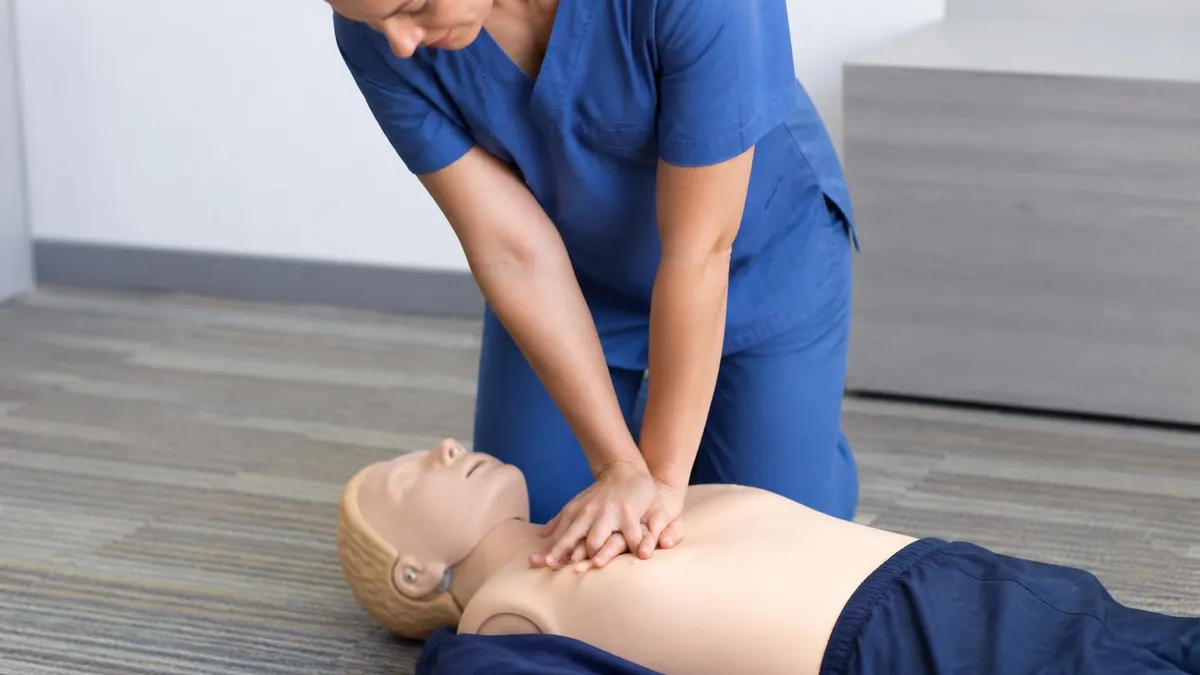
For adults and adolescents past puberty, the c a b cpr sequence uses two-handed compressions on the lower sternum, 2 to 2.4 inches deep, at 100-120 per minute. Single rescuers use a 30:2 compression-to-breath ratio. If untrained or unwilling to give breaths, hands-only CPR is fully acceptable and proven effective for witnessed adult collapse.
Attach an AED as soon as it arrives — what does aed stand for? Automated External Defibrillator. The device analyzes the rhythm and delivers a shock only if needed. Resume compressions immediately after any shock, without checking a pulse. Continue until EMS arrives, the victim moves, or you become physically unable to continue effective compressions safely.
C-A-B vs A-B-C: Why the Switch Made Sense
- +Compressions begin within seconds, restoring brain perfusion immediately
- +Easier for untrained bystanders who hesitate to give mouth-to-mouth
- +Single universal first action regardless of cause or victim age
- +Reduces hands-off chest time, the strongest predictor of survival
- +Aligns with hands-only CPR campaigns proven to raise bystander rates
- +Simpler to teach and recall under extreme stress
- +Integrates cleanly with AED use and ACLS handoff
- −Slightly delays ventilation in respiratory-cause arrests
- −Less intuitive for laypeople who think 'breathing first'
- −Requires retraining for providers taught the older A-B-C order
- −May undertreat asphyxial arrests if rescuers never get to breaths
- −Pediatric application requires nuance the public often misses
- −Can be misapplied to drowning where airway truly comes first
Pros and Cons at a Glance
| Pros | Cons |
|---|---|
| Compressions begin within seconds, restoring brain perfusion immediately | Slightly delays ventilation in respiratory-cause arrests |
| Easier for untrained bystanders who hesitate to give mouth-to-mouth | Less intuitive for laypeople who think 'breathing first' |
| Single universal first action regardless of cause or victim age | Requires retraining for providers taught the older A-B-C order |
| Reduces hands-off chest time, the strongest predictor of survival | May undertreat asphyxial arrests if rescuers never get to breaths |
| Aligns with hands-only CPR campaigns proven to raise bystander rates | Pediatric application requires nuance the public often misses |
| Simpler to teach and recall under extreme stress | Can be misapplied to drowning where airway truly comes first |

Quality C-A-B CPR Checklist
- ✓Confirm scene safety before approaching the victim
- ✓Check responsiveness with a shoulder tap and shout
- ✓Scan for normal breathing for no more than 10 seconds
- ✓Call 911 and request an AED before starting compressions when alone with an adult
- ✓Place hands on the lower half of the sternum, centered on the chest
- ✓Compress at least 2 inches deep for adults at 100-120 per minute
- ✓Allow full chest recoil between every compression
- ✓Minimize all pauses to under 10 seconds when possible
- ✓Deliver 2 breaths after every 30 compressions, watching for chest rise
- ✓Switch rescuers every 2 minutes to prevent fatigue-related shallow compressions
- ✓Attach the AED immediately on arrival and follow voice prompts
- ✓Continue until EMS arrives or the victim begins moving
Minimize compression interruptions
Every pause longer than 10 seconds drops coronary perfusion pressure dramatically and takes another 60 seconds of compressions to rebuild. The single biggest determinant of survival in cardiac arrest is the chest compression fraction — the percentage of total resuscitation time spent actually compressing. Aim for over 80 percent. Quick AED checks, fast rescuer swaps, and prepared airway equipment all serve one purpose: keep hands on the chest.
Even rescuers who memorize the c a b cpr sequence perfectly often make execution mistakes that quietly reduce effectiveness. The most common is compressing too shallow. Under pressure, almost everyone underestimates how hard they need to push. Two inches in an adult feels brutal, but anything less fails to generate meaningful cardiac output. Real-time feedback devices used in hospitals show that even trained providers compress too shallowly more than 40 percent of the time without feedback.
The second common error is leaning on the chest between compressions, preventing full recoil. When the chest does not fully expand, venous return drops and the next compression pushes less blood forward. Lift your hands slightly between compressions — keep them in contact with the chest but bear no weight. This single fix can double effective output without changing rate or depth.
Over-ventilation is the third major problem, and it kills people. Excited rescuers often give breaths that are too fast, too forceful, or too large. This raises intrathoracic pressure, compresses the great veins, and reduces venous return to the heart. With an advanced airway in place, the target respiratory rate is just one breath every six seconds — roughly 10 per minute. Slower than feels natural under stress.
The fourth mistake is interrupting compressions for too long. Pulse checks should take under 10 seconds. AED rhythm analysis should be optimized so compressions resume the instant the device finishes analyzing. Rescuer changes should be choreographed during ventilation pauses rather than triggering their own pause. Every second off the chest costs perfusion pressure that takes a full minute to rebuild.
Wrong hand placement is more common than instructors admit. Hands placed too high on the sternum compress nothing useful. Hands placed too low can fracture the xiphoid process or lacerate the liver. The correct landmark is the lower half of the sternum, centered between the nipples in adults. For infant cpr, two fingers go just below an imaginary line between the nipples — slightly lower than most beginners guess.
Failure to switch rescuers is another silent killer of CPR quality. After about two minutes of compressions, depth and rate measurably decline even though the rescuer subjectively feels fine. Plan to swap every two minutes — typically during the AED rhythm check — and make the swap quick. A five-second swap is worth it; a 30-second swap is not.
Finally, many rescuers forget that c a b cpr is just the start. Effective resuscitation includes early defibrillation, post-arrest care, and continuous quality monitoring. The acls algorithm exists to layer drugs, advanced airways, and reversible-cause investigation on top of the BLS foundation. CPR done well buys time for those interventions to work. CPR done poorly wastes the entire downstream chain of care.
In the first minutes of cardiac arrest, up to 40 percent of victims display agonal gasps — slow, irregular, snoring-like breaths. Rescuers frequently mistake these for normal breathing and withhold CPR, sometimes for several minutes. If a victim is unresponsive and not breathing normally — including agonal gasping — assume cardiac arrest and start compressions immediately. The cost of starting CPR on someone who turns out not to need it is trivial; the cost of withholding it is irreversible brain injury or death.
Learning c a b cpr from an article is a strong start, but psychomotor skills like compression depth and rate require hands-on practice. Certification courses through the American Heart Association, American Red Cross, or National CPR Foundation use manikins with real-time feedback so you can feel what 2 inches deep and 110 per minute actually require. Most lay-rescuer BLS courses run 3-4 hours and cost between 60 and 110 dollars, with cards valid for 2 years.
Healthcare providers typically need BLS for Healthcare Providers, which adds two-rescuer technique, bag-mask ventilation, and team dynamics. From there, nurses, paramedics, and physicians progress to acls algorithm training covering arrhythmia recognition, drug administration, and post-arrest care. Pediatric providers add pals certification, which extends c a b cpr principles to children and infants with age-specific rhythms, equipment sizing, and dosing tables.
Workplace requirements vary. Childcare workers, lifeguards, personal trainers, and many teachers need active BLS or Heartsaver cards. Some states require CPR training as a high school graduation requirement, exposing every student to the c a b cpr sequence at least once. Recertification typically happens every two years, though skills decay measurably after just three to six months — brief refresher drills between certifications dramatically improve retention.
Either way, life support skills remain the version of CPR that genuinely saves lives.
Beyond formal certification, free practice questions are a powerful way to harden knowledge between courses. Working through scenario-based items forces you to apply rates, depths, ratios, and the c a b cpr decision tree under simulated pressure. Spaced practice — short sessions over weeks — produces dramatically better retention than cramming the night before a recertification.
Consider keeping a personal CPR reference card in your phone wallet or workplace first-aid kit. Include the c a b cpr sequence, adult and pediatric compression depths, the 30:2 ratio, AED reminders, and the local emergency number. In a real arrest, having a visual prompt — even a brief one — reduces cognitive load and helps the bystander act faster and more accurately during the most chaotic moments.
Finally, normalize talking about CPR. Family members, coworkers, and neighbors are the people most likely to find you in arrest. Show them the c a b cpr sequence. Demonstrate compressions on a couch cushion. Run through what they should do if you collapse. CPR is a community skill — its survival benefit depends on whoever happens to be nearby being willing and able to act in the first two minutes.
Now that you understand the c a b cpr framework, the next step is making it second nature. Skill retention is the hidden challenge of resuscitation training — surveys show that compression quality begins decaying within weeks of certification. The fix is short, frequent practice, not longer initial courses. Even 5 minutes a month on a manikin or pillow, focused on rate and depth, keeps your skills sharper than an annual marathon class.
Audio metronomes set to 110 beats per minute are an underrated training tool. Free apps on any smartphone provide a steady click that helps anchor compression rate. Pairing the metronome with a known song — one with the right tempo and an appropriate, non-disturbing lyric — gives your muscle memory two redundant rate cues. During an actual arrest, the metronome in your head will run automatically once it has been trained.
Consider the layout of your home and workplace from a rescuer's perspective. Where is the nearest AED? Most office buildings, schools, gyms, and airports now have them, but employees often cannot point to one under stress. Walk the route at least once. If you manage a facility, ensure AEDs are signed, accessible 24/7, and have current pads and batteries. An AED that is locked in a closet at 3 a.m. saves no one.
For families with young children, infant cpr practice is particularly valuable. Choking events, drowning, and SIDS-related arrests all benefit from quick caregiver response. Pediatric BLS courses use infant manikins so you can rehearse the two-finger and two-thumb techniques. Childproofing and supervision prevent most events, but rehearsing the response means you can act decisively in the rare moment when prevention fails.
Document your readiness. Keep certification cards somewhere accessible — a digital photo on your phone works fine. Track recertification dates with calendar reminders set 60 days before expiration so you have time to schedule a class without lapsing. If your employer requires active CPR cards, a lapse can mean lost shifts or temporary reassignment. Treat your CPR card like any other professional credential.
When you actually witness an arrest, give yourself permission to act imperfectly. Bystander CPR is far better than no CPR, even when depth or rate is suboptimal. The most common reason for poor outcomes is not poor technique — it is no CPR at all. Push hard, push fast, push in the middle of the chest. Send someone for the AED. Trade off when you tire. The c a b cpr sequence is forgiving of small errors and unforgiving of total inaction.
Finally, debrief afterward. If you have ever performed CPR, talk to someone — a friend, a chaplain, a professional. Outcomes are not always good even when CPR is done perfectly. Resuscitation attempts can be emotionally heavy regardless of result. Recognizing that weight and processing it makes it more likely you will respond again next time, which is ultimately what community-wide cardiac arrest survival depends on.
CPR Questions and Answers
CPR Card Lookup: How to Verify, Replace, and Access Your CPR Certification in 2026
AHA CPR: What It Is, Which Course You Need, and How to Get Certified
Adult CPR: Complete Step-by-Step Guide to Hands-Only and Standard CPR in 2026

CPR - Cardiopulmonary Resuscitation: Complete Study Guide 2026
Inappropriate CPR Songs: What Not to Play, Why It Matters, and Better Beat-Per-Minute Alternatives
About the Author

Registered Nurse & Healthcare Educator
Johns Hopkins University School of NursingDr. Sarah Mitchell is a board-certified registered nurse with over 15 years of clinical and academic experience. She completed her PhD in Nursing Science at Johns Hopkins University and has taught NCLEX preparation and clinical skills courses for nursing students across the United States. Her research focuses on evidence-based exam preparation strategies for healthcare certification candidates.
Join the Discussion
Connect with other students preparing for this exam. Share tips, ask questions, and get advice from people who have been there.
View discussion (5 replies)