
CPR Equipment Guide 2026 October: Automated CPR Machines, AEDs & Life-Saving Tools
Complete guide to CPR equipment: ⏳ automated CPR machines, AEDs, BVMs, and airway tools. Specs, costs, and when each device saves lives.
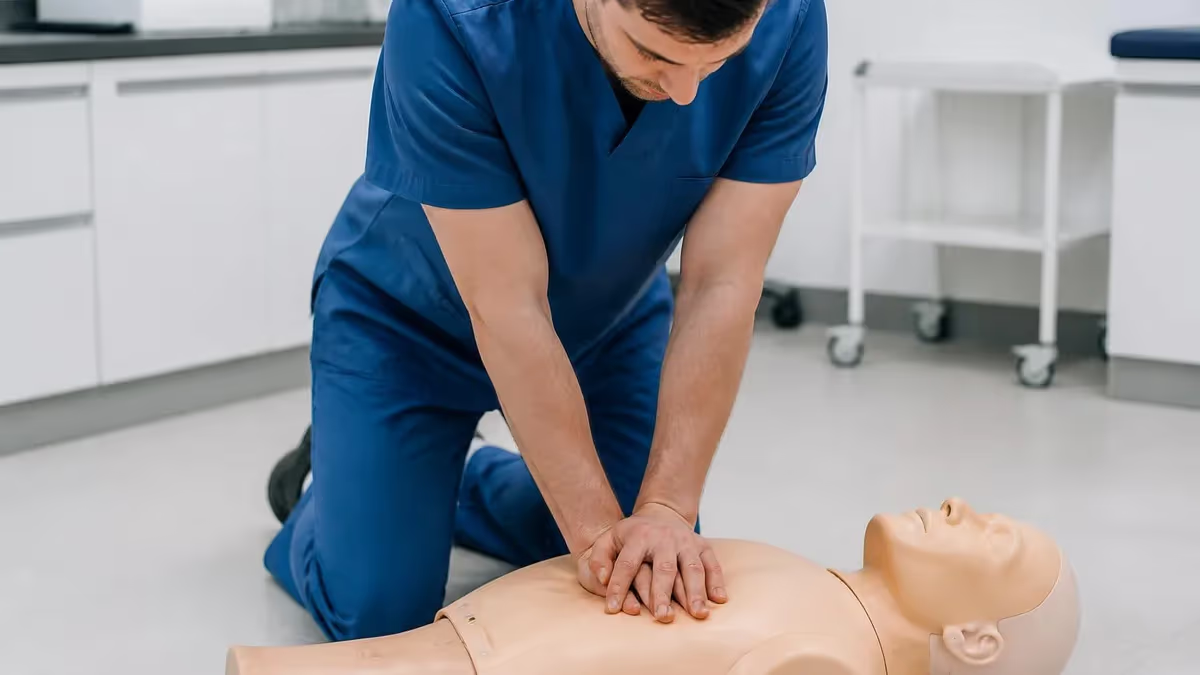
An automated cpr machine has quietly transformed prehospital cardiac arrest care over the last decade, taking what used to be an exhausting two-rescuer task and converting it into a steady, metronomic intervention that does not tire, does not slow, and does not falter during transport.
Devices like the LUCAS 3 and the Zoll AutoPulse deliver chest compressions at the AHA-recommended depth of 2.0 to 2.4 inches and a rate of 100 to 120 per minute, even while a stretcher is rolling, an ambulance is braking, or a stair chair is descending six flights. Understanding the full ecosystem of CPR equipment is now essential for every responder.
This guide covers every major category of CPR equipment used in 2026, from the bag-valve-mask sitting on a first-in jump bag to the mechanical piston pounding on a patient inside a moving cath lab. We will walk through automated external defibrillators (AEDs), advanced airway adjuncts, suction devices, capnography monitors, and the consumables that make a difference between a chaotic resuscitation and a choreographed one. Each tool has a purpose, a price, and a training curve.
Equipment alone does not save lives — protocols do. The national cpr foundation curriculum reinforces that compressions must begin within ten seconds of recognized arrest, that pauses must stay under ten seconds for any reason, and that defibrillation should be delivered within two minutes of collapse when a shockable rhythm is identified. The acls algorithm wraps around all of this, sequencing epinephrine, amiodarone, and advanced airway placement into a rhythm that maximizes survival odds.
For lay rescuers, CPR equipment may mean nothing more than a pocket mask and an AED pulled off a gym wall. For paramedics, it can mean a $17,000 piston device, a $3,000 video laryngoscope, and an integrated monitor-defibrillator costing more than a used car. For hospitals, it scales into crash carts, code blue trolleys, and ECMO circuits that bridge to definitive care. Every tier matters, and every tier connects.
We will also discuss respiratory rate monitoring, infant cpr equipment sizing, and the recovery-position considerations that follow return of spontaneous circulation (ROSC). Pediatric arrests require entirely different gear: smaller AED pads, length-based Broselow color zones, and uncuffed endotracheal tubes for the youngest patients. Adult arrests require attention to fatigue rotation, which is exactly the problem mechanical devices solve. Both populations benefit from real-time feedback on compression depth, rate, and recoil.
By the end of this guide you will know which devices belong in a corporate AED cabinet, which belong on an ALS rig, and which belong in an ICU. You will understand the difference between a load-distributing band and a piston compressor, between a supraglottic airway and an endotracheal tube, and between a manual defibrillator and an AED. You will also know what to skip — the gadgets that consume budget without changing outcomes — and where the cpr index of evidence actually points for survival improvements.
Whether you are a fire chief writing a capital budget, a small-business owner choosing a single AED, or a nursing student preparing for code blue clinicals, the equipment decisions you make ripple directly into patient outcomes. Treat this as both a buyer's guide and a clinical primer, because the device you choose only works as well as the hands and protocols deploying it.
CPR Equipment by the Numbers

The Five Core CPR Equipment Categories
Automated piston or load-distributing band systems that deliver consistent, fatigue-free chest compressions during transport, cath lab procedures, and prolonged resuscitations where rescuer rotation becomes impossible.
From public-access AEDs costing $1,200 to manual monitor-defibrillators with 12-lead ECG and pacing functions, these devices treat the shockable rhythms responsible for most witnessed sudden cardiac arrests.
Bag-valve-masks, oropharyngeal airways, supraglottic devices like the i-gel, endotracheal tubes, video laryngoscopes, and capnography sensors that secure ventilation and confirm tube placement.
Real-time CPR feedback pucks, ETCO2 monitors, pulse oximeters, and integrated patient monitors that quantify compression quality and detect ROSC the moment it occurs.
Suction units, IV/IO access kits, code-cart medications, pocket masks, gloves, electrode pads, and the disposable items that get burned through quickly in any real code blue event.
Mechanical CPR devices are the centerpiece of modern resuscitation hardware. The two dominant systems in 2026 are the Stryker LUCAS 3, a piston-driven device that straps over the chest and delivers programmable 30:2 or continuous compressions, and the Zoll AutoPulse, a load-distributing band that squeezes the entire thorax in a circumferential motion. Both achieve consistent depth and rate that human rescuers cannot maintain past two or three minutes, and both free hands for airway management, IV access, and rhythm interpretation during chaotic resuscitations.
Clinical evidence on mechanical CPR is nuanced. Large trials like LINC and PARAMEDIC found mechanical devices roughly equivalent to high-quality manual CPR for survival to discharge in out-of-hospital arrests, but mechanical systems shine in scenarios where human CPR degrades fastest: prolonged transports, stair carries, cath lab PCI during arrest, ECPR cannulation, and hypothermic resuscitations that may last hours. They also reduce rescuer back injury and free crew bandwidth for the acls algorithm tasks that actually change outcomes.
Setup time matters. A well-drilled crew can apply a LUCAS 3 in under 20 seconds with a pause of fewer than seven seconds, while an AutoPulse takes slightly longer because the patient must be log-rolled onto the backboard platform. Either way, training and muscle memory determine whether the device helps or hurts. Crews that practice device deployment monthly cut their hands-off-chest time in half compared to crews that train only annually, which is why most progressive EMS agencies build mechanical CPR into every quarterly skills day.
Battery life and logistics deserve attention too. The LUCAS 3 runs about 45 minutes per battery, the AutoPulse about 30 minutes, and both ship with spare batteries plus AC adapters for prolonged hospital use. Stocking strategy matters: a single battery sitting at 30 percent charge in a hot ambulance compartment will quit halfway through a 40-minute transport. Quartermasters should rotate batteries on a fixed schedule and document conditioning cycles in the same way they document defibrillator self-tests.
The cpr index of quality — the percentage of total arrest time spent delivering effective compressions — climbs dramatically with mechanical devices. Manual CPR often dips below 60 percent compression fraction during transport, while mechanical CPR routinely holds above 90 percent. That difference, especially during the critical first 20 minutes of arrest, can be the single largest modifiable variable affecting neurologically intact survival in field resuscitations. Reviewing the pals certification standards reinforces why uninterrupted compressions matter even more in pediatric arrests.
Cost remains the biggest barrier. A LUCAS 3 with full accessories runs $16,000 to $18,000, and an AutoPulse system with the disposable LifeBand sleeves adds about $500 per use. For a busy urban EMS system running 200 arrests per year, the device pays for itself in workers-compensation savings on back injuries alone within three years. For a rural volunteer department running ten arrests annually, the math is harder, and grant funding from organizations like the FEMA AFG program often makes the difference between owning one or going without.
Finally, do not let the machine become a crutch. Mechanical devices supplement good resuscitation; they do not replace recognition speed, defibrillation timing, airway competence, or post-ROSC care. Crews who lean entirely on the device sometimes neglect the surrounding choreography — failing to capnograph, failing to dose epinephrine on schedule, failing to identify a reversible H or T cause. The piston pounds whether you think or not, so the thinking has to be intentional.
CPR Practice Test Questions
Prepare for the CPR Cardiopulmonary Resuscitation Practice exam with our free practice test modules. Each quiz covers key topics to help you pass on your first try.
CPR Basic CPR
CPR Exam Questions covering Basic CPR. Master CPR Test concepts for certification prep.
CPR and First Aid
Free CPR Practice Test featuring and First Aid. Improve your CPR Exam score with mock test prep.
CPR (Cardiopulmonary Resuscitation) Adult ...
CPR Mock Exam on (Cardiopulmonary Resuscitation) Adult CPR and AED Usage. CPR Study Guide questions to pass on your first try.
CPR (Cardiopulmonary Resuscitation) Airway...
CPR Test Prep for (Cardiopulmonary Resuscitation) Airway Obstruction and Choking. Practice CPR Quiz questions and boost your score.
CPR (Cardiopulmonary Resuscitation) Cardio...
CPR Questions and Answers on (Cardiopulmonary Resuscitation) Cardiopulmonary Emergency Recognition. Free CPR practice for exam readiness.
CPR (Cardiopulmonary Resuscitation) Child ...
CPR Mock Test covering (Cardiopulmonary Resuscitation) Child and Infant CPR. Online CPR Test practice with instant feedback.
CPR (Cardiopulmonary Resuscitation) High-P...
Free CPR Quiz on (Cardiopulmonary Resuscitation) High-Performance Team Dynamics. CPR Exam prep questions with detailed explanations.
CPR (Cardiopulmonary Resuscitation) Legal ...
CPR Practice Questions for (Cardiopulmonary Resuscitation) Legal and Ethical Considerations. Build confidence for your CPR certification exam.
CPR for Specific Populations
CPR Test Online for for Specific Populations. Free practice with instant results and feedback.
CPR Airway & Breathing Management
CPR Exam Questions covering Airway & Breathing Management. Master CPR Test concepts for certification prep.
CPR Assessment & Recognition of Cardiac Ar...
Free CPR Practice Test featuring Assessment & Recognition of Cardiac Arrest. Improve your CPR Exam score with mock test prep.
CPR Chest Compressions & Defibrillation
CPR Mock Exam on Chest Compressions & Defibrillation. CPR Study Guide questions to pass on your first try.
CPR Post-Resuscitation Care & Recovery
CPR Test Prep for Post-Resuscitation Care & Recovery. Practice CPR Quiz questions and boost your score.
Defibrillators: From Public AEDs to Manual Monitors (Life Support Tier Comparison)
Public-access automated external defibrillators are the gateway equipment for bystander resuscitation. Units from Philips, Zoll, Defibtech, and Cardiac Science cost $1,200 to $2,500 and feature voice prompts, visual diagrams, and automatic rhythm analysis. Pads sense ventricular fibrillation or pulseless ventricular tachycardia, charge to 150 to 200 joules biphasic, and prompt the user to deliver a shock with a clearly marked button. No interpretation skill is required.
Maintenance is the often-overlooked half of AED ownership. Pads expire every two to five years, batteries every two to four, and the unit performs daily self-tests that flash a green check or red X. A program coordinator should log inspections monthly, replace consumables on schedule, and re-train designated responders annually. An AED in a locked cabinet behind expired pads helps no one when seconds matter.

Should Your Agency Invest in Mechanical CPR Devices?
- +Consistent compression depth and rate that never fatigues during long resuscitations
- +Frees two rescuers for airway, IV access, drug administration, and family communication
- +Enables safe compressions during transport, stair carries, and helicopter flights
- +Dramatically reduces rescuer back and shoulder musculoskeletal injuries over time
- +Allows continued CPR during PCI procedures, ECMO cannulation, and CT scanning
- +Boosts compression fraction above 90% in real-world field resuscitation data
- −Capital cost of $16,000 to $18,000 per unit strains smaller agency budgets
- −Application time can introduce hands-off-chest pauses if crews are not drilled regularly
- −Battery management adds logistical complexity and quartermaster workload monthly
- −Patient size limits may exclude very large, very small, or barrel-chested patients
- −Does not improve survival in standard short-transport urban arrests in major trials
- −Risk of complacency if crews stop reviewing manual CPR fundamentals during training
Pros and Cons at a Glance
| Pros | Cons |
|---|---|
| Consistent compression depth and rate that never fatigues during long resuscitations | Application time can introduce hands-off-chest pauses if crews are not drilled regularly |
| Frees two rescuers for airway, IV access, drug administration, and family communication | Battery management adds logistical complexity and quartermaster workload monthly |
| Enables safe compressions during transport, stair carries, and helicopter flights | Patient size limits may exclude very large, very small, or barrel-chested patients |
| Dramatically reduces rescuer back and shoulder musculoskeletal injuries over time | Does not improve survival in standard short-transport urban arrests in major trials |
| Allows continued CPR during PCI procedures, ECMO cannulation, and CT scanning | Risk of complacency if crews stop reviewing manual CPR fundamentals during training |
Code Cart and Crash Cart Equipment Checklist
- ✓Manual defibrillator with charged battery, spare battery, and current self-test log
- ✓Multifunction defibrillation pads (adult and pediatric) within expiration date
- ✓Bag-valve-mask with adult, child, and infant masks plus PEEP valve and reservoir
- ✓Oropharyngeal airways in sizes 0 through 5 and nasopharyngeal airways 6 to 8 mm
- ✓Supraglottic airways (i-gel sizes 3, 4, 5) or laryngeal mask airway equivalents
- ✓Endotracheal tubes 6.0 to 8.0 mm with stylets, syringe, and ETCO2 confirmation device
- ✓Video laryngoscope or direct laryngoscope with Mac 3, Mac 4, and Miller 2 blades
- ✓Portable suction unit with rigid Yankauer and soft suction catheters in multiple sizes
- ✓IV start kits, IO drill with 15mm, 25mm, and 45mm needles, and pressure infuser bag
- ✓Code medications: epinephrine 1:10,000, amiodarone 150mg, lidocaine, atropine, calcium
- ✓CPR feedback puck or compression depth monitor calibrated and battery checked
- ✓Backboard or mechanical CPR device with current battery and patient straps
Compressions and Early Defibrillation Beat Every Other Tool
Decades of resuscitation science point to a clear hierarchy: high-quality chest compressions and early defibrillation save more lives than any drug, airway, or advanced gadget. Spend your training time and budget on these fundamentals first, then layer advanced equipment around them. A $50 pocket mask used skillfully outperforms a $40,000 monitor used poorly every single time on every single arrest.
Pediatric and infant CPR equipment is not just adult gear in smaller sizes — it represents a fundamentally different approach to airway, compression, and pharmacology. Infant cpr begins with two-finger or two-thumb encircling technique for the chest, requires a compression depth of roughly 1.5 inches (about one-third the anteroposterior chest diameter), and uses a respiratory rate of 20 to 30 breaths per minute when an advanced airway is in place. The equipment must accommodate patients ranging from 3-kilogram neonates to 50-kilogram adolescents, often in the same shift.
The Broselow tape is the cornerstone of pediatric emergency equipment selection. This length-based color-coded system instantly tells responders which size bag-valve-mask, endotracheal tube, blood pressure cuff, IO needle, and defibrillation pad to grab based on the child's measured length. Every pediatric crash cart should have a current Broselow tape and color-coordinated drawers or bags so that under stress, the team grabs the pink bag for a 7-kilogram infant and the orange bag for a 30-kilogram school-age child without thinking.
Pediatric AED pads or attenuators reduce delivered energy from adult doses (150 to 200 joules) to roughly 50 joules for children under eight years old or under 25 kilograms. If pediatric pads are unavailable, adult pads can be used on a child as a last resort, placed in an anterior-posterior orientation to prevent overlap. The same priority applies: high-quality compressions, early defibrillation when indicated, and aggressive treatment of reversible causes including hypoxia, hypoglycemia, and hypovolemia which dominate pediatric arrest etiology.
Airway equipment for pediatrics demands precision sizing. Uncuffed endotracheal tubes were historically standard for children under eight, but modern cuffed tubes with low-pressure cuffs are now preferred in most settings when correctly sized. The formula (age/4) + 4 gives uncuffed tube size; subtract 0.5 for cuffed. A 4-year-old typically takes a 5.0 uncuffed or 4.5 cuffed tube. Video laryngoscopes with pediatric blades (Mac 1 and Mac 2, Miller 0 and Miller 1) have largely replaced direct laryngoscopy in pediatric emergency intubation.
The position recovery technique applies to pediatric patients with return of spontaneous circulation as well, though small infants are typically held in a parent's arms or placed supine with airway monitoring rather than rolled into the lateral recovery position. After ROSC, targeted temperature management, continuous capnography, and frequent neurological reassessment guide post-resuscitation care. Pediatric ICUs maintain specialized cooling blankets, age-appropriate IV pumps, and weight-based medication libraries that should integrate with field crews handing off the patient.
Family-centered resuscitation has gained ground in pediatric emergency medicine. Most modern protocols allow a parent or guardian to remain at the bedside during pediatric CPR with a dedicated support person assigned to them. Equipment that enables this — privacy curtains, comfortable seating, age-appropriate explanations of the gear in use — has become part of the broader pediatric CPR ecosystem. Studies show family presence does not slow resuscitation and improves grief outcomes when efforts are unsuccessful.
Finally, training. Pediatric CPR equipment is only effective if responders practice with it before it matters. Hospitals should run quarterly mock codes using actual pediatric crash carts, including drug dilution, tube selection, defibrillation pad placement, and family communication.

National survey data shows that 30 to 40 percent of public-access AEDs fail at the moment of need due to dead batteries or expired electrode pads. Assign a named program coordinator, log monthly visual checks, and budget for replacement consumables every two to four years. A well-maintained $1,500 AED beats a neglected $3,000 unit on every metric that matters during sudden cardiac arrest.
Field and transport CPR setup demands different choices than hospital crash carts. EMS rigs operate in motion, in rain, in cramped patient compartments, and in homes where the only working light comes from a flashlight clipped to a turnout coat. Equipment must be ruggedized, rapidly accessible, and configured for one-handed deployment whenever possible. Every second spent searching a kit is a second of hands-off-chest time, and field crews quickly learn that organization is itself a clinical intervention.
The first-in jump bag should contain only what is needed in the first 60 seconds: an AED or monitor-defibrillator, a bag-valve-mask with attached reservoir and oxygen tubing, an oropharyngeal airway set, suction (preferably a manual V-Vac for instant use), gloves, trauma shears, and a CO2 detector for endotracheal tube confirmation. Anything beyond that belongs in secondary bags — the airway kit, the IV/IO kit, the drug bag — staged for handoff as the resuscitation progresses through the acls algorithm steps.
Mechanical CPR devices live on the stretcher itself or in a dedicated mount near the action area of the ambulance. The application sequence matters: begin manual compressions, prepare the device while the second rescuer continues compressions, perform a coordinated pause of fewer than seven seconds to position the device, then resume mechanical compressions while a third rescuer verifies depth and recoil through visual inspection and end-tidal CO2 trending. Crews that drill this monthly cut their median application pause to under five seconds.
Capnography is the single most underused piece of field CPR equipment. End-tidal CO2 values during CPR correlate directly with compression quality and cardiac output. Values below 10 mmHg indicate ineffective compressions or non-survivable physiology; values above 20 mmHg suggest good compressions and reasonable prognosis. A sudden jump from 15 to 40 mmHg often signals ROSC before the pulse check can confirm it. Every ALS rig should have waveform capnography running on every cardiac arrest from the moment an advanced airway is placed.
The same philosophy applies to field equipment selection. Buy the tools that solve real problems crews face on real calls: compression fatigue on long transports, airway control during cramped extractions, monitoring during interfacility transfers. Skip the gadgets that look impressive on a vendor floor but never leave the cabinet during actual emergencies in your specific service area.
Vehicle layout matters too. The action area should put oxygen, suction, the monitor, and the airway kit within arm's reach of the seated paramedic during transport. Mechanical CPR devices should mount on the stretcher rail or in a quick-release bracket rather than buried in an outside compartment. Drug bags should hang on hooks, not lie flat in drawers where vials roll and labels disappear. These ergonomic choices add up to seconds saved per task and dozens of seconds saved per arrest.
Documentation hardware closes the loop. Modern monitor-defibrillators capture compression depth, rate, recoil, ventilation rate, and shock timing automatically, exporting the data to ePCR systems for post-event review. Quality improvement programs that review this data weekly identify systemic issues — a crew consistently compressing too shallow, a station with chronic battery problems, a protocol step regularly skipped — and feed those findings back into training. Equipment that captures its own quality data is the cheapest possible QI tool any agency can deploy.
Practical equipment management separates agencies that look good on paper from agencies that perform when it matters. Start with an honest inventory. Walk every ambulance, every crash cart, every AED cabinet, and every classroom manikin once per quarter. Note expiration dates, battery cycles, missing consumables, and damaged components. Photograph each station for visual reference and centralize the findings in a spreadsheet or asset-management app that flags items 60 days before expiration so reorders happen on schedule, not in panic the day a unit fails.
Train the way you operate. If your protocol uses mechanical CPR, drill mechanical CPR every quarter with realistic scenarios — patient on the floor, patient on the toilet, patient on a stair landing, patient in a car. If your protocol uses video laryngoscopy, train with the exact device model your rigs carry, not a different brand at the simulation center. Equipment-specific muscle memory is what enables the seven-second device application pause, the 12-second intubation, and the immediate recognition of a dislodged tube on capnography waveform.
Budget realistically. Plan for replacement, not just acquisition. A LUCAS 3 lasts about ten years, AED batteries two to four years, electrode pads two to five years, and disposable consumables get burned through on every code. Build a multi-year capital plan that staggers replacement so you never face the choice between letting equipment expire and blowing a single year's budget. Grant programs from FEMA, state EMS offices, hospital foundations, and corporate sponsors can offset costs for smaller agencies willing to invest the application time.
Standardize across your fleet. Mixed equipment — some rigs with Zoll, some with Stryker, some with Philips — multiplies training burden and introduces error during high-stress events. When budgets allow, transition to a single platform across all units so that a paramedic moving between rigs grabs identical gear in identical locations. The same logic applies to crash carts within a hospital: every code cart on every floor should be laid out identically, with identical drawers in identical orders.
Quality improvement closes the equipment loop. After every cardiac arrest, debrief the team within 24 hours using the data captured by the monitor and the mechanical CPR device. Was compression fraction above 80 percent? Was the longest pause under 10 seconds? Was first shock delivered within two minutes of arrival? Did capnography stay above 10 mmHg? Use the data to identify gear that needs replacement, training that needs reinforcement, and protocols that need revision. Equipment that captures its performance is equipment that improves over time.
Finally, do not neglect the human side. The best CPR equipment in the world fails when the rescuer using it is exhausted, undertrained, or grieving the patient they could not save. Build crew rest into long resuscitations, rotate compressions every two minutes even with mechanical devices running (because someone still has to manage the airway, push drugs, talk to family, and document), and offer critical incident stress debriefing after every pediatric arrest, every line-of-duty event, and every prolonged resuscitation that ends without ROSC. Equipment supports the rescuer, but the rescuer is the resuscitation.
Combine all of these practices — inventory, training, budgeting, standardization, QI, and crew care — and you have an equipment program that does more than store gear. You have a system that consistently delivers high-quality CPR, early defibrillation, and skilled airway management to every patient on every shift. That system, more than any single device, is what saves lives in 2026 and beyond.
CPR Questions and Answers

About the Author

Registered Nurse & Healthcare Educator
Johns Hopkins University School of NursingDr. Sarah Mitchell is a board-certified registered nurse with over 15 years of clinical and academic experience. She completed her PhD in Nursing Science at Johns Hopkins University and has taught NCLEX preparation and clinical skills courses for nursing students across the United States. Her research focuses on evidence-based exam preparation strategies for healthcare certification candidates.
Join the Discussion
Connect with other students preparing for this exam. Share tips, ask questions, and get advice from people who have been there.
View discussion (5 replies)