
CPR How To: Step-by-Step Guide to Saving a Life 2026 October
CPR how to guide: 🟢 compression depth, rate, hand placement, AED use, and rescue breaths explained for bystanders. Step-by-step instructions.
You've probably seen CPR in movies — someone collapses, a stranger jumps in, and the music swells. Real life isn't quite so cinematic. When someone goes into cardiac arrest in front of you, the moment is loud, chaotic, and over fast unless you do something. CPR isn't a magic trick. It's a sequence of physical actions that buys time for the heart and brain until paramedics arrive with a defibrillator and medications.
Here's the blunt reality: every minute without CPR drops the survival odds by about 7 to 10 percent. After 10 minutes, the chance of meaningful recovery approaches zero. That's why cardiopulmonary resuscitation matters so much for ordinary people, not just nurses and firefighters. You — yes, you reading this — are statistically the most likely person to be present when a family member, coworker, or stranger collapses. Bystander CPR doubles or triples survival rates. No one else is coming faster than you can act.
What CPR Actually Does Inside the Body
Stop thinking of CPR as "restarting" the heart. It doesn't do that. A defibrillator can sometimes shock a chaotic heart rhythm back into a normal beat, but your hands cannot. What your hands can do is keep oxygen-rich blood crawling through the brain and vital organs while the heart is offline. Chest compressions squeeze the heart between the sternum and spine, mechanically pumping blood. Rescue breaths refill the lungs with oxygen that the compressions then push out to the tissues.
Do this well, and you preserve brain function. Do it poorly — too shallow, too slow, with long pauses — and the brain starts dying within 4 to 6 minutes. The technique looks simple. The execution under stress is where most untrained people fall apart. That's why hands-on practice in a real CPR course beats reading any article, including this one.
The CPR Sequence: C-A-B
Older training used A-B-C (airway, breathing, compressions). Current American Heart Association and Red Cross guidelines flip that to C-A-B — compressions first. Why? Because in adult cardiac arrest, the blood already contains some oxygen. Pushing that blood to the brain matters more than topping it up with fresh air. Seconds saved on compressions save lives.
Step 1: Check the Scene and the Person
Before you touch anyone, scan for danger. A live electrical wire, oncoming traffic, a violent attacker — these threats turn one victim into two. Once it's safe, tap the person's shoulder and shout, "Are you okay?" If they don't respond, you've got a possible cardiac arrest on your hands.
Step 2: Call for Help and Get an AED
Yell for someone — anyone — to call 911 and grab the nearest automated external defibrillator. If you're alone with an adult, call 911 yourself first, put the phone on speaker, then start compressions. If you're alone with a child or infant who didn't suddenly collapse, do 2 minutes of CPR first, then call. The reasoning: kids usually arrest from breathing problems, so getting oxygen moving comes first.
Step 3: Start Chest Compressions
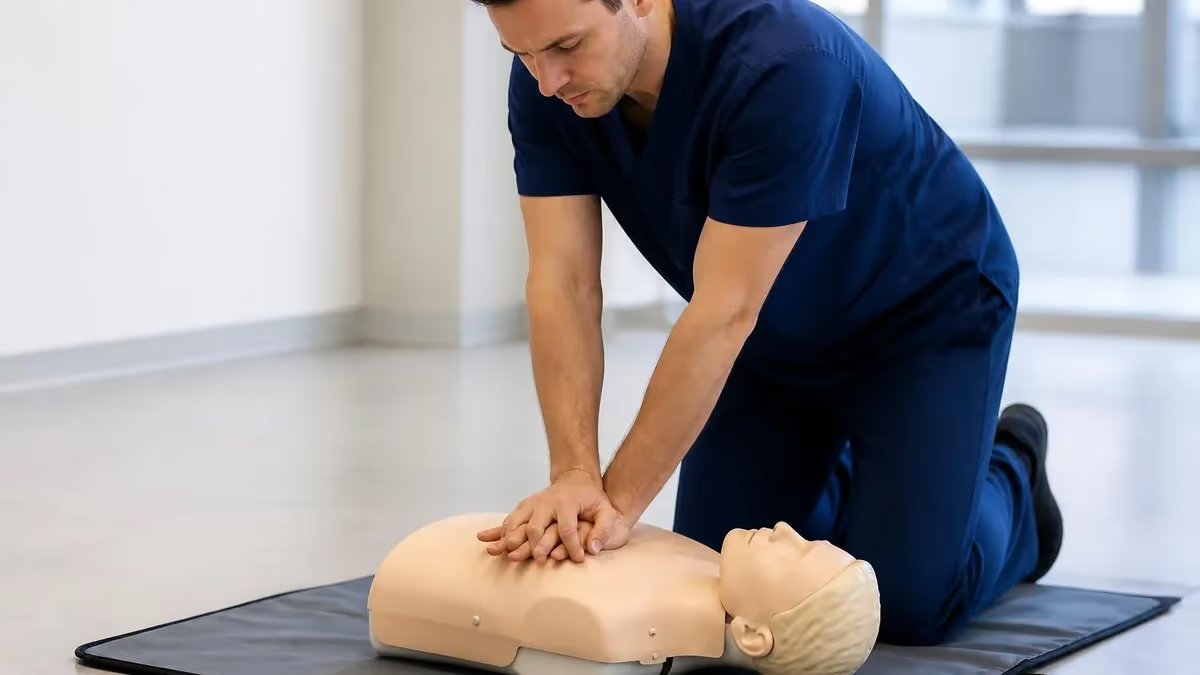
Place the heel of one hand in the center of the chest, on the lower half of the sternum (the breastbone). Stack your other hand on top, fingers interlocked. Lock your elbows. Position your shoulders directly above your hands. Now push.
- Depth: at least 2 inches for an adult, but not more than 2.4 inches. For a child, about 2 inches. For an infant, about 1.5 inches using two fingers or two thumbs encircling the chest.
- Rate: 100 to 120 compressions per minute. The Bee Gees' "Stayin' Alive" hits this tempo perfectly — and yes, that's officially recommended.
- Recoil: let the chest come all the way back up between compressions. Leaning on the chest prevents the heart from refilling.
- Minimize interruptions: every pause costs blood pressure to the brain. Keep going.
Your CPR hand placement determines whether you're actually compressing the heart or just bruising ribs. Too high, and you're hitting the upper sternum where compressions do nothing useful. Too low, and you can lacerate the liver. Center of the chest, between the nipples — that's the target.
Rescue Breaths: Optional for Untrained Bystanders
If you've never taken a class, just do compressions. Hands-only CPR is officially endorsed for adult cardiac arrest by untrained rescuers. It's better than nothing, by a huge margin, and it removes the squeamishness barrier that stops people from helping.
If you are trained and willing, deliver 2 rescue breaths after every 30 compressions. Tilt the head back, lift the chin, pinch the nose shut, and seal your mouth over theirs (or use a CPR mask if available). Each breath should last about 1 second and produce visible chest rise. Don't blow too hard — air will go into the stomach and force vomit back up.
The 30:2 Ratio
For adults and most pediatric situations with one rescuer, the ratio is 30 compressions to 2 breaths. Don't count out loud beyond 30 — it'll exhaust you. Just keep a rhythm and switch to breaths when the cycle ends. With two rescuers on a child or infant, the ratio shifts to 15:2 because kids need more frequent oxygen.
Using an AED
The moment someone arrives with an AED, get it on the chest. Turn it on. Most units talk you through the rest in plain English. Peel the pads, stick them on bare skin — one upper right chest, one lower left side. Don't pause compressions while the pads go on if you've got a second rescuer.
The AED will analyze the rhythm. If it advises a shock, make sure no one is touching the person, then press the button. Resume compressions immediately after the shock — don't stop to check for a pulse. The AED will re-analyze every 2 minutes. Keep cycling: compressions, analyze, shock if advised, compressions again. Don't take pads off, even if the person seems to wake up.
When to Stop CPR
You keep going until one of four things happens:
- Emergency medical services arrive and take over.
- The person shows obvious signs of life — moving, breathing normally, coughing.
- An AED instructs you to stop or pause.
- You're physically exhausted and unable to continue, and there's no one to swap with.
That last point is real. Effective CPR is brutal cardio. After 2 minutes, your compression quality drops measurably. If a second person is available, swap every 2 minutes (roughly 5 cycles of 30:2) so neither of you fatigues. The exchange should take less than 5 seconds.
Common Mistakes That Cost Lives
Most failed CPR attempts share a handful of errors. Compressions too shallow — fear of breaking ribs makes people hold back. Ribs heal; brain damage doesn't. Compressions too slow — panic makes people freeze up between pushes. Hands in the wrong place — the heart sits behind the lower sternum, not the upper chest. Long pauses to check pulses — current guidelines tell lay rescuers not to check pulses at all, because untrained fingers waste 30 seconds finding nothing.
Another big one: stopping too early. People expect a Hollywood gasp-and-recover. Real cardiac arrest victims usually don't wake up under your hands. They wake up later, in the back of an ambulance, after defibrillation and drugs. Your job is to keep them salvageable until that happens.

How to Get Real Training
Reading about CPR doesn't certify you, and it won't help you keep your composure when someone's lips turn blue. The two major certifying bodies in the US — the American Heart Association and the American Red Cross — both offer in-person and hybrid courses. A standard CPR class runs about 4 hours and costs $50 to $120. You'll practice on manikins until the motion feels automatic.
If you work in healthcare, you need BLS (Basic Life Support) certification, which adds two-rescuer techniques and bag-mask ventilation. If you teach kids, work in childcare, or are a new parent, take a pediatric-focused course covering infant CPR. Certifications last 2 years, after which you renew with a shorter refresher.
Plenty of free online courses exist, but the ones that produce a valid card include a hands-on skills check with an instructor. Pure-online "certifications" with no in-person component are widely rejected by employers. If your job requires a CPR card — and many do, from teachers to flight attendants to gym staff — verify the issuing organization is accepted before you pay.
Special Situations
Pregnant Women
Hand placement stays the same, but tilt the woman onto her left side or have someone manually pull the uterus to the left during compressions. This relieves pressure on the inferior vena cava and lets blood return to the heart. Without this displacement, your compressions move very little blood.
Drowning Victims
This is one of the rare cases where rescue breaths matter more than compressions. The cardiac arrest came from oxygen starvation, so giving 5 initial breaths before starting compressions is the recommended approach for drowning. Don't waste time trying to drain water from the lungs — it isn't there in the quantities you imagine.
Suspected Opioid Overdose
Start CPR as normal, but if naloxone (Narcan) is available, administer it. Compressions buy time; naloxone reverses the underlying problem. Both work together.
Liability and the Good Samaritan Question
People hesitate to help because they're afraid of being sued. Good Samaritan laws exist in all 50 states to protect bystanders who provide reasonable assistance in good faith. You cannot be successfully sued for performing CPR on someone who collapsed in front of you, even if you broke a rib or didn't save them. The legal risk is essentially zero. The moral risk of standing still is much higher.
So learn the technique. Take a class. Keep your CPR card current. And if you're ever the one person standing between a stranger and death, push hard, push fast, don't stop. That's the whole job.
About the Author

Registered Nurse & Healthcare Educator
Johns Hopkins University School of NursingDr. Sarah Mitchell is a board-certified registered nurse with over 15 years of clinical and academic experience. She completed her PhD in Nursing Science at Johns Hopkins University and has taught NCLEX preparation and clinical skills courses for nursing students across the United States. Her research focuses on evidence-based exam preparation strategies for healthcare certification candidates.
Join the Discussion
Connect with other students preparing for this exam. Share tips, ask questions, and get advice from people who have been there.
View discussion (5 replies)