
CPR Techniques: Complete Guide to Adult, Child & Infant Resuscitation 2026 October
Master CPR techniques for adult, child & infant rescue. 📝 Learn ACLS algorithm, compression depth, AED use, and recovery position with step-by-step guidance.
Modern cpr techniques have evolved dramatically over the past decade, with the 2025 American Heart Association updates emphasizing high-quality chest compressions, minimal interruptions, and earlier defibrillation. Whether you are a healthcare provider preparing for advanced certification or a bystander hoping to save a life in your own kitchen, understanding the mechanics, rhythm, and decision-making behind cardiopulmonary resuscitation is no longer optional. Sudden cardiac arrest claims more than 356,000 lives outside hospitals each year in the United States, and survival rates more than double when CPR is initiated within the first two minutes.
The foundational acls algorithm builds directly on basic life support, layering medication administration, advanced airway management, and rhythm interpretation on top of the same compression-and-ventilation cycles every layperson learns. Yet despite this technical hierarchy, the heart of resuscitation remains shockingly simple: push hard, push fast, allow full recoil, and minimize interruptions. The choreography between rescuers, the timing of breaths, and the seamless transition to an automated external defibrillator are what separate a chaotic response from a coordinated, evidence-based one.
This comprehensive guide walks you through every technique you need to perform high-quality CPR on adults, children, and infants. We cover hand placement, compression depth, ventilation ratios, recovery positioning, choking interventions, and the precise moments when each maneuver applies. You will also find practical guidance on team-based resuscitation, common errors that reduce survival, and how to maintain skills between certification cycles. Each section reflects the most current 2025 AHA and ILCOR consensus recommendations.
Beyond mechanics, we explore the cognitive frameworks that make experienced providers effective under pressure. Recognizing agonal breathing, calling for help correctly, and switching compressors every two minutes are not afterthoughts — they are the small decisions that compound into survival. Whether you are pursuing your first pals certification or refreshing skills you have not used in years, the techniques outlined here will serve you in both classroom testing and real-world emergencies.
For those preparing for written examinations, this guide doubles as a structured study reference. The keywords, ratios, and depths emphasized here are exactly what appear on BLS, ACLS, and PALS certification tests. We pair each technique explanation with practical memory aids, mnemonics, and common test-question framings so that you walk into your exam confident in both the why and the how.
By the end of this article, you will understand not just what to do during a cardiac emergency, but why each step matters physiologically. Effective compressions generate roughly one-third of normal cardiac output, which is just enough to keep the brain and heart muscle viable until defibrillation can restore an organized rhythm. Every second without compressions reduces survival by approximately ten percent — a sobering statistic that explains why technique, not theory, is what saves lives.
Bookmark this page, share it with family members, and return to it before every recertification. CPR is a perishable skill, and the most dangerous moment in any emergency is the one where hesitation replaces action. Let us begin with the fundamentals that anchor every other technique you will learn.
CPR Techniques by the Numbers

Core CPR Technique Components
The mechanical heart of CPR. Push hard at least 2 inches deep, fast at 100-120 per minute, allowing full chest recoil between each compression to refill the heart chambers.
Open the airway using head-tilt chin-lift for non-trauma patients or jaw-thrust when spinal injury is suspected. A patent airway is required for effective ventilation and oxygen delivery.
Deliver two breaths over one second each, watching for visible chest rise. Avoid excessive volume or rate, which causes gastric inflation and reduces venous return.
Attach the AED as soon as available. Early defibrillation within 3-5 minutes of collapse is the single strongest predictor of survival from ventricular fibrillation arrest.
Swap compressors every two minutes to prevent fatigue. Assign clear roles: compressor, airway, monitor, recorder, and team leader to simplify the resuscitation.
Adult CPR begins the moment you confirm unresponsiveness and absent or abnormal breathing. Tap the victim firmly on the shoulder and shout, then scan the chest for ten seconds or less looking for normal respirations. Agonal gasping — slow, irregular, fish-out-of-water breathing — is not normal breathing and should be treated as cardiac arrest. Call 911 immediately, request an AED, and place the patient supine on a firm, flat surface before beginning compressions.
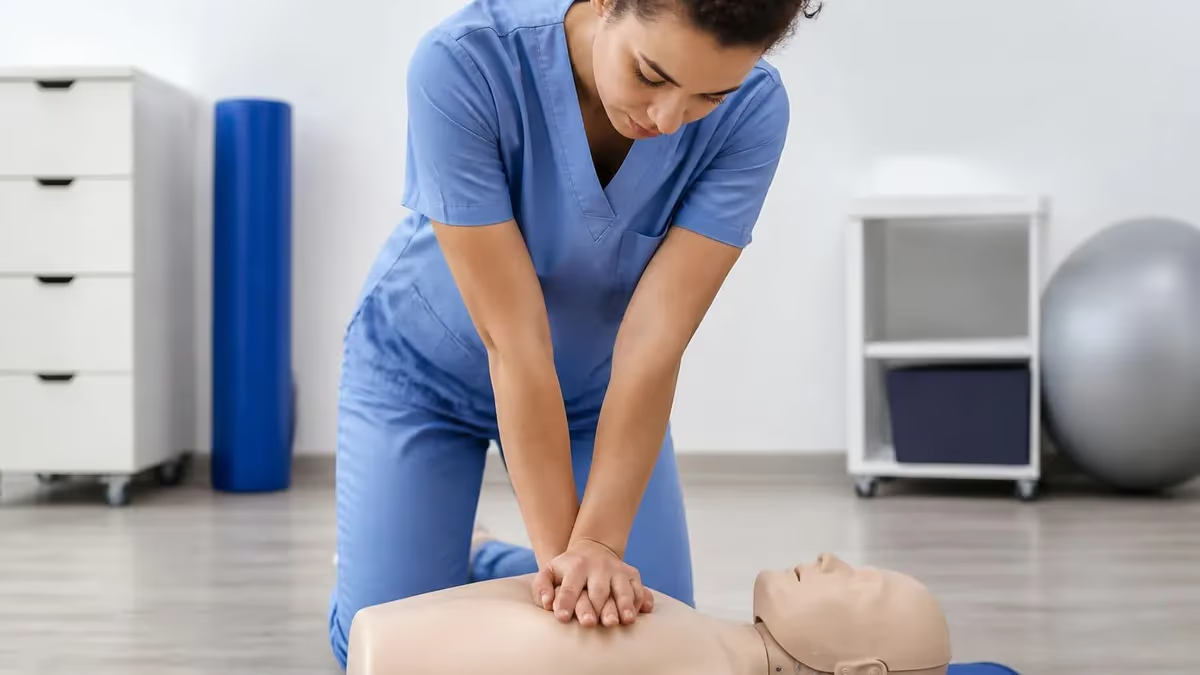
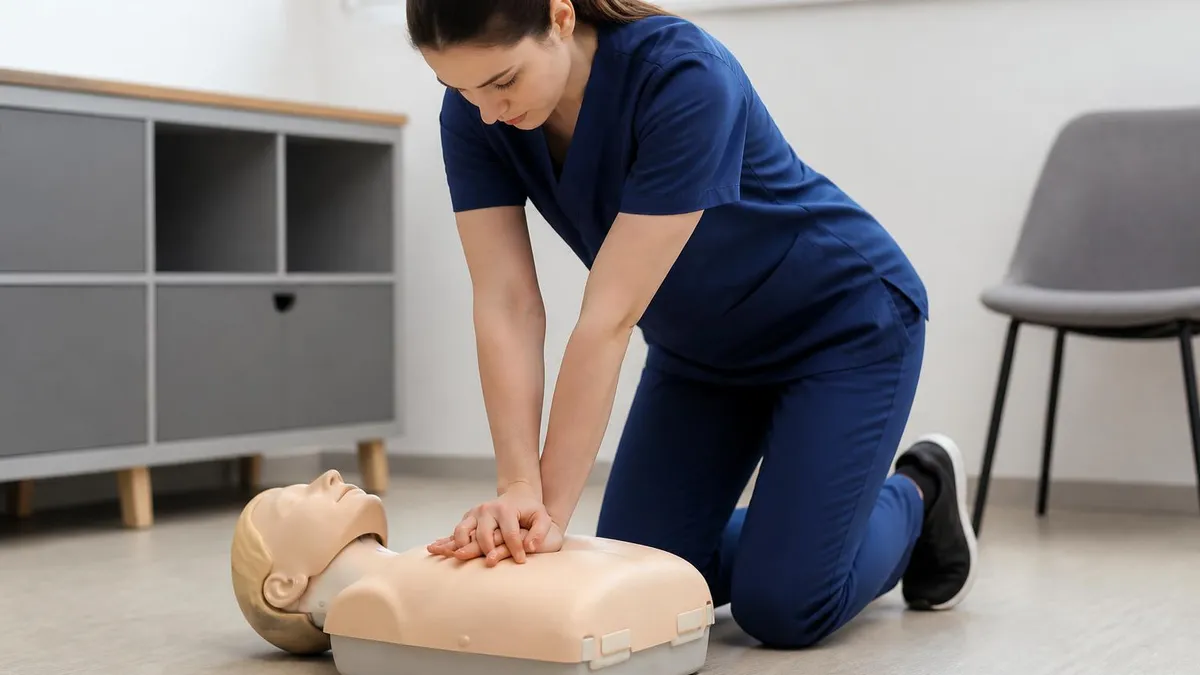
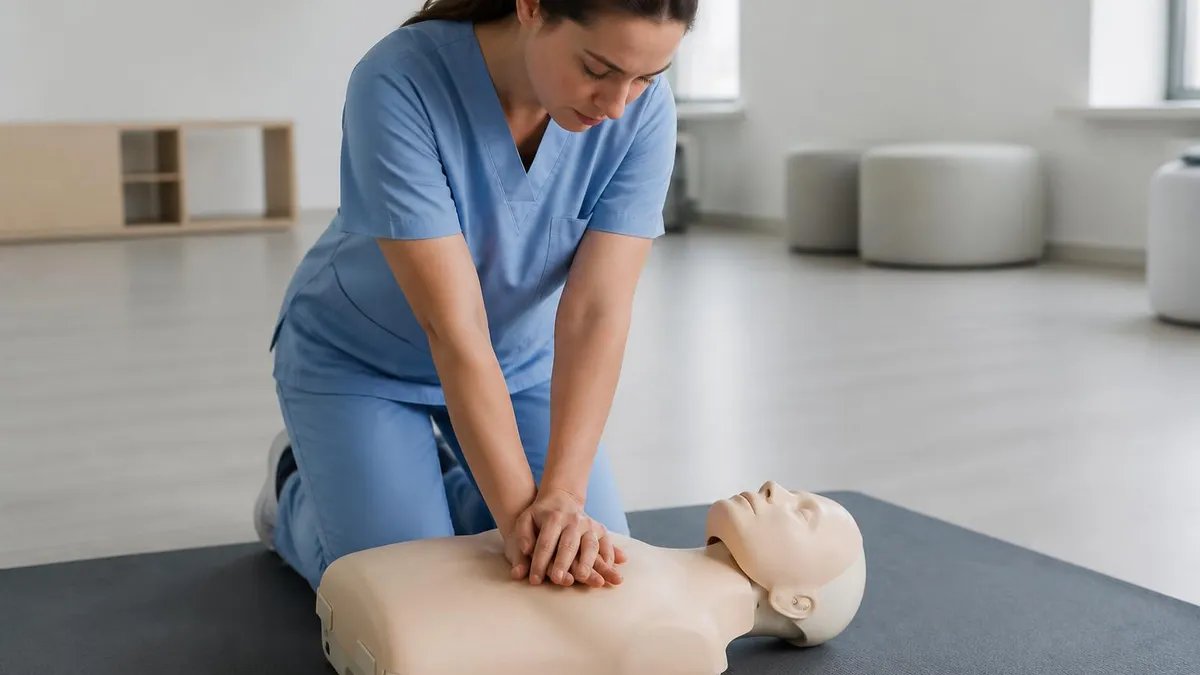
Position yourself at the patient's side, kneeling close enough that your shoulders are directly above your hands. Place the heel of one hand on the lower half of the sternum, between the nipples, and stack your other hand on top with fingers interlaced. Lock your elbows, keep your arms straight, and use your body weight rather than arm strength to compress. This biomechanical position dramatically reduces fatigue and allows you to maintain quality compressions for the full two-minute cycle.
Compress to a depth of at least 2 inches but no more than 2.4 inches in adults. The 2025 AHA guidelines emphasize avoiding excessive depth, which causes rib fractures and reduces cardiac filling. Full chest recoil is equally important — leaning on the chest between compressions has been shown to reduce coronary perfusion pressure and worsen outcomes. Count out loud or use a metronome app to maintain the 100-120 per minute cadence; pace yourself to the beat of "Stayin' Alive" or "Baby Shark."
After 30 compressions, open the airway with the head-tilt chin-lift maneuver and deliver two rescue breaths using a barrier device or bag-mask. Each breath should last about one second and produce visible chest rise. Avoid hyperventilation; over-ventilating increases intrathoracic pressure, decreases venous return, and worsens cerebral perfusion. If you are untrained or unwilling to give breaths, hands-only CPR with continuous compressions is acceptable and still saves lives.
Continue cycles of 30 compressions and 2 breaths until an AED arrives, advanced help takes over, or the patient shows signs of life. When the AED arrives, power it on immediately and follow the voice prompts. Expose the chest, attach the pads as illustrated, and ensure no one is touching the patient during rhythm analysis or shock delivery. Resume compressions immediately after each shock or no-shock advisory — do not pause to recheck pulses.
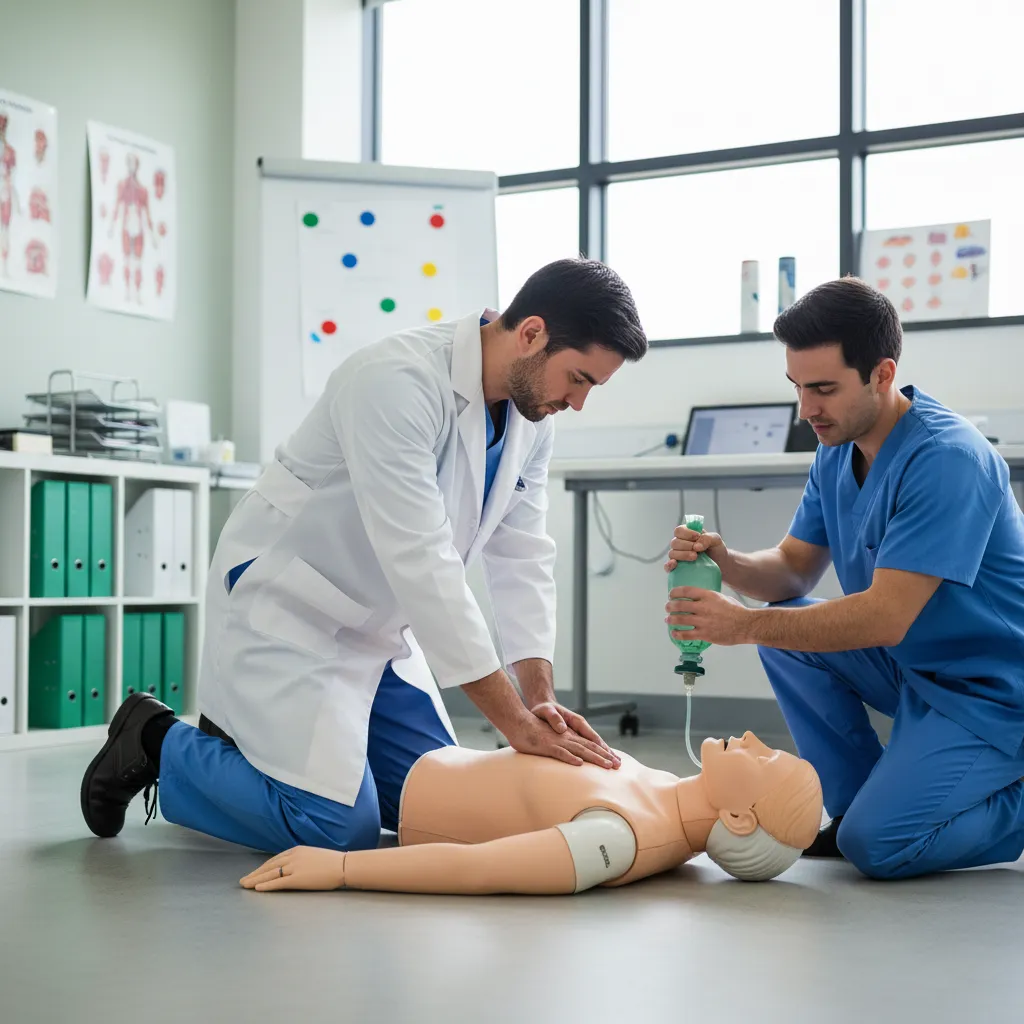
For two-rescuer adult CPR, the compression-to-ventilation ratio remains 30:2 until an advanced airway is in place. Once an endotracheal tube or supraglottic device is inserted, transition to continuous compressions at 100-120 per minute with asynchronous breaths every six seconds (10 per minute).
Switch compressors every two minutes — coinciding with rhythm checks — to prevent fatigue-related quality decay. Studies consistently show compression depth and rate deteriorate after 90 seconds of continuous effort, even when the rescuer feels strong. The handoff should take less than five seconds: the relieving rescuer kneels on the opposite side, places hands above the active rescuer's, and takes over on the next count without missing a beat.
CPR Practice Test Questions
Prepare for the CPR Cardiopulmonary Resuscitation Practice exam with our free practice test modules. Each quiz covers key topics to help you pass on your first try.
CPR Basic CPR
CPR Exam Questions covering Basic CPR. Master CPR Test concepts for certification prep.
CPR and First Aid
Free CPR Practice Test featuring and First Aid. Improve your CPR Exam score with mock test prep.
CPR (Cardiopulmonary Resuscitation) Adult ...
CPR Mock Exam on (Cardiopulmonary Resuscitation) Adult CPR and AED Usage. CPR Study Guide questions to pass on your first try.
CPR (Cardiopulmonary Resuscitation) Airway...
CPR Test Prep for (Cardiopulmonary Resuscitation) Airway Obstruction and Choking. Practice CPR Quiz questions and boost your score.
CPR (Cardiopulmonary Resuscitation) Cardio...
CPR Questions and Answers on (Cardiopulmonary Resuscitation) Cardiopulmonary Emergency Recognition. Free CPR practice for exam readiness.
CPR (Cardiopulmonary Resuscitation) Child ...
CPR Mock Test covering (Cardiopulmonary Resuscitation) Child and Infant CPR. Online CPR Test practice with instant feedback.
CPR (Cardiopulmonary Resuscitation) High-P...
Free CPR Quiz on (Cardiopulmonary Resuscitation) High-Performance Team Dynamics. CPR Exam prep questions with detailed explanations.
CPR (Cardiopulmonary Resuscitation) Legal ...
CPR Practice Questions for (Cardiopulmonary Resuscitation) Legal and Ethical Considerations. Build confidence for your CPR certification exam.
CPR for Specific Populations
CPR Test Online for for Specific Populations. Free practice with instant results and feedback.
CPR Airway & Breathing Management
CPR Exam Questions covering Airway & Breathing Management. Master CPR Test concepts for certification prep.
CPR Assessment & Recognition of Cardiac Ar...
Free CPR Practice Test featuring Assessment & Recognition of Cardiac Arrest. Improve your CPR Exam score with mock test prep.
CPR Chest Compressions & Defibrillation
CPR Mock Exam on Chest Compressions & Defibrillation. CPR Study Guide questions to pass on your first try.
CPR Post-Resuscitation Care & Recovery
CPR Test Prep for Post-Resuscitation Care & Recovery. Practice CPR Quiz questions and boost your score.
Infant CPR vs Child vs Adult Techniques
Adult cpr techniques use two-handed compressions on the lower sternum to a depth of 2-2.4 inches at 100-120 per minute. Single-rescuer ratio is 30 compressions to 2 breaths, transitioning to continuous compressions with asynchronous ventilations every six seconds once an advanced airway is placed.
The national cpr foundation and AHA both recommend hands-only CPR for untrained bystanders responding to adult collapse. Pulse checks should never exceed ten seconds, and chest recoil must be complete between compressions. Use an AED as soon as available — early defibrillation within five minutes is the single strongest survival predictor.

Hands-Only CPR vs Conventional CPR: Which Should You Use?
- +Easier for untrained bystanders to perform without hesitation
- +Eliminates concerns about disease transmission via mouth-to-mouth
- +Maintains continuous chest compressions with no interruptions
- +Equally effective as conventional CPR in witnessed adult cardiac arrest
- +Higher likelihood of bystander intervention in public settings
- +Simpler to remember under stress and easier to coach via 911 dispatcher
- −Not appropriate for drowning, drug overdose, or pediatric arrest
- −Less effective when arrest duration exceeds several minutes
- −Misses opportunity to address primary respiratory causes
- −Inappropriate for asphyxial arrest in children and infants
- −Does not deliver supplemental oxygen even when available
- −Healthcare providers are still expected to deliver conventional CPR
Pros and Cons at a Glance
| Pros | Cons |
|---|---|
| Easier for untrained bystanders to perform without hesitation | Not appropriate for drowning, drug overdose, or pediatric arrest |
| Eliminates concerns about disease transmission via mouth-to-mouth | Less effective when arrest duration exceeds several minutes |
| Maintains continuous chest compressions with no interruptions | Misses opportunity to address primary respiratory causes |
| Equally effective as conventional CPR in witnessed adult cardiac arrest | Inappropriate for asphyxial arrest in children and infants |
| Higher likelihood of bystander intervention in public settings | Does not deliver supplemental oxygen even when available |
High-Quality CPR Technique Checklist
- ✓Confirm scene safety before approaching the victim
- ✓Check responsiveness with shoulder tap and verbal cue
- ✓Scan for normal breathing for no more than 10 seconds
- ✓Call 911 and request an AED immediately upon recognition
- ✓Position patient supine on a firm, flat surface
- ✓Compress at 100-120 per minute to correct depth for age
- ✓Allow full chest recoil between every compression
- ✓Minimize interruptions — keep hands-off time under 10 seconds
- ✓Deliver ventilations over one second with visible chest rise
- ✓Switch compressors every two minutes to prevent fatigue
- ✓Attach and use the AED as soon as it arrives on scene
- ✓Continue cycles until ROSC, advanced help, or exhaustion
Minimize hands-off time at all costs
Every interruption in chest compressions causes coronary perfusion pressure to drop precipitously, and it takes 60 seconds of continuous compressions to rebuild that pressure. The 2025 AHA guidelines target a chest compression fraction (CCF) of greater than 80%, meaning hands should be on the chest more than 80% of total resuscitation time. Pulse checks, rhythm analyses, and intubation attempts should never exceed 10 seconds. This single metric — measured automatically by modern defibrillators — correlates more strongly with survival than almost any other variable.
The acls algorithm transforms basic life support into a coordinated, medication-driven resuscitation by layering advanced interventions on top of high-quality compressions. The cornerstone remains identical: push hard, push fast, allow recoil, minimize interruptions. What changes is the addition of rhythm interpretation, vasopressors like epinephrine 1 mg every 3-5 minutes, advanced airway placement, and consideration of reversible causes summarized by the Hs and Ts mnemonic. Understanding when each intervention applies is the difference between memorizing flowcharts and actually running a code.
Defibrillation deserves special emphasis because it is the only intervention proven to convert ventricular fibrillation back to a perfusing rhythm. Every minute that passes without defibrillation reduces survival from VF arrest by 7-10%. Modern AEDs analyze the rhythm and advise shocks automatically, but providers should still understand the underlying logic: shock VF and pulseless VT, do not shock asystole or pulseless electrical activity. The respiratory rate during arrest with an advanced airway is 10 breaths per minute (one every 6 seconds), a number frequently tested on certification exams.
Pad placement matters more than most rescuers realize. The standard anterior-lateral position places one pad below the right clavicle and the other on the left mid-axillary line at the fifth intercostal space. Avoid placing pads over medication patches, implanted devices, or directly on jewelry. For infants and small children, anterior-posterior placement (one pad on the chest, one on the back) prevents the pads from touching each other and creating a short circuit. Always dry the chest before pad application and shave excessive hair if a razor is available.
The team-based approach codified in ACLS training emphasizes closed-loop communication, clearly defined roles, and constructive intervention. The team leader stands at the foot of the bed, maintains situational awareness, and assigns tasks by name. The compressor focuses solely on quality compressions. Airway management, IV/IO access, medication administration, and timekeeping are each assigned to specific team members. This structure prevents the chaos that historically characterized codes and dramatically improves outcomes when practiced regularly through simulation.
Reversible causes — the Hs and Ts — should be considered every two minutes during rhythm checks. The Hs include hypovolemia, hypoxia, hydrogen ion (acidosis), hypo/hyperkalemia, and hypothermia. The Ts include tension pneumothorax, tamponade (cardiac), toxins, thrombosis (pulmonary), and thrombosis (coronary). Identifying and treating these causes is often the only path to return of spontaneous circulation, particularly in PEA and asystole arrests where defibrillation is not indicated.
Capnography has become the gold standard for monitoring CPR quality and detecting ROSC. End-tidal CO2 values below 10 mmHg suggest inadequate compressions or impending death, while a sudden rise to 35-40 mmHg often signals return of spontaneous circulation before a pulse can be confirmed. Continuous waveform capnography is now considered standard of care for any intubated cardiac arrest patient and is heavily emphasized on the AHA ACLS provider exam.
Post-cardiac-arrest care begins the moment ROSC is achieved. Targeted temperature management at 32-36°C for 24 hours, optimization of oxygenation and ventilation to avoid hyperoxia and hypocapnia, and rapid coronary angiography for suspected STEMI all contribute to improved neurologic outcomes. Many patients survive the arrest itself only to die from withdrawal of care based on premature neurologic prognostication — current guidelines recommend waiting at least 72 hours before making any definitive prognostic decisions.

Pulse checks must never exceed 10 seconds. Studies show that even experienced providers cannot reliably detect a pulse in critically ill patients, and prolonged pulse checks delay life-saving compressions. When in doubt, start compressions — the risk of harming a patient with a faint pulse is far lower than the risk of withholding compressions from someone in arrest. The same 10-second rule applies to rhythm analysis with an AED or manual defibrillator.
The recovery position — sometimes searched as "position recovery" — is used for unresponsive patients who are breathing normally and have a pulse but cannot maintain their own airway. It prevents aspiration of vomit or secretions and keeps the tongue from falling back to occlude the airway. To perform it, kneel beside the patient, place the near arm at a right angle above the head, bring the far arm across the chest, bend the far knee, and roll the patient toward you onto their side with the bent knee stabilizing the position.
This technique is appropriate after ROSC when a patient is breathing but not fully conscious, in postictal states following seizures, in alcohol or drug intoxication when respirations are adequate, and in many trauma scenarios where spinal precautions are not required. Never place a patient in the recovery position if you suspect spinal injury without proper logroll technique and cervical stabilization. Reassess breathing every two minutes while awaiting EMS, and be prepared to reposition supine and resume CPR if breathing stops.
Choking interventions blend seamlessly with cpr techniques and represent some of the most commonly tested material on certification exams. For conscious adults and children with complete airway obstruction, the Heimlich maneuver — five abdominal thrusts just above the navel — is the standard intervention. For infants under one year, use five back blows followed by five chest thrusts, never abdominal thrusts which can damage the liver. When a choking victim becomes unresponsive, lower them to the ground and begin CPR, looking in the mouth for the object before each set of breaths.
Pregnant women and obese patients require chest thrusts rather than abdominal thrusts because the diaphragm cannot be effectively compressed from below. Position your hands at the center of the sternum, similar to CPR hand placement, and deliver five firm thrusts. This adaptation is frequently tested and reflects the broader principle that techniques must be modified for anatomy. The cpr index of recognized exam questions includes dozens of these special-population scenarios.
For drowning victims, the rescue sequence prioritizes ventilation. Begin with five initial rescue breaths before starting compressions, because the underlying cause of arrest is hypoxia rather than primary cardiac dysfunction. This represents one of the few exceptions to the compression-first approach and is essential knowledge for lifeguards, swim instructors, and anyone working near water. The same principle applies to opioid overdose, where naloxone administration paired with rescue breathing often restores spontaneous breathing without ever requiring compressions.
Special environments — cold water, electrical injury, lightning strike, and pregnancy past 20 weeks — each carry technique modifications worth memorizing. Hypothermic patients require prolonged resuscitation efforts because the cold protects the brain; the adage "not dead until warm and dead" reflects documented survivors after hours of CPR. Pregnant patients near term should be manually displaced to the left to relieve aortocaval compression, with consideration of perimortem cesarean delivery within four minutes of arrest.
Maintaining proficiency between certifications is challenging because CPR skills degrade significantly within 3-6 months of training. Regular practice on a feedback-enabled manikin, participation in mock codes, and review of cognitive aids like pocket cards or smartphone apps all help preserve performance. Many institutions now use quarterly low-dose, high-frequency refresher sessions instead of the traditional two-year recertification cycle, with measurable improvements in real-world compression quality.
Preparing for certification exams requires understanding both the technique and the testing framework. The pals certification, what is a bls certification, and ACLS provider courses all share a common assessment philosophy: demonstrate high-quality compressions on a manikin, narrate your decision-making during a simulated arrest, and answer multiple-choice questions about ratios, depths, doses, and rhythms. Practice these three modalities separately — psychomotor skills, scenario-based reasoning, and written knowledge — rather than assuming proficiency in one guarantees mastery of the others.
One common student question is what does aed stand for — automated external defibrillator. Understanding the acronym is trivial, but understanding the device's function is foundational. AEDs analyze cardiac rhythm and deliver a defibrillating shock when ventricular fibrillation or pulseless ventricular tachycardia is detected. They will not shock asystole or PEA, which is why continuous high-quality compressions remain the dominant intervention even when an AED is attached. Memorize this distinction because it appears on virtually every basic life support exam.
Hand and finger fatigue during compressions is a real performance limitation that can be mitigated through technique refinement. Keep your shoulders directly above your hands, lock your elbows, and use hip-hinge mechanics rather than arm strength. Switch compressors every two minutes even if you feel fine — objective data from compression-monitoring devices shows quality declines well before subjective fatigue. For long resuscitations, mechanical compression devices like the LUCAS or AutoPulse can maintain consistent depth and rate when staffing is limited.
Common technique errors include compressing too shallowly (the most frequent error), compressing too fast (the second most frequent), failing to allow complete recoil, and hyperventilating during ventilations. Modern feedback devices integrated into defibrillators provide real-time audio coaching — "push harder," "slow down," "good compressions" — and have been shown to improve survival when used during real arrests. If your facility uses these devices, practice with them during training so the prompts feel familiar during real codes.
This format is now recognized by AHA, Red Cross, and most state regulatory bodies. Verify with your employer that the specific course you choose will be accepted for your role, as some healthcare systems still require fully in-person training for certain positions.
Document everything during a real resuscitation. Time of collapse, time of CPR initiation, time of first shock, medications administered with doses and times, and time of ROSC or termination should all be recorded by a dedicated team member. This documentation supports quality improvement reviews, billing, and any subsequent legal proceedings. Many facilities use code-event forms specifically designed for this purpose, and the AHA Get With The Guidelines registry collects this data nationally to drive evidence-based improvements in resuscitation care.
Finally, remember the emotional and psychological dimension of resuscitation. Cardiac arrest is traumatic for rescuers, family members, and bystanders, even when outcomes are positive. Critical incident stress debriefings, peer support programs, and acknowledgment of the emotional weight of these events are increasingly recognized as essential components of resuscitation systems of care. Take care of yourself and your team — sustainable response capability depends on healthy responders who can show up again tomorrow.
CPR Questions and Answers

About the Author

Registered Nurse & Healthcare Educator
Johns Hopkins University School of NursingDr. Sarah Mitchell is a board-certified registered nurse with over 15 years of clinical and academic experience. She completed her PhD in Nursing Science at Johns Hopkins University and has taught NCLEX preparation and clinical skills courses for nursing students across the United States. Her research focuses on evidence-based exam preparation strategies for healthcare certification candidates.
Join the Discussion
Connect with other students preparing for this exam. Share tips, ask questions, and get advice from people who have been there.
View discussion (5 replies)