
CPR Chest Compression Rate: The Complete Guide to Compression Speed, Depth, and Quality in 2026 October
Master the correct CPR chest compression rate (100-120/min), depth, and recoil. Step-by-step guide with rescuer tips, AED use, and certification info. 📚
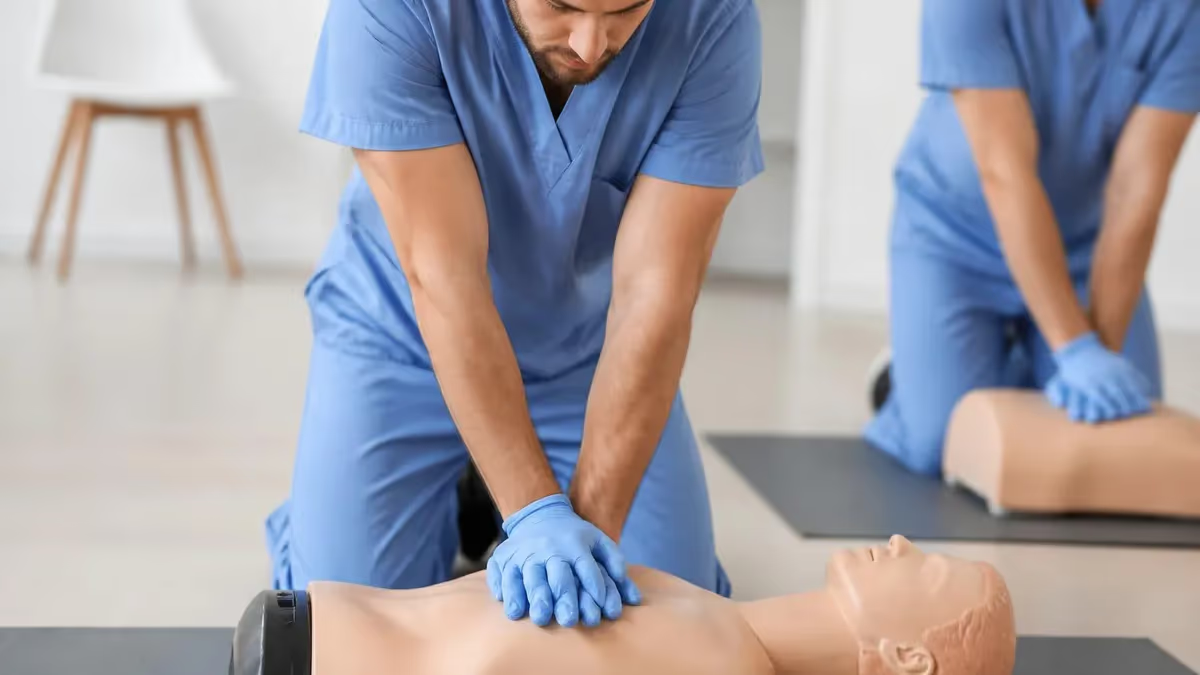
The correct cpr chest compression rate is one of the most heavily researched and frequently tested topics in resuscitation science, and getting it right can quite literally double a victim's chance of surviving sudden cardiac arrest. According to the American Heart Association and the latest International Liaison Committee on Resuscitation guidelines, rescuers should deliver chest compressions at a rate of 100 to 120 compressions per minute on adults, children, and infants alike, while also achieving adequate depth, full recoil, and minimal interruptions.
If you have ever taken a basic life support class, you have heard the instructor repeat that magic window of 100 to 120 compressions per minute over and over. That is because compression rate is the single rescuer-controlled variable that has the strongest dose-response relationship with return of spontaneous circulation, neurologically intact survival, and overall hospital discharge rates. Too slow, and coronary perfusion pressure never builds. Too fast, and the heart never refills between strokes.
This guide is written for the U.S. lay rescuer, the BLS-certified healthcare provider, and anyone studying for an acls algorithm refresher who wants a single, trustworthy resource on compression rate. We will cover the science behind 100 to 120 per minute, how rate interacts with depth and recoil, the songs and metronomes that help you keep tempo, and how rate expectations shift for infant cpr versus adult and child resuscitation.
You will also learn how compression rate fits inside the broader chain of survival, including AED deployment, ventilation ratios, and post-arrest care. We will explain what does aed stand for, when to switch rescuers, and how to interpret feedback devices that many modern manikins and real defibrillators now provide. Whether you are recertifying through the national cpr foundation, prepping for pals certification, or just refreshing your skills, the goal is the same: high-quality compressions, every time.
By the end of this article, you should be able to answer three questions confidently. First, what is the correct compression rate and depth for each age group? Second, how do you maintain that rate during a chaotic, stressful, real-world cardiac arrest? Third, how does compression quality interact with rescue breaths, AED shocks, and advanced life support drugs to determine the patient's outcome? Each of these touches a slightly different audience, so we have organized the article so you can jump to the section most relevant to your role.
Throughout, we will reference data from large registries such as the Resuscitation Outcomes Consortium, CARES, and Get With The Guidelines-Resuscitation, all of which have tracked tens of thousands of out-of-hospital cardiac arrests in the United States. The patterns are clear and consistent: rescuers who push hard, push fast within the 100 to 120 window, allow full recoil, and minimize off-chest time produce dramatically better outcomes than those who do not. The good news is that with practice and the right mental cues, anyone can hit those numbers reliably.
One important note before we dive in. This article is educational and does not replace hands-on training. To perform CPR on a real human being, you should complete a current, in-person or blended BLS or Heartsaver course from a recognized provider. The information here mirrors current 2020 AHA guidelines with the 2025 focused update incorporated, and it is consistent with what you will see on most U.S. certification exams in 2026.
CPR Compression Rate by the Numbers

Compression Rate and Depth by Age Group
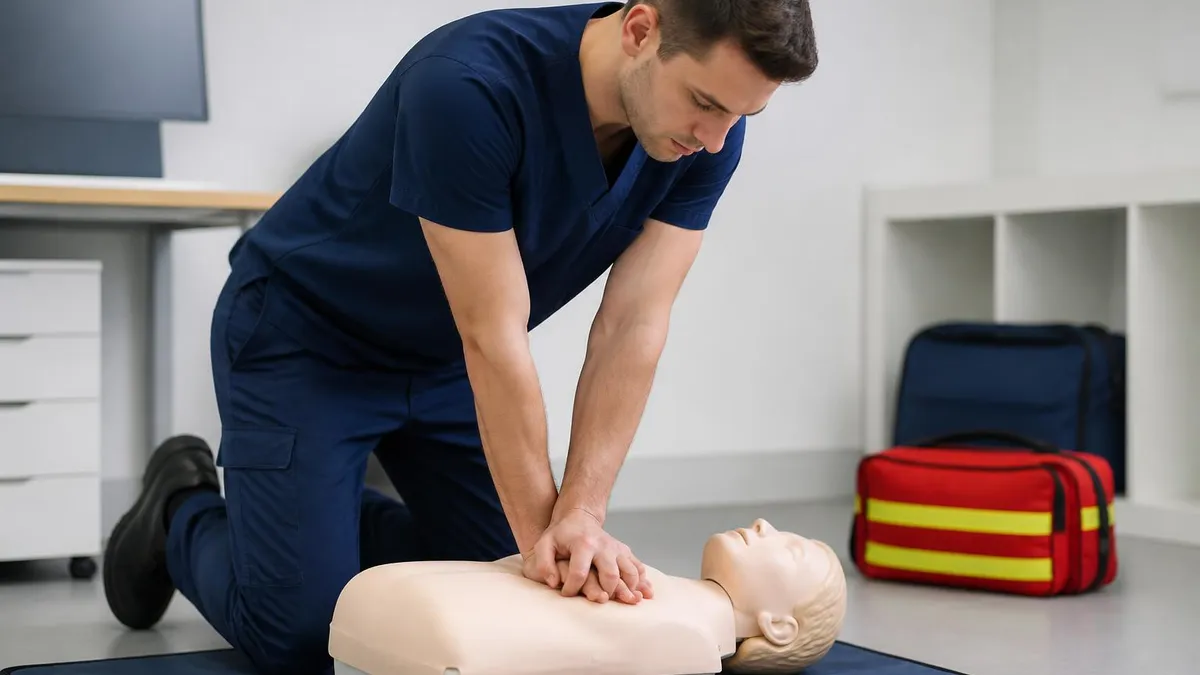
Compress the lower half of the sternum at 100-120 per minute, 2 to 2.4 inches deep. Use two-handed technique with heel of dominant hand and full body weight from straight arms above the chest.
Same 100-120 rate, but depth is about 2 inches or one-third the anterior-posterior chest depth. Use one or two hands depending on child size and rescuer strength. Ratio is 30:2 single rescuer.
Maintain 100-120 per minute with two fingers (single rescuer) or two-thumb encircling technique (two rescuers). Depth is about 1.5 inches or one-third AP diameter. Use 15:2 ratio with two trained rescuers.
Newborn resuscitation uses a unique 3:1 compression-to-ventilation ratio at 120 events per minute, equating to 90 compressions and 30 breaths each minute. This is a specialized NRP skill outside standard BLS.
Understanding why the cpr chest compression rate window of 100 to 120 per minute matters requires a brief tour of cardiac physiology. When the heart stops, blood stops moving, oxygen-rich plasma stops reaching the brain, and within four to six minutes irreversible neurologic injury begins. External chest compressions are essentially a manual pump: each downstroke squeezes the heart and thorax, pushing blood into the aorta and coronary arteries, while each release allows the chest to recoil and refill the chambers with venous return.
If you compress slower than about 80 per minute, the average forward flow drops because you are simply not doing enough work to maintain a meaningful cardiac output. Coronary perfusion pressure, which is the gradient that pushes blood into the cardiac muscle itself during the relaxation phase, never accumulates to the 15 to 20 mmHg threshold associated with return of spontaneous circulation. Slow CPR feels exhausting and produces almost no measurable benefit, which is one reason untrained bystanders often give up.
Conversely, compressing faster than 120 per minute creates a different problem. The chest does not have enough time between strokes to fully recoil, so venous blood cannot refill the right side of the heart. You end up squeezing an increasingly empty chamber. Studies by Idris and colleagues published in Circulation showed that rates above 125 per minute were independently associated with lower compression depth and reduced survival, even in otherwise well-performed resuscitation attempts.
This is also where life support concepts intersect with simple mechanics. Even the most aggressive acls algorithm with epinephrine, amiodarone, and rapid defibrillation cannot save a patient if the underlying compressions are inadequate. Drugs and shocks only work when there is enough perfusion to circulate them to the coronary arteries and brain. That is why every advanced cardiac life support course in the country, regardless of whether you train through the AHA, Red Cross, or national cpr foundation, drills the 100 to 120 number relentlessly.
The 100 to 120 range was not pulled from thin air. It reflects a meta-analysis of out-of-hospital cardiac arrest registries showing that survival peaks when rate hits roughly 107 per minute with full recoil. The ten-beat band around that peak acknowledges human variability under stress. Real rescuers cannot hold a single perfect tempo, but they can stay within a comfortable corridor. Hitting 110 is ideal, hitting 100 or 120 is fine, and anything outside that band starts to cost lives.
Compression rate also drives ventilation strategy. For single-rescuer adult CPR, you pause briefly after every 30 compressions to deliver two rescue breaths, which means real-world delivered rate ends up slightly below the raw compression speed. This is why modern hands-only CPR for untrained bystanders skips ventilations entirely. Continuous chest compressions at 100 to 120 per minute provide adequate oxygenation for the first several minutes because residual oxygen in the lungs and blood is still sufficient.
Finally, compression rate interacts with rescuer fatigue. A 2014 study in Resuscitation found that rescuers' depth and rate begin to degrade noticeably after just 90 to 120 seconds of compressions. That is why current guidelines recommend switching rescuers every two minutes, ideally synchronized with the AED's rhythm analysis pause. Knowing what does aed stand for, automated external defibrillator, is only step one. Using its mandatory pauses as natural rescuer-switch points is step two.

CPR Practice Test Questions
Prepare for the CPR Cardiopulmonary Resuscitation Practice exam with our free practice test modules. Each quiz covers key topics to help you pass on your first try.
CPR Basic CPR
CPR Exam Questions covering Basic CPR. Master CPR Test concepts for certification prep.
CPR and First Aid
Free CPR Practice Test featuring and First Aid. Improve your CPR Exam score with mock test prep.
CPR (Cardiopulmonary Resuscitation) Adult ...
CPR Mock Exam on (Cardiopulmonary Resuscitation) Adult CPR and AED Usage. CPR Study Guide questions to pass on your first try.
CPR (Cardiopulmonary Resuscitation) Airway...
CPR Test Prep for (Cardiopulmonary Resuscitation) Airway Obstruction and Choking. Practice CPR Quiz questions and boost your score.
CPR (Cardiopulmonary Resuscitation) Cardio...
CPR Questions and Answers on (Cardiopulmonary Resuscitation) Cardiopulmonary Emergency Recognition. Free CPR practice for exam readiness.
CPR (Cardiopulmonary Resuscitation) Child ...
CPR Mock Test covering (Cardiopulmonary Resuscitation) Child and Infant CPR. Online CPR Test practice with instant feedback.
CPR (Cardiopulmonary Resuscitation) High-P...
Free CPR Quiz on (Cardiopulmonary Resuscitation) High-Performance Team Dynamics. CPR Exam prep questions with detailed explanations.
CPR (Cardiopulmonary Resuscitation) Legal ...
CPR Practice Questions for (Cardiopulmonary Resuscitation) Legal and Ethical Considerations. Build confidence for your CPR certification exam.
CPR for Specific Populations
CPR Test Online for for Specific Populations. Free practice with instant results and feedback.
CPR Airway & Breathing Management
CPR Exam Questions covering Airway & Breathing Management. Master CPR Test concepts for certification prep.
CPR Assessment & Recognition of Cardiac Ar...
Free CPR Practice Test featuring Assessment & Recognition of Cardiac Arrest. Improve your CPR Exam score with mock test prep.
CPR Chest Compressions & Defibrillation
CPR Mock Exam on Chest Compressions & Defibrillation. CPR Study Guide questions to pass on your first try.
CPR Post-Resuscitation Care & Recovery
CPR Test Prep for Post-Resuscitation Care & Recovery. Practice CPR Quiz questions and boost your score.
Keeping Tempo: Songs, Metronomes, and Feedback
The Bee Gees classic Stayin' Alive sits at exactly 103 beats per minute, which is why it became the unofficial anthem of CPR training in the United States. Other songs in the target window include Another One Bites the Dust by Queen at 110 BPM, Crazy in Love by Beyoncé at 99 BPM, and Walk the Line by Johnny Cash at 104 BPM. Sing or hum the chorus in your head while compressing.
Music works because the brain locks onto rhythm extremely well under stress. Even untrained bystanders who recall a familiar song can hit the 100 to 120 window within five seconds of starting compressions. Avoid songs faster than 130 BPM because the urge to match the beat will push you over the safe ceiling and degrade compression depth, especially as fatigue accumulates after the first minute of work.
Hands-Only CPR vs. Conventional 30:2 CPR
- +Hands-only CPR is easier for untrained bystanders to perform without hesitation
- +Eliminates fear of disease transmission from mouth-to-mouth rescue breaths
- +Maintains uninterrupted compressions, maximizing coronary perfusion pressure
- +Phone instructions from 911 dispatchers are simpler and faster to deliver
- +Studies show equivalent neurologically intact survival in adult witnessed arrest
- +Reduces cognitive load so the rescuer can focus on rate, depth, and recoil
- −Not appropriate for infants, children, or drowning and respiratory arrest victims
- −Conventional 30:2 provides better outcomes when arrest is from hypoxic causes
- −Trained healthcare providers should always perform 30:2 with a barrier device
- −Hands-only is a temporary bridge until trained help or an AED arrives on scene
- −After several minutes residual oxygen is depleted and ventilations become essential
- −Lay rescuers may still feel pressure to give breaths, leading to unsafe delays
Pros and Cons at a Glance
| Pros | Cons |
|---|---|
| Hands-only CPR is easier for untrained bystanders to perform without hesitation | Not appropriate for infants, children, or drowning and respiratory arrest victims |
| Eliminates fear of disease transmission from mouth-to-mouth rescue breaths | Hands-only is a temporary bridge until trained help or an AED arrives on scene |
| Maintains uninterrupted compressions, maximizing coronary perfusion pressure | After several minutes residual oxygen is depleted and ventilations become essential |
| Studies show equivalent neurologically intact survival in adult witnessed arrest | Lay rescuers may still feel pressure to give breaths, leading to unsafe delays |
High-Quality Chest Compression Rate Checklist
- ✓Confirm scene safety and check responsiveness before touching the victim
- ✓Call 911 or have a bystander call while you retrieve the nearest AED
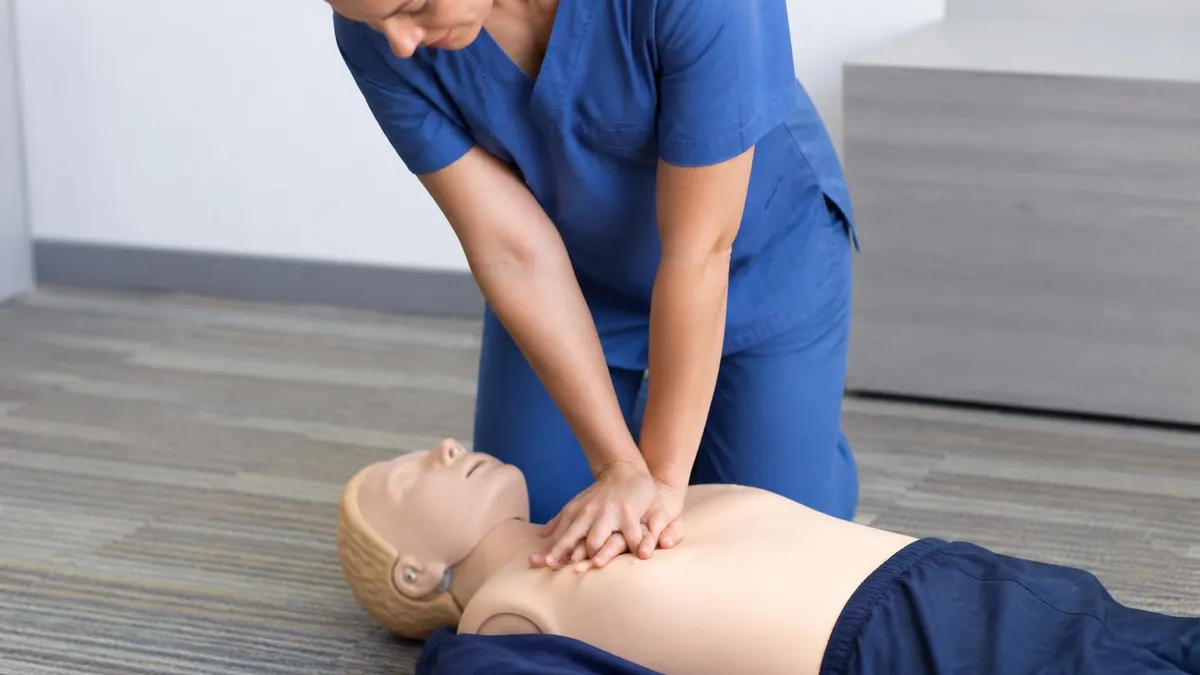
- ✓Place the heel of one hand on the lower half of the sternum, second hand stacked on top
- ✓Lock your elbows and position your shoulders directly over your hands
- ✓Push down at least 2 inches but no more than 2.4 inches on an average adult
- ✓Maintain a steady rate of 100 to 120 compressions per minute using a song or metronome
- ✓Allow complete chest recoil between compressions, do not lean on the chest
- ✓Limit pauses to under 10 seconds when switching rescuers or analyzing rhythm
- ✓Switch compressors every 2 minutes to prevent fatigue-related quality decline
- ✓Continue until ALS arrives, the patient moves purposefully, or you are physically unable
Aim for at least 80% hands-on-chest time
Compression rate matters, but chest compression fraction matters just as much. CCF is the percentage of the resuscitation time during which compressions are actively being delivered. Modern guidelines target 80% or higher. Every second of unnecessary pause for pulse checks, intubation attempts, or rhythm discussions costs perfusion pressure that takes 10 to 15 compressions to rebuild.
Even rescuers who know the correct cpr chest compression rate often drift outside the safe window during real arrests, and the reasons are predictable. Adrenaline, fear, and uncertainty all push humans toward faster, shallower compressions, while physical fatigue pulls them in the opposite direction toward slower, weaker work. Recognizing these patterns is half the battle, because the moment you notice yourself drifting, you can correct course with a deliberate breath and a re-anchor on your mental tempo cue.
The most common rate mistake is going too fast. Trainees in their first BLS class routinely hit 130 to 140 per minute on initial attempts, especially when an instructor or peer is watching. The fix is simple: slow your hands by counting out loud in pairs of two, one-and-two-and-three-and-four, which naturally lands you near 110 per minute. Real arrests in homes and gyms produce the same overshoot, made worse by panic, so practicing slow deliberate cadence in class transfers directly to the field.
Insufficient depth is the second epidemic mistake. Adults must be compressed at least 2 inches deep, which feels uncomfortably aggressive on a person who looks otherwise normal. Many rescuers, especially smaller-bodied or younger rescuers, compress only 1 to 1.5 inches because their instinct is to be gentle. Real-time feedback devices show that even healthcare professionals fall short on depth roughly 40% of the time, particularly during minutes three through eight when fatigue compounds.
Incomplete recoil is the third silent killer of CPR quality. Leaning on the chest between compressions, sometimes called residual leaning, prevents venous return and effectively shrinks every subsequent compression's stroke volume. Studies of in-hospital arrest video show leaning forces of just 2 to 3 kilograms reduce coronary perfusion pressure by 20% or more. The fix is to consciously lift your weight off the chest by straightening through your shoulders between strokes, even though your hands stay in contact with the sternum.
Interruptions are mistake number four. The seconds spent checking pulses, rotating rescuers, or fiddling with an AED add up shockingly fast. A code that looks 12 minutes long on the clock may contain only 7 minutes of actual compressions, dropping the chest compression fraction to 58%. Survival drops in lockstep. The remedy is choreography: pre-assigning roles, calling out pad placement out loud, and pre-charging the defibrillator during the last 15 seconds of a compression cycle.
Mistake five is failing to swap rescuers. Compressors almost always overestimate their own endurance. Subjective fatigue lags objective performance decline by 60 to 90 seconds, meaning by the time you feel tired, your numbers have already dropped. Set a hard rule: swap every two minutes regardless of how strong you feel. Synchronize the swap with the AED's rhythm analysis pause so no extra hands-off time is added. This is one of the highest-yield habits in resuscitation.
Finally, rescuers commonly forget the basics during pediatric or infant scenarios because the patient is small and the rescuer instinctively softens technique. Infant cpr still requires compressions at 100 to 120 per minute, and depth should be one-third the anterior-posterior diameter of the chest, which on a typical newborn means about 1.5 inches or 4 centimeters. That is firm and deep enough to scare new parents in class, but it is exactly what saves babies in real arrests.
Once compressions begin, do not stop to check for a pulse unless the patient moves, breathes normally, or the AED prompts you to. Pulse checks are notoriously inaccurate even for paramedics, and every unnecessary pause drops coronary perfusion pressure. Resume immediately after each AED rhythm analysis, even if you think you felt something. The next cycle of compressions is more valuable than a doubtful pulse.
For readers thinking about CPR as a career step rather than a one-time safety skill, mastering compression rate is the entry point to a much larger world of resuscitation credentialing. The basic Heartsaver or community CPR card you earn in a 3-hour class is the foundation, but healthcare and public safety careers stack additional certifications on top, each requiring deeper mastery of the same core mechanics. Understanding the ladder helps you choose the right next step.
The most common first credential beyond lay rescuer is Basic Life Support for Healthcare Providers, often shortened to BLS. This 4 to 5 hour course is required for nurses, EMTs, dental staff, medical students, respiratory therapists, and most allied health workers. BLS introduces two-rescuer CPR, bag-valve-mask ventilation, and the 30:2 versus 15:2 ratio distinction. Cards are typically valid for two years and cost between $60 and $120 depending on provider.
Advanced Cardiac Life Support, or ACLS, is the next tier and is required for ICU nurses, emergency physicians, paramedics, and anesthesia staff. ACLS expects flawless BLS skills as a prerequisite, then layers on rhythm interpretation, the acls algorithm for cardiac arrest, bradycardia, tachycardia, and post-arrest care, plus medications like epinephrine, amiodarone, and lidocaine. ACLS courses run two days and cost roughly $200 to $300. Renewal exams emphasize compression quality scoring on a feedback manikin.
Pediatric Advanced Life Support, or pals certification, runs parallel to ACLS but focuses on infants and children. PALS includes the unique 15:2 two-rescuer ratio, weight-based drug dosing, and recognition of respiratory failure or shock before arrest occurs. Most pediatric ICU, NICU, ED, and pediatric clinic staff carry PALS. The course also addresses respiratory rate norms by age, recognizing that pediatric arrests are usually hypoxic rather than cardiac in origin.
Beyond the AHA pathway, you can pursue Pre-Hospital Trauma Life Support, Neonatal Resuscitation Program certification, and Wilderness First Responder credentials. Each builds on the same core 100 to 120 compression rate but adapts technique for specialized environments. NRP, for example, uses the 3:1 ratio for the first minutes after birth, while wilderness protocols address prolonged CPR in remote settings where transport may take hours.
If your interest is teaching rather than treating, every major credentialing body offers instructor pathways. AHA, Red Cross, and the national cpr foundation each have separate train-the-trainer tracks that allow you to teach CPR, BLS, ACLS, or PALS courses commercially or within your employer. Instructor cards typically cost $300 to $600 to obtain initially and require teaching a minimum number of courses per renewal cycle to stay current.
If you landed here looking for phone screen replacement, head to their website. If you landed here because you want to save a life, you are in exactly the right place, and the next step is enrolling in a hands-on class near you.
Putting everything together into a smooth, high-quality resuscitation requires deliberate practice and a few mental shortcuts that experienced rescuers rely on under pressure. The first shortcut is a pre-arrival mental rehearsal. As soon as you recognize a possible arrest, before you even kneel down, run through the sequence in your head: check responsiveness, call 911, retrieve the AED, start compressions at the song tempo you have practiced, switch rescuers every two minutes. Naming the sequence out loud accelerates execution.
The second practical tip is to commit to one tempo cue and use it every time. Some rescuers prefer Stayin' Alive, others prefer counting in pairs, others rely on a wrist haptic. The specific cue matters less than the consistency. If you switch cues randomly, your tempo wanders. Pick one, practice with it on a manikin twice a year, and let it become your default. Your future patient will benefit from the automaticity.
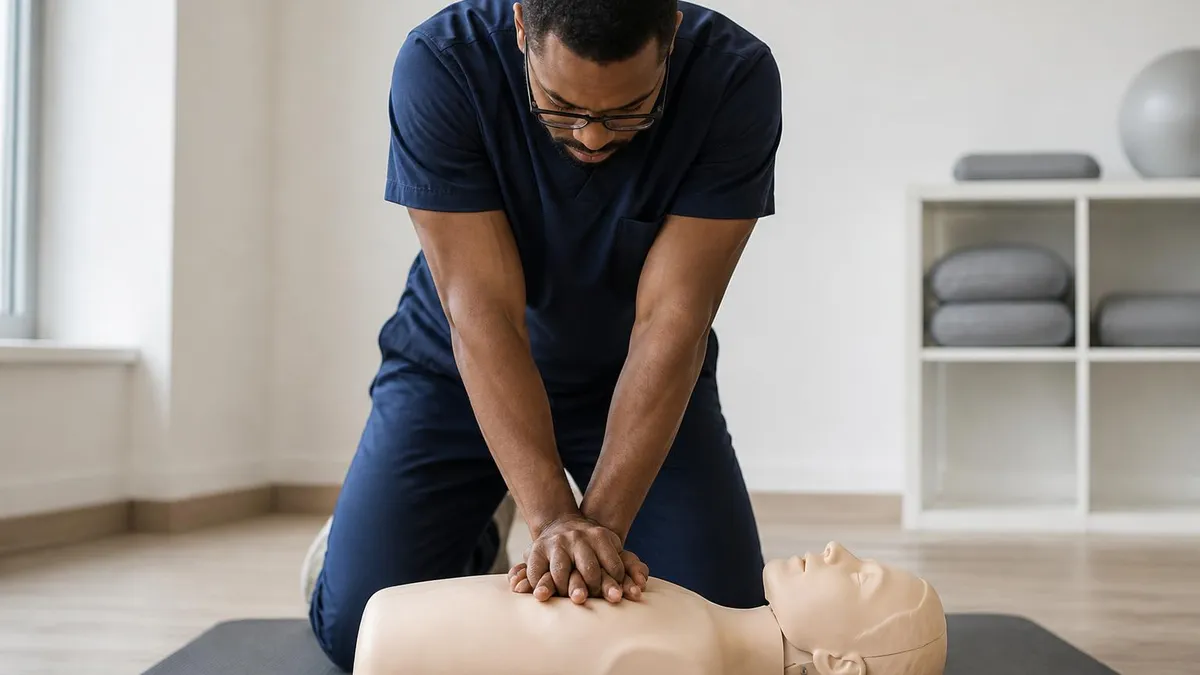
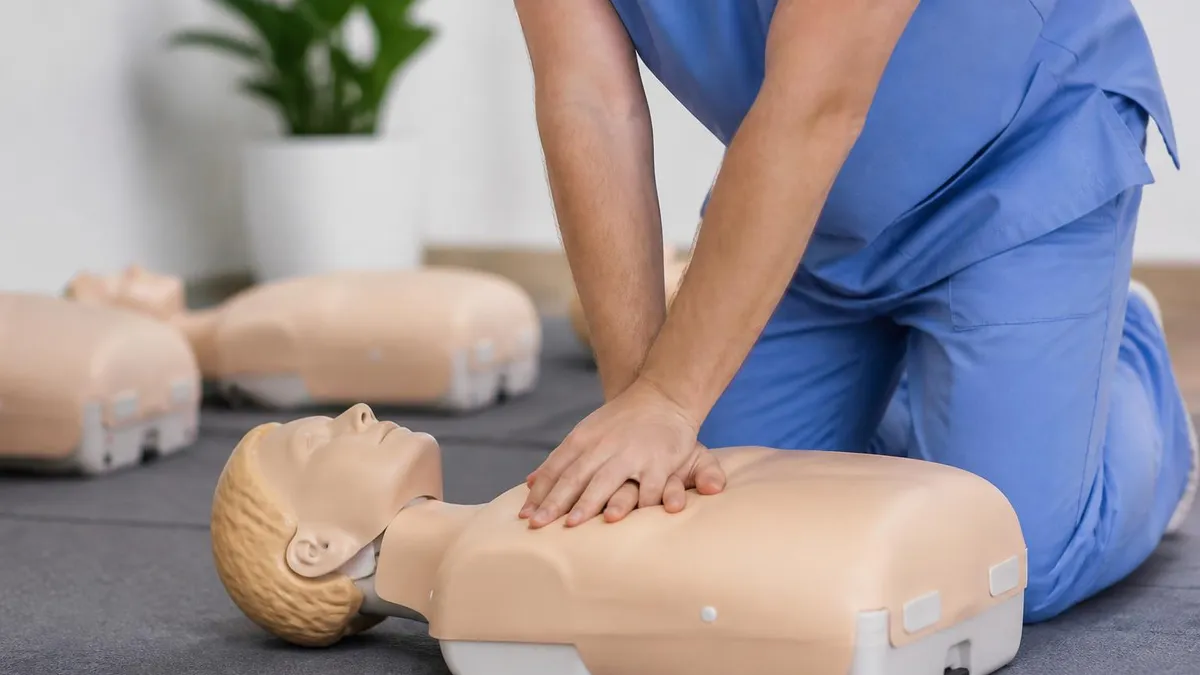
The third tip concerns hand position. Place the heel of your dominant hand on the lower half of the sternum, find the xiphoid notch with your other hand, then slide up about two finger widths and stack hands. Interlace fingers and pull them slightly back so only the heel of the lower hand makes contact. Wrong placement, especially too low, increases the risk of liver laceration and rib fractures without improving cardiac output.
The fourth practical recommendation involves the AED. Modern AEDs are intentionally idiot-proof. Open the case, follow the voice prompts, expose the chest, apply pads, and let the device analyze. The pads should be placed in the upper right chest below the clavicle and on the lower left ribcage in the mid-axillary line. For infants under 8 years or 25 kilograms, use pediatric pads or the pediatric setting if available. If only adult pads are present, use them rather than skipping defibrillation entirely.
The fifth tip is communication. Resuscitation is a team sport even when only two people are present. Call out roles clearly: I am doing compressions, you handle the AED, you call 911. When ALS arrives, give a brief SBAR-style handoff: situation, background, assessment, recommendation. Mention how long compressions have been ongoing, whether the AED has advised any shocks, and any known history. Clean handoffs preserve momentum and avoid wasted seconds.
The sixth recommendation addresses post-resuscitation care, which often gets neglected in lay rescuer training. If the patient regains a pulse and breathing, gently place them in the recovery position on their side to protect the airway from vomit or secretions. Continue monitoring breathing and pulse every minute until paramedics arrive. Be ready to restart CPR if the patient deteriorates again, which happens in roughly 15 to 20% of cases within the first hour after ROSC.
Finally, take care of yourself afterward. Performing CPR is physically exhausting and emotionally heavy regardless of outcome. Debrief with your team, your colleagues, or your family. Many EMS agencies and hospitals now offer formal critical incident stress management after pediatric or unsuccessful adult arrests. If you performed bystander CPR in your community, your local 911 center can often connect you with the patient's family if both sides consent. Closure helps, and it makes you more likely to step up next time.
CPR Questions and Answers
CPR Card Lookup: How to Verify, Replace, and Access Your CPR Certification in 2026
AHA CPR: What It Is, Which Course You Need, and How to Get Certified
Adult CPR: Complete Step-by-Step Guide to Hands-Only and Standard CPR in 2026

CPR - Cardiopulmonary Resuscitation: Complete Study Guide 2026
Inappropriate CPR Songs: What Not to Play, Why It Matters, and Better Beat-Per-Minute Alternatives
About the Author

Registered Nurse & Healthcare Educator
Johns Hopkins University School of NursingDr. Sarah Mitchell is a board-certified registered nurse with over 15 years of clinical and academic experience. She completed her PhD in Nursing Science at Johns Hopkins University and has taught NCLEX preparation and clinical skills courses for nursing students across the United States. Her research focuses on evidence-based exam preparation strategies for healthcare certification candidates.
Join the Discussion
Connect with other students preparing for this exam. Share tips, ask questions, and get advice from people who have been there.
View discussion (5 replies)