
Adult CPR: Complete Step-by-Step Guide to Hands-Only and Standard CPR in 2026 October
Master adult CPR with our complete 2026 October guide. Learn compression depth, rate, AED use, and the acls algorithm. Step-by-step instructions for bystanders. 💯
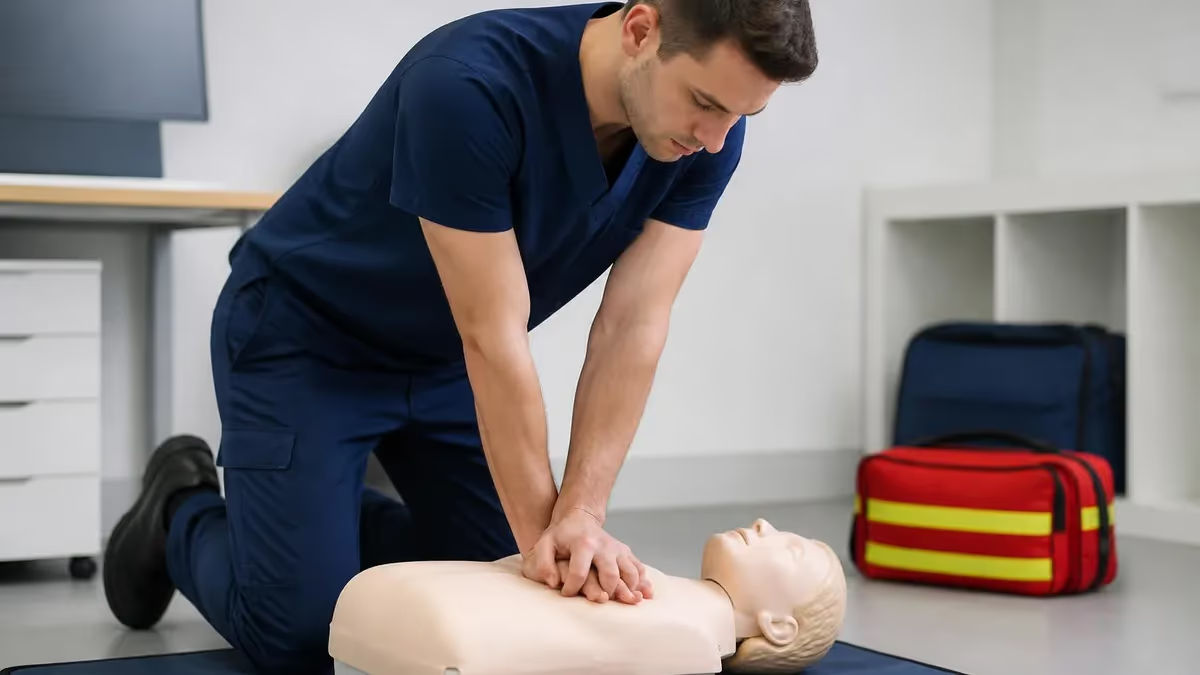
Adult CPR is the single most important emergency skill any bystander can learn, and every year in the United States more than 350,000 cardiac arrests happen outside of hospitals. When a heart stops beating effectively, brain damage begins within four to six minutes, which means the person standing closest to the victim becomes the most important link in the chain of survival. This guide walks you through every step of adult CPR, from recognizing cardiac arrest to delivering high-quality compressions and using an automated external defibrillator with confidence.
The 2026 guidelines from the American Heart Association continue to emphasize hands-only CPR for untrained bystanders and full cycles of 30 compressions to 2 breaths for trained rescuers. Compression depth for adults should reach at least two inches, the rate should be 100 to 120 per minute, and you must allow the chest to recoil fully between each push. These numbers come directly from the acls algorithm, which serves as the clinical backbone for both professional and lay rescuer response in adult cardiac emergencies.
Adult CPR differs significantly from baby cpr in several important ways, including hand placement, compression depth, and the typical cause of arrest. Adults usually go into cardiac arrest because of a primary heart problem like ventricular fibrillation, while children and infants more often arrest from respiratory failure or drowning. Understanding this distinction matters because it changes your immediate priorities, your call-for-help sequence, and whether you should begin CPR before or after activating the emergency response system.
One of the most encouraging statistics in emergency medicine is that bystander CPR can double or triple the chance of survival from out-of-hospital cardiac arrest. Despite this, fewer than half of cardiac arrest victims receive any bystander CPR before professional help arrives. The reason is almost always hesitation, fear of doing harm, or simple uncertainty about what to do. This article aims to eliminate that hesitation by giving you a clear, evidence-based playbook you can recall under pressure.
Whether you are a parent, teacher, gym member, office worker, or simply someone who wants to be prepared, this guide is designed to be practical. We will cover the recognition signs of cardiac arrest, the exact compression technique, when and how to use an AED, what to do if you are alone versus with help, and how to transition care when paramedics arrive. We also address common myths, like the fear of cracking ribs or the worry that giving CPR to someone who does not need it will cause harm.
By the end of this article, you will understand not only the mechanics of adult CPR but also the reasoning behind each step. That deeper understanding is what allows people to act decisively in a real emergency rather than freezing. Pair this knowledge with hands-on practice in a certified course, and you will be genuinely prepared to save a life when it matters most.
Adult CPR by the Numbers

Adult CPR Step-by-Step Sequence
Scene Safety & Response Check
Call 911 & Get an AED
Begin Chest Compressions
Deliver Rescue Breaths (If Trained)
Apply the AED ASAP
Continue Until Help Arrives
Recognizing cardiac arrest quickly is the foundation of every successful resuscitation, and confusion at this stage costs more lives than poor technique. An adult in cardiac arrest will suddenly collapse, become completely unresponsive, and either stop breathing entirely or display gasping movements known as agonal respirations. These gasps are not real breaths. They sound like snoring, gurgling, or labored sighing, and they fool many bystanders into thinking the person is still alive and simply needs to be left alone.
The official assessment process is straightforward. Tap the victim firmly on the shoulder and shout, asking if they are okay. Scan the chest for normal rise and fall for no more than ten seconds. If you see no breathing, only gasping, or you are unsure, treat it as cardiac arrest and begin CPR. The respiratory rate of a healthy adult at rest is 12 to 20 breaths per minute, so anything dramatically slower, irregular, or absent should immediately prompt action without further delay.
Do not waste time checking for a pulse if you are a lay rescuer. The 2026 guidelines explicitly removed the pulse check from civilian protocols because too many people misinterpret their own pulse as the victim's or take far too long to find one. Healthcare providers are still trained to check the carotid pulse for no more than ten seconds, but for everyone else, breathing assessment alone is the trigger for starting compressions. When in doubt, push.
Activating the emergency response system correctly is just as important as the physical skills. If you are alone with an unresponsive adult, call 911 first, then begin CPR. This is called the call-first approach and applies to adults because their arrests are most often cardiac in origin and benefit immediately from defibrillation. For drowning victims, drug overdoses, or pediatric arrests, you should perform two minutes of CPR before calling, since these are usually respiratory emergencies.
Modern 911 dispatchers are trained in telephone CPR, sometimes called T-CPR, and they will coach you through compressions step by step if you stay on the line. Put the phone on speaker, place it near the victim, and listen as you work. Many lives have been saved by people who had never taken a class but followed dispatcher instructions perfectly. This is one reason organizations like the cpr fix phones guidance and other authoritative sources emphasize calling immediately rather than searching for help yourself.
Public access defibrillators have transformed survival rates, but only when bystanders know to look for them. Common AED locations include gyms, schools, airports, train stations, shopping malls, large office buildings, golf courses, and government facilities. Many cities now have AED registry apps that show the closest device to your GPS location. Familiarizing yourself with these tools before an emergency happens means you will react faster when seconds genuinely determine survival.
Finally, do not let fear of legal consequences stop you from acting. All fifty states have Good Samaritan laws that protect bystanders who provide reasonable emergency assistance in good faith. You cannot be successfully sued for attempting CPR on someone in cardiac arrest. The legal risk of doing nothing while a person dies far exceeds any risk of helping, and courts have consistently ruled in favor of rescuers who acted with reasonable care.
CPR Practice Test Questions
Prepare for the CPR Cardiopulmonary Resuscitation Practice exam with our free practice test modules. Each quiz covers key topics to help you pass on your first try.
CPR Basic CPR
CPR Exam Questions covering Basic CPR. Master CPR Test concepts for certification prep.
CPR and First Aid
Free CPR Practice Test featuring and First Aid. Improve your CPR Exam score with mock test prep.
CPR (Cardiopulmonary Resuscitation) Adult ...
CPR Mock Exam on (Cardiopulmonary Resuscitation) Adult CPR and AED Usage. CPR Study Guide questions to pass on your first try.
CPR (Cardiopulmonary Resuscitation) Airway...
CPR Test Prep for (Cardiopulmonary Resuscitation) Airway Obstruction and Choking. Practice CPR Quiz questions and boost your score.
CPR (Cardiopulmonary Resuscitation) Cardio...
CPR Questions and Answers on (Cardiopulmonary Resuscitation) Cardiopulmonary Emergency Recognition. Free CPR practice for exam readiness.
CPR (Cardiopulmonary Resuscitation) Child ...
CPR Mock Test covering (Cardiopulmonary Resuscitation) Child and Infant CPR. Online CPR Test practice with instant feedback.
CPR (Cardiopulmonary Resuscitation) High-P...
Free CPR Quiz on (Cardiopulmonary Resuscitation) High-Performance Team Dynamics. CPR Exam prep questions with detailed explanations.
CPR (Cardiopulmonary Resuscitation) Legal ...
CPR Practice Questions for (Cardiopulmonary Resuscitation) Legal and Ethical Considerations. Build confidence for your CPR certification exam.
CPR for Specific Populations
CPR Test Online for for Specific Populations. Free practice with instant results and feedback.
CPR Airway & Breathing Management
CPR Exam Questions covering Airway & Breathing Management. Master CPR Test concepts for certification prep.
CPR Assessment & Recognition of Cardiac Ar...
Free CPR Practice Test featuring Assessment & Recognition of Cardiac Arrest. Improve your CPR Exam score with mock test prep.
CPR Chest Compressions & Defibrillation
CPR Mock Exam on Chest Compressions & Defibrillation. CPR Study Guide questions to pass on your first try.
CPR Post-Resuscitation Care & Recovery
CPR Test Prep for Post-Resuscitation Care & Recovery. Practice CPR Quiz questions and boost your score.
Compressions, Breaths, and Life Support Technique
High-quality chest compressions are the engine of CPR. Place the heel of your dominant hand on the lower half of the sternum, between the nipples, and stack your other hand on top with fingers interlaced. Position your shoulders directly over your hands, keep your arms straight, and use your upper body weight to push down at least two inches but no more than 2.4 inches deep on an average adult.
Maintain a rate of 100 to 120 compressions per minute, which matches the beat of songs like Stayin' Alive or Baby Shark. Many trained rescuers use mental cpr songs to keep tempo. Allow the chest to fully recoil after each push so the heart can refill with blood. Minimize interruptions and switch compressors every two minutes to maintain effective depth and rate quality.
Hands-Only CPR vs Conventional CPR: Which Should You Use?
- +Hands-only CPR is easier to remember for untrained bystanders
- +Eliminates fear of mouth-to-mouth contact with strangers
- +Compressions stay continuous, maximizing blood flow to the brain
- +Recommended by the American Heart Association for adult witnessed arrests
- +Dispatcher coaching is faster and clearer over the phone
- +Reduces hesitation that costs critical seconds in emergencies
- −Less effective for drowning, overdose, or asphyxial arrest victims
- −Not recommended for pediatric or infant cpr scenarios
- −Cannot oxygenate blood once existing oxygen is consumed (~4-6 min)
- −Inappropriate when arrest cause is clearly respiratory
- −Provides no airway management benefit during prolonged efforts
- −May be insufficient if EMS response time exceeds 8 minutes

Pre-CPR Safety and Setup Checklist
- ✓Verify the scene is free of traffic, electrical hazards, fire, or unstable structures
- ✓Put on gloves or use a barrier device if immediately available
- ✓Tap the shoulder firmly and shout to confirm unresponsiveness
- ✓Scan for chest rise and fall for no more than 10 seconds
- ✓Call 911 yourself or assign a specific bystander by pointing directly at them
- ✓Send a second bystander to retrieve the nearest AED immediately
- ✓Position the victim flat on their back on a firm surface
- ✓Expose the chest by removing or cutting through clothing
- ✓Kneel beside the victim's chest with your knees shoulder-width apart
- ✓Place the phone on speaker so the 911 dispatcher can coach you in real time
Push hard, push fast, and do not stop
Research consistently shows that interruptions in chest compressions are the single biggest factor reducing survival from cardiac arrest. Even brief pauses of 10 seconds can drop coronary perfusion pressure enough to prevent the heart from restarting. If you are unsure whether someone needs CPR, start anyway. Doing nothing guarantees death; doing imperfect CPR offers real hope of survival.
Using an automated external defibrillator on an adult is the single most powerful intervention a bystander can provide besides high-quality compressions. So what does aed stand for? It stands for Automated External Defibrillator, a portable device that analyzes heart rhythms and delivers a controlled electrical shock to restart a heart in ventricular fibrillation or pulseless ventricular tachycardia. AEDs are designed for use by people with zero medical training and guide you through every step with voice prompts and clear visual instructions.
When the AED arrives at the scene, turn it on first. Do not waste time reading the case or hesitating. Most modern AEDs begin speaking immediately and walk you through every action. Expose the victim's chest completely, even if it requires cutting through a bra or shirt, because the electrode pads must make direct skin contact. If the chest is wet, wipe it dry quickly. If the chest is excessively hairy and pads do not stick, shave the area using the razor included in the AED kit.
Pad placement on an adult is straightforward but specific. Place one pad on the upper right side of the chest just below the collarbone, and the other pad on the lower left side under the armpit along the rib cage. The pads are usually labeled with pictures showing exactly where they go. Once placed, the AED will tell everyone to stand clear while it analyzes the rhythm. Do not touch the victim during this phase, as movement can interfere with rhythm interpretation.
If a shock is advised, the device will charge and instruct you to press the shock button. Look around, shout clear, ensure no one is touching the victim, and deliver the shock. Immediately resume chest compressions without checking for a pulse. The AED will reanalyze every two minutes, telling you when to pause for the next rhythm check. This cycle continues until the person revives, EMS takes over, or you are physically unable to continue.
Special situations require small adjustments. If the victim is lying on a metal surface, slide them onto something non-conductive if possible, though modern AEDs are generally safe even on metal. For victims with implanted pacemakers, place pads at least one inch away from the visible bulge under the skin. For pregnant women, use standard adult placement and standard energy levels. The shock will not harm the fetus, and saving the mother is the priority for both lives.
If you are looking up emergency contacts on a smartphone with a cracked screen, do not delay calling 911. Issues with leather cpr phone cases or damaged screens should never slow your response. Use any available phone, including the victim's, since emergency calls work even on locked devices. Apple, Android, and most carriers honor emergency dialing from the lock screen regardless of password, PIN, or biometric status.
One critical reminder: an AED will never deliver a shock to a heart that does not need one. The device is rigorously programmed to analyze rhythms accurately and refuse shocks for normal heartbeats, asystole, or pulseless electrical activity. This means you cannot accidentally hurt someone by attaching an AED. If the person does not need a shock, the device will say so and prompt you to continue CPR. Trust the technology and follow its instructions exactly.
If an AED is more than a few seconds away or someone is still retrieving it, begin chest compressions immediately. Compressions sustain blood flow to the brain and heart muscle until defibrillation can be delivered. Pausing to wait for equipment or to perform extensive airway maneuvers significantly reduces survival odds in adult cardiac arrest scenarios.
Becoming officially certified in adult CPR is the best way to translate this knowledge into reliable, real-world performance. The most widely recognized certifications come from the American Heart Association, the American Red Cross, and the national cpr foundation. Each organization offers Basic Life Support, Heartsaver, and standalone CPR/AED courses. What is a bls certification? It is a healthcare provider-level credential covering adult, child, and infant CPR, AED use, bag-valve-mask ventilation, and team-based resuscitation skills.
For most non-medical adults, a Heartsaver CPR/AED course is sufficient and takes about two to three hours. Healthcare professionals, including nurses, paramedics, dentists, and physical therapists, typically need BLS at minimum, and many advance to PALS certification for pediatric advanced life support or Advanced Cardiovascular Life Support for adult emergencies. Pals certification adds critical pediatric assessment skills, drug dosing, and rhythm recognition specifically for children in arrest or pre-arrest states.
Choosing between in-person, blended, and fully online courses depends on your goals. In-person classes provide the most hands-on practice and immediate instructor feedback, which is crucial for skill retention. Blended courses combine online learning with a brief in-person skills check, balancing convenience with quality. Purely online certifications exist but are not accepted by most hospitals, schools, or licensing boards because they lack the hands-on skills evaluation that proves you can actually perform CPR correctly.
Renewal is required every two years for most CPR certifications. The science of resuscitation evolves quickly, and guidelines update every five years based on international consensus. Staying current ensures you are practicing the latest evidence-based techniques rather than outdated methods. Many employers track expiration dates automatically, but you should also set your own calendar reminder three months before expiration to schedule a renewal class without rushing.
Cost varies by provider and format. A basic Heartsaver class typically runs $60 to $90, BLS for healthcare providers averages $70 to $110, and advanced courses like ACLS or PALS range from $200 to $300. Many employers, especially hospitals, schools, and gyms, cover certification costs as part of professional development budgets. Community organizations, fire departments, and YMCAs often offer subsidized or free classes for the general public, so check local options before paying full price.
Beyond certification, regular practice matters more than the card in your wallet. Skills decay measurably within three to six months without rehearsal. Mental rehearsal works surprisingly well. Walk through the sequence in your mind when you see an AED in public, review the steps before a long flight, or watch refresher videos every few months. Some workplaces install practice manikins for self-directed skill maintenance, and apps with metronome features help you maintain correct compression rhythm.
Finally, encourage everyone in your household, workplace, and community to learn adult CPR. The more trained bystanders exist in any population, the higher the survival rate from cardiac arrest. Cities with widespread CPR training programs, like Seattle, consistently achieve survival rates two to three times the national average. Your decision to learn and stay current does not just prepare you, it strengthens the entire safety net around the people you love and the strangers you may someday save.
Putting adult CPR knowledge into practice requires more than memorizing steps. It requires mental rehearsal, physical conditioning, and emotional preparation for the chaos of a real emergency. Start by visualizing common scenarios where you might need to respond: a coworker collapsing in a meeting, a stranger going down in a grocery store, a family member during a holiday gathering. The more vividly you imagine these moments, the faster your trained response will activate when adrenaline floods your system in the real event.
Physical fitness affects your ability to deliver high-quality compressions. Effective adult CPR requires sustained upper body strength because each compression pushes 80 to 100 pounds of force into the chest wall. Studies show compression depth drops measurably after just one minute of continuous CPR, even in trained rescuers. This is why guidelines recommend swapping compressors every two minutes when multiple rescuers are present. If you live alone or work in isolated environments, building shoulder and core strength makes a tangible difference in survival outcomes.
Mental preparation also involves accepting that not every CPR attempt succeeds. Even with perfect technique, immediate response, and rapid defibrillation, overall survival from out-of-hospital cardiac arrest hovers around 10 to 12 percent. This is not a reason to hesitate. It is a reason to act, because every act of CPR represents the single best chance that person has. Many trained rescuers benefit from talking through the emotional aftermath with peers, EMS providers, or mental health professionals if they ever perform CPR in a real situation.
Keep your skills sharp by participating in community events that promote bystander CPR awareness. Local fire departments often host free hands-only CPR demonstrations during national CPR and AED Awareness Week each June. Organizations like the position recovery training initiatives also teach the recovery position, which is essential for unconscious but breathing victims. Knowing when to roll someone onto their side prevents airway obstruction from vomit, blood, or relaxed tongue muscles in non-cardiac unconsciousness.
Equip your home and workplace with the right tools. A basic CPR readiness kit includes a CPR face shield with one-way valve, disposable gloves, trauma shears for cutting clothing, and a printed quick-reference card. Larger workplaces, sports facilities, and places of worship should invest in an AED and post clear signage indicating its location. The capital cost of $1,200 to $2,000 per unit is small compared to the lives saved, and many states offer grants or tax incentives for AED placement in public spaces.
Teach the next generation. Children as young as nine can learn hands-only CPR, and many states now require CPR training as a high school graduation requirement. The earlier people learn these skills, the more comfortable they become with the idea of stepping forward in an emergency. Programs that combine classroom instruction with hands-on practice using inflatable manikins have demonstrated long-term retention rates that far exceed traditional lecture-only approaches.
Most importantly, remember that perfect is the enemy of done. The biggest barrier to bystander CPR is not lack of training, it is hesitation born from fear of doing it wrong. You will not break the victim by pushing too hard. You will not be sued for trying. You will not regret acting. The only regret survivors and families ever describe is wishing they had started sooner. Take that lesson into every moment of your life, and you will be ready when your moment comes.
CPR Questions and Answers
CPR vs BLS: Complete Comparison Guide for 2026 — Which Certification Do You Need?
CPR Card Lookup: How to Verify, Replace, and Access Your CPR Certification in 2026
AHA CPR: What It Is, Which Course You Need, and How to Get Certified
CPR Instructor Jobs 2026: How to Become a Certified Instructor, Salary Expectations, and Career Pathways
CPR - Cardiopulmonary Resuscitation: Complete Study Guide 2026
About the Author

Registered Nurse & Healthcare Educator
Johns Hopkins University School of NursingDr. Sarah Mitchell is a board-certified registered nurse with over 15 years of clinical and academic experience. She completed her PhD in Nursing Science at Johns Hopkins University and has taught NCLEX preparation and clinical skills courses for nursing students across the United States. Her research focuses on evidence-based exam preparation strategies for healthcare certification candidates.
Join the Discussion
Connect with other students preparing for this exam. Share tips, ask questions, and get advice from people who have been there.
View discussion (5 replies)