
CPR Training Near Me: Find Local Courses, Certifications, and Career Pathways in 2026 October
Find CPR training near me with local class options, 🗨️ ACLS algorithm review, BLS certification paths, and career pathways. Updated 2026 October guide for
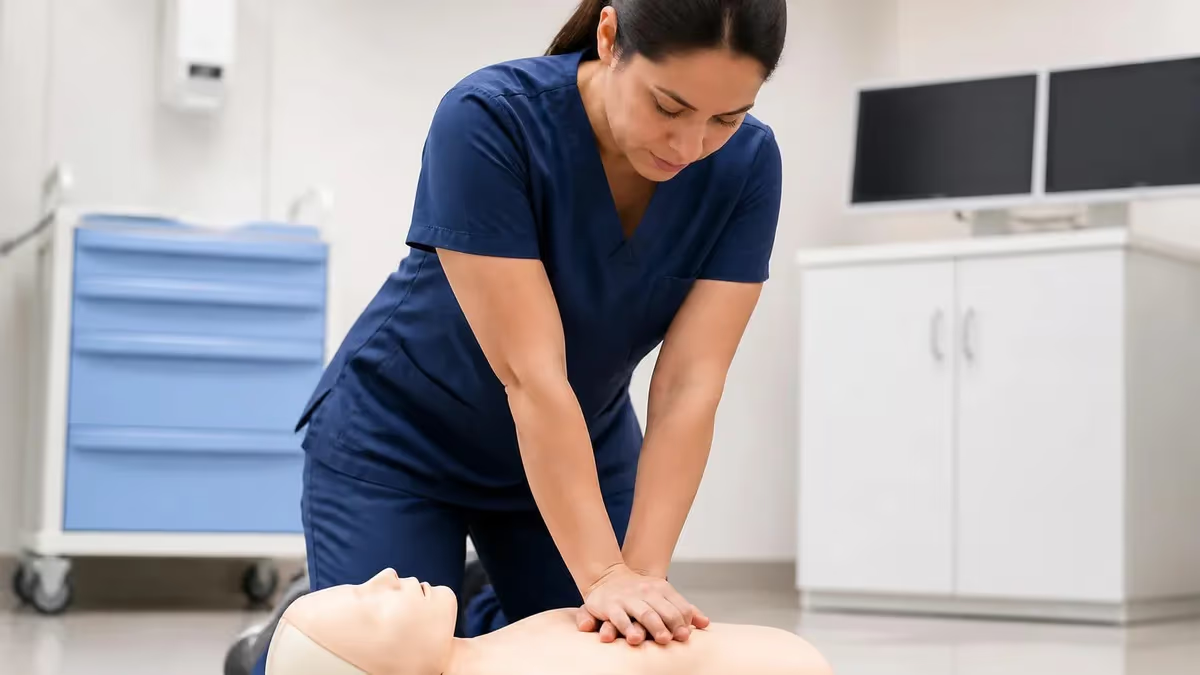
Searching for CPR training near me usually starts with a single life event: a job offer that requires certification, a family member with a new heart condition, or a viral news story about a stranger saving a life on a sidewalk. Whether you live in a major metro or a small town, the demand for trained responders has never been higher, and the cpr nashville market is a perfect example of how local classes have evolved to meet that demand with weekend intensives, hybrid options, and skills-only sessions.
The modern landscape blends in-person practice with online theory, and it also wraps in adjacent credentials like the acls algorithm review for clinicians, BLS for healthcare workers, and lay-rescuer Heartsaver courses for teachers, coaches, and parents. Choosing well means understanding which credential employers in your zip code actually accept, how long the card lasts, and what the renewal cycle looks like two years from now when your card expires and you need a refresher class.
This guide walks you through every meaningful decision: how to identify a legitimate training site, how to compare American Heart Association courses with the national cpr foundation alternative, what a typical Nashville classroom looks like on a Saturday morning, and how to use your new certification into a paying job in healthcare, fitness, childcare, or emergency services.
We will also cover the cost spectrum, from free community sessions sponsored by fire departments to premium clinical bundles that include ACLS and PALS. You will see typical pricing for adult, child, and infant cpr modules, plus the time commitments for first-time learners versus renewal candidates. Most importantly, you will learn how to evaluate whether your instructor is certified to issue cards that pass employer verification.
If you want to test your readiness before sitting through a four-hour course, the practice quizzes embedded throughout this article mirror the kinds of scenarios instructors present during skills checks. They cover compression depth, ventilation timing, AED pad placement, recovery position techniques, and the choking algorithm for conscious and unconscious patients of every age group.
By the end, you will have a concrete shortlist of class types, a checklist for vetting providers, a realistic budget, and a clear understanding of how a $70 weekend course can launch a career path that pays $40,000 to $80,000 a year in roles ranging from EMT to surgical technologist to childcare director.
Let's start with the numbers that define the training market today, then move through certifications, costs, classroom expectations, and the questions readers ask most often when they finally type those four words into a search bar at 11 p.m. on a Tuesday night.
CPR Training Market by the Numbers

Local Training Options & Formats
Hosted by fire departments, hospitals, and Red Cross chapters in church basements, libraries, and community centers. Typically run 3 to 4 hours with full hands-on skills, group manikin practice, and same-day card issuance. Best for first-time learners.
You complete didactic material online in one to two hours, then attend a 60 to 90 minute in-person skills check. Ideal for working professionals who already understand the theory and need a flexible schedule. Cards are equivalent in validity.
Instructors travel to your workplace, daycare, gym, or community group. Cost per learner drops sharply at scale, often below $40 per person for groups of ten or more. Common for restaurants, schools, and corporate wellness programs.
For currently certified learners whose cards are expiring, a 45 to 60 minute skills session refreshes practical competence without repeating full theory. Bring your old card, demonstrate compressions and AED use, and walk out renewed.
Designed for nurses, MAs, dental staff, and EMS personnel. Includes two-rescuer scenarios, bag-valve-mask ventilation, and pulse checks. Required for hospital employment and most clinical licensure renewals across all fifty states.
Choosing the right certification is the most consequential decision you'll make during your search, because the wrong card can cost you a job offer or force you to retake an entire course. The two dominant brands in the United States are the American Heart Association and the American Red Cross, and both produce cards that meet OSHA, state licensing, and most employer standards. A third option, the pals certification pathway from AHA, layers pediatric advanced life support on top of base BLS for clinicians who treat children.
For most lay rescuers, the AHA Heartsaver or Red Cross Adult and Pediatric First Aid/CPR/AED is the right entry point. These courses cover compressions, rescue breaths, AED operation, choking response, and basic first aid. They are accepted by daycares, summer camps, gyms, coaching organizations, and most non-clinical employers. The class runs about four hours and ends with a practical skills demonstration rather than a written examination.
Healthcare workers need the BLS Provider course instead. This curriculum adds two-rescuer CPR, advanced airway adjuncts, pulse-check techniques, and team dynamics. The course assumes you understand basic anatomy and clinical terminology, and the assessment includes both a written exam and a hands-on megacode. Pass rates exceed 95 percent because instructors coach you through skills until competence is demonstrated.
Clinicians working in emergency departments, ICUs, telemetry units, or cath labs typically stack ACLS on top of BLS. ACLS introduces rhythm interpretation, drug dosing, and team leadership for cardiac arrest, stroke, and acute coronary syndromes. The acls algorithm flowcharts for VF/pulseless VT, asystole/PEA, bradycardia, and tachycardia become muscle memory through repeated megacode practice over the two-day course.
Pediatric specialists add PALS, which mirrors ACLS structure but focuses on infant and child physiology, including pediatric respiratory rate norms, weight-based medication dosing via the Broselow tape, and the unique reversible causes of pediatric arrest. Nurses in NICU, PICU, and pediatric EDs are required to maintain PALS continuously, and many family practice and urgent care clinicians choose to carry it as well.
The Heartsaver Bloodborne Pathogens add-on, the babysitter certification, and lifeguard packages round out the menu. None of these are interchangeable with the others, so before paying for any course, confirm in writing with your future employer or licensing board exactly which credential they will accept and whether they require an in-person skills check rather than an online-only completion certificate.
One persistent confusion worth clearing up: there is a national cpr foundation that issues 100 percent online certifications, and these may be accepted by some non-clinical employers but are generally rejected by hospitals, EMS agencies, and state nursing boards. Always verify with the requesting party before paying, because a $20 instant card is no bargain if it doesn't open the door you need it to open.
CPR Practice Test Questions
Prepare for the CPR Cardiopulmonary Resuscitation Practice exam with our free practice test modules. Each quiz covers key topics to help you pass on your first try.
CPR Basic CPR
CPR Exam Questions covering Basic CPR. Master CPR Test concepts for certification prep.
CPR and First Aid
Free CPR Practice Test featuring and First Aid. Improve your CPR Exam score with mock test prep.
CPR (Cardiopulmonary Resuscitation) Adult ...
CPR Mock Exam on (Cardiopulmonary Resuscitation) Adult CPR and AED Usage. CPR Study Guide questions to pass on your first try.
CPR (Cardiopulmonary Resuscitation) Airway...
CPR Test Prep for (Cardiopulmonary Resuscitation) Airway Obstruction and Choking. Practice CPR Quiz questions and boost your score.
CPR (Cardiopulmonary Resuscitation) Cardio...
CPR Questions and Answers on (Cardiopulmonary Resuscitation) Cardiopulmonary Emergency Recognition. Free CPR practice for exam readiness.
CPR (Cardiopulmonary Resuscitation) Child ...
CPR Mock Test covering (Cardiopulmonary Resuscitation) Child and Infant CPR. Online CPR Test practice with instant feedback.
CPR (Cardiopulmonary Resuscitation) High-P...
Free CPR Quiz on (Cardiopulmonary Resuscitation) High-Performance Team Dynamics. CPR Exam prep questions with detailed explanations.
CPR (Cardiopulmonary Resuscitation) Legal ...
CPR Practice Questions for (Cardiopulmonary Resuscitation) Legal and Ethical Considerations. Build confidence for your CPR certification exam.
CPR for Specific Populations
CPR Test Online for for Specific Populations. Free practice with instant results and feedback.
CPR Airway & Breathing Management
CPR Exam Questions covering Airway & Breathing Management. Master CPR Test concepts for certification prep.
CPR Assessment & Recognition of Cardiac Ar...
Free CPR Practice Test featuring Assessment & Recognition of Cardiac Arrest. Improve your CPR Exam score with mock test prep.
CPR Chest Compressions & Defibrillation
CPR Mock Exam on Chest Compressions & Defibrillation. CPR Study Guide questions to pass on your first try.
CPR Post-Resuscitation Care & Recovery
CPR Test Prep for Post-Resuscitation Care & Recovery. Practice CPR Quiz questions and boost your score.
BLS, ACLS, and PALS Certification Pathway
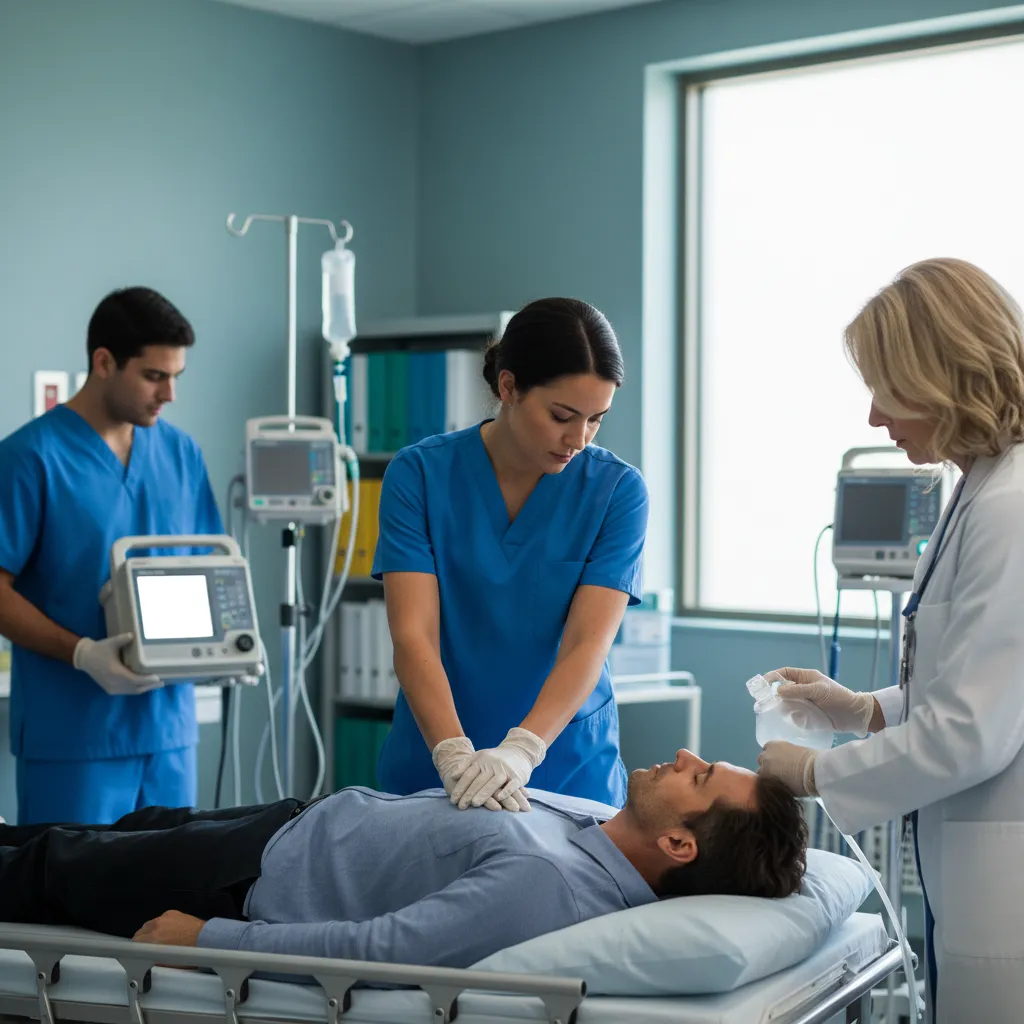
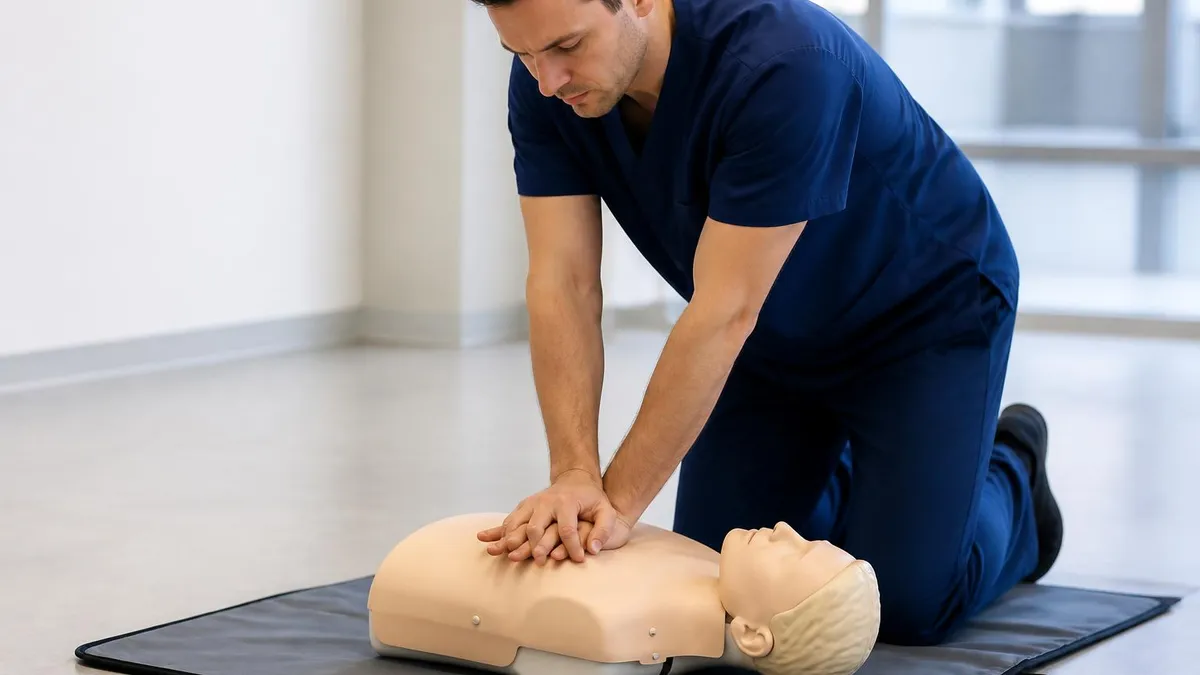
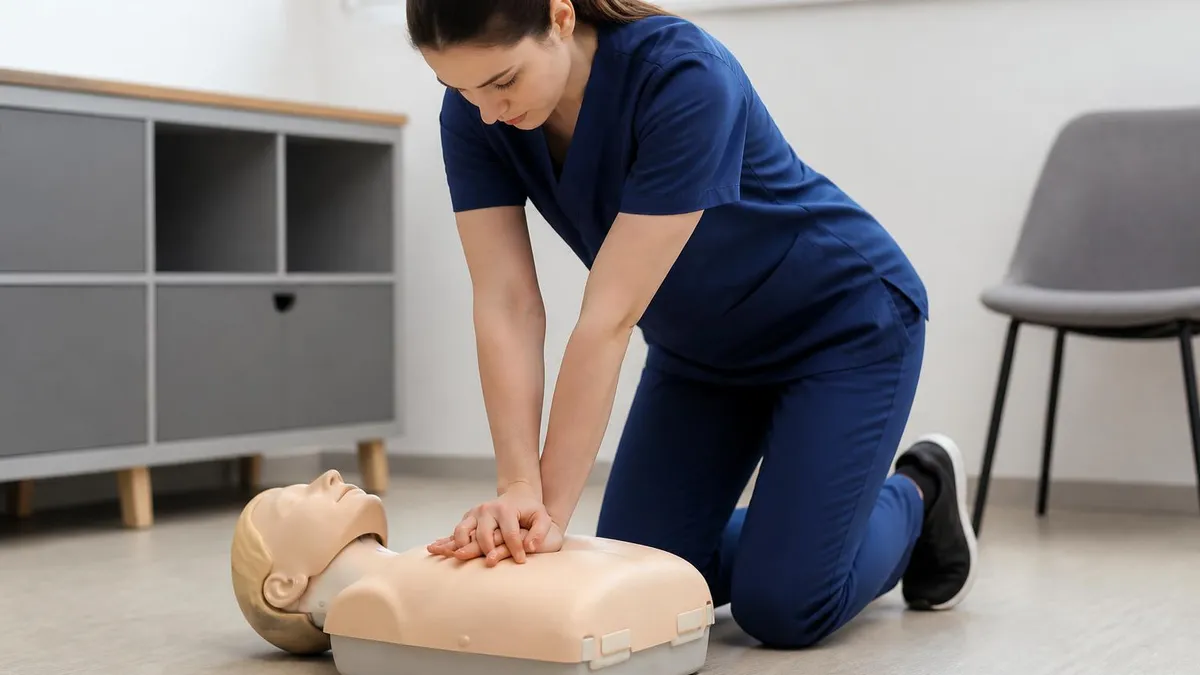
Basic Life Support is the foundation for every clinical role. The course covers high-quality compressions at 100 to 120 per minute, two inches deep for adults, with full chest recoil and minimal interruptions. You'll practice single-rescuer and two-rescuer scenarios across adult, child, and infant cpr manikins, plus bag-valve-mask ventilation and AED integration during ongoing compressions.
Most learners ask what is a bls certification really worth, and the honest answer is that it is the single most universally required healthcare credential in the country. It is mandatory for nursing licensure, EMS hiring, dental hygiene, surgical technology, respiratory therapy, and virtually every allied health program admission. The card is valid for two years and renewal takes about three hours.
In-Person vs Hybrid CPR Training: How to Choose
- +Same-day card issuance immediately after passing the skills check
- +Full instructor feedback on compression depth, rate, and recoil
- +Hands-on AED practice with realistic manikins and training pads
- +Group scenarios build muscle memory through repetition
- +Networking with healthcare peers and local EMS personnel
- +Universally accepted by employers and licensing boards
- +Better retention because skills are practiced under direct supervision
- −Requires committing 3 to 4 continuous hours on a single day
- −Scheduling conflicts with shift work, childcare, or travel
- −Travel time and parking add hidden cost to advertised price
- −Group pace may feel slow for experienced renewers
- −Limited availability in rural areas without a nearby training center
- −Cost is typically $20 to $40 higher than online-plus-skills options
Pros and Cons at a Glance
| Pros | Cons |
|---|---|
| Same-day card issuance immediately after passing the skills check | Scheduling conflicts with shift work, childcare, or travel |
| Full instructor feedback on compression depth, rate, and recoil | Travel time and parking add hidden cost to advertised price |
| Hands-on AED practice with realistic manikins and training pads | Group pace may feel slow for experienced renewers |
| Group scenarios build muscle memory through repetition | Limited availability in rural areas without a nearby training center |

Vetting Your Local CPR Training Provider
- ✓Confirm the instructor is certified through AHA, Red Cross, or ASHI, not a self-issued credential.
- ✓Ask which specific card you'll receive and whether it requires in-person skills verification.
- ✓Verify the training site's ID number on the AHA Atlas or Red Cross provider directory.
- ✓Read recent reviews on Google, Yelp, and Facebook for the actual classroom experience.
- ✓Check whether the price includes the manual, card processing fee, and online portion.
- ✓Ask the class size — quality drops sharply when one instructor manages more than 12 students.
- ✓Confirm the manikin-to-learner ratio — ideally no more than three students per adult manikin.
- ✓Verify card delivery timeline — most legitimate sites issue digital cards within 24 hours.
- ✓Ask whether your future employer or licensing board has approved this specific provider.
- ✓Confirm refund and reschedule policies in writing before paying any deposit.
Always ask: "Will my employer's HR department accept this exact card?"
Bring the specific card name and issuing organization to your employer in writing before you pay for class. A $25 difference in tuition is irrelevant if your card is rejected on day one of orientation. Healthcare employers almost always require AHA BLS Provider, never an online-only completion certificate, regardless of marketing claims.
A CPR certification is more than a wallet card — it's an on-ramp to dozens of careers in healthcare, public safety, education, and fitness. Entry-level roles like EMT, certified nursing assistant, medical assistant, and patient care technician all list BLS as a hiring prerequisite, and many of these jobs pay $35,000 to $50,000 in your first year with paid training, predictable schedules, and clear pathways to higher-credential roles like paramedic, RN, or surgical technologist.
In the fitness and recreation sector, personal trainers, group exercise instructors, lifeguards, ski patrol members, and youth sports coaches are typically required to maintain current CPR and AED certification. Pay ranges from $15 to $45 per hour depending on specialty, geography, and certifications stacked alongside CPR. Many gyms and recreation departments will reimburse the cost of your card if you sign a one-year employment agreement.
Childcare is another high-demand pathway. Daycare workers, preschool teachers, summer camp counselors, and nannies almost universally need pediatric CPR and first aid certification, sometimes with the babysitter add-on. Center directors often require staff to renew annually rather than every two years, and parents increasingly prefer nannies who carry pediatric-specific credentials covering infant cpr, choking response, and the position recovery sequence for unconscious breathing patients.
The corporate safety officer role has grown rapidly in the post-pandemic era. Companies with 50 or more employees often designate trained first responders on each shift, and these individuals receive stipends ranging from $500 to $2,000 annually on top of their base salary. The role requires BLS plus first aid and bloodborne pathogen training, and many employers will pay for the certifications and the time spent in class.
For learners interested in a clinical career but not ready for nursing school, the medical assistant pathway offers fast entry. Twelve-month MA programs typically include BLS certification, phlebotomy, EKG, and clinical procedures, with graduate placement rates above 80 percent at primary care offices, urgent care chains, and specialty clinics. Median pay sits around $40,000 with strong upward mobility into office management or clinical lead roles.
Public safety pathways including firefighter, paramedic, and police officer all require BLS at minimum, with paramedics adding ACLS and PALS during academy. These roles offer pension benefits, predictable shift schedules, and starting salaries of $45,000 to $70,000 depending on jurisdiction. Many municipalities offer tuition reimbursement for paramedic school after one year of EMT employment, creating a debt-free path to a $65,000-plus career.
Finally, instructor certification itself is a viable side income. After two years of holding your card and completing an instructor course, you can teach Heartsaver and BLS classes through an AHA training center, earning $30 to $75 per student. A single Saturday class of twelve students can generate $400 to $900 in tuition revenue, making it a popular evening and weekend supplement for nurses, paramedics, and retired clinicians.
Hospitals, EMS agencies, and state nursing boards almost universally reject 100 percent online CPR certifications, even when the issuing organization claims they are valid. Before paying for any online-only course, get written confirmation from your employer or licensing board. The cpr index of accepted providers varies by state and institution.
Once you hold a card, the real challenge becomes keeping your skills sharp between renewal cycles. The two-year validity window is generous, but research shows that CPR skill retention drops measurably within just three to six months of training. That's why progressive healthcare organizations now run quarterly mock codes, low-dose high-frequency manikin practice, and just-in-time refresher modules to keep clinical staff competent between formal renewals.
For lay rescuers, the best retention strategy is occasional self-quizzing using free practice questions, watching a five-minute refresher video every few months, and physically practicing compressions on a pillow or training manikin. Many community centers and fire departments offer free skills practice sessions where you can drop in, do twenty minutes of manikin compressions, and leave without paying or scheduling a formal class.
Renewal time arrives faster than expected. Most working professionals book renewal six to eight weeks before card expiration, because clinical employers will not let you work past your expiration date, and last-minute renewal classes can be hard to find. Set a calendar reminder for the twenty-one-month mark and treat renewal scheduling as a non-negotiable appointment, especially if you carry stacked certifications like BLS plus ACLS plus PALS.
Renewal courses are shorter and cheaper than initial certification. A BLS renewal typically runs ninety minutes and costs $50 to $75, compared to three to four hours and $80 to $110 for an initial card. ACLS and PALS renewals are typically one day instead of two, with abbreviated didactic material and a simplified megacode. Bring your current card to every renewal class to qualify for the shortened format.
Watch for curriculum updates between cycles. The 2025 AHA Guidelines refined recommendations on hands-only versus conventional CPR, AED use in pregnant patients, naloxone administration during suspected opioid overdose arrest, and the role of bystander video calls with 911 dispatchers. Your renewal class will incorporate these updates, but you can also read the executive summary on heart.org to stay current without waiting for class.
Some learners assume you should pick a provider based purely on price, but local reputation matters more. Use the AHA Atlas or Red Cross directory to find verified sites near your zip code.
Above all, remember that the card is just the beginning. The real value of training is the confidence to act in the critical first three to five minutes before EMS arrives. Survival rates triple when bystander CPR is delivered immediately, and AED defibrillation within three minutes pushes survival above 70 percent for shockable rhythms. Your training literally saves lives, and every renewal cycle is an investment in someone's future, possibly your own family member's.
Practical preparation for class day matters more than most learners realize. Wear comfortable, loose-fitting clothing that allows you to kneel, lean over a manikin, and perform compressions for sustained intervals without restriction. Sneakers or flat shoes are essential because high heels and dress shoes make kneeling miserable. Bring a water bottle, a light snack, and any reading glasses you need to see slides and printed materials clearly during didactic portions.
Eat a full meal before class. Performing compressions is genuinely physical work — instructors target two-minute cycles to mimic real cardiac arrest pacing, and an empty stomach combined with improved heart rate can cause lightheadedness or nausea. Healthcare workers coming off a night shift should consider rescheduling rather than attending fatigued, because skills retention drops sharply when you're sleep deprived during initial training.
If your course requires online pre-work, complete it 24 to 48 hours before class rather than the night before. Pre-work modules typically take 60 to 90 minutes and include the videos, embedded knowledge checks, and a precourse self-assessment. Print or screenshot your completion certificate — instructors may require proof at check-in, and forgetting it can disqualify you from earning a card even after attending the full session.
Bring a photo ID, a method of payment if any balance is due, and your current card if you're renewing. Some sites still process cards manually and require exact cash or check, though most have moved to digital cards delivered via email within 24 hours of completion. Confirm the card delivery method when you register so you know exactly when and how to expect your credential.
During class, ask questions early and often. Instructors expect and welcome questions, especially during the practice portions where you're refining technique. Don't wait until the skills check to ask why your compressions feel different from the instructor's demonstration. The class is your opportunity to get coaching from an expert; the skills check is your opportunity to demonstrate that the coaching worked.
For learners studying alongside training, the most efficient approach is to read the manual the day before class, complete free practice questions the morning of class, and review the skills checklist during your commute. This three-touch approach reinforces recall through varied modalities — reading, testing, and visualization — which research consistently shows produces better retention than passive single-pass reading of the same material multiple times.
After class, use your new credential immediately. Update your resume, LinkedIn profile, and any employment applications. Tell your family and friends so they know to call you in an emergency before EMS arrives. Consider downloading the PulsePoint app to receive notifications of nearby cardiac arrests in public spaces, where your willingness to act can literally double a stranger's chance of survival before professional responders arrive on scene.
CPR Questions and Answers
About the Author

Registered Nurse & Healthcare Educator
Johns Hopkins University School of NursingDr. Sarah Mitchell is a board-certified registered nurse with over 15 years of clinical and academic experience. She completed her PhD in Nursing Science at Johns Hopkins University and has taught NCLEX preparation and clinical skills courses for nursing students across the United States. Her research focuses on evidence-based exam preparation strategies for healthcare certification candidates.
Join the Discussion
Connect with other students preparing for this exam. Share tips, ask questions, and get advice from people who have been there.
View discussion (5 replies)