
CPR Definition: What Cardiopulmonary Resuscitation Is and Why It Saves Lives
CPR definition explained — what cardiopulmonary resuscitation is, the science of compressions and breaths, history, when to use it, and why training ✅
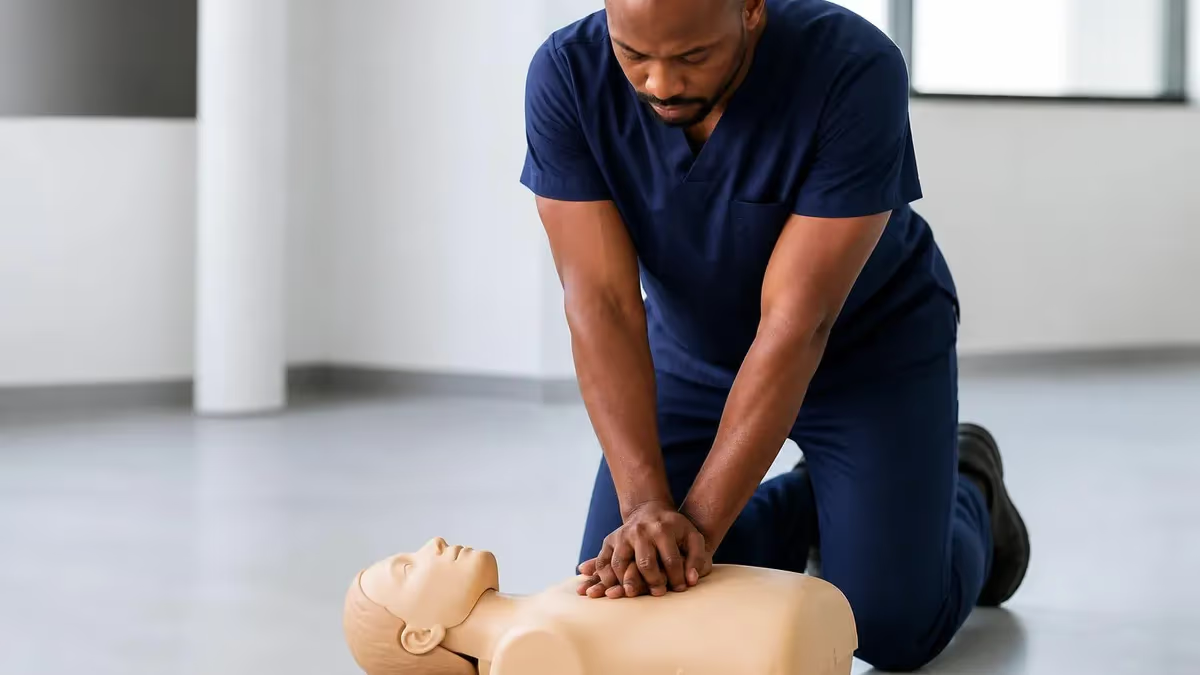
CPR stands for Cardiopulmonary Resuscitation — an emergency medical procedure that combines manual chest compressions with rescue breaths to maintain blood circulation and oxygen delivery when a person's heart has stopped beating and their breathing has stopped or become inadequate. The technique buys time for the natural heart rhythm to be restored either by an Automated External Defibrillator (AED) or by advanced medical care. Without CPR, brain damage from oxygen deprivation begins within 4-6 minutes of cardiac arrest and becomes irreversible within 8-10 minutes for most patients.
This guide explains what CPR is in plain language, the underlying science of how chest compressions and rescue breaths work, the history of how the modern technique was developed in the 1960s, the Chain of Survival framework that describes the sequence of events that produces successful cardiac arrest outcomes, when CPR is indicated and when it isn't, how CPR differs from related interventions like the Heimlich maneuver and AED defibrillation, the survival statistics that show how meaningful bystander CPR is, and the role of training in producing the muscle memory needed to perform CPR effectively when seconds count.
The clinical situation CPR addresses is cardiac arrest — sudden cessation of effective heart function, usually caused by an abnormal electrical rhythm (ventricular fibrillation or ventricular tachycardia most commonly), but sometimes by other mechanisms including drowning, drug overdose, severe trauma, or asphyxiation. Cardiac arrest is different from a heart attack (myocardial infarction), though heart attacks can lead to cardiac arrest. Cardiac arrest means no effective heartbeat producing circulation; heart attack means a blocked coronary artery causing damage to the heart muscle, which may or may not progress to cardiac arrest depending on the location and severity.
When cardiac arrest happens, the person collapses, stops breathing normally (or makes occasional gasping sounds called agonal breathing), and rapidly loses consciousness. Brain function ceases as blood circulation stops. Without intervention, biological death follows within minutes as cells begin to die from oxygen deprivation. CPR delays this cascade by manually moving blood through the body — chest compressions act as an external pump squeezing the heart against the spine to push blood out, and rescue breaths add oxygen to that blood as it cycles through the lungs during the compression rhythm.
For the general public, the practical takeaway is that bystander CPR doubles or triples survival rates from out-of-hospital cardiac arrest. The American Heart Association and similar organizations have run extensive public campaigns since the 1990s to increase bystander CPR rates, with measurable success in many communities. Learning even basic Hands-Only CPR (compressions without rescue breaths) is among the highest-use things any adult can do to potentially save a life — including the lives of family members, since cardiac arrest most often happens at home rather than in public locations where strangers might intervene.
CPR at a glance
Definition: Cardiopulmonary Resuscitation — manual chest compressions plus rescue breaths that maintain blood circulation and oxygen delivery during cardiac arrest. What it treats: cardiac arrest (sudden cessation of effective heartbeat). How it works: compressions act as external pump moving blood through the body; rescue breaths add oxygen. Time-critical: brain damage begins within 4-6 minutes without circulation; CPR delays the cascade. Public health impact: bystander CPR doubles or triples out-of-hospital cardiac arrest survival rates.
The science behind CPR
The body needs continuous blood circulation to survive. The heart pumps oxygen-rich blood from the lungs through arteries to every cell in the body, then collects deoxygenated blood through veins back to the heart and out to the lungs again to refresh the oxygen. When the heart stops effectively pumping (cardiac arrest), this circulation halts. Cells continue to consume oxygen for a few seconds from what's already in the bloodstream, then start to fail as oxygen runs out. The brain — the most oxygen-sensitive organ — begins to suffer damage within 4-6 minutes of circulation loss.
Chest compressions work because the heart sits between the sternum (breastbone) and the spine in the center of the chest. When the rescuer pushes down on the sternum at the right depth (about 2 inches for adults), the heart is compressed against the spine, squeezing blood out of the heart chambers and into the arteries.
When the rescuer releases pressure, the chest recoils and the heart fills again with blood from the veins. Repeated compressions at 100-120 per minute maintain artificial blood circulation that approaches 25-30% of normal heart output — enough to delay brain damage significantly even though it's far below normal.
Rescue breaths work because the lungs need fresh air to oxygenate the blood that compressions are circulating. After 30 compressions, the rescuer tilts the patient's head back to open the airway, pinches the nose, and breathes into the patient's mouth (or uses a CPR mask). Each breath delivers air containing roughly 16% oxygen (your exhaled air still contains plenty of oxygen because you only consume a fraction of the inhaled oxygen). The breath inflates the lungs, oxygenating the blood that compressions are then pumping through the body. Two breaths follow every 30 compressions in standard adult CPR.
Modern guidelines have shifted somewhat toward emphasizing chest compressions over breaths for untrained bystanders. Hands-Only CPR uses compressions only, with no breaths. Research showed that for adult cardiac arrests, the existing oxygen in the bloodstream plus passive air movement from chest compressions provides enough oxygenation for the first several minutes — long enough for EMS to arrive in many cases.
Hands-Only CPR is easier to teach, more likely to be performed by hesitant bystanders, and produces survival outcomes comparable to traditional CPR for adult bystander interventions where rescue breaths from untrained rescuers might be poorly performed and worse than no breaths at all.

The Chain of Survival
Recognize that cardiac arrest is happening (collapse, no breathing or only agonal gasping, no responsiveness) and call 911 immediately. The faster EMS is dispatched, the faster advanced care arrives. Bystanders should call 911 first or have someone else call while CPR begins. Modern dispatch systems can often guide bystanders through CPR over the phone if no other guidance is available at the scene during the emergency.
Begin CPR within seconds of recognizing cardiac arrest. Chest compressions are the most important component because they maintain circulation. The 100-120 per minute compression rate at 2 inches depth is the standard for adults. Hands-Only CPR for untrained bystanders skips rescue breaths but maintains the compression rate and depth. Quality matters — inadequate compressions don't provide enough circulation to delay brain damage meaningfully during the early minutes of arrest.
Many cardiac arrests are caused by ventricular fibrillation (VF) or pulseless ventricular tachycardia (VT) — abnormal electrical rhythms that an AED can correct with a controlled electric shock. AEDs are increasingly available in public places (airports, schools, gyms, shopping centers, large offices). They provide voice prompts that guide users through electrode placement and shock delivery. Time matters — survival decreases roughly 10% per minute of delay between arrest and first defibrillation attempt.
Trained EMS or hospital teams provide advanced interventions including IV medications (epinephrine, antiarrhythmics), advanced airway management, and continued resuscitation. The arrival of advanced help is often the survival-determining factor for cardiac arrest patients. Cities with strong EMS systems and dense AED placement see meaningfully higher cardiac arrest survival rates than cities without these infrastructure investments.
After return of spontaneous circulation, patients receive intensive post-arrest care including targeted temperature management (mild hypothermia for some patients), neurologic monitoring, treatment of underlying causes, and rehabilitation. The post-arrest care phase increasingly determines long-term outcome — many patients survive the immediate arrest but die from complications during recovery. Hospitals with strong post-arrest care protocols produce better survival and neurological outcomes than hospitals without these protocols.
Long-term recovery from cardiac arrest can take months. Patients often need cardiac rehabilitation, neurological rehabilitation, mental health support, and lifestyle modifications. Many survivors experience cognitive changes ranging from subtle memory issues to more significant impairments depending on the duration of arrest before resuscitation began. Outcomes vary widely; many cardiac arrest survivors return to normal life while others require ongoing supportive care for the rest of their lives.
History — how modern CPR was developed
Modern CPR was developed in the 1950s and 1960s through several converging research streams. Closed-chest cardiac massage — the technique of compressing the chest externally to circulate blood — was developed and validated by Drs. Kouwenhoven, Knickerbocker, and Jude at Johns Hopkins in 1958-1960. Their landmark 1960 paper in the Journal of the American Medical Association demonstrated that closed-chest compressions could maintain circulation in cardiac arrest patients, replacing the older approach of opening the chest surgically to massage the heart directly.
Mouth-to-mouth resuscitation was independently validated as effective for ventilation by Dr. Peter Safar and colleagues in 1957-1958. Safar conducted experiments demonstrating that a single rescuer could effectively ventilate an unconscious patient through mouth-to-mouth, replacing the older techniques of arm-lift-chest-pressure that had limited effectiveness. Safar later collaborated with the Norwegian toymaker Asmund Laerdal to develop the Resusci Anne mannequin ("Annie") that is still used worldwide for CPR training today.
The combination of compressions and breaths into cardiopulmonary resuscitation was formalized in the early 1960s. The American Heart Association first published CPR guidelines in 1966, establishing the foundation for the standardized training that has developed since. Major guideline revisions have happened roughly every five years (1974, 1980, 1986, 1992, 2000, 2005, 2010, 2015, 2020, with the next major update expected as new evidence emerges) through the International Liaison Committee on Resuscitation (ILCOR) consensus process that integrates research from around the world into updated recommendations.
The most significant recent shifts have been the emphasis on high-quality compressions (correct depth, correct rate, full chest recoil between compressions, minimizing interruptions) and the introduction of Hands-Only CPR for untrained bystanders. The 2010 guidelines reorganized the basic life support sequence from "A-B-C" (Airway, Breathing, Circulation) to "C-A-B" (Circulation, Airway, Breathing) to emphasize starting compressions immediately rather than spending time on airway maneuvers before circulation support. The current guidelines remain stable at this framework with refinements but no major restructuring since 2015.
When CPR is and isn't indicated
Start CPR when you find a person who is unresponsive, not breathing normally (or only gasping), and shows no signs of life. The classic triad is collapse, unresponsive, and no breathing — these are the signs of cardiac arrest. Don't wait to confirm the absence of a pulse if you're not trained in pulse checking; the absence of normal breathing in an unresponsive person is sufficient indication. Modern training emphasizes 'when in doubt, start compressions' because incorrectly starting CPR on someone who doesn't need it produces minimal harm while failing to start CPR on someone who does need it produces death.
How CPR differs from related interventions
Several emergency medical interventions are sometimes confused with CPR or applied incorrectly. The Heimlich maneuver (abdominal thrusts) is for choking — when a conscious person has a foreign body blocking their airway. The Heimlich uses upward abdominal thrusts to force the obstruction out. CPR is for cardiac arrest, not choking. If a choking victim becomes unconscious, the response transitions to CPR (chest compressions can sometimes dislodge the obstruction). The two interventions address different problems and use different physical techniques.
The Automated External Defibrillator (AED) delivers a controlled electrical shock to correct certain abnormal heart rhythms (ventricular fibrillation, pulseless ventricular tachycardia). AEDs are increasingly available in public places. The device analyzes the patient's rhythm and automatically determines whether a shock is appropriate. If yes, the device guides the rescuer through electrode placement and shock delivery. AEDs complement CPR rather than replacing it — CPR continues during AED setup and between shocks because circulation must be maintained throughout the entire resuscitation effort.
Naloxone (Narcan) reverses opioid overdose by displacing opioids from receptors in the brain. Increasingly available over the counter and in public locations including some libraries, schools, and police stations. Naloxone can restore breathing in opioid-overdose victims, often eliminating the need for CPR if administered early enough. For arrests with suspected opioid involvement (overdose pattern, drug paraphernalia visible), naloxone administration is a meaningful adjunct to CPR rather than a replacement for it.
Advanced airway management (endotracheal intubation, supraglottic airways, bag-valve-mask ventilation) is performed by trained EMS providers and hospital teams during cardiac arrest. The advanced airway provides more reliable ventilation than mouth-to-mouth or pocket-mask techniques. Bystanders typically don't have access to advanced airway equipment and aren't trained to use it; the role of bystander CPR is to maintain circulation and provide basic ventilation through pocket mask or mouth-to-mouth (or compressions only) until trained EMS providers arrive with advanced equipment.
If you witness an adult collapse and aren't trained in CPR, the American Heart Association recommends Hands-Only CPR — chest compressions only, no rescue breaths. Push hard and fast in the center of the chest at 100-120 compressions per minute. Don't worry about getting it perfect; doing something is dramatically better than doing nothing. The science shows that bystander Hands-Only CPR doubles or triples survival outcomes from out-of-hospital cardiac arrest. Don't wait to refresh formal training; if the moment arrives, push on the chest, fast and hard, and keep going until help arrives.
Survival statistics — why CPR matters
Out-of-hospital cardiac arrest survival is dismal without intervention. Studies show that without bystander CPR, only about 10% of patients survive to hospital discharge. With effective bystander CPR begun within the first few minutes, survival doubles or triples — to roughly 20-30% in many studies. With prompt bystander CPR plus AED defibrillation within the first 3-5 minutes, survival can exceed 50% for shockable rhythm arrests. The combination of bystander intervention and rapid EMS response produces dramatically better outcomes than either alone or neither.
The variation in survival across regions is striking. Cities with strong public CPR training programs, dense AED placement, and well-organized EMS systems consistently report higher cardiac arrest survival rates than cities without these investments. Seattle, often cited as having one of the strongest cardiac arrest survival systems in the United States, achieves out-of-hospital cardiac arrest survival rates above 30% in some categories — roughly triple the national average. The difference reflects deliberate community investment in the chain of survival rather than fundamental medical differences across populations.
Despite the importance of bystander CPR, only about 40-45% of out-of-hospital cardiac arrests in the US receive bystander CPR before EMS arrival. The remaining 55-60% of victims receive no intervention until trained responders arrive, by which point survival chances have already declined substantially. The gap reflects multiple factors including bystander hesitation, lack of training, fear of doing harm, and witnesses being unsure whether the person actually needs CPR. Public education campaigns continue to address these barriers, with measurable but uneven success.
For the individual reader, the practical implication is simple: learning even basic CPR is one of the highest-use skills you can acquire. The training takes a few hours and costs around $50-$150 for community-level certification.
The skill may be the difference between life and death for a family member, friend, coworker, or stranger you encounter in your lifetime. Cardiac arrest happens roughly 350,000 times per year in the United States, mostly at home rather than in public — meaning your most likely use of CPR skills is on someone you know rather than a stranger you'll never see again afterward.
If you witness a possible cardiac arrest — checklist
- ✓Check the scene for safety — don't put yourself in danger to help.
- ✓Check the person's responsiveness — tap shoulder, shout 'are you OK?'
- ✓If unresponsive and not breathing normally, call 911 immediately.
- ✓Send someone for an AED if one is available nearby.
- ✓Begin chest compressions — 100-120 per minute, 2 inches deep for adults.
- ✓If trained and willing, give 2 rescue breaths after every 30 compressions.
- ✓Continue CPR until EMS arrives, an AED is available, or the person responds.
- ✓If an AED arrives, follow its voice prompts to attach electrodes and deliver shocks if advised.
- ✓Don't stop CPR for more than 10 seconds at a time except as directed by the AED.
- ✓Stay with the patient until EMS takes over and provide them with the timeline of events.
One overlooked but important point: bystanders frequently report fear of legal liability as a reason for not attempting CPR. Good Samaritan laws in every US state protect bystanders who provide reasonable emergency care in good faith.
The laws specifically protect against liability for outcomes — even if the bystander couldn't save the person, even if the bystander caused incidental injury during compressions (rib fractures are common during CPR and don't create legal exposure when the underlying intervention was reasonable). The legal protection should not be a barrier to attempting CPR; the actual risk of legal action against a Good Samaritan bystander is essentially zero in practice.
Why training matters — the muscle memory factor
Reading about CPR is helpful background, but it doesn't substitute for hands-on practice. The physical skill of performing high-quality chest compressions — finding the right hand position, achieving the right depth, maintaining the right rate, allowing full chest recoil between compressions — develops only through repetition on a manikin under instructor feedback. Most certification programs include 15-30 minutes of practical practice on a CPR manikin with feedback technology that measures compression depth, rate, and recoil quality.
The muscle memory matters because cardiac arrest is sudden and stressful. When a person collapses in front of you, adrenaline floods your system and conscious recall of training fades. What persists is the muscle memory built through hands-on practice. Trained rescuers report performing compressions almost automatically once they begin — the body remembers the rhythm and depth from training even when conscious thought is impaired by stress. This is why even brief Hands-Only CPR training (15-30 minutes including practical practice) produces meaningfully better real-world performance than reading alone.
Standard certification programs cover more than just compression technique. They cover scene assessment, calling for help, AED use, working with EMS arrival, and special situations (drowning, drug overdose, pediatric arrest, pregnancy). The 4-6 hour Heartsaver program covers Hands-Only CPR plus AED use plus basic first aid for most adult emergencies. The 6-8 hour BLS Provider program covers full CPR with rescue breaths, AED use, choking response, and pediatric variations — the standard for healthcare workers, lifeguards, daycare staff, and others whose work may involve emergency response.
Renewal training every 2 years is the standard interval for both Heartsaver and BLS certifications. Skills decay measurably between training cycles — research shows compression quality declines noticeably within 6-12 months without practice or refresher exposure. The 2-year renewal interval represents a compromise between training investment and skill maintenance. Healthcare workers who may face cardiac arrest situations more frequently sometimes pursue refresher training annually rather than waiting for the full renewal cycle.

CPR — quick numbers
Common questions about CPR
Possibly. Rib fractures during CPR are common, especially in older patients with brittle bones. The fractures heal; the alternative without CPR is death. Rescuers should not avoid CPR or compress too gently to prevent rib fractures — inadequate compressions don't maintain circulation, which is the entire point of CPR. The Good Samaritan laws protect rescuers from liability for incidental injuries during reasonable emergency care, including rib fractures. Push hard and fast as the standard requires.
Default toward starting CPR if you're unsure. Modern training emphasizes 'when in doubt, start compressions' because incorrectly starting CPR on someone who doesn't need it produces minimal harm (some bruising, possibly a few seconds of confusion if they wake up immediately) while failing to start CPR on someone who does need it produces death. Don't waste time in extensive checks for pulse or other signs — unresponsive plus not breathing normally is sufficient indication to start compressions immediately.
Essentially no. Good Samaritan laws in every US state protect bystanders who provide reasonable emergency care in good faith. The laws specifically protect against liability for outcomes and incidental injuries during reasonable resuscitation efforts. The actual risk of legal action against a Good Samaritan bystander is essentially zero in practice. Don't let fear of legal liability prevent you from attempting CPR; the legal protection is strong and well-established across all US jurisdictions for genuine emergency care situations.
Imperfect CPR is dramatically better than no CPR. Even untrained bystanders performing Hands-Only CPR with imperfect technique produce meaningfully better outcomes than no intervention. The body's tolerance for imperfect compressions is greater than untrained rescuers expect. Push in the center of the chest, push hard (about 2 inches deep for adults), push fast (100-120 per minute), and keep going. The rhythm of Stayin' Alive, Crazy in Love, or many other popular songs matches the right compression rate.
Where to learn CPR
CPR training is widely available across the United States. The two largest national providers are the American Heart Association (AHA) and the American Red Cross. Both organizations offer Heartsaver-level courses for the general public and BLS-level courses for healthcare workers and others requiring more comprehensive training. Course costs range from $50-$150 typically, with online and blended-learning options widely available alongside traditional in-person classes.
For a brief overview suitable for the general public, the American Heart Association offers free 1-minute Hands-Only CPR videos online (heart.org/HandsOnlyCPR). The 1-minute video covers the basic technique — push hard and fast in the center of the chest at 100-120 per minute. While not a substitute for formal training, the video is enough to give a previously-untrained bystander a starting point for emergency response. The free resource is part of AHA's broader public education effort to increase bystander CPR rates across the country.
For employer-required certification, employers typically arrange training through their established providers. Many hospitals run internal AHA training centers for staff, with certifications recognized across the healthcare industry. Schools, daycares, fitness centers, and similar settings often arrange Red Cross training for staff. The certification card from any AHA-approved or Red Cross-approved program is generally accepted by employers across industries that require CPR training as a hiring or maintenance condition.
For workplaces that want to establish their own training programs, AHA runs the Heart Saver and BLS Instructor programs that train people to deliver CPR instruction. Becoming an AHA Instructor takes 15-25 hours of training plus practice teaching, and authorizes the instructor to certify students through AHA-approved courses. Many workplaces designate one or two staff as AHA Instructors so the workplace can provide training internally without contracting external providers for every certification cycle. The model works well for organizations with frequent training needs across many staff members.
CPR: Pros and Cons
- +how to perform cpr — cPR credential is recognized by employers and industry professionals
- +Higher earning potential compared to non-credentialed peers
- +Expanded career opportunities and professional advancement
- +Structured learning path builds comprehensive knowledge
- +Professional development that stays current with industry standards
- −Preparation requires significant time and study commitment
- −Associated costs for exams, materials, and renewal fees
- −Continuing education needed to maintain credentials
- −Competition for advanced positions can be challenging
- −Requirements and standards may vary by state or region
Pros and Cons at a Glance
| Pros | Cons |
|---|---|
| how to perform cpr — cPR credential is recognized by employers and industry professionals | Preparation requires significant time and study commitment |
| Higher earning potential compared to non-credentialed peers | Associated costs for exams, materials, and renewal fees |
| Expanded career opportunities and professional advancement | Continuing education needed to maintain credentials |
| Structured learning path builds comprehensive knowledge | Competition for advanced positions can be challenging |
| Professional development that stays current with industry standards | Requirements and standards may vary by state or region |
CPR Questions and Answers
About the Author

Registered Nurse & Healthcare Educator
Johns Hopkins University School of NursingDr. Sarah Mitchell is a board-certified registered nurse with over 15 years of clinical and academic experience. She completed her PhD in Nursing Science at Johns Hopkins University and has taught NCLEX preparation and clinical skills courses for nursing students across the United States. Her research focuses on evidence-based exam preparation strategies for healthcare certification candidates.
Join the Discussion
Connect with other students preparing for this exam. Share tips, ask questions, and get advice from people who have been there.
View discussion (5 replies)