
American Red Cross CPR Certification: Courses, Cost & How to Get Certified
American Red Cross CPR certification explained: 📝 courses offered, cost, online vs. blended options, validity period, and how it compares to AHA
Red Cross CPR Certification at a Glance
What Is American Red Cross CPR Certification?
The American Red Cross is one of the two major CPR certification organizations in the United States — the other being the American Heart Association (AHA). Red Cross CPR certification means you've completed a course covering cardiopulmonary resuscitation techniques, automated external defibrillator (AED) use, and basic first aid or choking response depending on the specific course. The certification is nationally recognized, accepted by most employers, and valid for two years.
Red Cross CPR courses are offered in two main formats: blended learning (online course + in-person skills check with an instructor) and fully in-person classes. Most people take the blended format today — you complete the knowledge component online at your own pace, then attend a 1–2 hour in-person skills session to demonstrate compressions, rescue breaths, and AED use with a certified instructor. The in-person skills check is required to earn the certification — there's no fully online CPR certification that's accepted by healthcare employers or regulatory bodies.
Certification from the Red Cross and AHA are both widely accepted for workplace requirements, though some employers specify one or the other. Healthcare facilities increasingly specify BLS (Basic Life Support) from either the AHA or Red Cross Healthcare Provider track. For lay responders — teachers, childcare workers, coaches, and others required to have CPR by their employer or regulatory body — either certification is typically acceptable. Understanding which course you actually need before registering saves you from completing the wrong track.
Red Cross CPR Course Options
The Red Cross offers several CPR and first aid courses, each designed for different audiences and use cases. Choosing the right one depends on your role and what your employer, school, or state requires.
Heartsaver CPR/AED is the standard course for lay responders — anyone who isn't a healthcare professional but needs CPR certification for work or personal preparedness. It covers adult CPR and AED use, and versions exist for adult-only, adult/child, and adult/child/infant. Duration is typically 2–3 hours for the in-person skills session after completing the online portion. This is the most commonly required course for teachers, coaches, childcare workers, lifeguards (supplemental), and similar roles.
BLS (Basic Life Support) for Healthcare Providers is the healthcare professional course — equivalent to AHA BLS. It covers adult, child, and infant CPR, 2-rescuer CPR, bag-valve-mask ventilation, and AED use. This is the certification hospitals, clinics, nursing schools, and healthcare licensing boards typically require. Duration runs 3–4 hours for the skills session. This is a more rigorous course than Heartsaver — it assumes familiarity with medical settings and tests technical skills more thoroughly.
First Aid/CPR/AED combines CPR training with basic first aid (bleeding control, burns, allergic reactions, choking, fractures). This is appropriate when your employer requires both CPR and first aid certification in a single course. It's common for workplaces with physical safety requirements — construction, manufacturing, fitness facilities — and for roles like personal trainers and park rangers. The combined course runs longer but earns both certifications simultaneously.

Who Needs Red Cross CPR Certification
Nurses, physicians, EMTs, paramedics, dental hygienists, medical assistants, and other clinical staff are typically required to hold current BLS certification. Many state licensing boards and all Joint Commission-accredited facilities require current BLS. Red Cross BLS Healthcare Provider is equivalent to AHA BLS and accepted at most healthcare employers.
Most state childcare licensing regulations require CPR certification for teachers and childcare staff. K–12 physical education teachers, coaches, and school nurses are often required to hold current CPR certification. Some states require all teachers to be certified. The Heartsaver CPR/AED with infant module typically satisfies childcare requirements — check your specific state regulation.
Personal trainers (required by most certification bodies like ACE, NASM, ACSM), group fitness instructors, lifeguards, park rangers, and camp counselors commonly need CPR certification. Aquatic facilities typically have specific certification requirements — verify whether your employer accepts Red Cross or specifies Lifeguarding CPR courses, which are different from standard Heartsaver.
OSHA-regulated workplaces may require designated first responders to hold CPR and first aid certifications. Employers in construction, manufacturing, mining, and other high-hazard industries typically designate employees with current CPR/first aid certifications to serve as first responders. The Red Cross First Aid/CPR/AED combined course is commonly used for this purpose.
Many volunteer positions — fire and rescue auxiliaries, disaster response volunteers, community health workers, and school volunteers in certain roles — require CPR certification. The Red Cross is a natural fit for many volunteers given the organization's broader emergency response mission. Basic CPR/AED certification is typically sufficient for non-clinical volunteer first responders.
You don't need a workplace requirement to take a CPR course. Bystander CPR significantly improves survival rates in cardiac arrest emergencies — and cardiac arrest occurs most often at home, not in a hospital. Anyone who wants to be prepared to help family members, neighbors, or strangers benefits from Red Cross CPR training. The Heartsaver course is accessible to anyone over 12.
How to Get American Red Cross CPR Certified
The process for earning a Red Cross CPR certification is straightforward. Here's how it works step by step.
First, go to redcross.org and find the course that matches your needs. Use the class locator to find in-person or blended learning sessions near you, or register for the online portion of a blended course immediately. If your employer specified a particular course (BLS vs. Heartsaver, with or without first aid), confirm the course name before registering.
For blended learning, you'll complete the online module first — typically 1–2 hours of video content covering CPR science, step-by-step technique, AED operation, and recognition of cardiac arrest and choking. You take a knowledge check at the end. After completing the online portion, you schedule your in-person skills check with a Red Cross instructor. Skills sessions are typically 1–2 hours and take place at Red Cross training centers, partner organizations (YMCAs, fire stations, community colleges), or employer-arranged sessions.
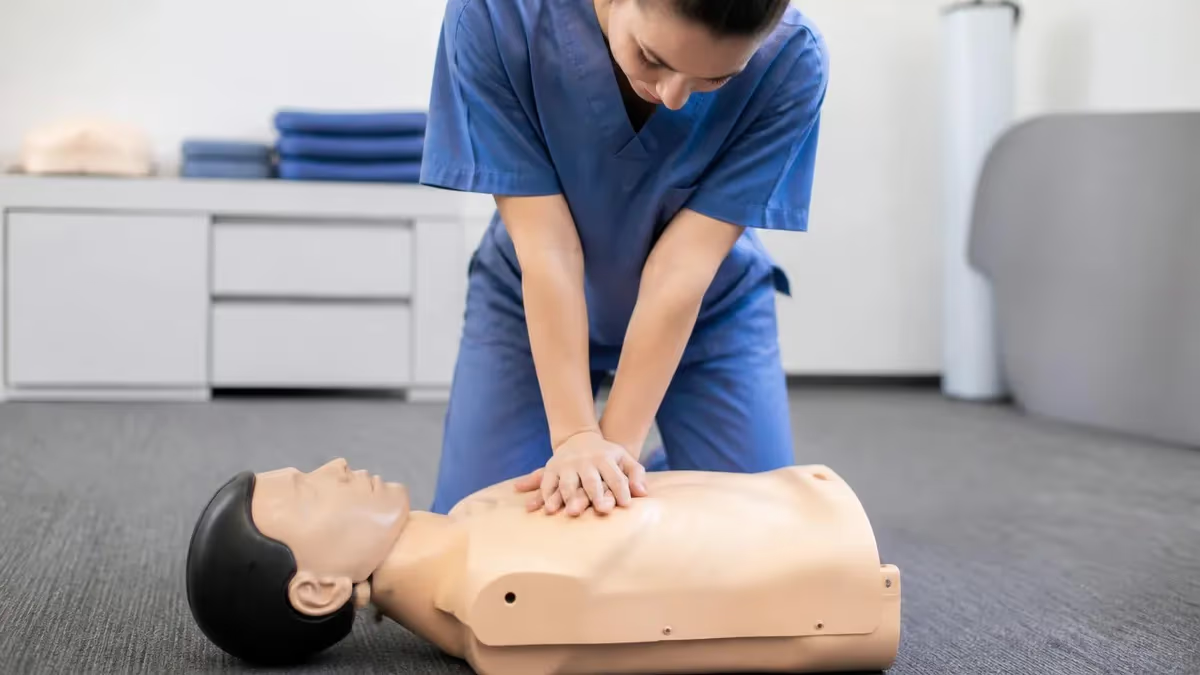
At the skills session, you'll practice chest compressions on a manikin, demonstrate proper rescue breathing technique (or compression-only CPR, depending on the course), operate an AED trainer, and demonstrate the response sequence for an unresponsive adult, child, and infant (for full-range courses). Instructors assess your technique and provide immediate feedback. You don't need to be perfect — you need to demonstrate that you can perform each skill safely and correctly.
Once you pass the skills check, your certification is issued digitally. The Red Cross provides a digital certificate that can be downloaded immediately and a physical wallet card mailed to you. You can verify your certification status online through the Red Cross certification verification portal — a useful feature when employers want to confirm your credentials without seeing a physical card. Certification is valid for two years from the date of your skills completion.
If you work for a hospital, school, large employer, or community organization, ask whether they arrange group CPR sessions. Many Red Cross partners offer on-site group training that's cheaper per person than individual registration and more convenient. Some employers cover the cost entirely. Healthcare employers often schedule annual or biennial BLS renewal sessions on-site — check with your HR department or education coordinator before paying for an individual registration.
Red Cross CPR Course Comparison
Audience: Lay responders — teachers, coaches, childcare workers, workplace first responders
Content: Adult CPR and AED use; optional modules for child/infant CPR, first aid, opioid overdose
Duration: ~1.5–2 hours online + ~1.5 hours in-person skills check
Cost: $50–$75 typical
Validity: 2 years
Good for: Most non-healthcare workplace requirements, state childcare licensing, personal preparedness

Red Cross vs. AHA CPR Certification: What's the Difference?
Both the American Red Cross and the American Heart Association base their CPR guidelines on the same scientific evidence — the International Liaison Committee on Resuscitation (ILCOR) guidelines updated every five years. In practice, the core techniques taught are identical: 30 compressions to 2 breaths ratio, 100–120 compressions per minute, compression depth of 2–2.4 inches for adults. The skills you learn in a Red Cross BLS course are the same skills taught in an AHA BLS course.
The differences are primarily administrative and organizational. AHA courses are delivered only through AHA Training Centers — often hospital education departments, fire departments, or dedicated training companies. Red Cross courses are available through Red Cross chapters, a large network of community partners (YMCAs, colleges, corporations), and online registration. In many regions, Red Cross courses are more conveniently located or offered at more times than AHA courses, simply because the Red Cross has a larger community partner network. In some metropolitan areas, the reverse is true.
Most healthcare employers accept both certifications for BLS credentialing. However, a minority of healthcare employers specify AHA BLS explicitly — this is most common at large academic medical centers and VA hospitals, where historical standardization on AHA courses created a stated preference. If you're starting a nursing program, clinical rotation, or hospital job, verify which organization your employer accepts before registering. If it doesn't matter, choose based on price, convenience, and availability in your area. The American Heart Association CPR Certification Guide covers AHA-specific course details and registration for comparison.
For non-healthcare contexts — workplace first responder requirements, childcare licensing, coaching certifications — Red Cross and AHA certifications are functionally interchangeable. State licensing bodies and employer policies at this level virtually never specify one over the other. Choose whichever is more convenient and affordable for you.
Employers can verify Red Cross certifications at redcross.org/take-a-class/certification-verification. You need your full name and date of birth. This is useful when you need to send proof of certification to an employer before receiving your physical card, or when an employer wants real-time verification rather than relying on a physical card that could be outdated. Always keep your certification number from your digital certificate as a backup reference.
Red Cross CPR Certification Cost and How to Save Money
Red Cross CPR course pricing varies by region, course type, and whether you register through the Red Cross directly or through a community partner. Heartsaver CPR/AED typically costs $50–$75. BLS Healthcare Provider courses run $70–$120. Combined First Aid/CPR/AED courses are typically $75–$100. These are standard retail prices for individual registration through the Red Cross website.
Several ways to reduce the cost are worth knowing. First, many employers cover CPR certification as a workplace requirement. If your job mandates CPR certification, ask HR whether they reimburse the expense — most workplaces with formal CPR requirements have a reimbursement process. Second, community partners often offer courses at lower prices than direct Red Cross registration.
YMCAs, community colleges, fire departments, and hospitals that run authorized Red Cross training centers sometimes charge less per session. Third, group rates are available when multiple people from the same organization register together — organizations with 10+ people needing certification can negotiate group pricing directly with a Red Cross chapter.
If cost is a barrier, check whether your local Red Cross chapter offers any subsidized community training programs. During community health initiatives or disaster preparedness drives, some chapters offer free or reduced-cost CPR training to the public. Community events around Heart Month (February) frequently include free CPR demonstrations and sometimes full certification courses at no charge. The CPR Certification Online guide covers fully online options and their acceptability for different use cases.
For renewal specifically, look for the shorter renewal course rather than the full initial course — it's cheaper and takes less time. If you're renewing for a healthcare employer, confirm that the renewal course (vs. full course) meets their requirement. Most do, but some facilities require the full course even for renewal. Checking before you register avoids wasting time and money on the wrong format.
Use the class finder at redcross.org/take-a-class to search by zip code, course type, and date. You can filter for in-person, blended (online + skills check), and scheduling windows that fit your availability. If no sessions appear in your immediate area, expand the search radius — Red Cross partner organizations (YMCAs, hospitals, community colleges, fire departments) often run authorized training sessions that appear in the same search. Calling your local Red Cross chapter directly sometimes surfaces upcoming community sessions not yet listed online.
Red Cross CPR Certification for Healthcare Students
If you're starting a nursing program, medical school, dental school, or allied health program, your program will specify which CPR certification you need and typically when you need it by. Most clinical programs require BLS Healthcare Provider certification — either Red Cross or AHA — before your first clinical rotation. Some programs require certification before orientation day. Don't wait until the last minute: skills check sessions book up weeks in advance, especially in university towns in late August and January when cohorts are starting simultaneously.
Some nursing schools specify AHA explicitly; others accept either organization. The Red Cross BLS Healthcare Provider course covers the same skills and is held to the same ILCOR standards — if your program says "BLS" without specifying AHA, Red Cross BLS is almost certainly acceptable. If you're unsure, email your program coordinator before registering. A five-minute email saves you from taking the wrong course.
For nursing students, the skills that matter most for clinical settings are 2-rescuer CPR and bag-valve-mask ventilation — skills that appear in BLS but not Heartsaver. These techniques reflect how CPR actually works in hospital settings where a full code team responds. The Heartsaver course won't satisfy your clinical requirements even if you hold it from a prior job. Make sure you register for BLS Healthcare Provider, not just "CPR."
If you hold a current Heartsaver certification from a prior job and your nursing program requires BLS, you'll need to take the BLS course — they're different certifications. Some people ask whether they can take a shorter "upgrade" course to convert Heartsaver to BLS. Typically, no — BLS requires different skills training and is a separate course. Check with your program and the Red Cross training center to see what options exist in your specific situation.

Most nursing programs require BLS certification before your first clinical rotation — not by graduation. That means you may need to get certified during your first week of school or even before orientation. Check your program's specific requirement as soon as you're accepted. Red Cross BLS Healthcare Provider is accepted at virtually all programs unless they specify AHA. Book your skills check session early — August and January sessions fill quickly as cohorts start together.
What You'll Learn in a Red Cross CPR Course
Understanding the actual course content helps you prepare mentally for what to expect and evaluate whether the course covers what your specific role requires. Red Cross CPR courses follow the ILCOR guidelines and teach a defined sequence of actions — the chain of survival — that you'll practice until the steps become automatic.
The response sequence starts with scene safety assessment — checking whether the environment is safe before approaching a person who appears unresponsive. You'll practice checking for responsiveness, calling for help (or directing bystanders to call 911 and retrieve an AED), and beginning compressions. The course emphasizes minimizing the time between recognizing cardiac arrest and starting chest compressions, since each minute without compressions reduces survival probability by 7–10%.
Chest compression technique is the physical core of the course. You'll practice hand placement (heel of hand on lower half of sternum), compression depth (2–2.4 inches for adults), rate (100–120 per minute), and allowing full chest recoil between compressions. Instructors will watch your technique and give feedback on depth, rate, and position. Most people underestimate how physically demanding sustained compressions are — the course teaches you to recognize fatigue and switch rescuers if available.
AED use is covered thoroughly. You'll practice turning on the AED, attaching pads to a manikin, following voice prompts, clearing the person for shock delivery, and resuming compressions immediately after shock. The key message: AEDs are designed for untrained bystanders to use — they talk you through every step. The course reinforces that using an AED is the right action even if you're nervous, and that you can't accidentally hurt someone in cardiac arrest by using one.
Courses with infant and child CPR modules cover the anatomical differences that change technique: two-finger compression for infants, single-hand compression for smaller children, shallower depth (1.5 inches for infants), and the recognition that pediatric cardiac arrest is more often respiratory in origin than in adults — meaning rescue breathing is proportionally more important. This is why childcare and pediatric healthcare providers need the full infant/child module rather than adult-only courses. The CPR Training guide explains the differences between adult, child, and infant CPR protocols in more detail.
One thing most people don't expect: you'll be tired after 2 minutes of compressions. The Red Cross course is honest about this — sustained chest compressions at the correct depth and rate are genuinely physically demanding, and the course teaches you not to sacrifice quality as fatigue sets in. If a second rescuer is available, switching every 2 minutes maintains compression quality.
If you're alone, focusing on depth and rate — even as you fatigue — is still significantly better than stopping. Knowing this before your class helps you approach the physical hands-on practice with realistic expectations rather than feeling like you're doing something wrong when you get winded during the practice session.
- ✓Confirm which course your employer, licensing board, or school requires (Heartsaver vs. BLS vs. First Aid/CPR)
- ✓Check whether your employer specifies Red Cross or AHA — most don't, but healthcare employers sometimes do
- ✓Ask your employer about reimbursement before paying out of pocket
- ✓For blended learning, confirm you have a device and internet connection to complete the online portion
- ✓Choose the full-range course (adult/child/infant) if you work with children or in healthcare
- ✓Bring a completed health disclosure form if required — some courses ask about back or knee injuries that affect kneeling
- ✓Wear comfortable, non-restrictive clothing — you'll be kneeling on the floor performing compressions
- ✓Check if your certification is expired or expiring — renewal courses are shorter and cheaper than initial courses
- ✓For group certification, contact your local Red Cross chapter directly for group pricing
- ✓Download and save your digital certificate immediately after the skills check — physical cards take 7–10 days to arrive
Some CPR courses include a written knowledge check in addition to the skills assessment. Our CPR study guide and CPR exam prep cover the knowledge content tested in certification courses — compression ratios, depth and rate requirements, AED sequences, choking response steps, and rescue breathing. Reviewing these before your course helps you focus the in-person session on hands-on skills rather than re-learning the underlying protocols during class time.
Red Cross CPR Certification Pros and Cons
- +Widely accepted nationally for most workplace and licensing requirements
- +Blended learning format lets you complete knowledge portion on your own schedule
- +Large partner network means more class locations and time slots than AHA in many areas
- +Digital certificate issued immediately after skills check, no waiting
- +Online certification verification tool for employer confirmation
- −Some healthcare employers specifically require AHA BLS — verify before registering
- −In-person skills check is mandatory — no fully online certification
- −Physical wallet card delivery takes 7–10 business days
- −Price varies significantly by region and partner organization
- −Skills check availability may be limited in rural areas
American Red Cross CPR Questions and Answers
CPR Practice Test Questions
Prepare for the CPR Cardiopulmonary Resuscitation Practice exam with our free practice test modules. Each quiz covers key topics to help you pass on your first try.
CPR Basic CPR
CPR Exam Questions covering Basic CPR. Master CPR Test concepts for certification prep.
CPR and First Aid
Free CPR Practice Test featuring and First Aid. Improve your CPR Exam score with mock test prep.
CPR (Cardiopulmonary Resuscitation) Adult ...
CPR Mock Exam on (Cardiopulmonary Resuscitation) Adult CPR and AED Usage. CPR Study Guide questions to pass on your first try.
CPR (Cardiopulmonary Resuscitation) Airway...
CPR Test Prep for (Cardiopulmonary Resuscitation) Airway Obstruction and Choking. Practice CPR Quiz questions and boost your score.
CPR (Cardiopulmonary Resuscitation) Cardio...
CPR Questions and Answers on (Cardiopulmonary Resuscitation) Cardiopulmonary Emergency Recognition. Free CPR practice for exam readiness.
CPR (Cardiopulmonary Resuscitation) Child ...
CPR Mock Test covering (Cardiopulmonary Resuscitation) Child and Infant CPR. Online CPR Test practice with instant feedback.
CPR (Cardiopulmonary Resuscitation) High-P...
Free CPR Quiz on (Cardiopulmonary Resuscitation) High-Performance Team Dynamics. CPR Exam prep questions with detailed explanations.
CPR (Cardiopulmonary Resuscitation) Legal ...
CPR Practice Questions for (Cardiopulmonary Resuscitation) Legal and Ethical Considerations. Build confidence for your CPR certification exam.
CPR for Specific Populations
CPR Test Online for for Specific Populations. Free practice with instant results and feedback.
CPR Airway & Breathing Management
CPR Exam Questions covering Airway & Breathing Management. Master CPR Test concepts for certification prep.
CPR Assessment & Recognition of Cardiac Ar...
Free CPR Practice Test featuring Assessment & Recognition of Cardiac Arrest. Improve your CPR Exam score with mock test prep.
CPR Chest Compressions & Defibrillation
CPR Mock Exam on Chest Compressions & Defibrillation. CPR Study Guide questions to pass on your first try.
CPR Post-Resuscitation Care & Recovery
CPR Test Prep for Post-Resuscitation Care & Recovery. Practice CPR Quiz questions and boost your score.
About the Author

Registered Nurse & Healthcare Educator
Johns Hopkins University School of NursingDr. Sarah Mitchell is a board-certified registered nurse with over 15 years of clinical and academic experience. She completed her PhD in Nursing Science at Johns Hopkins University and has taught NCLEX preparation and clinical skills courses for nursing students across the United States. Her research focuses on evidence-based exam preparation strategies for healthcare certification candidates.
Join the Discussion
Connect with other students preparing for this exam. Share tips, ask questions, and get advice from people who have been there.
View discussion (5 replies)