
CPR Certification Online: How to Get Certified Fast in 2026 September
CPR certification online in 2026 September — 🎯 compare top providers, costs, what's covered, and how long your card stays valid. Get certified today.
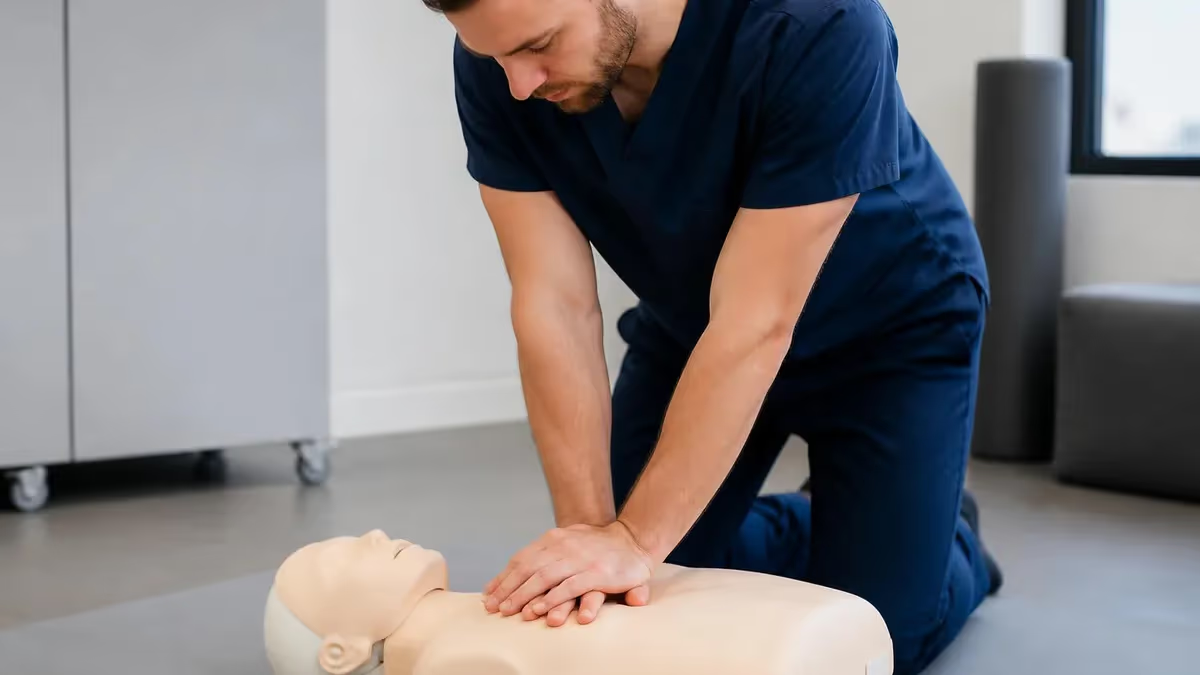
CPR Certification Online: How to Get Certified Fast in 2026
Getting your CPR certification online has never been more accessible — or more important. Whether you're a nurse, a teacher, a parent, or someone who just wants to be ready when it counts, online CPR courses let you learn the fundamentals on your schedule without driving to a class.
But here's the thing: not all online CPR certifications are equal. Some are fully accepted by employers and regulatory bodies; others won't pass muster at a hospital or childcare center. This guide breaks down exactly what you need to know — providers, costs, blended vs. fully online options, and how to pick the right one for your situation.
What Is Online CPR Certification?
Online CPR certification is a training program you complete — at least partly — through a website or app rather than exclusively in a classroom. These programs cover cardiopulmonary resuscitation techniques, AED use, and basic life support. You'll watch instructional videos, take knowledge checks, and (in most cases) complete an in-person hands-on skills session to earn your official card.
There are two main models:
- Blended learning (hybrid): You do the knowledge portion online, then attend a brief in-person session for hands-on practice. This is the format accepted by the American Heart Association and American Red Cross — which means it's recognized by virtually every employer.
- Fully online: You complete everything digitally, including simulated compressions via a phone or sensor pad. These certificates work for many workplaces, but some hospitals, schools, and healthcare licensing boards specifically require an in-person skills component.
Before you enroll anywhere, check with your employer or licensing body about which format they accept. Five minutes of upfront research can save you from having to redo your certification.
Top Online CPR Certification Providers in 2026
Several major organizations offer reputable online or blended CPR courses. Here's how they compare.
American Heart Association (AHA)
The AHA's American Heart Association CPR Certification Guide is the gold standard for healthcare workers. Their HeartCode BLS and Heartsaver courses use a blended format — online modules plus a skills check with an authorized instructor. AHA certification is accepted at virtually every hospital and medical employer in the US. Expect to pay 0–0 for the online portion, then an additional fee to your skills center.
American Red Cross
The Red Cross CPR Certification program is equally trusted and slightly more flexible. Their blended learning option lets you do the coursework online in about 45 minutes, then finish with a 60-minute skills session. They also offer a standalone online certificate for workplaces that accept it. Pricing runs 0–0 for the full blended course.
National CPR Foundation
The National CPR Foundation offers a fully online option that's popular with individuals and workplaces that don't require AHA/Red Cross specifically. Their courses are self-paced, typically take 1–2 hours, and cost around 6–0. The digital certificate is issued immediately upon passing. It's a solid choice for fitness trainers, childcare workers, and general workplace compliance — just verify your employer accepts it first.
ProTrainings
ProTrainings offers OSHA-compliant online CPR courses accredited through the American Safety and Health Institute (ASHI). Their fully online CPR/AED certificate costs around 5 and is accepted by OSHA-regulated workplaces. They're known for straightforward content and fast completion times.
CPR Select
CPR Select provides OSHA-compliant, fully online training with instant certification. Their basic CPR/AED course typically runs 6–5 and includes downloadable wallet cards. Good for individuals needing quick renewal or workplaces with flexible requirements.
How Much Does Online CPR Certification Cost?
Costs vary widely by provider and format:
- Fully online courses: 0–5 for individuals; bulk pricing available for groups
- Blended AHA or Red Cross courses: 0–0 total (online portion + skills session fee)
- On-site group training: 5–0 per person when an instructor comes to your location
Don't just shop by price. A 2 certificate that your employer won't accept is money wasted. The CPR training options that cost a bit more through AHA or Red Cross tend to have universal acceptance — which matters if you're in healthcare, education, or any regulated industry.
What's Covered in an Online CPR Course?
Most standard CPR basic life supports cover these core topics:
- Recognizing cardiac arrest and respiratory emergencies
- Adult, child, and infant CPR techniques
- Hands-only CPR vs. rescue breathing
- AED use (automated external defibrillator)
- Choking response (Heimlich maneuver)
- Chain of survival and when to call 911
BLS (Basic Life Support) courses — required for most healthcare workers — go deeper, covering two-rescuer CPR, bag-mask ventilation, and team dynamics. If you're in a clinical role, make sure you're enrolling in a BLS course, not a standard CPR/AED course.
How Long Does Online CPR Certification Take?
The online portion of most courses runs 45 minutes to 2 hours. Add a 60-minute in-person skills session for blended courses, and you're looking at a half-day commitment at most. Fully online courses can be done in under 90 minutes if you move quickly through the modules.
This is one of the biggest advantages of online certification over traditional classroom-only training, which often runs 4–8 hours with scheduling constraints.
How Long Is Online CPR Certification Valid?
Standard CPR certification — regardless of format — is valid for 2 years. How long CPR certification lasts doesn't change based on whether you trained online or in person; what matters is the issuing organization and whether your employer tracks expiration dates.
Set a reminder 60 days before your expiration. Many providers offer renewal discounts, and blended renewal courses often have a shorter skills session than the initial certification.
Is Online CPR Certification Accepted Everywhere?
Honestly — no, not everywhere. Here's the breakdown:
- Healthcare employers (hospitals, clinics, nursing homes): Almost always require AHA or Red Cross blended certification with an in-person skills component. Fully online-only certificates are generally not accepted.
- Schools and childcare centers: State-specific rules apply. Many require at least a blended course; some accept fully online.
- Fitness industry (personal trainers, gym staff): Most facilities accept OSHA-compliant fully online certificates.
- General workplace compliance: OSHA doesn't mandate a specific provider, so most online certificates qualify.
- Volunteer and community roles: Very flexible — almost any recognized certificate works.
If you're not sure what CPR stands for in your workplace's requirements, ask HR before enrolling. Better to know upfront.
Steps to Get Your CPR Certification Online
Here's the process from start to card-in-hand:
- Check your employer's requirements — AHA/Red Cross required? Blended or fully online OK?
- Choose a provider — AHA, Red Cross, National CPR Foundation, or OSHA-compliant options
- Complete the online modules — takes 45 minutes to 2 hours
- Pass the knowledge assessment — typically 70–80% to pass
- Schedule your skills session (if blended) — find an authorized skills center near you
- Receive your certificate/card — digital immediately; physical card by mail in 1–2 weeks
Keep a copy of your certificate in your email and download a PDF. Many providers also let you access your credentials through an online portal if you need to verify or reprint later.
Blended vs. Fully Online: Which Should You Choose?
This decision really comes down to one question: what does your employer or licensing board require?
If you're in healthcare — nursing, EMT, dental hygienist, physical therapy — get AHA HeartCode BLS or Red Cross blended. Period. No fully online certificate will satisfy a hospital credentialing office, and finding that out after the fact is a headache you don't need.
If you're a personal trainer, office manager, teacher (in most states), or someone wanting personal preparedness, a fully online course from a reputable OSHA-compliant provider is fine. You'll save time, pay less, and get certified today rather than waiting for a skills session opening.
For parents and caregivers who just want to know they'd be ready in an emergency — any recognized course is vastly better than no training at all. Don't let perfect be the enemy of good here.
Renewal: What to Expect
CPR renewal is simpler than initial certification. Most providers offer shorter renewal courses since you're building on prior knowledge. AHA renewal (HeartCode BLS) can be completed online in about 20 minutes before the skills check. Red Cross offers a 45-minute blended renewal.
Don't let your certification lapse — some employers require proof of current certification, and a lapsed card can create compliance issues. Two-year renewals go fast when you're busy, so calendar it now.
Group and Employer CPR Training Online
If you're coordinating CPR training for a team — say, a school staff, construction crew, or office — most providers offer group discounts. Some allow you to purchase bulk codes that employees redeem individually. For blended courses, you can arrange a single skills session where an instructor comes to your facility, which is more efficient than sending everyone to different skills centers.
Bulk pricing from the National CPR Foundation or ProTrainings can bring per-person costs under 5 for fully online courses. AHA group rates vary by skills center partner.

Practice Tests: Know the Material Before You Take the Course
Even though CPR certification isn't a high-stakes exam in the traditional sense, it helps to go in knowing the terminology and protocols. Understanding what compression depth means, when to use an AED, and the correct rate for chest compressions (100–120 per minute) makes the course go faster — and the information stick better.
Our free CPR practice questions cover the same content you'll encounter in certification courses: adult and infant CPR, AED steps, choking response, and BLS protocols. Spending 20–30 minutes on practice questions before your course is a smart move, especially if it's your first certification or you haven't been trained recently.
Being CPR-certified isn't just about meeting a workplace requirement. Every year, about 350,000 cardiac arrests occur outside of hospitals in the US. Bystander CPR — started immediately, before paramedics arrive — can double or triple survival rates. The few hours you spend getting certified online could, genuinely, save someone's life. That's worth more than the cost of any course.
About the Author

Registered Nurse & Healthcare Educator
Johns Hopkins University School of NursingDr. Sarah Mitchell is a board-certified registered nurse with over 15 years of clinical and academic experience. She completed her PhD in Nursing Science at Johns Hopkins University and has taught NCLEX preparation and clinical skills courses for nursing students across the United States. Her research focuses on evidence-based exam preparation strategies for healthcare certification candidates.
Join the Discussion
Connect with other students preparing for this exam. Share tips, ask questions, and get advice from people who have been there.
View discussion (5 replies)