
CPR Meaning: What It Stands For and How It Works 2026 September
CPR meaning explained: ✅ Cardiopulmonary Resuscitation. Learn how it works, the CAB sequence, hands-only vs full CPR, and when to use it.
What Does CPR Stand For?
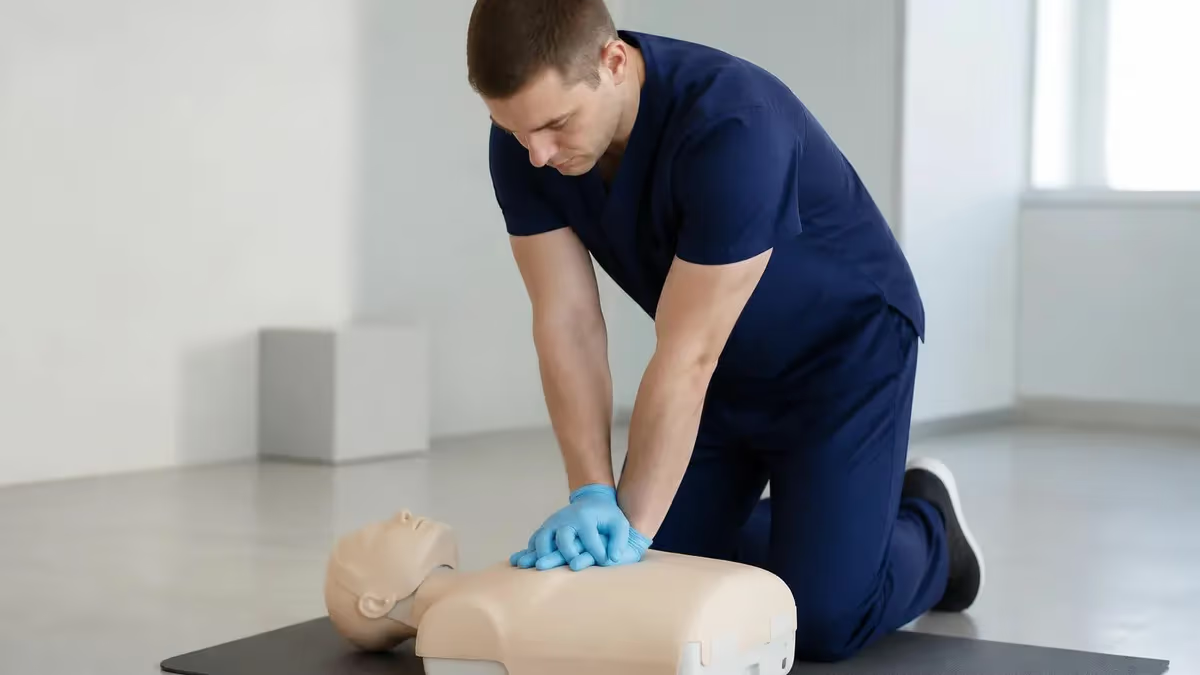
CPR stands for Cardiopulmonary Resuscitation. Break it down: cardio refers to the heart, pulmonary refers to the lungs, and resuscitation means reviving someone who has stopped breathing or whose heart has stopped. Three words. One life-or-death technique.
When someone's heart stops — a condition called cardiac arrest — blood stops moving to the brain. Brain cells start dying within 4 to 6 minutes. CPR buys time. It manually pumps blood through the circulatory system using chest compressions, keeping oxygen flowing to the brain until a defibrillator or emergency responders can restore the heart's normal rhythm.
That's the core of it. CPR doesn't fix the underlying problem — it keeps the person alive long enough for something else to fix it.
The term itself dates back to the 1960s, when Peter Safar and James Elam developed the technique by combining mouth-to-mouth resuscitation with chest compressions. Before that, external cardiac massage existed, but it wasn't paired with airway management in any systematic way. The AHA formalized CPR training for the public starting in the 1970s and has updated the protocols repeatedly since — most significantly in 2010 when the sequence changed from ABC to CAB. Understanding that history matters because you'll still encounter people who learned the old ABC method and haven't updated their training.
Why CPR Matters More Than You Think
About 350,000 Americans go into cardiac arrest outside of a hospital every year. The survival rate without bystander CPR? Around 10%. With immediate bystander CPR, survival rates double — sometimes triple — depending on how fast it starts.
Here's the brutal math: for every minute that passes without CPR after cardiac arrest, the chance of survival drops by roughly 7 to 10%. By the time an ambulance arrives — average response time in the U.S. is 8 to 12 minutes — that window has already closed for many people. Do that math: 8 minutes at 10% per minute means the odds have dropped 80% before the paramedics even walk through the door.
You don't need certification to save a life. Hands-only CPR can be done by virtually anyone. The American Heart Association actively encourages untrained bystanders to do something rather than nothing. A broken rib heals. Brain death doesn't.
The geography problem makes this worse. Rural areas face EMS response times of 20 minutes or more. In those communities, bystander CPR isn't just helpful — it's the difference between a functioning brain and permanent damage. Urban areas aren't immune either: elevator waits, traffic, locked apartment access points all eat into response time. The gap between collapse and paramedic arrival is almost always longer than people assume.
Want to test your knowledge before you keep reading? Take a CPR practice test to see where you stand right now.

CPR by the Numbers
How CPR Actually Works
Most people picture CPR as hands pressing on a chest. That's accurate — but there's a lot happening underneath those compressions that explains why the technique works the way it does.
The heart is a pump. When it stops, blood pools. Chest compressions physically squeeze the heart between the sternum and spine, forcing blood out into the arteries. When you release, the chest recoils and draws blood back in. You're essentially acting as an external heart — inefficient compared to the real thing, but enough to keep oxygen-rich blood reaching the brain.
Compressions alone deliver somewhere between 25 to 33% of normal cardiac output. Not great. But enough. The brain can survive on reduced oxygen flow for several minutes if compressions start quickly and stay consistent. That window is the entire reason bystander CPR exists — you're not trying to fix anything permanently. You're bridging to something that can.
Rescue breaths — when used — add oxygen into the lungs, which then gets picked up by the circulating blood. In hands-only CPR, the residual oxygen already in the blood and lungs does the job for the first few minutes. After about 4 minutes of hands-only CPR, though, oxygen levels in the blood drop significantly, and rescue breaths become more critical — another reason why getting a defibrillator or professional help fast matters so much.
Quality matters as much as speed. Compressions that are too shallow don't generate adequate blood flow. Compressions that are too fast don't allow the heart to refill between beats. The AHA's guidelines specify 100 to 120 compressions per minute — fast enough to maintain output, but not so fast that you're vibrating without actual compression and release cycles. The compression-to-release ratio should be roughly 1:1; pressing down and letting the chest rebound fully are equally important.
One thing that surprises most people: the person doing compressions should be positioned directly above the patient, with arms straight and shoulders over the hands. Leaning at an angle wastes effort. If you're kneeling beside someone on a hard floor, that's the right setup. Soft surfaces like beds or thick mattresses don't work well for compressions — the cushioning absorbs the force before it reaches the heart. Move the person to a hard floor if at all possible.
The CAB Sequence: Step by Step
Push hard and fast on the center of the chest. For adults, compress at least 2 inches deep at 100–120 beats per minute. Use two hands — heel of your dominant hand on the lower half of the sternum, other hand stacked on top. Lock your elbows, lean directly over the person, and use your body weight, not just your arms. The Bee Gees' "Stayin' Alive" is exactly the right tempo. Give 30 compressions before moving to airway.
Don't stop for more than 10 seconds at a time. Every interruption reduces blood flow to the brain. If there are two rescuers, one handles compressions while the other manages airway and breaths — then switch every 2 minutes to maintain compression quality as fatigue sets in.

Hands-Only CPR vs. Full CPR — Which Do You Use?
Short answer: it depends on who collapsed and why.
Hands-only CPR — continuous chest compressions with no rescue breaths — is what the AHA recommends for untrained bystanders responding to adult cardiac arrest. It's simpler, less intimidating, and removes the barrier of mouth-to-mouth contact. Research shows it's roughly as effective as full CPR for adult cardiac arrest in the first few minutes after collapse.
Use hands-only CPR when:
- You're not trained in rescue breaths
- An adult suddenly collapses (witnessed collapse, likely cardiac cause)
- You're uncomfortable giving mouth-to-mouth
Full CPR with rescue breaths is recommended for:
- Children and infants — breathing problems are more often the primary cause
- Drowning victims — they desperately need oxygen
- Drug overdose situations
- Asphyxiation from choking or suffocation
- Any situation where a breathing problem caused the cardiac arrest
The logic is straightforward. In adult cardiac arrest, the heart gives out first — there's still oxygen in the blood. In drowning or choking, oxygen deprivation came first — compressions without breaths won't help as much. If you're not sure? Start compressions. Something beats nothing every time.
There's also a middle ground worth knowing: if you're trained but don't have a barrier device (a face shield or pocket mask), you can still do compression-only CPR on an adult and it won't significantly hurt your chances. Trained rescuers should ideally give rescue breaths when a barrier is available, but not having one isn't a reason to stop.
Common CPR Myths Worth Correcting
"CPR is only for trained people." Not true. The AHA specifically designed hands-only CPR so anyone can do it — it's pushed in public campaigns precisely because bystander hesitation kills people. You won't make things worse by trying. You will make things worse by doing nothing.
"You'll catch something from giving rescue breaths." The risk of disease transmission through rescue breathing is extremely low. In real emergencies, this concern has led to unnecessary hesitation. If you're worried, hands-only CPR sidesteps the issue entirely — and it's what the AHA recommends for untrained bystanders anyway.
"CPR will definitely save them." Honest answer: CPR is a bridge, not a cure. It buys time. Sometimes that's enough. Sometimes it isn't. But the alternative — doing nothing — is almost never the right call when someone collapses in front of you.
"I'll freeze and do it wrong." This is real. Panic disrupts recall. That's exactly why hands-on practice — not just reading about technique — matters. A certification course with a skills check builds the kind of memory that holds up under stress. Even imperfect CPR is better than no CPR: studies consistently show that compression depth and rate don't have to be perfect to meaningfully improve outcomes. Your 80% effort is infinitely better than 0%.
CPR by Age Group
- ▸Compression depth: at least 2 inches (5 cm)
- ▸Rate: 100–120 compressions per minute
- ▸Hand position: two hands, heel on lower half of sternum
- ▸Ratio: 30 compressions to 2 rescue breaths
- ▸Check pulse: carotid (neck)
- ▸Compression depth: about 2 inches (one-third of chest depth)
- ▸Rate: same 100–120 per minute
- ▸Hand position: one or two hands depending on child's size
- ▸Ratio: 30:2 lone rescuer; 15:2 with two rescuers
- ▸Check pulse: carotid (neck)
- ▸Compression depth: about 1.5 inches (one-third of chest depth)
- ▸Rate: 100–120 per minute
- ▸Hand position: two fingers, center of chest below nipple line
- ▸Ratio: 30:2 lone rescuer; 15:2 with two rescuers
- ▸Rescue breaths: cover both nose and mouth with your mouth
- ▸Check pulse: brachial (inside upper arm), not carotid
AEDs: The Tool That Actually Restarts the Heart
CPR keeps the blood moving. An AED — Automated External Defibrillator — is what actually shocks the heart back into a normal rhythm. They work together, not instead of each other.
AEDs are designed for non-medical people to use. The device talks you through every step. You place two adhesive pads on the chest, the AED analyzes the heart rhythm, and if it detects a shockable rhythm (like ventricular fibrillation), it charges and delivers a shock. If the rhythm isn't shockable, it tells you not to shock and to continue CPR.
Don't stop compressions while you're setting up the AED — divide the work if someone else is there. Resume compressions immediately after the shock. The AED tells you when to stand clear. Hands off during the analysis and shock, immediately back on after. That rhythm is non-negotiable.
AEDs are now required in many public spaces — airports, gyms, schools, shopping malls. Most are in clearly marked wall-mounted cases. Knowing where the nearest one is before you need it matters more than people realize. Walk around your workplace or gym and find them now. It takes 30 seconds and could matter enormously someday.
Common misconception: the shock from a defibrillator doesn't restart a stopped heart. It resets the chaotic electrical signals of ventricular fibrillation — when the heart quivers uselessly instead of pumping. After the shock, the heart's natural pacemaker can reassert itself and restore a normal rhythm. If the heart is completely still (asystole — the flatline in movies), a defibrillator does nothing. CPR is the only tool. That's why continuing compressions after a shock, rather than waiting to see what happens, is so important — the heart needs help to fully recover even if the shock works.
When Do You Stop CPR?
Knowing when to stop is just as important as knowing how to start. Stop CPR when: the person shows obvious signs of life (purposeful movement, breathing, regaining consciousness), a trained professional takes over, an AED is attached and guiding you, you're physically unable to continue, or the scene becomes unsafe.
A common fear: "What if I hurt them?" Broken ribs from CPR happen — more often than people expect, especially in older adults. They're painful but survivable. Cardiac arrest is not survivable without intervention. Keep going.
For situations with multiple rescuers, switch out the person doing compressions every 2 minutes. Fatigue degrades compression depth fast — a tired rescuer at 1.5 inches is doing considerably less than a fresh rescuer at 2 inches, even though the gap seems small. Time your switches to not interrupt compressions for more than a second or two.
CPR Certification Checklist
- ✓Choose a course: AHA BLS/Heartsaver or American Red Cross
- ✓Find heart association cpr classes or Red Cross sessions near you
- ✓Complete the online portion (blended courses) or attend in person
- ✓Pass the hands-on skills check — manikin compressions and rescue breaths
- ✓Receive your certification card (valid 2 years)
- ✓Set a renewal reminder at 18–22 months to avoid lapsing
- ✓Check whether your employer requires AHA or Red Cross specifically
- ✓If certified in healthcare: confirm BLS vs. Heartsaver level matches your role
CPR Certification: Who Needs It and How to Get It
Anyone can do hands-only CPR. Formal certification matters for healthcare workers, teachers, coaches, lifeguards, childcare providers, and many other professions. If your job involves contact with people — patients, students, athletes, children — there's a good chance your employer or licensing board expects it.
The two main certifying bodies are the American Heart Association — whose BLS and Heartsaver courses are the gold standard for healthcare settings — and the American Red Cross, which is widely accepted and often more accessible for non-healthcare workers. To find heart association cpr classes near you, use the AHA's course locator. If you want to understand how long does cpr certification last and what renewal looks like before you register, the Red Cross site has those details clearly laid out.
Standard certification courses run 2 to 4 hours for basic CPR/AED, longer for full BLS. Cost varies: free community sessions exist; paid courses typically run $30 to $100. Online blended courses — where you complete the knowledge portion digitally and attend a shorter in-person skills check — have become the most popular format since 2020. They're equally valid as long as the provider is AHA or Red Cross certified.
Certification is valid for 2 years. Some healthcare employers require renewal at 18 months rather than 24 to build in a buffer against expiration gaps. Check your employer's policy before assuming the standard 2-year window applies to you. Lapsed certification is a common reason healthcare workers are temporarily pulled from patient-facing roles during audits.
Workplace CPR: What OSHA and Other Bodies Require
OSHA doesn't mandate CPR training for all workplaces — but several industries do have specific requirements:
- Healthcare settings: Staff with direct patient contact typically must hold current BLS or ACLS certification
- Schools: Many states require CPR training for teachers and coaches; some require student CPR training before graduation
- Construction: OSHA's First Aid standard (29 CFR 1910.151) requires someone with first aid training when a medical facility isn't reasonably accessible
- Childcare centers: Most states require at least one certified staff member for infant/child CPR at all times
Don't assume someone else has it covered. If your workplace has more than a handful of employees and no one has checked on CPR certification status recently, there's a reasonable chance you're not in compliance with your state's regulations or your industry's standards. Check with your HR department or state labor board to confirm exactly what applies to your situation — the answer varies significantly by state and sector.
Ready to prep for your certification exam? Start with a CPR practice test — it's free, no account or registration needed, and it covers all the major topics.
CPR Training: Worth It?
- +Hands-on training builds muscle memory — you act faster in real emergencies
- +Certification satisfies employer requirements across healthcare, education, and childcare
- +Learning age-specific techniques (adult vs. child vs. infant) prevents critical mistakes
- +AED training pairs naturally with CPR — knowing both dramatically improves outcomes
- +Good Samaritan laws protect certified and uncertified rescuers equally
- −Certification expires every 2 years — renewal is required to stay current
- −In-person skills checks can be hard to schedule around work or family commitments
- −Course quality varies; some online-only courses don't adequately prepare for real scenarios
- −Hands-only CPR (which anyone can do) is sufficient for most adult cardiac arrest situations
- −Compression fatigue sets in quickly — knowing technique doesn't fully prepare you for the physical demand
CPR Questions and Answers
About the Author

Registered Nurse & Healthcare Educator
Johns Hopkins University School of NursingDr. Sarah Mitchell is a board-certified registered nurse with over 15 years of clinical and academic experience. She completed her PhD in Nursing Science at Johns Hopkins University and has taught NCLEX preparation and clinical skills courses for nursing students across the United States. Her research focuses on evidence-based exam preparation strategies for healthcare certification candidates.
Join the Discussion
Connect with other students preparing for this exam. Share tips, ask questions, and get advice from people who have been there.
View discussion (5 replies)