
CPR Training: Classes, Certification, Online Courses, and Cost 2026 September
📚 Complete guide to CPR training: Red Cross vs. AHA classes, online options, BLS certification, cost, how long training takes, and how to find classes
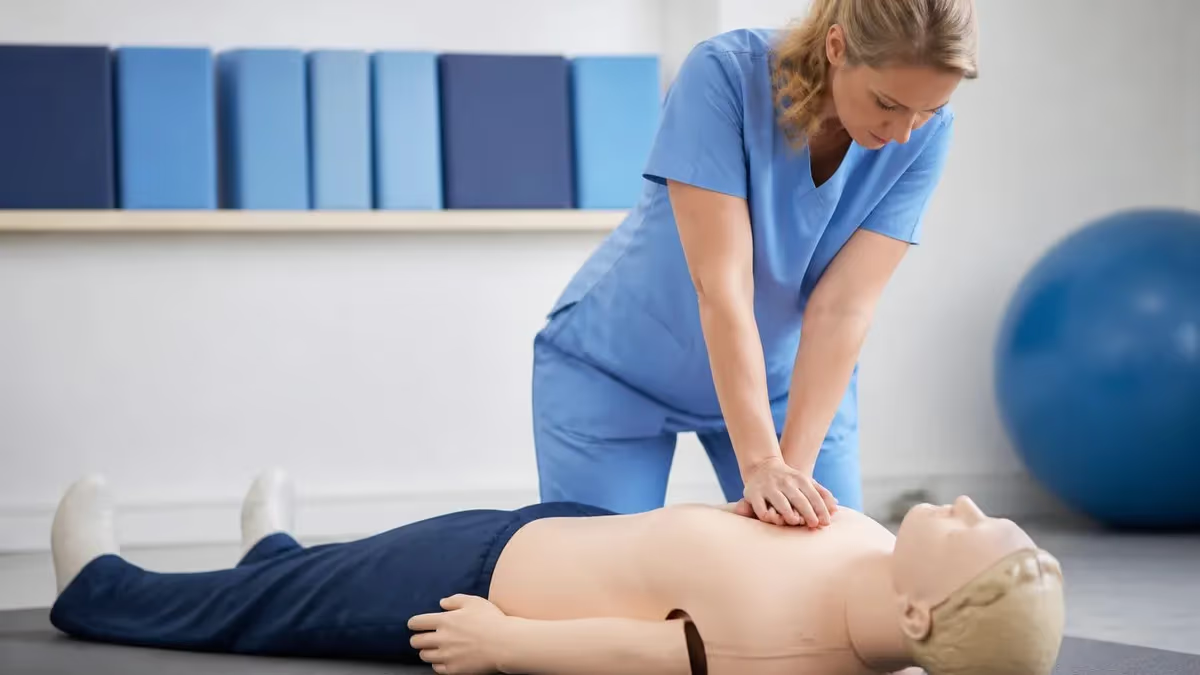
- CPR training courses typically last 2–8 hours depending on the certification level and provider.
- The two dominant providers in the U.S. are the American Red Cross and the American Heart Association (AHA).
- Standard CPR/AED training for lay rescuers costs $20–$80; BLS certification for healthcare providers costs $60–$120.
- CPR certifications are valid for 2 years and must be renewed to remain current for employment requirements.
- Free and low-cost community CPR training is available through many hospitals, fire departments, and employer wellness programs.
CPR Training Overview
Cardiopulmonary resuscitation (CPR) training teaches you how to respond when someone's heart stops beating or they stop breathing. The skills — chest compressions, rescue breathing, and automated external defibrillator (AED) use — can mean the difference between life and death in the critical minutes before emergency medical services arrive. Sudden cardiac arrest kills over 350,000 Americans outside of hospitals each year, and survival rates more than double when bystanders perform CPR immediately.
CPR training has evolved considerably since it was first standardized in the 1970s. Modern courses reflect guidelines issued by the International Liaison Committee on Resuscitation (ILCOR) and updated every five years based on current science.
The most significant recent changes include the emphasis on high-quality chest compressions (at least 2 inches deep, 100–120 compressions per minute) over rescue breathing for lay rescuers — a shift that simplified training and removed a significant barrier for bystanders reluctant to perform mouth-to-mouth. Hands-only CPR, endorsed by both the AHA and Red Cross, is now the recommended approach for untrained bystanders and for adult cardiac arrest in witnessed settings.
Who needs CPR training? The answer is broader than most people assume. Healthcare providers — nurses, doctors, paramedics, medical assistants, dental hygienists — are typically required to hold current Basic (BLS) certification. Teachers, childcare workers, coaches, lifeguards, fitness instructors, and many workplace safety officers are also commonly required to maintain CPR certification. Beyond mandated requirements, millions of Americans choose to get trained voluntarily each year because they want the ability to help family members, neighbors, or strangers in emergencies. The few hours invested in a CPR course could be among the most valuable you ever spend.
This guide covers everything you need to know about CPR training: which certification you need, how to choose between the AHA and Red Cross, what online training can and cannot cover, how much courses cost, and what to expect during the training itself. Whether you're getting certified for the first time, renewing an expired card, or choosing the right course level for your profession, you'll find practical guidance on each of those questions below.
The chain of survival concept, developed by the AHA, outlines the sequence of actions that maximizes survival in cardiac arrest: early recognition and activation of the emergency response system, early high-quality CPR, rapid defibrillation, advanced resuscitation by EMS, and integrated post-cardiac-arrest care in the hospital. CPR training addresses the second and third links in this chain — the ones where bystanders have the most impact. Every minute that passes without CPR reduces survival odds by approximately 10%, which is why the first bystander's response in the first 1–3 minutes is so disproportionately influential on the outcome.
Many people feel uncertain about performing CPR correctly under pressure, even after training. This concern is valid — motor skills degrade under stress — which is why high-quality CPR training emphasizes repetitive practice over passive learning. The more times you perform compressions on a manikin with real-time feedback, the more automatic the muscle memory becomes. Research consistently shows that feedback-enhanced practice produces significantly better skill retention at 3, 6, and 12 months post-training compared to lecture-only instruction. When selecting a CPR course, prioritizing hands-on practice time over class size and price is the most important quality factor.
Developing CPR confidence is a process, not a single event. Taking a refresher course every two years — not just for the renewal card but to stay sharp — keeps your technique current with updated guidelines and reinforces the automaticity that makes a real-life response instinctive rather than hesitant. Many experienced healthcare providers and community responders deliberately practice with feedback manikins periodically between their formal renewal dates specifically to maintain that level of comfort.
Every person who completes CPR training becomes a potential first responder in their community.

CPR Training by the Numbers
CPR Training Providers: AHA vs. Red Cross
The American Heart Association and the American Red Cross are the two largest CPR training organizations in the United States, and both produce certifications widely accepted by employers, state licensing boards, and accreditation bodies. Choosing between them is less about scientific content — both follow the same ILCOR guidelines — and more about convenience, employer preference, and specific course availability in your area.
The American Heart Association trains over 22 million people annually and is particularly dominant in healthcare settings. Most hospitals, healthcare systems, and clinical training programs specify AHA certification. The AHA's BLS (Basic Life Support) course is the industry standard for healthcare providers, while their Heartsaver courses serve the lay public and workplace responders. AHA courses must be taken through authorized AHA Training Centers, which include hospitals, community colleges, fire departments, and independent training centers. AHA's Blended Learning format combines online modules with a brief in-person skills session, making it more flexible than traditional classroom-only instruction.
The American Red Cross reaches a similarly large audience and has particularly strong penetration in community settings, schools, and workplaces outside healthcare. Their CPR/AED and First Aid combination courses are popular for teachers, coaches, and community members. The Red Cross also operates an extensive network of in-person classes and offers online simulation-based training. Some employers specifically request Red Cross certification, particularly in childcare and educational settings where Red Cross community partnerships are well-established.
Other training organizations with employer-recognized certifications include the American Safety & Health Institute (ASHI), the National Safety Council (NSC), and MEDIC First Aid. These organizations may be preferred in specific industries or regions and are generally accepted alongside AHA and Red Cross credentials in most non-healthcare employment settings. If you have a specific employer requirement, confirm which organizations they recognize before registering for a course.
One factor that sometimes confuses people is that both the AHA and Red Cross offer courses with similar-sounding names at different price points. The AHA's Heartsaver CPR/ and the Red Cross's Basic Life Saving course cover essentially the same content for lay rescuers. Neither is universally superior — the right choice is whichever is accepted by your specific employer or licensing authority, and which has convenient class times near you. When both are accepted, choose based on instructor quality and training center proximity rather than brand loyalty.
Refresher courses (renewals) are available from both organizations and are shorter than initial basic life supports. The AHA's BLS renewal course runs 3–4 hours compared to 4–5 hours for initial certification. The Red Cross similarly offers shorter renewal formats. If your certification has lapsed by more than a few months, some training centers will require you to take a full initial course rather than a renewal, so it's worth keeping track of your expiration date and not letting it slip too far past due.
One underrated aspect of choosing a provider is the quality and attitude of the individual instructor. Both AHA and Red Cross instructors vary widely in experience and teaching effectiveness. Asking your training center whether their instructors hold active clinical or emergency response roles — rather than being purely classroom-based trainers — is a reasonable indicator of practical teaching quality. Instructors who have actually performed CPR in real emergencies bring authenticity and practical context to their corrections that classroom-only trainers often can't match.

Types of CPR Certification
For lay responders, community members, and non-healthcare workers. Covers adult, child, and infant CPR, AED use, and choking relief. Duration: 3–4 hours. Valid 2 years. Accepted for most non-clinical employer requirements.
Required for healthcare providers: nurses, doctors, medical assistants, EMTs, dental professionals. More intensive than Heartsaver — includes team dynamics, mask ventilation technique, and high-performance CPR. Duration: 4–5 hours. AHA and Red Cross both offer BLS.
Combined certification covering CPR, AED, and basic first aid (bleeding control, burns, fractures, allergic reactions). Popular for teachers, coaches, childcare workers, and workplace safety officers. Duration: 4–6 hours depending on provider and depth of first aid content.
Focused on infant and child emergencies: child CPR compression ratios, infant airway management, and pediatric AED pad placement. Required for daycare workers, elementary teachers, and pediatric healthcare staff in many states.
Advanced certification for physicians, advanced practice providers, and critical care nurses. Covers cardiac arrhythmia recognition, medication administration, team leadership during codes. Prerequisite: current BLS. Duration: 1–2 days.
Not a formal certification — a brief 30-minute to 1-hour public health session teaching chest-compression-only CPR to community members. Available through many hospitals and community events for free. Does not satisfy employer certification requirements.
Online CPR Training
Online CPR training has expanded significantly, but it's important to understand what 'online CPR certification' actually means before purchasing a course. Genuine CPR certification from the AHA, Red Cross, or equivalent organization requires a hands-on skills verification component — you must physically demonstrate correct compression depth, rate, hand position, and AED use. A purely online course that issues a card without any skills assessment does not meet this requirement and is typically not accepted by hospitals, healthcare licensing boards, or employers who specify AHA or Red Cross certification.
That said, legitimate blended learning options from AHA and the Red Cross combine self-paced online modules with a shorter, more efficient in-person skills session. The AHA's BLS Blended Learning course, for example, has you complete online video modules at your own pace, then attend a 60–90 minute skills session at an authorized Training Center where an instructor verifies your hands-on technique. This format significantly reduces classroom time while maintaining the standards that make the certification credible. Red Cross offers a similar structured format for their CPR/AED courses.
Fully online CPR cards — which issue certifications without any in-person component — are legitimate for some specific use cases: employers or situations that simply require documented CPR awareness training rather than skills-verified certification, or personal education for family members who want to know the basics without a formal credential. If you're unsure whether your employer or licensing board will accept a fully online card, ask them explicitly before purchasing. The answer in healthcare settings is almost always no; in many other settings, it varies by employer policy.
The cost advantage of online and blended options is real. A traditional in-person BLS course might cost $60–$80, while the blended version is often $30–$45 for the online portion with a reduced skills session fee of $20–$30 — saving both money and a full day of scheduling. For busy healthcare professionals who need to renew every two years, the flexibility of blended learning is a genuine quality-of-life improvement over traditional classroom scheduling.
When evaluating online CPR courses, check whether the issuing organization is recognized by your employer or state licensing board before purchasing. The AHA maintains a list of authorized Training Centers on their website, and eCards issued through this system include verifiable certification numbers that employers can authenticate. Non-AHA, non-Red Cross cards from internet-only providers may look similar but often cannot be verified and are rejected by healthcare employers on sight. A $15 online card that isn't accepted by your employer is worth less than a $75 blended course that is.
For community members who simply want to know the fundamentals without the credential, fully online courses or free hands-only CPR videos from the AHA are perfectly appropriate. Many people learn hands-only CPR from a 2-minute YouTube video and have successfully used it to save lives. The distinction between "good enough to help in an emergency" and "meets formal employer certification requirements" is important to keep in mind when deciding what level of training you actually need.

CPR Training Costs
In-person CPR classes through authorized training centers typically cost $20–$80 for Heartsaver courses and $60–$120 for BLS certification. Combined CPR + First Aid courses run $50–$100. Prices vary significantly by region, provider, and whether the training center is nonprofit (often cheaper) or a private training business. Group discounts are available for employers training 5+ employees simultaneously, often reducing per-person costs by 20–40%.
What to Expect in a CPR Training Class
A typical in-person CPR/AED certification course for lay rescuers (Heartsaver or Red Cross equivalent) runs 3–4 hours and covers three main content areas: adult CPR and AED, child CPR and AED, and infant CPR. Each section combines brief video instruction or instructor demonstration with hands-on practice using manikins — foam and plastic practice bodies that allow you to work on compression depth, rate, and hand positioning without the stakes of a real emergency. You'll also practice proper AED pad placement and the sequence of steps: recognizing cardiac arrest, calling 9-1-1, beginning compressions, and using the AED when one arrives.
Quality indicators to look for in a CPR class include small class sizes (8–12 students per instructor ratio is optimal for hands-on skills), feedback manikins that display compression depth and rate in real-time, and instructors who correct technique actively during practice rather than just demonstrating.
CPR feedback manikins — which show whether you're compressing deep enough and at the right rate — have been shown to significantly improve skill retention and are a standard feature in well-equipped training centers. If a course lacks practice equipment or spends most of the time on lecture slides rather than hands-on practice, your retention and confidence will suffer.
BLS courses for healthcare providers are more intensive and include additional skills: bag-mask ventilation using a resuscitation bag instead of mouth-to-mouth, two-rescuer CPR technique with role assignments, team dynamics training for high-performance CPR teams, and often AED use in clinical versus public settings. BLS courses run 4–5 hours for initial certification and 3–4 hours for renewal. The skills evaluation at the end of the course is a pass/fail assessment — instructors observe your technique and check off required competencies before signing your certification card.
After completing the course and passing the skills evaluation, you receive a certification card immediately — either physical or digital depending on the provider. The AHA now issues eCards (digital certification cards accessible through the AHA website) rather than physical plastic cards, which are easier to store and share electronically with employers.
Red Cross issues printable digital cards accessible through your Red Cross account. Some employers require the actual card number and issue date for their records; others accept a screenshot or download of the digital card. Store your eCard information in your email or a password manager where you can retrieve it easily when employers request it.
Scheduling CPR training doesn't need to be complicated. Both the AHA and Red Cross have online training center locators where you can search by zip code and date. Many hospitals, community colleges, and fire departments post their schedules publicly.
For employer-required certification, check with HR or your manager first — your employer may cover costs or have scheduled group sessions that are more convenient than finding your own class. If you're in a rural area with limited local options, blended learning formats offer the best flexibility, allowing you to complete coursework at home before a shorter skills session at the nearest authorized Training Center.
CPR Pros and Cons
- +CPR certification is recognized by employers as verified competency
- +Provides a structured knowledge framework beyond just the credential
- +Certified professionals report 10–20% salary increases on average
- +Maintenance requirements create ongoing professional development
- +Differentiates candidates in competitive hiring and promotion decisions
- −Certification fees, materials, and renewal costs add up over a career
- −Requirements change — delaying may mean facing updated content
- −Salary ROI varies significantly by geography and industry
- −Preparation requires significant time alongside existing responsibilities
- −Validates knowledge at a point in time, not ongoing real-world performance
CPR Training Questions and Answers
About the Author

Registered Nurse & Healthcare Educator
Johns Hopkins University School of NursingDr. Sarah Mitchell is a board-certified registered nurse with over 15 years of clinical and academic experience. She completed her PhD in Nursing Science at Johns Hopkins University and has taught NCLEX preparation and clinical skills courses for nursing students across the United States. Her research focuses on evidence-based exam preparation strategies for healthcare certification candidates.
Join the Discussion
Connect with other students preparing for this exam. Share tips, ask questions, and get advice from people who have been there.
View discussion (5 replies)