
American Heart Association CPR Certification: Courses, Costs, and What to Expect
Complete guide to American Heart Association CPR certification. Compare AHA CPR courses, costs, renewal requirements, and what each certification covers. ❓
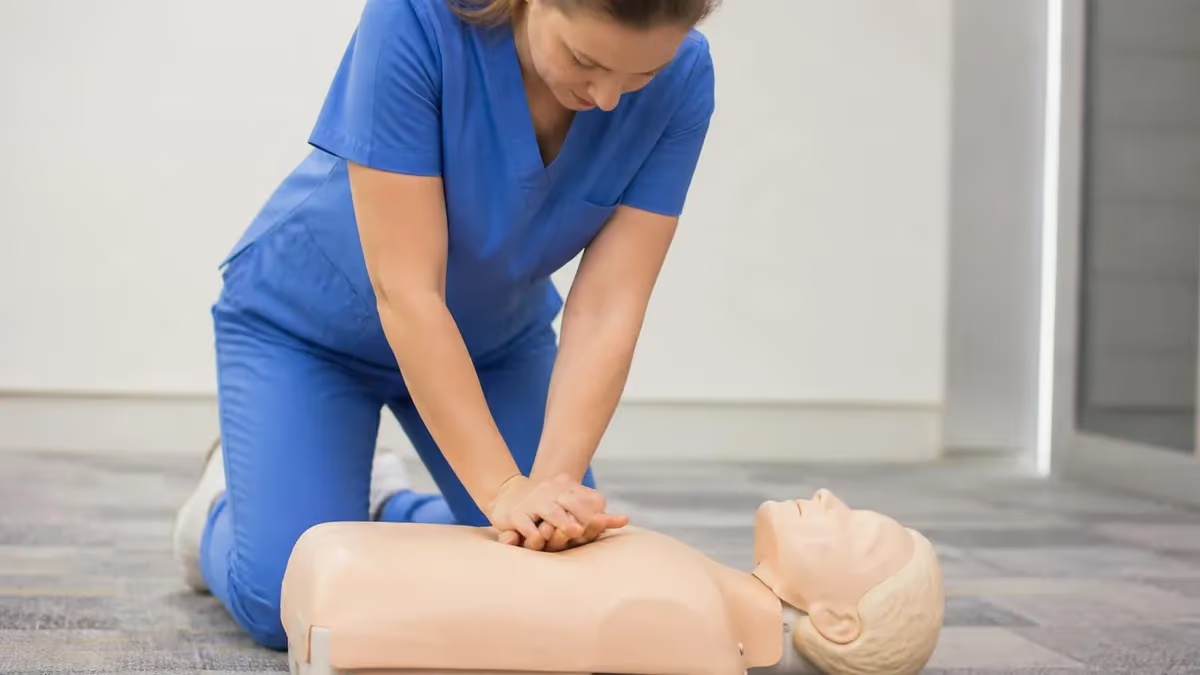
Main courses: BLS for Healthcare Providers, Heartsaver CPR AED (lay rescuer), ACLS (advanced providers), PALS (pediatric providers).
Certification validity: 2 years for BLS, Heartsaver, ACLS, and PALS.
Renewal options: Full course retake or HeartCode online + skills session.
Where to certify: AHA Training Centers nationwide, hospital programs, and authorized independent instructors.
What Is AHA CPR Certification?
The American Heart Association (AHA) is the largest and most recognized provider of CPR training and certification in the United States. Founded in 1924 and headquartered in Dallas, the AHA develops evidence-based resuscitation guidelines used by healthcare providers, emergency responders, and lay rescuers worldwide. Its CPR certification programs train millions of people annually, and the AHA's cardiac arrest survival guidelines — updated every five years based on systematic evidence reviews — form the scientific foundation for virtually all CPR training in the US and many international programs.
AHA CPR certification is a formal credential demonstrating that the holder has completed an approved AHA training program and demonstrated competency in resuscitation skills. Unlike informal CPR training videos or apps, AHA certification requires skills practice with a certified instructor who observes and confirms the trainee's compression depth, rate, recoil, and overall technique. This hands-on validation is why AHA certification carries institutional weight — hospitals, schools, fitness facilities, and employers requiring CPR certification typically specify AHA or Red Cross credentials, recognizing that these programs involve verified practical training rather than knowledge-only coursework.
The AHA's training network is built on a hierarchy of authorized training centers. Organizations that want to offer AHA CPR courses become Training Centers (TCs), which operate under an AHA Regional or National Training Center. Individual instructors complete AHA instructor courses and teach under a TC's umbrella. This layered authorization system maintains quality control — every AHA certification card issued comes from a course taught by an authorized instructor using approved AHA curriculum and materials.
AHA guidelines are updated on a two-year cycle, with major updates every five years when the International Liaison Committee on Resuscitation (ILCOR) publishes a comprehensive evidence review. The most recent major guidelines were released in 2020. When guidelines change, AHA updates its training materials and courses accordingly, meaning AHA-certified providers learn current best-practice techniques rather than outdated approaches. For healthcare providers particularly, staying current with AHA guidelines is a professional and sometimes regulatory requirement.
The AHA's public-facing mission extends beyond provider certification. Its campaigns like Nation of Lifesavers and its Push to Save initiative work to increase the proportion of Americans trained in CPR and willing to perform it on strangers. Cardiac arrest kills approximately 350,000 Americans outside hospitals every year, and survival rates depend heavily on bystander action in the first minutes before emergency services arrive. By making CPR training widely accessible and by maintaining the institutional relationships that drive healthcare provider certification requirements, the AHA creates a continuous pipeline of people prepared to act in emergencies.

AHA CPR Training Impact
AHA CPR Courses: Which One Do You Need?
The AHA offers several CPR certification programs designed for different audiences, from lay rescuers to advanced healthcare providers. Choosing the right course depends on your role, the setting where you'll use CPR skills, and what certification your employer or institution requires.
BLS (Basic Life Support) for Healthcare Providers is the most commonly required AHA course for medical professionals. It's designed for nurses, physicians, paramedics, dentists, pharmacists, medical assistants, and other clinical and allied health providers. BLS covers adult and pediatric CPR, two-rescuer CPR, AED use, relief of foreign body airway obstruction, and the team dynamics that make resuscitation effective in healthcare settings. Most hospitals require BLS certification for all clinical staff, and many healthcare education programs require it before students can complete clinical rotations.
Heartsaver CPR AED is AHA's lay rescuer course, designed for people who aren't healthcare providers but need to be prepared to respond to cardiac emergencies — teachers, coaches, daycare workers, office employees, fitness instructors, and community members. It covers adult and pediatric CPR, AED use, and choking relief. The Heartsaver course typically takes two to three hours and can be completed in a single session. Some versions also include First Aid content for a more comprehensive emergency response credential.
ACLS (Advanced Cardiovascular Life Support) is a provider-level course for healthcare professionals who respond to cardiac arrest and other cardiovascular emergencies. It covers pharmacology, advanced airway management, team communication during resuscitation, and the ACLS algorithms for cardiac arrest, stroke, and other emergencies. ACLS builds on BLS and is required for physicians, nurses working in critical care or emergency departments, and paramedics in most US states and institutions.
PALS (Pediatric Advanced Life Support) addresses resuscitation of infants and children and is required for providers who work in pediatric care settings. Like ACLS, it covers assessment, systematic approaches, and pharmacological interventions for pediatric emergencies. Emergency nurses, pediatric intensivists, pediatric hospitalists, and pediatric code response team members typically require PALS certification.
NRP (Neonatal Resuscitation Program) is an additional AHA-affiliated course specifically for providers who work with newborns — labor and delivery nurses, neonatologists, pediatricians, and midwives. While NRP operates somewhat separately from the main CPR certification ladder, it's also governed by evidence-based guidelines and required for providers in newborn care settings. Pediatric First Aid CPR AED courses serve as an accessible entry-level certification for childcare workers, teachers, and parents who need training specific to pediatric emergencies without the full clinical depth of PALS.
Choosing between courses also depends on the specific skills each employer requires. A newly hired dental assistant may only need Heartsaver CPR AED if the dental practice doesn't perform procedures requiring BLS-level skills monitoring. A hospital unit clerk who responds to code situations alongside clinical staff may need BLS even without a clinical license. When in doubt, ask your employer's human resources or education department for the specific AHA course name they require — the distinction between Heartsaver and BLS matters for institutional compliance even though both teach similar CPR basics.
AHA CPR Key Numbers

AHA CPR Course Cost and Availability
AHA CPR course costs vary by location, provider, and course type. Heartsaver CPR AED courses for lay rescuers typically cost between $50 and $75. BLS for Healthcare Providers courses generally range from $50 to $90 at independent training centers. ACLS courses run $200–$350 for initial certification due to the greater course length and content complexity. PALS has similar pricing to ACLS. Hospital-employed healthcare providers often have their certifications covered as an employment benefit, taking courses through their employer's in-house AHA Training Center.
AHA training centers are located across the United States in hospitals, universities, community colleges, fire stations, community centers, and commercial training companies. The AHA's training center locator on the AHA website helps candidates find authorized providers by ZIP code and course type. Some training centers specialize in healthcare provider courses, while others focus on community lay rescuer courses. Many training centers offer both public enrollment courses on a fixed schedule and private group training for organizations wanting to certify their entire staff at once.
Online blended learning options through the AHA's HeartCode programs allow candidates to complete the cognitive (knowledge) portion of BLS, ACLS, or PALS online at their own pace, then complete a brief in-person skills check with an authorized AHA instructor or through a skills station at selected locations. HeartCode courses typically cost slightly more than instructor-led classroom courses but offer schedule flexibility, particularly useful for busy healthcare providers who struggle to attend full-course classroom sessions during work hours.
Employer-sponsored certification is common in healthcare. Many hospitals, EMS agencies, dental offices, and outpatient clinics pay for their employees' initial certifications and renewals as part of employment. Confirming whether your employer covers certification costs before registering for a course independently can save significant expense. If your employer doesn't cover certification, some professional associations and community organizations offer subsidized AHA training for members or community volunteers.
Group training discounts are available at many AHA training centers for organizations certifying five or more employees simultaneously. Workplaces, sports organizations, school districts, and community groups that need to certify multiple people can often negotiate reduced per-person rates compared to individual public enrollment. Some training centers also offer on-site training where an AHA instructor comes to your facility with manikins and equipment, eliminating travel time for large groups. Calculating the cost per person when comparing on-site training against public enrollment often reveals on-site options to be competitive even before accounting for the value of avoided travel and scheduling coordination.
Some insurance programs and wellness incentive systems reimburse employees for CPR certification costs. Health insurance plans with wellness benefits, employer-sponsored health programs, and health savings accounts may cover certification expenses under preventive wellness or professional development categories. Checking with your HR department or benefits administrator before registering can reveal whether certification costs qualify for reimbursement, effectively making the course free from an out-of-pocket perspective.
AHA CPR Course Comparison
For lay rescuers, coaches, teachers, and non-clinical workers. 2–3 hours. Covers adult/pediatric CPR and AED use. Valid 2 years. Cost: $50–$75.
For nurses, physicians, paramedics, and allied health. 3–4 hours. Covers BLS skills plus two-rescuer and team dynamics. Valid 2 years. Cost: $50–$90.
For ER/ICU nurses, physicians, paramedics. Full-day initial certification. Covers ACLS algorithms, advanced airway, pharmacology. Valid 2 years. Cost: $200–$350.
For pediatric care providers. Full-day course. Covers pediatric resuscitation algorithms and emergencies. Valid 2 years. Cost: $200–$350.
Online knowledge component plus in-person skills check. Available for BLS, ACLS, and PALS. Flexible scheduling. Slightly higher cost than classroom-only versions.
Combines CPR/AED training with basic first aid skills. For workplace, school, and community settings where comprehensive emergency response is needed.

The AHA Certification Card
After successfully completing an AHA CPR course, participants receive an AHA certification card — sometimes called the AHA provider card. For courses with an in-person component, the instructor issues the card after observing and confirming each participant's skill competency. For HeartCode blended learning completions, the card is issued after the skills check is completed. The card displays the course completed, the expiration date (two years from completion), and an eCard ID or verification number.
AHA certification cards are now primarily issued as eCards — digital credentials delivered via email and accessible through the AHA's online eCard system. Physical wallet cards are available in some cases but eCards are the current standard. Employers, licensing boards, and educational programs accepting AHA certification can verify eCard credentials through the AHA's online verification portal using the eCard ID, which provides tamper-evident confirmation without requiring the cardholder to present a physical card.
Keeping track of your certification expiration date is the cardholder's responsibility. The AHA and training centers typically don't send automatic reminders as your two-year certification approaches expiration. Entering your certification expiration date in your personal calendar or professional licensing management system at the time of completion prevents the common scenario of discovering an expired certification when a new employer or clinical rotation requires proof of current BLS or ACLS status.
Some institutions and licensing boards require current certification — within the two-year window — as an ongoing condition of employment or practice. Letting certification lapse can create administrative complications for clinical staff if a regulatory body or accreditation survey finds non-compliant records. Scheduling renewal before the expiration date, ideally with two to four weeks of buffer, ensures there's no gap in certified status even if unexpected scheduling conflicts arise.
Lost or damaged AHA certification cards can be replaced through the training center that issued the original card or through the AHA's eCard system for digital credentials. For cards issued within the past several years, the eCard portal typically allows re-access using the original email address associated with the certification.
This recovery pathway is more reliable for digitally-issued eCards than for older paper cards, which required contacting the issuing training center and sometimes the regional AHA office. Keeping a digital copy of your eCard confirmation email at the time of certification creates an easy reference point if you need to locate your certification record later.
Organizations that require CPR certification as a condition of employment should maintain a systematic tracking process for staff certification records. A simple spreadsheet with employee names, certification types, completion dates, and expiration dates — reviewed quarterly — prevents the compliance gaps that can arise when individual employees don't proactively renew. Some hospital compliance software integrates directly with AHA's eCard verification system for automated tracking, but for smaller organizations, a manually maintained tracking system reviewed on a regular schedule is effective and straightforward to implement.
AHA CPR vs American Red Cross CPR
Both the American Heart Association and American Red Cross offer recognized CPR certifications. Most employers and regulatory bodies accept either organization's credentials. When a job posting or school requirement specifies 'AHA BLS' or 'AHA certification,' they typically want the AHA provider card specifically. When it says 'CPR/AED certification from an approved provider,' both AHA and Red Cross are accepted.
Healthcare settings — hospitals, nursing programs, medical schools — predominantly specify AHA BLS for Healthcare Providers. This is partly historical and partly because AHA's BLS guidelines are the most widely adopted in clinical protocols. For lay rescuer contexts, Red Cross and AHA certifications are generally interchangeable.
AHA CPR Certification Renewal
AHA CPR certifications expire two years after the completion date. Renewal is required before expiration to maintain continuous certified status, particularly important for healthcare providers whose employment or clinical practice may be contingent on current certification. Renewal options include completing the full course again (which covers updated materials) or completing a shorter HeartCode blended renewal if the candidate's original certification is still current.
Renewal courses for BLS for Healthcare Providers are shorter than initial certification courses — typically 60 to 90 minutes for the skills component after completing the online knowledge module — because experienced providers are recertifying skills rather than learning them for the first time. Renewal courses also introduce any updates to AHA guidelines or protocols that occurred since the previous certification. This update component is one reason AHA recommends not delaying renewal — letting certification lapse significantly means taking the full initial certification course rather than the shorter renewal format.
Many healthcare institutions build automatic renewal processes into their staff education programs. Annual skills fairs, competency verification events, or dedicated recertification sessions make renewal part of the routine professional development calendar rather than an individual responsibility to manage independently. Providers who work in multiple settings — such as a nurse who works at a hospital and a clinic — typically only need one current AHA certification that covers both employment settings, rather than separate certifications for each employer.
The timing of renewal matters practically. If your certification expires in September and you plan to renew in August, your new card's expiration is typically set two years from the renewal date — August — rather than from the original September date. This means renewing early slightly shortens the next cycle. Some providers time renewals to align with a convenient annual window rather than tracking individual expiration dates, accepting a small reduction in total certified time for the convenience of a predictable schedule.
For providers who travel between states or countries for clinical work, AHA certification is recognized nationally — there's no state-specific renewal requirement. Travel nurses, locum physicians, and military healthcare providers can maintain a single AHA BLS or ACLS certification that satisfies requirements across all assignments. This national portability distinguishes AHA and Red Cross certifications from some state-specific CPR programs that may not transfer to new locations, making AHA certification particularly practical for mobile healthcare professionals.
AHA CPR Certification Checklist
- ✓Determine which AHA course you need: Heartsaver (lay rescuer), BLS (healthcare provider), ACLS, or PALS
- ✓Confirm with your employer or institution which specific certification they require
- ✓Find an authorized AHA Training Center using the locator on the AHA website
- ✓Register for a scheduled course or arrange group training through your organization
- ✓Consider HeartCode blended learning if you need scheduling flexibility
- ✓Complete the course and pass the skills check with the AHA instructor
- ✓Receive your AHA eCard via email — save it and note the expiration date
- ✓Enter your certification expiration date in your calendar for renewal reminder
- ✓Verify your eCard is accessible through the AHA eCard portal before submitting to employer
- ✓Plan renewal 4–6 weeks before expiration to avoid any gap in certified status
AHA CPR Certification: Pros and Considerations
- +Most widely required CPR certification in US healthcare settings — accepted universally
- +Evidence-based curriculum updated every 2 years with latest resuscitation science
- +Hands-on skills verification ensures actual competency, not just knowledge
- +Digital eCard system allows instant employer verification without paper card
- +Extensive training center network with healthcare and community-focused options
- +HeartCode blended learning option provides scheduling flexibility for busy providers
- −2-year expiration requires periodic renewal — ongoing time and cost commitment
- −Course cost not always covered by employers, particularly in non-healthcare roles
- −Healthcare settings typically specify AHA specifically, limiting interchangeability with Red Cross for clinical roles
- −ACLS and PALS courses require significant time commitment (6–8 hours for initial certification)
- −In-person skills component required — purely online completion not accepted for full certification
AHA CPR Questions and Answers
About the Author

Registered Nurse & Healthcare Educator
Johns Hopkins University School of NursingDr. Sarah Mitchell is a board-certified registered nurse with over 15 years of clinical and academic experience. She completed her PhD in Nursing Science at Johns Hopkins University and has taught NCLEX preparation and clinical skills courses for nursing students across the United States. Her research focuses on evidence-based exam preparation strategies for healthcare certification candidates.
Join the Discussion
Connect with other students preparing for this exam. Share tips, ask questions, and get advice from people who have been there.
View discussion (5 replies)