
AHA CPR: What It Is, Which Course You Need, and How to Get Certified
📝 AHA CPR explained: BLS vs Heartsaver, course formats, costs, how to find a training center, and how to verify your card at heart.org.
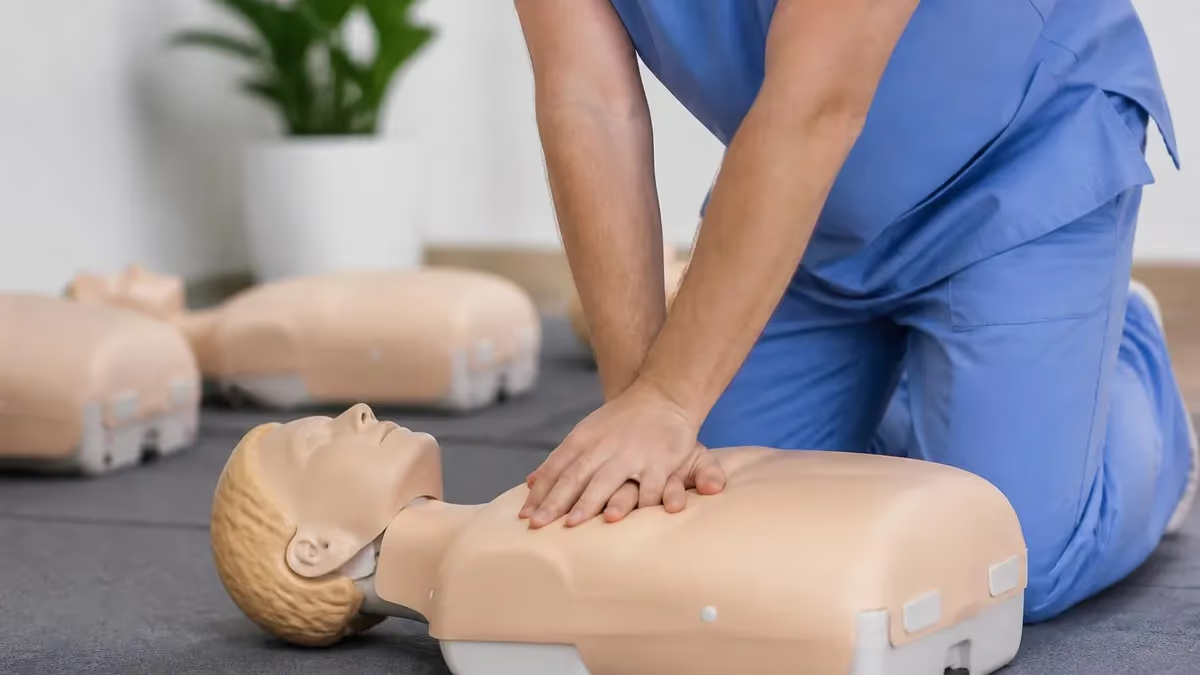
What it is: CPR training and certification from the American Heart Association — the most widely required credential in US healthcare settings.
Main courses: BLS for Healthcare Providers (clinical staff), Heartsaver CPR AED (lay rescuers), ACLS (advanced providers), PALS (pediatric providers).
Valid for: 2 years. All courses require an in-person skills check — no fully online option.
Cost: Heartsaver ~$30–$50; BLS ~$50–$70; ACLS/PALS ~$200–$350.
Verify your card: www.heart.org/cpr/mycards using your eCard ID.
What Is AHA CPR?
AHA CPR is CPR training and certification delivered by the American Heart Association — not just any CPR training, but the specific credential millions of employers, hospitals, nursing programs, and licensing boards across the US require. If you've been told to get "AHA CPR" or seen a job listing that says "BLS certification required," you're looking for an American Heart Association course.
The AHA doesn't run a handful of classes. It operates a massive network of authorized Training Centers — hospitals, community colleges, fire departments, commercial training companies — that teach AHA-approved curricula and issue official AHA provider cards. Every instructor in that network is credentialed by the AHA. That layered system is why the card carries institutional weight that a YouTube tutorial never could.
Here's something most people don't realize: the AHA sets the CPR guidelines that nearly everyone else follows. The compression rate (100–120 per minute), compression depth (2–2.4 inches for adults), the 30:2 ratio — all of it comes from the AHA's evidence reviews, updated every five years through the International Liaison Committee on Resuscitation (ILCOR). When guidelines change in 2025, the AHA updates its courses, and certified providers learn current technique — not outdated approaches from a decade ago.
About 350,000 cardiac arrests happen outside of hospitals in the US every year. Survival depends on bystander action in the first few minutes — before paramedics arrive. That's the whole reason the AHA trains millions of people annually: to make sure there's a trained rescuer in the room when it matters.

AHA CPR by the Numbers
AHA's Main CPR Courses — Which One Do You Actually Need?
There are four main AHA CPR courses, and picking the wrong one is a surprisingly common mistake. Employers are specific. If your hospital says "BLS for Healthcare Providers," a Heartsaver card won't satisfy that requirement — even though both cover CPR. Here's how to tell them apart.
BLS for Healthcare Providers
This is the one most clinical staff need. Nurses, physicians, dental hygienists, paramedics, medical assistants, physical therapists — if you work in a clinical setting, there's a good chance your employer requires BLS. The course covers adult and pediatric CPR, two-rescuer CPR with bag-mask ventilation, AED use, and the team dynamics that matter in a code situation. Duration runs about 3.5 to 4.5 hours depending on the format and class size.
BLS isn't designed to overwhelm you. It's structured so that even someone coming in cold can complete it in an afternoon. The skills check at the end is pass/fail — you demonstrate compression depth, rate, and proper hand placement on a manikin in front of your instructor.
Heartsaver CPR AED
Designed for people who aren't in healthcare but need to be prepared anyway. Teachers, coaches, daycare workers, office managers, fitness instructors — Heartsaver is your course. It covers adult and child CPR, infant CPR (in some versions), AED use, and choking relief for adults and children. Most people finish in two to three hours. It's also available bundled with First Aid if your workplace or program needs both.
Don't let the "lay rescuer" label make you think it's not a real credential. It's a legitimate AHA certification — it just doesn't cover the advanced two-rescuer and team dynamics content that clinical staff practice.
ACLS and PALS — for Advanced Providers
Advanced Cardiovascular Life Support (ACLS) is for providers who actually manage codes: ER nurses, intensivists, paramedics, hospitalists. It builds on BLS and covers pharmacology, advanced airway management, and ACLS algorithms for cardiac arrest, stroke, and post-arrest care. Initial ACLS certification takes a full day — sometimes two. Renewal is shorter, but still substantial.
Pediatric Advanced Life Support (PALS) is the equivalent for pediatric providers — emergency nurses in children's hospitals, pediatric intensivists, pediatric rapid response team members. Both ACLS and PALS expire at two years like every other AHA credential.
Not sure which one you need? Ask HR or your clinical education department — specifically ask for the course name and AHA product code if possible. "CPR certification" is vague. "BLS for Healthcare Providers (AHA)" is not.
For a CPR practice test covering the core concepts from BLS and Heartsaver, you can prep your knowledge before stepping into the skills session.
AHA CPR Course Comparison
| Section | Questions | Time |
|---|---|---|
| Heartsaver CPR AED | 2–3 hrs | Lay rescuers, teachers, coaches |
| BLS for Healthcare Providers | 3.5–4.5 hrs | Nurses, doctors, paramedics, allied health |
| ACLS | 1–2 days | ER/ICU providers, paramedics, physicians |
| PALS | 1–2 days | Pediatric providers, emergency staff |
| HeartCode (Blended) | Online + 1–2 hr skills | Any provider needing flexibility |
AHA Course Formats: In-Person, Blended, or HeartCode?
This is where a lot of people get confused — and it matters more than you'd think for scheduling.
Traditional instructor-led courses run everything in one room, in one session. You show up, watch the AHA videos, practice on manikins, get your skills checked, leave with your card. Simple. For Heartsaver, that's two to three hours. For BLS, it's closer to four. These classroom sessions run at hospitals, training centers, community colleges, and fire stations nationwide.
Blended learning splits the cognitive part from the skills part. You complete an online knowledge module on your own schedule — at home, during a lunch break, whenever — then show up for a shorter in-person skills session (usually 60–90 minutes) where an instructor verifies your technique. For busy nurses or residents who struggle to block out a full afternoon, this is often the practical choice. The certification you receive is identical to classroom-only completion.
HeartCode is AHA's branded blended learning platform. HeartCode BLS, HeartCode ACLS, HeartCode PALS — each has an online module followed by an in-person or skills station component. Some medical centers and training facilities have set up Laerdal LLEAP skills stations where you complete the hands-on portion without a live instructor present, using a computerized manikin that evaluates your technique. The instructor signs off remotely or reviews the station data.
One thing won't change no matter which format you choose: you cannot complete AHA certification entirely online. The skills check is non-negotiable. If someone is selling a "100% online AHA CPR certification," that's not a legitimate AHA credential — full stop. The AHA explicitly requires that skills be observed and verified by an authorized instructor or through an approved skills station. Employers who check eCard validity will see a real certification; a fraudulent online card won't pass verification.
Want to work on the knowledge side before your class? CPR techniques practice questions cover compression mechanics, rescue breathing, and AED protocols that appear in both Heartsaver and BLS content.
How to Find an AHA Training Center
The fastest way: go to heart.org/cpr and use the training center locator. You enter your ZIP code, select the course you need (BLS, Heartsaver, ACLS, PALS), and get a list of authorized AHA Training Centers near you with contact information. Not every training center offers every course — some specialize in healthcare provider BLS and ACLS; others focus on community Heartsaver programs. The locator shows you which courses each location offers.
What types of places run AHA courses? Hospitals and health systems are the most common — most large hospitals have their own Training Centers for staff certification and sometimes open to the public. Community colleges, vocational schools, American Red Cross chapters (which do run some AHA-authorized courses in certain regions), fire departments, YMCAs, and commercial training companies like ProTrainings or the National CPR Foundation all operate as authorized AHA Training Centers in various parts of the country.
Group training is worth asking about. If you need to certify five or more people — a dental office, a school staff, a sports team coaching staff — many training centers offer on-site group training where an instructor brings manikins and AED trainers to your location. The per-person cost is often comparable to public course enrollment, and you eliminate the logistics of transporting your whole group. For organizations certifying 20+ people, on-site training is almost always the better option logistically.
When you're scheduling, check whether the training center issues AHA eCards directly or uses a third-party system. Most authorized centers now issue official AHA eCards through the AHA's eCard portal, which gives your employer a verifiable credential. Some older systems still issue paper cards — valid, but not as easily verifiable by employers who use the AHA's online verification tool. Asking upfront saves confusion later.
Looking for community CPR resources alongside certification? Heart association cpr classes covers the full training network and what to expect when you walk in for your first session.

AHA Training Center Checklist
- ✓Verify the center is an authorized AHA Training Center (listed on heart.org/cpr)
- ✓Confirm they offer your specific course — BLS, Heartsaver, ACLS, or PALS
- ✓Ask whether they issue official AHA eCards (not third-party certificates)
- ✓Check whether public sessions are available or registration is required in advance
- ✓Ask about group pricing if certifying 5 or more people at once
- ✓Confirm the format: classroom-only or blended HeartCode option available
- ✓Ask whether your employer covers the cost before paying out of pocket
Your AHA Certification Card: What It Is and How to Verify It
Once you pass your skills check, your instructor issues your AHA provider card — now primarily delivered as a digital eCard via email. The eCard arrives with your name, the course completed, your completion date, and your expiration date (two years out). It also has a unique eCard ID number.
That eCard ID is the key to verification. Anyone who needs to confirm your certification — a hospital HR department, a nursing school clinical coordinator, a new employer — can visit the AHA's online verification portal and enter your eCard ID to confirm it's a real, current credential.
This makes it much easier to submit proof of certification than hunting down a physical card. Save that eCard email somewhere permanent. Your calendar app, a professional documents folder, a screenshot on your phone — doesn't matter where, just somewhere you can find it in six months when your new employer's credentialing department asks for it.
To look up or re-access your own card: go to www.heart.org.cpr/mycards and log in with the email address you used when you registered for your course. If you registered through a training center that didn't create an AHA account for you, contact the training center directly — they maintain records of completed courses and issued cards.
Physical wallet cards still exist at some training centers, but they're increasingly rare. The eCard system is now the AHA standard. Physical cards aren't more "official" than eCards — they're the same credential, just in different formats. If your employer asks for a "physical card," what they usually mean is proof of certification, which an eCard screenshot or printed copy satisfies.
Two-year expiration. That's the rule across all AHA CPR courses — BLS, Heartsaver, ACLS, PALS. The AHA doesn't send renewal reminders — not by email, not by text. If you don't set a calendar reminder yourself, you'll find out your certification expired when someone asks to see a current card. The most practical move: the day you complete your course, add an event to your calendar 20 months out titled "renew CPR certification" — that gives you a 4-month buffer before actual expiration.
AHA eCard Quick Facts
AHA vs. Red Cross CPR — What's Actually Different?
Both are legitimate. Both follow the same ILCOR evidence-based guidelines, which means the compression rate, depth, and ratio they teach are identical. A person certified by the AHA and a person certified by the American Red Cross have learned the same fundamental technique. The CPR itself isn't different.
What's different is institutional preference — and it matters more than people expect. Healthcare settings almost universally specify AHA BLS for Healthcare Providers. Not "CPR certification from an approved provider." Not "Red Cross CPR is fine." They want the AHA card specifically. This is partly historical (AHA has been the dominant clinical standard for decades), partly because many hospital accreditation programs reference AHA guidelines specifically, and partly because AHA's BLS curriculum covers team dynamics and two-rescuer scenarios in the depth that clinical settings need.
For lay rescuer contexts — teacher certification requirements, daycare worker requirements, workplace first responder programs — the two organizations are generally interchangeable. Most non-clinical employers accepting CPR certification will accept either Red Cross or AHA credentials without preference.
Red Cross courses tend to have a slightly heavier first aid integration in their standard offerings, while AHA courses are more CPR-focused with separate first aid add-ons. Red Cross chapters are often more distributed in community settings; AHA Training Centers are more concentrated in clinical and hospital environments. Depending on your location, one may have more accessible scheduling than the other.
Bottom line: if you're in healthcare or pursuing a healthcare education program, get AHA. If you're a teacher, coach, or workplace first responder and your employer just says "CPR certification," call and ask whether they accept Red Cross — many do, and it might be easier to schedule. Don't assume though. Ask first. The cost of getting the wrong card and having to redo it is more annoying than a five-minute phone call.
If you want to compare your knowledge across both first aid and CPR frameworks, CPR and first aid questions covers both areas in a single practice set.

AHA vs. Red Cross: Key Differences
AHA BLS is the standard in healthcare — hospitals, nursing programs, medical schools, and dental schools almost always specify AHA. If the requirement says "BLS for Healthcare Providers," you need the AHA card specifically. Red Cross CPR is typically interchangeable in lay rescuer and non-clinical contexts: daycares, schools, workplaces, fitness facilities. When in doubt, ask your employer which one they accept before paying for a course.
Renewal vs. Initial Certification — What Changes the Second Time Around
Renewal courses are shorter. That's the main difference. When you recertify before your current card expires, you complete a renewal-format course that assumes you already know the fundamentals — it focuses on skills refresher and any guideline updates since your last certification. BLS renewal with HeartCode takes about 60–90 minutes for the skills component after completing the online module. Compare that to the 3.5–4.5 hours for initial BLS. The certification you receive is identical — the renewal just gets you there faster.
The critical catch: "renewal" only applies if you're recertifying while your current card is still valid. If your certification has already expired, you don't get the shorter renewal format. You start over with the full initial course. This is why the advice to renew early isn't just pro-forma guidance — it has a real practical cost if ignored. An expired-by-one-day card means a full afternoon instead of 90 minutes.
Some healthcare organizations build renewal into their employee education calendar — annual skills fairs, designated recertification sessions, on-site training days. If your employer offers this, use it. It's usually covered, it's scheduled for you, and there's no logistics to manage. For providers who work at multiple facilities, one current AHA certification covers all of them — you don't need separate cards for each employer.
Timing renewal strategically: if you renew a month before expiration, your new card expires two years from the renewal date — one month earlier in the cycle than before. Over a decade of healthcare employment, that can accumulate into meaningful lost time per renewal cycle. Some providers time their renewal to the same month every even year for simplicity, accepting the slight shortening in exchange for a predictable annual schedule. Worth thinking about if you plan to maintain certification long-term.
The how long does cpr certification last article covers expiration and renewal timing across both AHA and Red Cross in detail, including what to do if you've let a card lapse. For the AHA-specific side, what you need to know is: two years, renew early, use HeartCode if your schedule is tight.
Steps to Get AHA CPR Certified
Ask your employer or program for the specific AHA course name — BLS, Heartsaver, ACLS, or PALS. Don't guess. The wrong card means doing it again.
Use the locator at heart.org/cpr. Filter by course type and ZIP code. Confirm the center issues official AHA eCards before registering.
Classroom (all in one session) or blended/HeartCode (online knowledge + in-person skills check). Both give you the same credential. Blended fits busy schedules better.
Show up prepared — skills check is pass/fail on compression depth, rate, and technique. Your instructor observes and signs off. No shortcuts.
Your AHA eCard arrives by email. Save it somewhere permanent. Add a calendar reminder for 20 months out — don't wait until expiration to act.
What AHA CPR Certification Actually Costs
Heartsaver CPR AED runs about $30–$50 at most training centers. Some community programs — fire department open houses, hospital outreach events, nonprofit training days — offer it cheaper or free. If cost is a barrier, check whether your local hospital, fire station, or YMCA runs subsidized training.
BLS for Healthcare Providers is typically $50–$70. Some hospitals offer it to new hires at no cost during orientation. Ask your employer's education department before paying out of pocket — you might find it's already covered.
ACLS and PALS initial certifications run $200–$350, sometimes higher at commercial training companies. Renewal courses are cheaper — usually $150–$250. Employers requiring ACLS and PALS commonly cover these as benefits. If yours doesn't, professional association membership sometimes unlocks discounts at affiliated training centers.
HeartCode blended courses typically cost $20–$30 more than classroom-only versions. Worth it if your schedule is tight; skip the premium if you can block a full afternoon. Ready to test your knowledge? Cardiopulmonary resuscitation techniques covers the hands-on mechanics you'll be tested on during your skills check.
AHA CPR Certification: Pros and Considerations
- +Most widely required CPR credential in US healthcare — BLS accepted by virtually every hospital
- +Evidence-based curriculum updated with latest ILCOR guidelines — you learn current technique
- +In-person skills check ensures actual competency, not just multiple-choice knowledge
- +Digital eCard system lets employers verify credentials online instantly
- +Nationwide network of Training Centers — most areas have multiple options
- +HeartCode blended learning allows flexible scheduling for busy healthcare providers
- −2-year expiration means ongoing renewal commitment — time and cost every two years
- −In-person skills component required — no way to certify 100% online
- −BLS not interchangeable with Heartsaver for clinical employment — must have correct course
- −Course costs not always covered by employer, especially in non-clinical roles
- −ACLS and PALS involve significant time and cost for initial certification
- −AHA doesn't send expiration reminders — your responsibility to track renewal dates
AHA CPR Questions and Answers
About the Author

Registered Nurse & Healthcare Educator
Johns Hopkins University School of NursingDr. Sarah Mitchell is a board-certified registered nurse with over 15 years of clinical and academic experience. She completed her PhD in Nursing Science at Johns Hopkins University and has taught NCLEX preparation and clinical skills courses for nursing students across the United States. Her research focuses on evidence-based exam preparation strategies for healthcare certification candidates.
Join the Discussion
Connect with other students preparing for this exam. Share tips, ask questions, and get advice from people who have been there.
View discussion (5 replies)