
Basic Life Support Certification: BLS Course Guide 2026 September
🆕 Get your basic life support certification with our complete BLS guide. Learn course requirements, costs, renewal, and how to prepare for the exam.
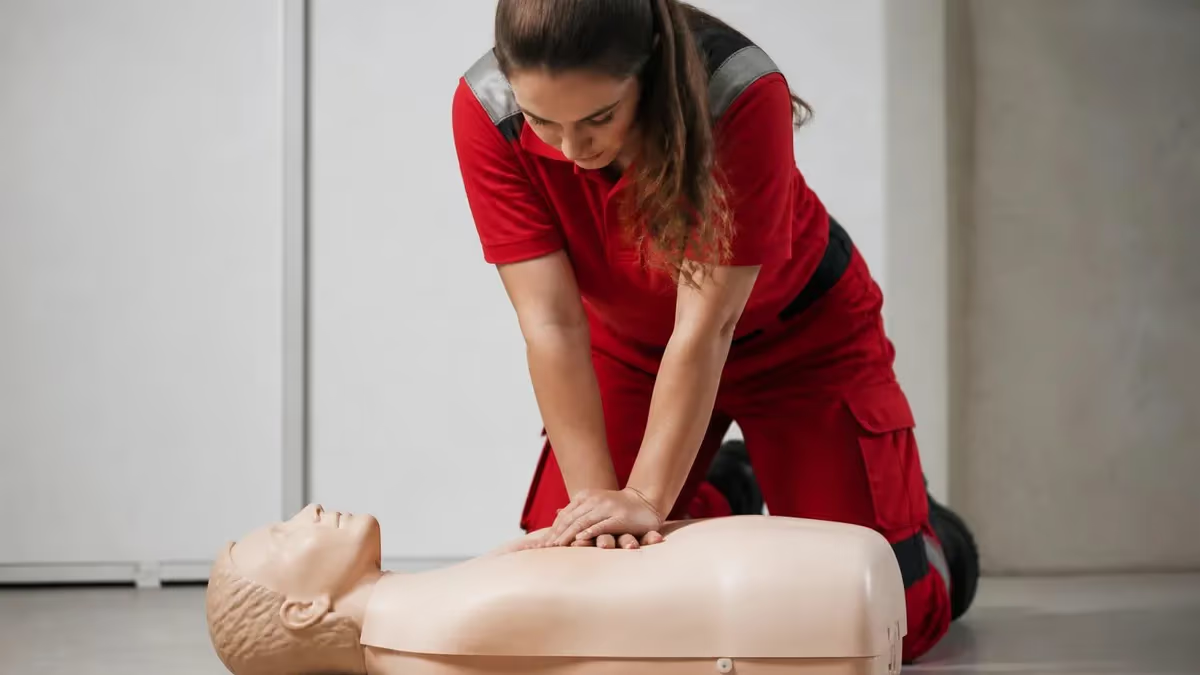
Basic Life Support Certification: What You Need to Know
Basic life support certification is one of the most in-demand credentials in healthcare. Whether you're a nurse, EMT, dental hygienist, or fitness trainer, having a valid BLS card can mean the difference between keeping your job and losing it. About 18,000 people search for basic life support certification every month—and most of them are trying to answer the same handful of questions: How do I get certified? How much does it cost? How long does it last?
This guide answers all of that. We'll walk through the entire process from picking a course to sitting the exam, so you can walk away with your card and get back to work.
What Is Basic Life Support Certification?
BLS certification proves you can perform basic life support techniques—CPR, rescue breathing, and AED use—on adults, children, and infants. It's not the same as a general first aid certificate or a public CPR course. BLS is specifically designed for healthcare providers: people who might encounter a cardiac arrest on the job, not just in a parking lot.
The American Heart Association (AHA) is the gold standard for BLS training. Their AHA BLS certification is recognized by virtually every hospital, clinic, and healthcare employer in the United States. The Red Cross also offers a widely accepted version. When your employer says "BLS required," they almost always mean one of these two.
Who Needs BLS Certification?
The short answer: anyone who works in or near a clinical setting. That said, requirements vary by role and state.
You'll almost certainly need current BLS if you're a:
- Registered nurse (RN) or licensed practical nurse (LPN)
- Medical assistant or phlebotomist
- EMT or paramedic
- Dental hygienist or dental assistant
- Respiratory therapist or physical therapist
- Medical student or nursing student (many programs require it before clinical rotations)
- Personal trainer or fitness instructor at a facility with AED equipment
Even some non-clinical roles—school employees, lifeguards, childcare workers—are required to hold BLS in certain states. Check your licensing board's rules if you're not sure.
Choosing a BLS Course
The AHA offers three delivery formats for its BLS Provider course:
Classroom (Instructor-Led)
You show up in person, practice on manikins, and get immediate feedback from a certified instructor. This is the traditional route, and it's still the most thorough. Classes typically run 3–4 hours. If you've never had BLS training before, start here.
Blended Learning (HeartCode BLS)
HeartCode splits the course into two parts: you complete the cognitive portion online (about 1–2 hours), then attend a brief hands-on skills session at an authorized training site. The skills session usually takes 45–60 minutes. Many hospitals and large healthcare systems use this format because it's faster and flexible without skipping the manikin practice.
Online-Only Courses: A Warning
Here's where people get confused. You cannot complete a fully AHA-compliant BLS certification online. Any course that promises a card without hands-on skills testing isn't a real AHA course—and many employers won't accept it. If someone's offering a 0 online-only BLS card, walk away.
BLS Course Requirements and Format
The AHA BLS Provider course covers:
- High-quality CPR for adults, children, and infants
- Team dynamics and real-time feedback on compression depth and rate
- AED operation and safe use
- Relief of foreign-body airway obstruction
- Two-rescuer scenarios
The skills evaluation is practical—an instructor watches you perform CPR and other skills on a manikin and checks that you meet minimum competency standards. There's also a written or digital exam, typically 25 questions, covering core concepts. You need to pass both parts to earn your card.
Understanding the bls chain of survival is crucial for the exam. The AHA's chain of survival lays out the sequence of actions that maximize survival after cardiac arrest: early recognition, early CPR, early defibrillation, advanced care, and recovery.
How Much Does BLS Certification Cost?
Expect to pay 0–00 for a BLS provider course. Here's roughly what drives the price:
- Location: Hospital-based courses are often subsidized for employees. Community courses at firehouses or community colleges tend to be cheaper than private training centers.
- Format: Blended learning (HeartCode) is sometimes cheaper than a full classroom session because instructor time is shorter.
- Group vs. individual: If you're getting certified as part of a workplace group, your employer might cover the cost entirely.
Don't pay extra for expedited processing or fancy laminated cards—the AHA eCard (digital certification) is valid and widely accepted. You can verify it instantly online.
How Long Is BLS Certification Valid?
Your BLS card is valid for two years. After that, you need to renew—even if you know the material cold.
Many healthcare workers get caught off guard when their card expires right before a license renewal or hospital credentialing check. Set a calendar reminder 3 months before your expiration date. That gives you plenty of time to find a bls renewal course without scrambling.
BLS Renewal and Recertification
The renewal process is nearly identical to initial certification—you take the course again and demonstrate your skills. There's no shortcut for letting your card lapse; if it's expired, you retake the full course.
Some providers offer a renewal-specific class that's slightly shorter, since you're assumed to have prior experience. These typically run 2–3 hours for classroom format. HeartCode BLS Renewal is also available for the blended path.
BLS recertification should be on your radar if:
- Your card expires in the next 60–90 days
- You're starting a new job that requires proof of current BLS
- Your card has already lapsed (you'll need the full course)
Preparing for the BLS Exam
Most people pass the BLS written test without much trouble—but it's not completely trivial. The questions cover CPR ratios, compression depth, AED operation, and scenarios where you have to identify the right action. Here are the key numbers to memorize:
- Compression rate: 100–120 per minute for all ages
- Adult compression depth: at least 2 inches (no more than 2.4 inches)
- Child compression depth: at least 2 inches
- Infant compression depth: at least 1.5 inches
- CPR ratio (1 rescuer): 30 compressions to 2 breaths for adults, children, and infants
- CPR ratio (2 rescuers, infant or child): 15 compressions to 2 breaths
- After AED shock: resume CPR immediately—do not stop to check for a pulse
Running through practice questions before your class helps you feel more confident during the skills portion too, because you've already thought through the scenarios. Our American Heart Association BLS practice resources include hundreds of questions modeled on real exam content.
Putting BLS Certification on Your Resume
Once you have your card, list it clearly. The standard format:
BLS Provider — American Heart Association, Expires [Month Year]
Include it in a Certifications or Licenses & Certifications section, not buried in your skills list. Recruiters and HR teams scan for it specifically, and it needs to be findable. Don't abbreviate it as just "CPR"—employers looking for BLS won't equate the two.
If your employer verifies credentials through a platform like symplr or Greenway Health, make sure your card number is entered correctly. The AHA's verification portal (using your eCard code) is where they'll check.
How to Find BLS Certification Classes Near You
The AHA's course finder at heart.org lets you search by zip code for authorized training centers. Filter by BLS Provider and your preferred format. Results show price, availability, and whether group bookings are accepted.
A few other places to check:
- Your employer's education department — many hospitals run their own AHA training centers and offer courses to employees at reduced or no cost
- Community colleges — often have allied health or EMS programs with open-enrollment BLS classes
- Fire departments — some run community training programs; availability varies by region
- Local YMCA or Red Cross chapters — for Red Cross BLS specifically, the Red Cross site has a similar finder tool
If you're in a rural area or have a packed schedule, HeartCode BLS gives you the most flexibility. You do the online portion whenever you want, then find any authorized skills station for a 45-minute slot.
Common Mistakes to Avoid
Buying an online-only card. Some sites sell certificates that look official but aren't recognized by hospitals or licensing boards. Always verify that a course is run by an AHA-authorized training center before you pay.
Letting your card expire before renewal. An expired card is the same as no card in most employers' eyes. Don't wait until the month it expires—renewal slots fill up fast, especially in January and September when clinical programs start.
Confusing BLS with ACLS or PALS. Advanced Cardiovascular Life Support (ACLS) and Pediatric Advanced Life Support (PALS) are higher-level credentials for specific clinical roles. BLS is the prerequisite for both. Get BLS first, then layer on ACLS or PALS if your role requires it.
Not practicing compression technique before class. The skills evaluation tests compression depth, rate, and recoil. Going in cold can mean failing the practical even if you ace the written portion. Watch a couple of AHA tutorial videos beforehand—it helps more than you'd think.
BLS for Healthcare vs. Community CPR: Key Differences
It's worth being specific about what BLS certification is and isn't. Here's how it stacks up against other CPR courses:
Community or Heartsaver CPR/AED courses are designed for laypeople—bystanders who might respond to an emergency in a public setting. They're shorter, often fully online, and don't require skills testing by a credentialed instructor in the same way.
BLS for Healthcare Providers is a more rigorous standard. It covers additional scenarios (two-rescuer CPR, infant CPR, bag-mask ventilation), requires instructor observation, and results in a card that healthcare employers actually accept. If a job posting says "BLS required," they mean this version—not a Heartsaver card.
When in doubt, call your employer's credentialing or HR department and ask which specific certification they accept. Five minutes on the phone saves you from taking the wrong course.

Ready to Get Certified?
Basic life support certification isn't complicated—but it does require showing up and doing the work. Pick an authorized course, practice your compression technique, and review the key numbers before class. Two to four hours later, you'll have a credential that most healthcare jobs require and that stays valid for two years.
If you want a head start on the written exam, practice tests are one of the best ways to identify gaps in your knowledge before you're sitting in a classroom. Our BLS practice questions cover the same topics as the AHA exam—CPR ratios, AED protocols, team dynamics, and multi-rescuer scenarios—so you walk in knowing what to expect.
Don't wait until your employer sends a reminder that your card is expiring. Find a bls certification classes option that fits your schedule, lock in your renewal date, and keep your credentials current.
About the Author

Registered Nurse & Healthcare Educator
Johns Hopkins University School of NursingDr. Sarah Mitchell is a board-certified registered nurse with over 15 years of clinical and academic experience. She completed her PhD in Nursing Science at Johns Hopkins University and has taught NCLEX preparation and clinical skills courses for nursing students across the United States. Her research focuses on evidence-based exam preparation strategies for healthcare certification candidates.
Join the Discussion
Connect with other students preparing for this exam. Share tips, ask questions, and get advice from people who have been there.
View discussion (8 replies)