
AHA BLS Certification: Course, Renewal, and Exam Guide 2026 September
Complete guide to AHA BLS certification: what the course covers, written exam format, CPR skills tested, renewal requirements, HeartCode BLS, and how 🔎
What Is AHA BLS Certification?
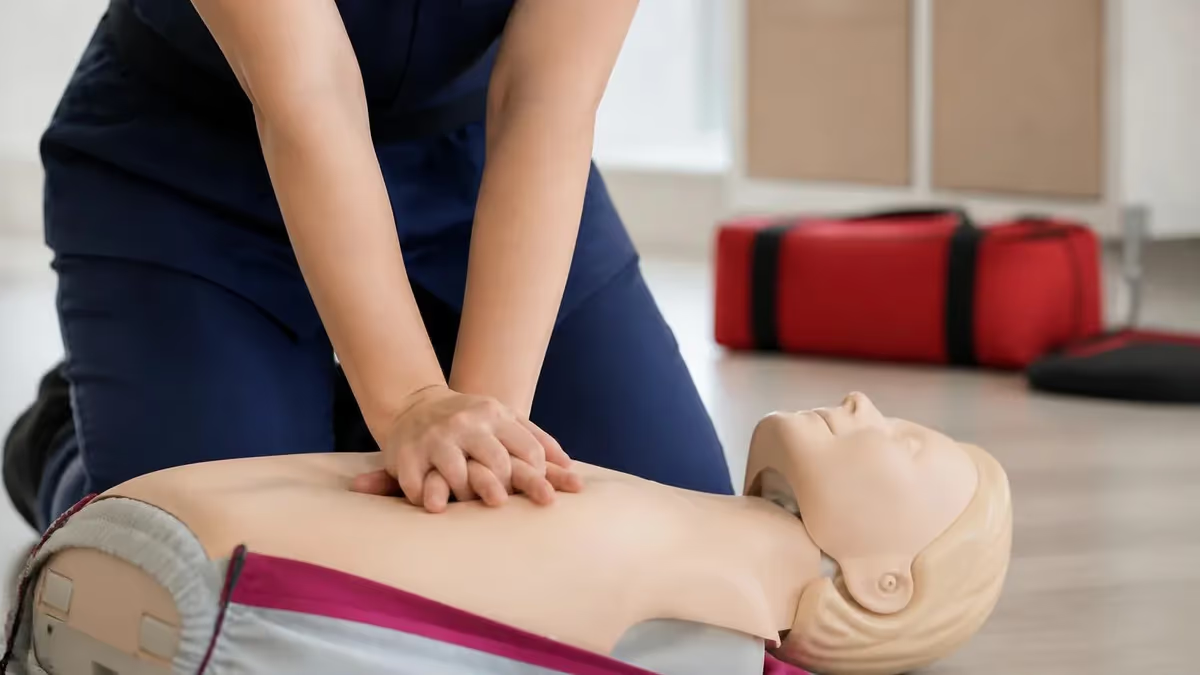
The American Heart Association's Basic Life Support (BLS) certification is the most widely recognized healthcare provider CPR credential in the United States. It's designed for clinical professionals — nurses, physicians, paramedics, EMTs, respiratory therapists, and other allied health workers — who need to respond to cardiac and breathing emergencies in healthcare settings. Unlike lay rescuer CPR courses, the AHA BLS certification follows the AHA's evidence-based guidelines and is updated every five years following the AHA's comprehensive review of resuscitation science.
BLS certification from the AHA is more than a CPR card — it demonstrates competency in a specific protocol. The course covers adult, child, and infant CPR and AED use, two-rescuer CPR techniques, bag-valve-mask (BVM) ventilation, team dynamics in resuscitation, and special situations including drowning victims and opioid overdose. Completion requires both a written (or online) knowledge assessment and a hands-on skills evaluation conducted by an AHA-certified instructor.
Many employers — particularly hospitals, surgical centers, urgent care clinics, and healthcare agencies — require that their clinical staff maintain current AHA BLS certification rather than accepting cards from other organizations. This is worth understanding before you sign up: if your employer specifies AHA BLS, a Red Cross course or other provider's certification may not satisfy the requirement even if the content is similar. When in doubt, confirm with your HR or credentialing department which specific card they accept.
The AHA issues BLS certifications valid for two years. When your card expires, you must complete the BLS Renewal course (also called the BLS for Healthcare Providers Renewal) to maintain active certification. Letting your certification lapse beyond the expiration date typically requires repeating the full initial course rather than just the shorter renewal version, so staying current avoids extra time and cost.

- Full name: BLS for Healthcare Providers
- Provider: American Heart Association (AHA)
- Valid for: 2 years
- Course duration: 4–5 hours (blended); 2–3 hours (renewal)
- Pass mark (written): 84% or higher
- Who needs it: Healthcare professionals, students in clinical programs
- Formats: Instructor-led, HeartCode BLS (online + skills), blended learning
Who Needs AHA BLS Certification?
AHA BLS certification is required or strongly preferred for a wide range of healthcare professions. Registered nurses and licensed practical nurses must typically maintain current BLS certification throughout their career, regardless of specialty. Physicians, nurse practitioners, and physician assistants are expected to hold BLS certification, with many advanced practice providers also carrying ACLS (Advanced Cardiovascular Life Support) certification. Paramedics and EMTs carry BLS as a foundational credential alongside more advanced certifications.
Allied health professionals — including respiratory therapists, physical therapists, occupational therapists, radiologic technologists, and phlebotomists — frequently need BLS certification as a condition of employment or clinical placement. Dental professionals, including dentists, dental hygienists, and dental assistants, are required to maintain BLS certification in most states through dental licensing regulations. Medical assistants and surgical technologists are also commonly required to hold current BLS cards.
Healthcare students need BLS certification before or during their clinical rotations. Nursing schools, medical schools, physician assistant programs, and most allied health programs require students to demonstrate current AHA BLS certification before beginning patient contact in clinical placements. Getting certified early in your training — rather than waiting until just before clinicals begin — is strongly advised, as enrollment demand for BLS classes tends to spike at the start of academic terms.
Non-healthcare professionals who work in healthcare-adjacent settings may also need BLS certification. School nurses, childcare providers, and fitness professionals (including personal trainers and group exercise instructors) often need BLS-level CPR certification, though some employers in these settings accept lay rescuer CPR courses rather than requiring the full healthcare provider BLS. Check your specific employer's requirement to determine which course applies.
AHA BLS vs. Other CPR Certifications
Full healthcare provider CPR certification. Covers adult/child/infant CPR, 2-rescuer CPR, BVM ventilation, AED use, team dynamics. Required by most hospitals and clinical employers. 2-year validity.
Designed for lay rescuers, schools, workplaces, and non-clinical settings. Simpler content, no bag-mask ventilation. Acceptable for non-clinical jobs, coaches, teachers, etc. NOT accepted by most healthcare employers in place of BLS.
American Red Cross alternative to AHA. Content is similar but not identical. Some employers accept Red Cross CPR/AED; others specifically require AHA. Always verify which organization your employer accepts before enrolling.
Advanced certification building on BLS. Required for RNs in ICU, ED, and telemetry units, and for physicians in most specialties. BLS is a prerequisite for ACLS. Covers arrhythmia recognition, algorithm-based resuscitation, and IV medication use.
AHA BLS Course Formats
The AHA offers BLS certification through several delivery formats, giving healthcare providers flexibility based on their schedule, learning preferences, and employer requirements. Not all formats are available everywhere, and employers sometimes specify which format they accept — so it's worth confirming before you register.
The instructor-led classroom course is the traditional format. Students complete the entire course in person with a certified AHA instructor over approximately four to five hours. Video-based instruction using AHA's curriculum is integrated with hands-on practice on mannequins, using an AED trainer, and bag-valve-mask equipment. The skills test is conducted by the instructor at the end of the session. This format works well for learners who prefer direct feedback during practice and for organizations that provide group training onsite.
HeartCode BLS is the AHA's fully online knowledge component, available through the AHA Training Network or directly from the AHA. Students complete the cognitive (knowledge) portion of the course online at their own pace — typically two to three hours — then schedule a hands-on skills check session at a local AHA Training Center to complete the certification. The HeartCode format doesn't eliminate the in-person skills component; it replaces the classroom knowledge instruction but still requires verified hands-on competency with a certified instructor before the card is issued. This is the most flexible format for busy professionals.
The blended learning format combines an online component (like HeartCode) with a face-to-face skills session. It's increasingly common for institutions to purchase group licensing for the online portion and then bring students through skills sessions in cohorts. This reduces the total time spent in classroom instruction while maintaining the hands-on competency verification that the BLS certification is built on.
AHA BLS Format Requirements
- ✓All AHA BLS formats require in-person skills evaluation with a certified instructor
- ✓No fully online BLS certification exists that satisfies AHA requirements
- ✓HeartCode BLS online modules must be completed before the in-person skills session
- ✓Verify your employer accepts blended/HeartCode format before enrolling
- ✓Skills sessions for HeartCode completers are typically 30-60 minutes at a Training Center
- ✓AHA requires that instructors observe and verify each skill individually, not as a group demo

What the BLS Course Covers
The AHA BLS curriculum is based on the most current AHA Guidelines for CPR and Emergency Cardiovascular Care, updated every five years. The content covers the entire chain of survival — from recognition of cardiac arrest through CPR, defibrillation, and preparation for advanced care. Every component of the course is clinically grounded and tested in real-world resuscitation research.
High-quality CPR is the central skill in BLS. This includes correct hand placement, compression depth (at least 2 inches for adults, 2 inches or about one-third chest depth for children, 1.5 inches for infants), compression rate (100–120 per minute), allowing full chest recoil between compressions, minimizing interruptions to compressions, and avoiding excessive ventilation. These specific parameters matter — research demonstrates that each deviation from the guidelines (too slow, too deep, not allowing recoil) measurably reduces resuscitation outcomes.
AED use is a core component. BLS providers must be able to safely operate an AED — power it on, apply pads correctly, follow the device's prompts, ensure everyone is clear during shock delivery, and resume CPR immediately after the shock. AED use is covered for adults and pediatric patients, including the use of pediatric pads or key when available for children under 8 or under 55 pounds.
Bag-valve-mask (BVM) ventilation is taught in BLS as both a single-rescuer and two-rescuer skill. Maintaining a proper mask seal, delivering appropriate tidal volume (visible chest rise without excessive inflation), coordinating ventilation with compressions during two-rescuer CPR, and using an oral airway adjunct when available are all covered. Ventilation technique is commonly undertrained — students who spend extra time practicing BVM technique typically perform better in their skills assessment.
Infant and child CPR uses different techniques than adult CPR. The course covers two-finger and two-thumb encircling hand technique for infant chest compressions, head-tilt/chin-lift versus jaw thrust in trauma situations, recognition of pediatric cardiac arrest versus respiratory arrest, and when and how to modify the CPR sequence based on the patient's age and situation. Special situations covered include near-drowning, opioid overdose response, and recognizing when lay rescuers have already started CPR before the healthcare provider arrives.
AHA BLS and Cardiac Arrest Facts
The BLS Written Exam
The AHA BLS written exam consists of 25 multiple-choice questions and must be completed with a score of 84% or higher (21 out of 25 correct) to pass. The exam covers the knowledge components of the BLS course — the rationale behind CPR techniques, recognition of cardiac arrest, AED operation, team roles in resuscitation, and the evidence-based parameters that define high-quality CPR. It's not a trick exam, but it does require genuine understanding of the protocols, not just surface familiarity.
Question topics include the definition of cardiac arrest versus respiratory arrest, the sequence of BLS actions (C-A-B — compressions first, then airway and breathing), compression depth and rate requirements, ventilation ratios (30:2 for single rescuer adult CPR, 15:2 for two-rescuer pediatric CPR), AED pad placement, indications for withholding or discontinuing CPR, the role of epinephrine (mentioned in course context), and team dynamics including closed-loop communication and role clarity in resuscitation.
A passing score on the written exam is required alongside successful skills evaluation to receive the BLS certification card. If you fail the written component, you can typically retake it — check with your training center for their specific retake policy. Some training centers allow an immediate retake; others require a brief review period first. Students who fail the written exam despite completing the course usually benefit from reviewing the AHA BLS provider manual before retaking, paying particular attention to the specific numbers (compression depth, rate, pass threshold) that are commonly missed.
One practical tip: the AHA BLS exam allows you to reference the course materials during the assessment at some training centers, while others require closed-book testing. Ask your training center before the class so you know what to expect. Even if materials are available, knowing the key numbers cold will save you time and reduce errors under test conditions.
BLS Skills Stations
The adult CPR station assesses: scene safety check, recognizing cardiac arrest (unresponsive, no normal breathing), activating emergency response, initiating high-quality compressions (depth ≥2 inches, rate 100–120/min, full recoil), delivering 30 compressions to 2 ventilations, and correctly operating an AED. You must demonstrate the complete sequence from recognition through defibrillation. Delays, incorrect compression depth or rate, and improper AED pad placement are the most common reasons for failing this station.
BLS Renewal and Expiration
AHA BLS certification is valid for exactly two years from the completion date printed on the card. Healthcare employers track expiration dates carefully — many credentialing departments send renewal reminders 60–90 days before expiration, and some clinical environments won't allow a provider with an expired card to take patient assignments until they're recertified. Don't let your card lapse if you can help it.
The BLS certification renewal course is shorter than the initial certification course — typically two to two-and-a-half hours for the instructor-led format. It assumes you already know the BLS content and focuses on reviewing updates to guidelines since your last certification, verifying that your skills remain sharp, and completing the written knowledge assessment. If your card has expired, the training center may require you to repeat the full initial course rather than the shorter renewal, since an expired provider is treated as if they have no current certification.
HeartCode BLS is also available as the renewal format. The online component covers the same renewal content as the classroom renewal course, followed by the in-person skills check. Many providers find the HeartCode renewal format more flexible than attending a scheduled class, particularly for those with irregular shifts or who work at facilities without frequent onsite BLS training sessions.
Some employers require renewal before the actual expiration date — for example, a hospital might require that BLS certification not expire during any scheduled pay period, meaning you may need to renew a month or two before the technical expiration date. Check your employer's specific policy to avoid unexpected compliance issues. Many institutions also require that BLS renewal be completed through AHA specifically, not just any CPR provider.
How to Prepare for the BLS Exam
- ✓Read the AHA BLS Provider Manual before your course — it contains all tested content
- ✓Memorize the key numbers: 30:2 ratio, 100–120 compressions/min, 2-inch adult depth
- ✓Know the pediatric differences: 15:2 for 2-rescuer, 1.5-inch infant depth
- ✓Understand AED pad placement for adults vs. children vs. infants
- ✓Review the Chain of Survival for in-hospital vs. out-of-hospital cardiac arrest
- ✓Practice BVM ventilation technique — specifically the E-C clamp mask seal
- ✓Take practice BLS questions to identify knowledge gaps before the course
- ✓Know when to use jaw thrust vs. head-tilt/chin-lift (suspected spinal injury)
- ✓Review the opioid emergency response protocol covered in current AHA curriculum
- ✓Practice compressions until 100–120/min rate and 2-inch depth feel natural
How to Pass the AHA BLS Certification
The BLS certification has two components, and you need to pass both: the written knowledge exam and the hands-on skills evaluation. Most people pass both on the first attempt with adequate preparation, but the skills portion is where unprepared students most often struggle. The key is genuine practice before your course — not just attending class and hoping the practice time during the session is enough.
For the written exam, preparation means reading the AHA BLS Provider Manual and taking practice questions targeting the specific content areas. The exam isn't designed to trick you — it tests whether you understand the protocols well enough to apply them. Pay particular attention to the numerical parameters (compression depth, rate, ratio, pass threshold), the differences between adult and pediatric BLS, and the sequence of actions in a 1-rescuer vs. 2-rescuer scenario. Students who fail the written exam typically either didn't review the manual or confused the pediatric and adult numbers.
For the skills evaluation, repetition is everything. The goal is to perform each skill automatically, without having to consciously recall each step. Practice compressions with a pillow or chair cushion if you don't have a training mannequin — getting the rhythm and pressure right takes repetition. If your employer has a skills lab or sim lab with mannequins and AED trainers, use it before your certification class. The more comfortable you are with the physical execution of the skills, the better you'll perform under observation.
Don't underestimate the bag-valve-mask station. The E-C clamp technique for achieving a mask seal is counterintuitive for most students and requires deliberate practice to execute correctly. Ask your instructor to watch you practice the seal specifically, since this is the component most often requiring correction during the skills evaluation. Two-rescuer BVM coordination — where one person holds the mask while the other squeezes the bag — is also worth practicing with a partner if possible before the class.
Getting a study group together before the class is more effective than studying alone. A study partner can watch your compression technique and give honest feedback, time your compressions to check the rate, and run through practice questions with you. Many clinical units have regular BLS simulation days where staff can practice together -- if your unit offers this, take advantage of it. Peer observation during practice builds the same mental habits that will serve you during the actual skills evaluation when the instructor is watching.
AHA BLS First-Attempt Pass Rate
HeartCode BLS vs. Instructor-Led Classroom
- +HeartCode BLS: complete online knowledge component at your own pace, any time
- +HeartCode BLS: shorter skills session since knowledge is pre-completed
- +HeartCode BLS: ideal for professionals with unpredictable schedules
- +Instructor-led: immediate feedback during practice before the skills test
- +Instructor-led: complete everything in one session — knowledge and skills the same day
- +Instructor-led: group learning with peers reinforces team dynamics concepts
- −HeartCode BLS: requires two separate appointments — online portion, then skills check
- −HeartCode BLS: some employers don't accept the blended format — verify first
- −HeartCode BLS: limited instructor guidance during the knowledge portion
- −Instructor-led: requires attending a scheduled class — less flexible scheduling
- −Instructor-led: faster pace may leave some students wishing for more practice time
- −Both formats: skills session still requires in-person attendance — no fully online BLS
AHA BLS Certification Questions and Answers
About the Author

Registered Nurse & Healthcare Educator
Johns Hopkins University School of NursingDr. Sarah Mitchell is a board-certified registered nurse with over 15 years of clinical and academic experience. She completed her PhD in Nursing Science at Johns Hopkins University and has taught NCLEX preparation and clinical skills courses for nursing students across the United States. Her research focuses on evidence-based exam preparation strategies for healthcare certification candidates.
Join the Discussion
Connect with other students preparing for this exam. Share tips, ask questions, and get advice from people who have been there.
View discussion (8 replies)