
BLS Basic Life Support Practice Test PDF 2026 September
Pass your BLS Basic Life Support exam on the first attempt. ✍🏼 Practice questions with detailed answer explanations, hints, and instant scoring.
BLS Basic Life Support Practice Test PDF 2026
Preparing for your AHA BLS certification exam? A printable BLS practice test PDF is one of the most effective study tools for reviewing CPR algorithms, AED operation, and team dynamics before your certification class or renewal test. The BLS exam is scenario-based — it tests whether you can apply the correct response in real patient situations, not just memorize isolated facts. This guide covers every major BLS content area from adult and pediatric CPR to opioid overdose response.
AHA BLS Certification Overview
The American Heart Association (AHA) Basic Life Support (BLS) Provider course is the standard CPR certification for healthcare professionals including nurses, physicians, paramedics, EMTs, respiratory therapists, and allied health students. It is required for employment and clinical training in virtually all healthcare settings.
The BLS course includes both a written exam and a hands-on skills test. The written exam consists of 25 multiple-choice questions with a passing score of 84% (21 of 25 correct). The skills test evaluates CPR quality, AED operation, bag-mask ventilation, and team dynamics in simulated scenarios. Both components must be passed to receive the BLS Provider card.
BLS certification is valid for 2 years. Renewal requires completing either a full BLS Provider course or a BLS HeartCode (online cognitive portion) followed by an in-person skills session. The AHA updates its guidelines every 5 years based on the latest cardiac science — the current guidelines are from 2020, with updates incorporated into training materials.
Chain of Survival
The AHA's Chain of Survival framework describes the sequence of actions that maximize survival from cardiac arrest. The BLS exam tests knowledge of each link:
Adult Out-of-Hospital Chain of Survival (6 links):
- Activation of emergency response system (call 911)
- Early high-quality CPR
- Rapid defibrillation
- Advanced resuscitation (ALS care)
- Post-cardiac arrest care
- Recovery
In-Hospital Chain of Survival: Surveillance and prevention → Recognition and activation → High-quality CPR → Defibrillation → Post-cardiac arrest care → Recovery.
The single most important early interventions are high-quality CPR and early defibrillation — survival rates drop approximately 7–10% for every minute without defibrillation. BLS providers are the critical link in ensuring CPR and defibrillation begin before ALS arrives.
Adult CPR — One and Two Rescuer
Adult CPR is the most heavily tested area of the BLS exam. Candidates must know the exact compression rate, depth, and recoil requirements, plus ventilation ratios.
Adult CPR Parameters (2020 AHA Guidelines):
- Compression rate: 100–120 per minute. Too fast (>120) reduces compression depth; too slow (<100) reduces perfusion pressure.
- Compression depth: At least 2 inches (5 cm), no more than 2.4 inches (6 cm). Over-compression can cause rib fractures and internal injury.
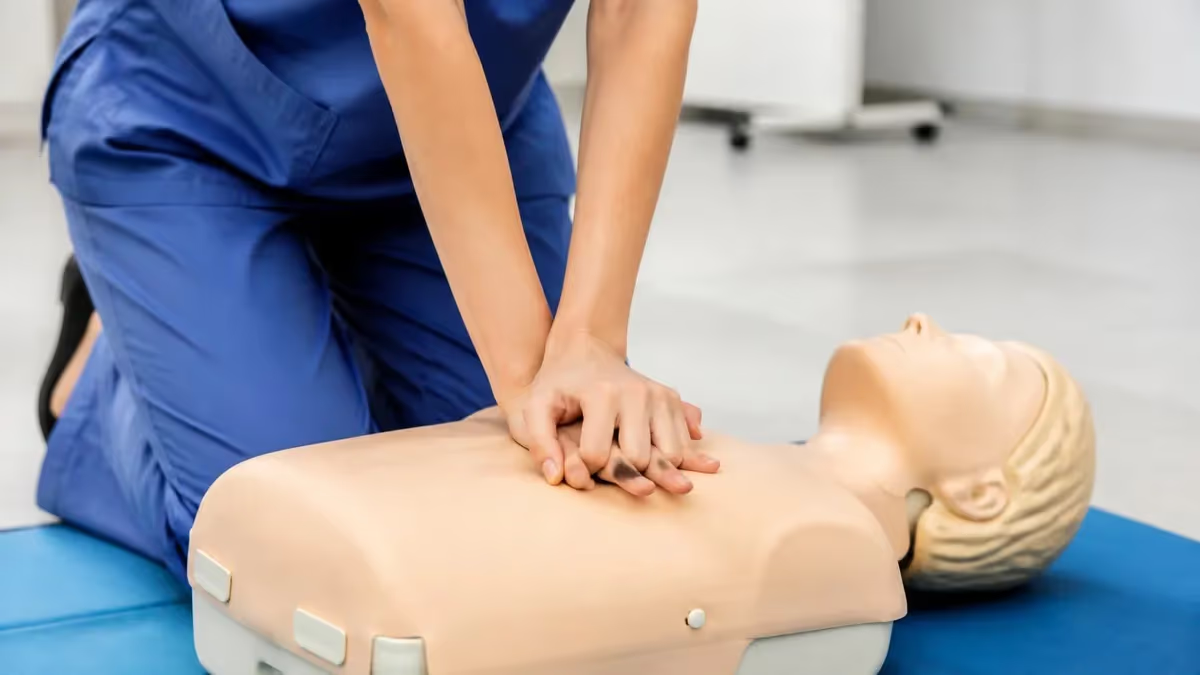
- Hand position: Lower half of the sternum. Two hands overlapped, heel of hand on chest. Arms straight, compression straight down.
- Chest recoil: Allow complete recoil between compressions — do not lean on the chest. Incomplete recoil reduces venous return and cardiac output during CPR.
- Compression-ventilation ratio (1 rescuer, no advanced airway): 30 compressions : 2 breaths. Pause compressions briefly to deliver breaths (1 second per breath, visible chest rise).
- Compression-ventilation ratio (2 rescuers, no advanced airway): Also 30:2.
- With advanced airway (endotracheal tube, supraglottic airway): Continuous compressions at 100–120/min; ventilations every 6 seconds (10/min). Do NOT pause compressions for ventilations once advanced airway is placed.
- CPR pause time: Minimize pauses to <10 seconds. CCF (Chest Compression Fraction) should be >60% (ideally >80%).
2-Rescuer BLS: One rescuer performs compressions while the other manages the airway and ventilations. Switch compressor roles every 2 minutes (every 5 cycles of 30:2) to prevent rescuer fatigue and maintain compression quality. The switch must be performed quickly (<10 second pause).
Pediatric CPR — Children and Infants
BLS providers must know the differences between adult and pediatric CPR. The BLS exam tests these differences directly.
Child CPR (1 year to puberty):
- Compression depth: At least 2 inches (5 cm) or approximately 1/3 of the AP chest depth.
- Compression rate: 100–120/min (same as adult).
- Hand position: 2 hands (one or two if child is very small). Heel of one hand if only one hand is needed to achieve proper depth.
- C:V ratio: 30:2 with 1 rescuer; 15:2 with 2 rescuers who are healthcare providers (one difference from adult).
Infant CPR (under 1 year, excluding newborns):
- Compression depth: At least 1.5 inches (4 cm) or approximately 1/3 of the AP chest depth.
- Compression rate: 100–120/min.
- Hand position: 2-finger technique (1 rescuer) — two fingers on lower half of sternum, one finger-width below the nipple line. 2-thumb encircling hands technique (2 rescuers) — preferred because it generates higher peak aortic pressure.
- C:V ratio: 30:2 with 1 rescuer; 15:2 with 2 healthcare provider rescuers.
Pediatric Cardiac Arrest — Most Common Cause: Unlike adults (where cardiac arrest is usually primary cardiac), most pediatric cardiac arrests are preceded by respiratory failure. This is why pediatric BLS emphasizes prompt airway management and ventilation — starting CPR at the first sign of respiratory distress can prevent cardiac arrest.
AED — Automated External Defibrillator
AED operation is tested in both the written and skills portions of the BLS exam. The universal AED sequence:
- Power ON the AED (open the lid or press the power button).
- Attach pads to the bare, dry chest. Adult pads: one below the right clavicle (upper right chest), one at the left axillary line at the level of the 5th or 6th intercostal space (lower left). Do NOT place on clothing, over a medication patch, over a pacemaker/ICD, or on wet skin.
- Clear and analyze — AED analyzes the rhythm. Everyone clears the patient. Do NOT touch patient during analysis.
- If shock advised: clear and shock — announce "everyone clear," visually confirm no one is touching the patient, then deliver shock.
- Immediately resume CPR — begin compressions immediately after the shock, before reassessing the rhythm. Continue CPR for 2 minutes, then allow AED to reanalyze.
Pediatric AED Use: Use pediatric pads/attenuator cable for children under 8 years if available — this reduces the energy delivered to an appropriate pediatric dose. If only adult pads are available, use them — defibrillation with adult pads is better than no defibrillation. For infants (<1 year), a manual defibrillator is preferred; if unavailable, use AED with pediatric pads/attenuator.
Bag-Mask Ventilation
Bag-mask (BVM) ventilation is a two-rescuer skill: one rescuer uses two hands for the EC-clamp mask seal while the second rescuer squeezes the bag. Single-rescuer BVM is less effective due to difficulty maintaining a seal with one hand.
Technique: EC-clamp — form a "C" with the thumb and index finger around the mask connector, and an "E" shape with the remaining three fingers under the mandible to lift the jaw (head-tilt positioning). Squeeze the bag to deliver a breath over 1 second — visible chest rise confirms adequate seal and ventilation. Avoid excessive ventilation (overpressure) which causes gastric inflation and increases risk of regurgitation.
Oxygen Concentration: Room air bag-mask provides approximately 21% O₂. With an oxygen reservoir attached and O₂ flow at 10–15 L/min, concentration rises to approximately 60–100%. High-flow supplemental O₂ should be used during resuscitation when available.
Opioid Overdose Response
The 2020 AHA guidelines added opioid overdose as a specific scenario in BLS, reflecting the public health epidemic. The BLS response to suspected opioid overdose:
- Assess responsiveness — tap shoulders, shout "Are you okay?"
- Call for help — activate EMS (911), send someone for AED and naloxone.
- Rescue breathing — if patient is not breathing normally but has a pulse, provide rescue breaths (1 breath every 5–6 seconds for adults).
- Administer naloxone (Narcan) if available — intranasal (IN) or IM naloxone. Onset approximately 2–5 minutes.
- If no pulse — begin CPR and use AED per standard BLS algorithm.
- If patient responds to naloxone — keep in recovery position, monitor, do not leave alone. Naloxone wears off in 30–90 minutes; opioids may outlast naloxone, causing re-sedation.
BLS vs. ACLS vs. PALS
BLS is the foundation on which Advanced Cardiac Life Support (ACLS) and Pediatric Advanced Life Support (PALS) build:
- BLS: Core CPR skills — the foundation for all healthcare providers. Covers adult, child, and infant CPR; AED use; bag-mask ventilation; relief of foreign body airway obstruction. Required for all clinical staff.
- ACLS: For providers who respond to or direct adult cardiac arrest. Adds advanced airway management, cardiac rhythm recognition, advanced ACLS algorithms (VF/pVT, PEA, asystole), medication administration, post-cardiac arrest care. Builds on BLS skills. Typically required for nurses, physicians, respiratory therapists in critical care settings.
- PALS: Pediatric-focused advanced life support. Covers pediatric assessment, respiratory emergencies, pediatric arrhythmia recognition and management, pediatric cardiac arrest algorithms. Builds on BLS skills. Required for providers who care for pediatric patients in acute care settings (NICU, PICU, ED).
BLS Renewal Requirements
BLS certification is valid for 2 years from the course date. Renewal options:
- Full BLS Provider Course: Complete classroom/skills session (typically 3–4 hours) with an AHA-authorized instructor. Includes written exam and skills testing.
- BLS HeartCode (Blended Learning): Online cognitive component (eLearning) completed at home, followed by a skills session with an authorized instructor. The HeartCode uses an advanced medical simulation to teach algorithms before the skills session. This option allows flexible scheduling of the eLearning portion.
Employers typically track BLS expiration dates and require renewal before cards expire. Most hospitals send alerts 30–60 days before expiration. Expired BLS cards may prevent clinical assignment or require immediate renewal before returning to patient care duties.
You can continue preparing with the aha bls practice questions, which includes answer explanations for every question.
Pro Tip: Focus your BLS study time on the areas where you score lowest in practice tests. Most exam questions test application of knowledge, not memorization.
- ✓Review the official BLS exam content outline
- ✓Take a diagnostic practice test to identify weak areas
- ✓Create a study schedule (4-8 weeks recommended)
- ✓Focus on your weakest domains first
- ✓Complete at least 3 full-length practice exams
- ✓Review all incorrect answers with explanations
- ✓Take a final practice test 1 week before exam day

- ✓Chain of Survival — 6 links, early CPR and defibrillation, in-hospital vs. out-of-hospital
- ✓Adult CPR — compression rate/depth/recoil, 30:2 ratio, CCF, 2-rescuer technique
- ✓Pediatric CPR — child vs. infant differences, 15:2 ratio with 2 HCP rescuers
- ✓AED Use — pad placement, clear-analyze-shock sequence, pediatric pads
- ✓Bag-Mask Ventilation — EC-clamp technique, 1-second breath, O₂ concentration
- ✓Advanced Airway — continuous compressions, 10 breaths/min with ETT
- ✓Opioid Overdose — rescue breathing, naloxone administration, re-sedation risk
- ✓BLS vs. ACLS vs. PALS — scope, when each is required, renewal requirements
Join the Discussion
Connect with other students preparing for this exam. Share tips, ask questions, and get advice from people who have been there.
View discussion (8 replies)