
American Heart Association BLS: Certification, Renewal, Cost & What to Expect
🎓 Prepare for the American Heart Association BLS: certification. Practice questions with answer explanations covering all exam domains.
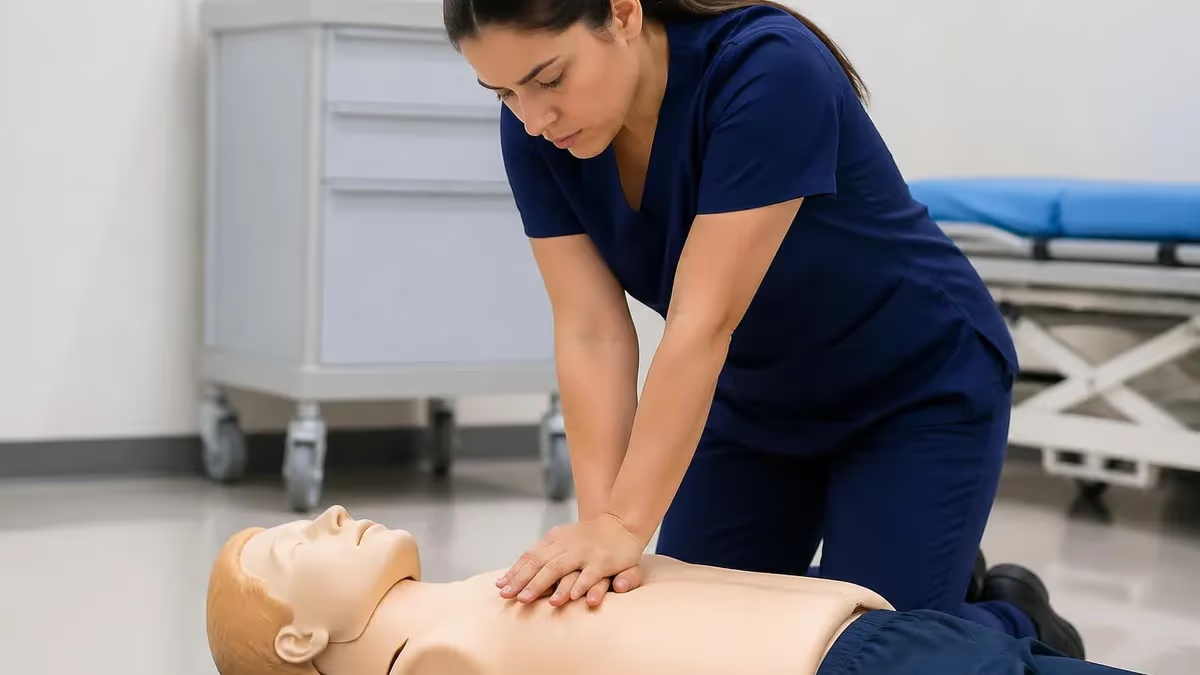
The American Heart Association BLS certification is the gold standard for healthcare providers who need to prove they can perform CPR. Hospitals, nursing programs, dental offices, EMS agencies -- nearly every clinical setting in the US requires it. If you're wondering what is HeartCode BLS, it's the AHA's blended learning option: online coursework followed by an in-person skills check. Same credential, more flexible scheduling. And if you've seen the term basic cardiac life support BCLS certification, that's just the older name for the same BLS Provider course.
AHA BLS covers one-rescuer and two-rescuer CPR for adults, children, and infants. It includes AED operation, bag-mask ventilation, choking rescue, and team dynamics during resuscitation. These aren't optional extras. They're the core skills every healthcare provider needs before touching a patient. The AHA updates its guidelines every five years based on the latest resuscitation research from ILCOR, so your certification reflects current evidence -- not outdated protocols.
This guide covers everything you need: how long the certification lasts, what renewal actually requires, how much you'll pay, and how AHA BLS stacks up against Red Cross and Heartsaver alternatives. If you're getting certified for the first time or renewing before your card expires, you'll find the answers here. We've also included free BLS practice tests so you can walk into your skills check confident and prepared.

What AHA BLS Certification Covers
If you're pursuing a basic cardiac life support BCLS certification, here's exactly what the course teaches. You'll learn high-quality chest compressions -- proper depth, rate, and recoil -- for adults, children, and infants. You'll practice rescue breathing with and without a barrier device. AED use gets covered in detail: pad placement, analyzing rhythms, delivering shocks safely around bystanders.
Team-based resuscitation is a big part of the curriculum. In a hospital code, you don't work alone. The AHA trains you on role assignments, clear communication, and handoff techniques so the team runs smoothly under pressure. You'll also learn bag-mask ventilation for two-rescuer scenarios and foreign body airway obstruction (choking) protocols for all age groups.
One question that comes up constantly: how many CEUs is BLS renewal American Heart Association? The answer is zero. AHA BLS renewal doesn't award continuing education units. You renew by retaking the full BLS Provider course or completing HeartCode BLS online plus a hands-on skills session. Some state licensing boards accept BLS renewal as CE credit separately, but the AHA itself doesn't issue CEUs with the card. Check your state board's specific requirements to confirm whether BLS renewal counts toward your CE obligations -- the rules vary significantly from state to state.
Is Heartsaver the Same as BLS?
Short answer: no. Is Heartsaver the same as BLS? They're both AHA courses, but they serve different audiences and teach different skill levels. Heartsaver is designed for non-healthcare professionals -- coaches, teachers, daycare workers, personal trainers. BLS Provider is for healthcare professionals who need to perform CPR as part of their job duties. If your employer or school requires "BLS," Heartsaver won't satisfy that requirement.
The skill gap is significant. BLS covers two-rescuer CPR, bag-mask ventilation, and team dynamics in multi-provider resuscitation scenarios. Heartsaver covers single-rescuer CPR and basic AED use -- that's it. BLS requires demonstrating compressions on adult, child, and infant manikins during a proctored skills test with specific depth and rate measurements. Heartsaver's skills check is simpler, shorter, and less rigorous. Both certifications last 2 years, but they're absolutely not interchangeable in healthcare settings.
How long does American Heart Association BLS certification last? Exactly 2 years from your course completion date. The expiration is printed right on your provider card. Most employers require you to renew before it expires -- not after. The AHA recommends starting the renewal process within 90 days of your expiration date. Some hospitals require renewal within 60 days. Don't wait until the last week -- classes fill up fast near common deadline dates.
BLS Course Formats Compared
Duration: 4-5 hours in a single session. Instructor-led with hands-on practice throughout. You'll use manikins, AED trainers, and bag-mask devices. Written exam and skills check happen at the end. Best for first-time learners who want real-time feedback. Cost: $40-$90 depending on location and training center.
AHA BLS vs. American Red Cross BLS
This causes more confusion than almost anything else in healthcare credentialing. Is American Red Cross BLS AHA approved? No. The Red Cross and AHA are separate organizations with separate courses and separate certifications. A Red Cross BLS card is not an AHA BLS card. They teach similar content, but they're issued by different bodies.
Is American Red Cross BLS the same as AHA? Functionally, the skills overlap heavily -- both cover adult/child/infant CPR, AED use, and choking rescue. But acceptance varies by employer. Most hospitals and nursing programs specifically require AHA BLS. Some accept Red Cross as equivalent. A few accept either. Before enrolling in any BLS course, confirm with your employer or school which issuing organization they require. Getting the wrong one wastes time and money.
The Red Cross offers its own online-plus-skills format similar to HeartCode BLS. Pricing is comparable. The key difference is brand acceptance: AHA dominates the hospital and clinical education market. Red Cross is more common in community and workplace settings. If you're in healthcare, AHA is the safer bet unless your employer explicitly states otherwise. When in doubt, call your credentialing office -- a five-minute phone call beats retaking an entire course because you picked the wrong provider.
How Much Is an AHA BLS Class?
How much is American Heart Association BLS class? Prices range from $40 to $90 for an in-person course. The variation depends on your location, the training center, and whether materials are included. Some centers charge separately for the BLS Provider Manual ($20-$25). HeartCode BLS online costs about $32 from AHA's website, plus $25-$50 for the in-person skills session -- so the total is roughly comparable to a full in-person class.
How long is American Heart Association BLS class? The standard in-person BLS Provider course runs 4-5 hours. That includes instruction, hands-on practice, the written exam, and the skills check. HeartCode BLS splits this into 2-3 hours online (self-paced) and a 1-hour skills session. Either way, you're looking at about half a day of commitment. Some training centers offer evening or weekend classes to accommodate work schedules.
Group discounts are common. If your hospital or organization needs to certify multiple employees, most training centers offer on-site group classes at reduced per-person rates. This is how large hospitals handle it -- they bring an AHA instructor on-site and certify dozens of staff in a single day. Ask your employer if they coordinate group BLS before paying out of pocket on your own. Many nursing students also find group rates through their program -- schools often arrange bulk BLS classes at the start of each semester for incoming clinical students.
Pros and Cons of AHA BLS Certification
- +Most widely accepted BLS credential in US healthcare -- nearly universal hospital recognition
- +HeartCode BLS offers flexible online learning with same certification validity
- +Skills-based testing ensures you can actually perform CPR, not just pass a written test
- +2-year validity period is standard and predictable for career planning
- +AHA guidelines reflect the latest ILCOR resuscitation research every 5 years
- +Provider manual serves as an ongoing reference for clinical practice
- −No shortened renewal course -- full course required every 2 years regardless of experience
- −AHA BLS doesn't award CEUs, which means it may not count toward state CE requirements
- −Cost adds up over a career: $40-$90 every 2 years for your entire healthcare tenure
- −Hands-on skills session required even for online HeartCode -- can't complete 100% remotely
- −Not interchangeable with Red Cross BLS at many employers despite similar content
- −Class availability varies by location -- rural areas may have limited training centers
AHA BLS Cost Breakdown
How much is BLS certification American Heart Association? Here's the full picture. Initial certification through an in-person class costs $40-$90. Renewal costs the same -- there's no discounted renewal rate because you're taking the same course. HeartCode BLS online runs about $32 from AHA, plus $25-$50 for the required skills check. The BLS Provider Manual adds $20-$25 if your training center doesn't include it in the course fee.
Now, what is the difference between Heartsaver and BLS when it comes to cost? Heartsaver courses are slightly cheaper -- typically $30-$60 -- because they're shorter and cover less material. But remember: Heartsaver isn't accepted as a substitute for BLS in healthcare settings. Paying less for Heartsaver when you need BLS means you'll end up paying for both courses. Get the right one the first time and save yourself the hassle.
Some employers reimburse BLS certification costs -- it's worth asking before you pay. Check with your HR department or education benefits coordinator. Many hospitals cover the full cost for current employees and some reimburse nursing students during clinical rotations as well. If you're paying yourself, shop around -- prices vary significantly between training centers in the same city. Community colleges and fire departments often offer the lowest rates, sometimes 30-40% cheaper than private training companies.
AHA BLS Certification Checklist
- ✓Confirm your employer or school requires AHA BLS specifically (not Red Cross or Heartsaver)
- ✓Find an AHA-authorized training center at cpr.heart.org or call local hospitals
- ✓Choose between in-person class (4-5 hrs) or HeartCode BLS online + skills session
- ✓If using HeartCode, complete the online module before scheduling your skills check
- ✓Bring a valid photo ID to your skills check or in-person class
- ✓Practice high-quality chest compressions: 2 inches deep, 100-120 per minute, full recoil
- ✓Review infant CPR technique -- two-finger and two-thumb methods trip up many test-takers
- ✓Study the BLS algorithm: check responsiveness, activate EMS, start CPR, use AED
- ✓Score at least 84% on the written exam (25 multiple-choice questions)
- ✓Store your provider card digitally and note the expiration date for renewal planning
BLS vs. Heartsaver: Understanding the Difference
People ask this constantly: what is the difference between BLS and Heartsaver? They're both AHA certifications, but they target completely different audiences. BLS is for healthcare providers -- nurses, doctors, paramedics, dental professionals. Heartsaver is for lay rescuers -- teachers, coaches, office workers, babysitters. The clinical expectations are worlds apart.
BLS trains you on two-rescuer CPR, team dynamics, bag-mask ventilation, and multi-victim scenarios. Heartsaver teaches basic single-rescuer CPR and AED use. BLS requires demonstrating skills on adult, child, and infant manikins with specific depth and rate measurements. Heartsaver's skills check is less rigorous. Does American Heart Association BLS include first aid? No. BLS is strictly CPR and emergency cardiac care. If you need first aid training, that's a separate Heartsaver First Aid course.
Here's the practical takeaway: if any healthcare employer, nursing school, or clinical program asks for "BLS," they mean the BLS Provider course. Heartsaver won't count. Period. If you're a non-healthcare professional who just wants to know CPR for personal readiness, Heartsaver is the right fit and costs less. Don't overpay for BLS if Heartsaver meets your actual needs -- but don't underpay for Heartsaver when your job requires BLS either.
Renewing Your AHA BLS Certification
How to renew CPR BLS American Heart Association: the process is straightforward but there are no shortcuts. You retake the full BLS Provider course -- either in person or through HeartCode BLS online plus a hands-on skills check. The AHA eliminated shortened renewal courses years ago. Whether it's your first renewal or your tenth, the time commitment is the same.
The American Heart Association BLS Basic Life Support Provider Manual is your primary study resource for renewal. The current edition covers the latest AHA guidelines and includes practice scenarios. If your training center doesn't provide a manual with the course fee, you can purchase one from the AHA's online store for about $20-$25. Having the manual before class helps, especially if you haven't performed CPR since your last certification.
Mark your calendar now. Set a reminder for 90 days before your BLS expiration. Popular training centers fill up fast -- especially in January and May when nursing program deadlines hit. If you wait until the last minute, you may not find an available class before your card expires. Proactive scheduling is the simplest way to avoid a lapse in certification that could affect your employment status. Many training centers also send email reminders if you're in their system, but don't rely on those -- set your own calendar alert.
If your AHA BLS card expires, you don't lose your knowledge -- but you lose your credential. Most hospitals and clinical programs will not allow you to work with patients until you recertify. There's no grace period at most employers. An expired card means the same thing as no card: you're non-compliant. Recertification after expiration requires the same full course as renewal. There's no penalty or extra cost for letting it lapse, but the employment consequences can be serious.
Getting Your AHA BLS Card Renewed or Replaced
How do I renew my American Heart Association BLS card? Go to cpr.heart.org, find a training center near you, and register for either a BLS Provider course or complete HeartCode BLS online. After passing both the written exam and skills check, you'll receive a new provider card with a fresh 2-year expiration date. Your old card becomes invalid immediately -- the new one supersedes it.
If you've lost your card, the AHA maintains digital records through their eCard system. Log into your AHA account to access your certification history and download a digital copy. Training centers can also look up your record by name and date of birth. A basic life support BLS from the American Heart Association card -- whether physical or digital -- is proof of certification. Most employers accept the eCard format.
For healthcare workers relocating between states: your AHA BLS is valid nationwide. Unlike some state-specific licenses, BLS certification from the AHA is recognized by employers and licensing boards in all 50 states. You don't need to recertify when you move. Just make sure it's current. The expiration date is the only thing that matters, not where you got certified. This portability is one of the biggest advantages of AHA BLS over any state-specific certification program.
BLS Practice Test Questions
Prepare for the BLS - Basic Life Support exam with our free practice test modules. Each quiz covers key topics to help you pass on your first try.
BLS High-Quality CPR & Provider Skills
BLS Exam Questions covering BLS High-Quality CPR & Provider Skills. Master BLS Test concepts for certification prep.
BLS Special Situations & Scenarios
Free BLS Practice Test featuring BLS Special Situations & Scenarios. Improve your BLS Exam score with mock test prep.
BLS Adult, Child & Infant Resuscitation
BLS Mock Exam on Adult, Child & Infant Resuscitation. BLS Study Guide questions to pass on your first try.
BLS Airway Management & Ventilation
BLS Test Prep for Airway Management & Ventilation. Practice BLS Quiz questions and boost your score.
BLS Automated External Defibrillator (AED)...
BLS Questions and Answers on Automated External Defibrillator (AED) Use. Free BLS practice for exam readiness.
BLS Certification: Cardiac Arrest
BLS Mock Test covering Certification: Cardiac Arrest. Online BLS Test practice with instant feedback.
BLS Certification: Choking
Free BLS Quiz on Certification: Choking. BLS Exam prep questions with detailed explanations.
BLS Certification: Respiratory Arrest
BLS Practice Questions for Certification: Respiratory Arrest. Build confidence for your BLS certification exam.
BLS Chain of Survival
BLS Test Online for Chain of Survival. Free practice with instant results and feedback.
BLS CPR Techniques & Procedures
BLS Study Material on CPR Techniques & Procedures. Prepare effectively with real exam-style questions.
BLS Legal & Ethical Considerations
Free BLS Test covering Legal & Ethical Considerations. Practice and track your BLS exam readiness.
BLS Post-Resuscitation Care
BLS Exam Questions covering Post-Resuscitation Care. Master BLS Test concepts for certification prep.
Choosing the Right BLS Course for Your Career
If you're an American Heart Association Basic Life Support BLS Provider, your certification opens doors across every healthcare discipline. Nursing, medicine, dentistry, EMS, respiratory therapy, physical therapy -- they all require it. The Provider designation specifically means you completed the healthcare-level course, not the community Heartsaver version. Employers verify this distinction during onboarding.
Is American Red Cross BLS AHA certified? No. Red Cross issues its own BLS certification, which is a separate credential from AHA BLS. Some employers accept both; many don't. Before spending money on a BLS class, send a quick email to your employer's HR or credentialing department asking exactly which BLS they require. Three words -- "AHA BLS Provider" or "Red Cross BLS" -- can save you from retaking a course you didn't need.
Bottom line: for most healthcare careers in the US, AHA BLS Provider certification is the standard. It's what nursing schools list in their requirements. It's what hospitals check during privileging. It's what JCAHO looks for during accreditation surveys. If you're in healthcare or planning to be, get AHA BLS and keep it current.
Don't let it lapse, don't get the wrong version, and don't assume Red Cross or Heartsaver will be accepted without checking first. Use the practice tests on this page to prepare for your written exam and skills check -- they're free and they cover the same topics you'll see on the real test.
BLS Questions and Answers

About the Author

Registered Nurse & Healthcare Educator
Johns Hopkins University School of NursingDr. Sarah Mitchell is a board-certified registered nurse with over 15 years of clinical and academic experience. She completed her PhD in Nursing Science at Johns Hopkins University and has taught NCLEX preparation and clinical skills courses for nursing students across the United States. Her research focuses on evidence-based exam preparation strategies for healthcare certification candidates.
Join the Discussion
Connect with other students preparing for this exam. Share tips, ask questions, and get advice from people who have been there.
View discussion (8 replies)