
Free Basic Life Support Questions and Answers Guide 2026 October
Free basic life support questions and answers — 💯 AHA BLS exam prep, renewal classes, CPR steps, AED use, and certification pathways for healthcare
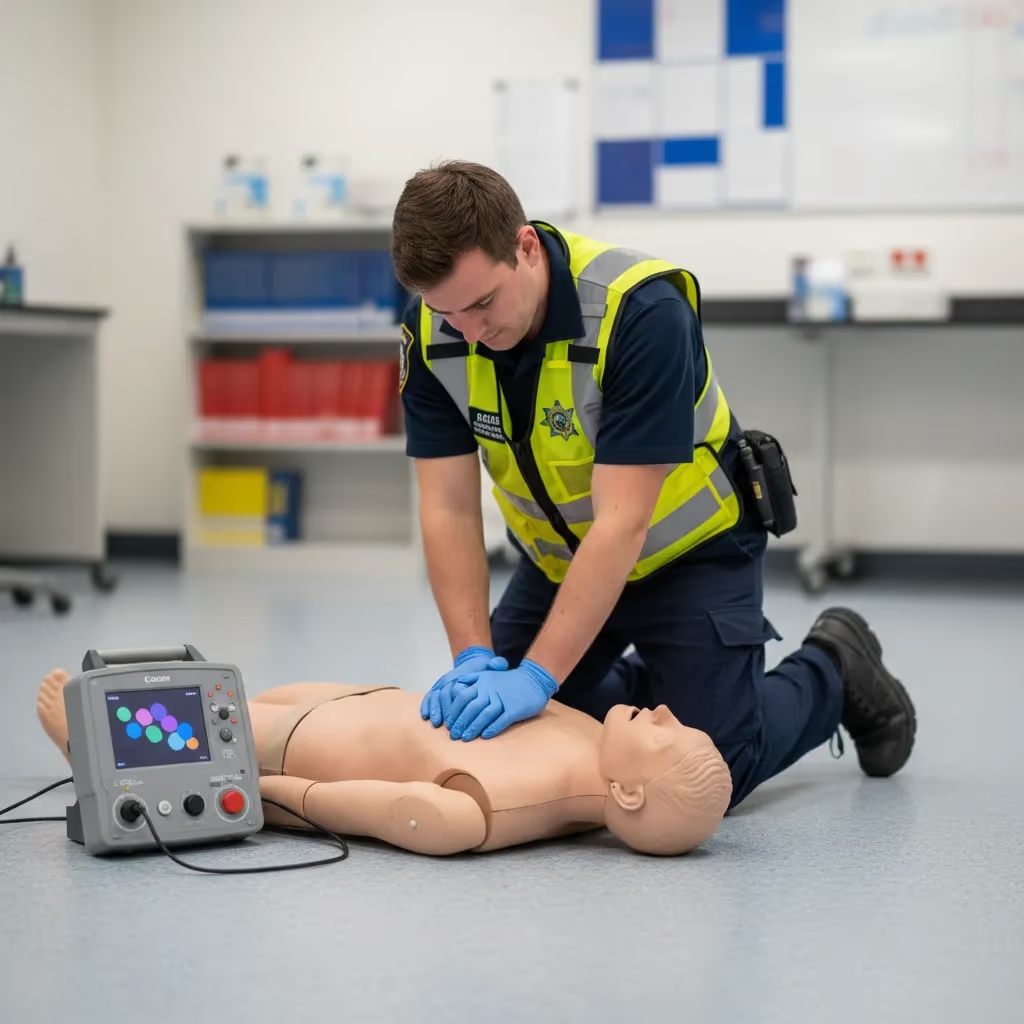
If you searched free basic life support questions and answers, you're either preparing for the AHA BLS Provider exam, renewing an expiring card, or refreshing skills before a new clinical role. This guide gives you the practice questions, content review, and certification roadmap to walk into the exam confident. Aha basic life support renewal is required every two years for healthcare providers, so even seasoned nurses, paramedics, and physicians need periodic refresher prep. The basic life support exam american heart association covers single-rescuer and team CPR, AED operation, choking management, and high-quality compressions across adult, child, and infant scenarios.
BLS isn't just about memorizing compression rates and ratios — it's about building the muscle memory and decision speed that turns a chaotic emergency into an organized response. The exam tests whether you can recognize cardiac arrest within seconds, deliver compressions at 100-120 per minute with proper depth, switch between compressors smoothly, and integrate AED shocks without losing rhythm. Free practice questions are the easiest way to catch knowledge gaps before exam day.
This guide walks through every BLS exam topic, links to free practice tests across all scenario types, covers the AHA vs Red Cross certification differences, and outlines the renewal process. Whether you're a first-time tester or a 20-year veteran nurse renewing for the tenth time, you'll find what you need below to pass quickly and keep your card active.
BLS Certification by the Numbers
Key Facts at a Glance
| Item | Value | Details |
|---|---|---|
| BLS Exam Questions | 25 | |
| Passing Score | 84% | |
| Certification Validity | 2 yrs |
The basic life support exam american heart association tests both written knowledge and hands-on skills competency. Most certification courses combine 4-6 hours of classroom or online video instruction with an in-person skills check at a training site. The written exam runs 25 multiple-choice questions covering compression depth, ventilation rates, AED protocols, choking management, and team dynamics. Skills check covers single-rescuer CPR, two-rescuer CPR with AED integration, infant CPR, and choking response. The aha basic life support exam is the gold standard credential for healthcare workers — accepted by every U.S. hospital, nursing program, and medical practice.
BLS certification is mandatory for nurses, physicians, paramedics, EMTs, dental staff, respiratory therapists, pharmacists, and most allied health professionals. Many medical assistants, nursing assistants, and patient care technicians also need BLS for employment. If you're entering nursing school, EMT training, medical school, or any clinical pathway, BLS is your first credential — required before clinical rotations begin.
Plan ahead — most renewal classes book 4-6 weeks out, so don't wait until your card is days from expiring to register.
Healthcare employers verify BLS certification through unique cardholder ID lookups in AHA or Red Cross databases. Make sure your card displays your legal name exactly as on your other professional credentials.
A focused aha basic life support exam prep routine saves time on test day and reinforces the critical skills you'll use in real emergencies. The American Heart Association is the most recognized BLS certifier — its basic life support exam standards align with international resuscitation guidelines updated every 5 years (most recent: 2020 guidelines, with 2025 update pending). The American Red Cross offers a competing BLS certification accepted by many but not all healthcare employers.
Most hospitals require AHA specifically; some accept either. Verify your employer's certification requirement before enrolling. Basic life support training typically runs $50-90 for initial courses, $40-60 for renewals.
Online-only BLS certification (with no in-person skills check) is generally not accepted by hospitals — those certifications come from non-AHA, non-Red Cross providers and don't include the hands-on competency verification that healthcare employers require. Always choose a blended (online + in-person skills) or fully in-person course from AHA or Red Cross to ensure your certification is widely accepted.
Confirm course type before paying: 'BLS Provider' (the right one) versus 'Heartsaver CPR/AED' (the layperson one) — they aren't interchangeable for healthcare jobs.
Some training centers also offer evening and weekend sessions to accommodate working healthcare professionals — call ahead to schedule outside the standard 9-5 window if your work schedule conflicts.
BLS Practice Test Questions
Prepare for the BLS - Basic Life Support exam with our free practice test modules. Each quiz covers key topics to help you pass on your first try.
BLS High-Quality CPR & Provider Skills
BLS Exam Questions covering BLS High-Quality CPR & Provider Skills. Master BLS Test concepts for certification prep.
BLS Special Situations & Scenarios
Free BLS Practice Test featuring BLS Special Situations & Scenarios. Improve your BLS Exam score with mock test prep.
BLS Adult, Child & Infant Resuscitation
BLS Mock Exam on Adult, Child & Infant Resuscitation. BLS Study Guide questions to pass on your first try.
BLS Airway Management & Ventilation
BLS Test Prep for Airway Management & Ventilation. Practice BLS Quiz questions and boost your score.
BLS Automated External Defibrillator (AED)...
BLS Questions and Answers on Automated External Defibrillator (AED) Use. Free BLS practice for exam readiness.
BLS Certification: Cardiac Arrest
BLS Mock Test covering Certification: Cardiac Arrest. Online BLS Test practice with instant feedback.
BLS Certification: Choking
Free BLS Quiz on Certification: Choking. BLS Exam prep questions with detailed explanations.
BLS Certification: Respiratory Arrest
BLS Practice Questions for Certification: Respiratory Arrest. Build confidence for your BLS certification exam.
BLS Chain of Survival
BLS Test Online for Chain of Survival. Free practice with instant results and feedback.
BLS CPR Techniques & Procedures
BLS Study Material on CPR Techniques & Procedures. Prepare effectively with real exam-style questions.
BLS Legal & Ethical Considerations
Free BLS Test covering Legal & Ethical Considerations. Practice and track your BLS exam readiness.
BLS Post-Resuscitation Care
BLS Exam Questions covering Post-Resuscitation Care. Master BLS Test concepts for certification prep.
BLS Exam Content Domains
High-quality CPR is the most heavily tested domain. You must compress at 100-120 per minute, depth of at least 2 inches (5 cm) for adults (1.5 inches for children, 1.5 inches for infants), allow full chest recoil between compressions, minimize interruptions (target chest compression fraction >60%), and avoid excessive ventilation. Rotate compressors every 2 minutes (or sooner if fatigue affects quality). The exam includes scenarios testing your ability to identify quality issues — too shallow, too slow, no recoil, excessive pauses.
A targeted basic life support for healthcare professionals course covers all three age groups — adult, child, infant — with specific compression depth, ventilation rate, and rescue technique differences for each. Adult CPR (>8 years): 30:2 compression-to-ventilation ratio for single rescuer, 30:2 for two rescuers without advanced airway. Child CPR (1-8 years): same ratio for single rescuer, 15:2 for two rescuers. Infant CPR (<1 year): same ratios as child, two-finger or two-thumb encircling technique for compressions. Memorize these protocols — exam scenarios will test your application across age groups. Most students benefit from a focused basic life support renewal class rather than self-study, especially if you haven't done CPR in a while or have new content from the latest guidelines update.
Two-rescuer CPR with advanced airway (intubated, supraglottic): switch to continuous compressions at 100-120/min plus 10 ventilations per minute (one breath every 6 seconds). This protocol applies once an advanced airway is in place — without one, stick to 30:2 for adults and 15:2 for two-rescuer pediatric.
Don't skip pediatric content during prep — exam questions cover adult and pediatric scenarios in roughly equal proportion despite many providers working primarily with adults.
Bring two pens, your registration confirmation, and a small snack for breaks during longer initial certification courses. Maintain hydration during the skills check section, since hands-on practice can be physically demanding.
4 BLS Certification Strategies
Compression rate (100-120/min), depth (2 inches adult, 1.5 inches pediatric), ventilation rate (10/min with advanced airway, 30:2 without for adults), and AED pad placement. These specific numbers appear repeatedly on the written exam. Use flashcards to drill them until automatic — knowing these cold lets you focus on scenario reasoning.
If your training site allows it, practice on the mannequin before your skills check. Hands-on muscle memory differs from textbook understanding. Compress at the right depth, count out loud, allow full recoil, and time your switches. Real practice prevents the common skills-check stumbles that delay certification by requiring retesting.
Free BLS practice tests across all scenario types (adult, child, infant, AED, choking) build the breadth of preparation that walks you through the actual exam easily. Aim for 85%+ on practice tests across all domains before sitting the official exam. Most students who pass on first attempt completed 3-5 practice tests with detailed review.
Schedule renewal 2-3 months before your existing card expires. Healthcare employers don't accept lapsed certifications, even by a single day. Plan for class scheduling delays, especially in high-demand cycles (early year, mid-year). Setting calendar reminders 90 and 30 days out keeps your card continuously valid.
Basic cardiac life support certification is sometimes used interchangeably with BLS, but they refer to the same credential. The American Heart Association renamed its provider certification from 'Healthcare Provider CPR' to 'BLS Provider' to align international resuscitation terminology. basic life support exam certification through AHA includes a digital eCard delivered after passing both written and skills components — most employers accept the digital card, but some still require printed copies for personnel files. Basic life support certification online alone (without in-person skills check) is rarely accepted by healthcare employers; verify your specific employer's requirements before paying for online-only options.
The blended learning approach — AHA's most popular format — combines self-paced online video instruction with an in-person hands-on skills session. Total time commitment: 1-2 hours online plus 1-1.5 hours skills check. Cost: $60-90 typically. The written exam is included in the online portion; the skills check verifies competency on the mannequin. Both must be passed for certification.
Some hospitals run internal BLS programs for employees, scheduling renewal classes on-site at no employee cost — check with your HR department before paying for an external course.
If two-rescuer pediatric CPR confuses you, build a simple mnemonic — '15:2 with two, 30:2 with one' — to keep the ratio straight under exam pressure.
AHA vs Red Cross BLS: Pros and Cons
- +AHA BLS is universally accepted at all U.S. hospitals and most clinical employers
- +Red Cross BLS is widely accepted but verify with specific employer first
- +Both certifications cover identical core BLS content (CPR, AED, choking)
- +Both require in-person skills competency check for healthcare provider validity
- +Both deliver digital cards immediately after passing for employer documentation
- +Both include adult, child, and infant resuscitation across age groups
- −AHA materials and class fees often slightly higher than Red Cross equivalents
- −Some employers explicitly require AHA certification regardless of equivalence
- −Red Cross online-only certification not accepted by most healthcare employers
- −Renewal class scheduling can delay re-certification during high-demand cycles
- −Online-only courses without skills check are not valid for hospital employment
- −Both require recertification every 2 years — no extended-validity options exist
The basic life support cpr american heart association certification covers the entire chain of survival: early recognition of cardiac arrest, immediate high-quality CPR, rapid defibrillation, advanced life support, post-cardiac arrest care, and recovery. As a BLS provider, your role is the first three links — recognition, CPR, and AED.
Advanced life support (ACLS) and post-arrest care belong to advanced credentialed providers (paramedics, nurses, physicians). Knowing where BLS ends and ACLS begins prevents scope-of-practice issues during real emergencies. American red cross basic life support follows the same chain of survival framework, with similar content and skills requirements but different course branding and material design.
Both AHA and Red Cross update their content based on the International Liaison Committee on Resuscitation (ILCOR) guidelines, which are revised every 5 years. Current curriculum reflects 2020 guidelines; 2025 updates are pending publication. When the new guidelines drop, expect course content updates within 6-12 months. Renewal classes always teach the most current guidelines, so don't worry about being out-of-date if you renew on time.
Watch for new content like recognition of impending cardiac arrest, opioid overdose response (now BLS-level), and updated AED protocols when guidelines change.
Build a quick reference card listing depth, rate, and ratio for each age group and review it before exam day. The mental rehearsal makes scenario questions feel automatic during the timed test.
BLS Certification Checklist
- ✓Verify employer requirement (AHA, Red Cross, or either)
- ✓Choose course format — fully in-person, blended, or instructor-led online
- ✓Register 2-4 weeks ahead of preferred date for class availability
- ✓Complete online portion (1-2 hours self-paced video) before in-person skills
- ✓Review compression rate, depth, and ratios for adult, child, infant
- ✓Memorize AED pad placement and shock-resume cycle
- ✓Practice with a mannequin or video demonstration before skills check
- ✓Bring photo ID and registration confirmation to class
- ✓Pass written exam (typically 84%+) and demonstrate skills competency
- ✓Receive digital eCard within 24 hours and save copy for employer files
Basic life support for healthcare providers is the formal name often used to distinguish the BLS Provider course (for healthcare workers) from layperson CPR courses (Heartsaver CPR/AED). Healthcare provider courses include team dynamics, two-rescuer protocols, AED integration with team CPR, and special situations (opioid overdose, pregnancy, drowning) that layperson courses don't cover.
If you're a healthcare professional, always enroll in the BLS Provider course — not Heartsaver — even if it's slightly more expensive. The basic life support training through AHA includes both written exam and skills competency check verifying your hands-on technique meets standards. The red cross basic life support course covers identical content under different branding — choose based on your employer's requirements and local instructor availability.
Find local AHA training centers via the AHA's online course finder at heart.org. The Red Cross offers a similar course locator at redcross.org. Both organizations also list virtual instructor-led options (with mailed mannequin kits) for remote candidates without local class options. Virtual courses still require in-person skills verification at an authorized training site or via remote skills check with a qualified instructor.
Save your digital eCard immediately after passing — most platforms send it within hours, but lost cards take 1-2 weeks to replace and may delay employment paperwork.
Watch for AHA guideline updates expected in 2025, including potential revisions to ventilation rates, AED protocols, and post-arrest care recommendations. Renewal classes always teach the latest standards.
BLS Covers the First 3 Links of the Chain of Survival
BLS Provider covers recognition of cardiac arrest, high-quality CPR, and AED defibrillation — the first three links of the chain of survival. ACLS (Advanced Cardiac Life Support) covers IV access, advanced airway management, ECG interpretation, and resuscitation pharmacology — the next links in the chain. PALS (Pediatric Advanced Life Support) is the pediatric equivalent of ACLS. BLS is foundational; many healthcare professionals stack BLS plus ACLS or PALS depending on their clinical role. Renew all certifications on schedule to maintain employment eligibility.
Basic trauma life support (BTLS) — now more commonly called International Trauma Life Support (ITLS) — is a separate certification from BLS focusing on trauma assessment and pre-hospital care. It's required for many EMTs and paramedics but not for nurses or general healthcare providers. Don't confuse BTLS/ITLS with BLS; they cover different content and serve different roles.
If you're entering EMS, expect to certify in BLS, ACLS, PALS, and ITLS depending on agency requirements. How long does basic life support certification last — exactly two years from the date of issue. Renewal must occur before expiration to maintain continuous active status. Lapsed certifications require a full course (not the abbreviated renewal version) to recertify.
Set calendar reminders 90, 60, and 30 days before your card expires. Many employers will not allow you to work clinically with an expired BLS card, even by a single day, so timing matters. Some hospitals run internal BLS programs that proactively schedule renewals for employees — use these if available rather than paying out of pocket.
If your card has lapsed, plan for a full BLS Provider course (not the renewal version), which takes longer and costs more.
Always document the time of cardiac arrest recognition, time of CPR initiation, and number of shocks delivered if you respond to a real emergency at work. These data points support both clinical care and quality review afterward.
Online-only BLS certifications (without in-person skills check) are not accepted by most healthcare employers, hospitals, and nursing programs. These typically come from non-AHA, non-Red Cross providers selling 'BLS cards' for $20-40. They lack the hands-on competency verification that legitimate BLS certification requires. Always choose a course that includes either in-person skills check or instructor-led remote skills verification. Verify your specific employer's accepted providers before paying for any course — saving $30 on a worthless certification costs much more in re-certification fees.
A common question asked is is basic life support the same as cpr — and the answer is partially yes. BLS includes CPR but covers more: AED operation, choking response, two-rescuer dynamics, and special situations. CPR alone refers specifically to chest compressions and rescue breaths. BLS is the comprehensive credential that healthcare workers need; basic CPR (Heartsaver CPR/AED) is the layperson credential for non-healthcare contexts. Your basic life support card is valid for two years from the date of issue — check the expiration date and renew well in advance to avoid employment gaps.
The digital eCard format includes a QR code or unique verification ID that employers can verify online through the AHA or Red Cross verification portal. This makes credential checking easy for HR departments and prevents fraudulent BLS cards from circulating. Always keep both digital and printed copies of your card; some employers prefer printed for personnel files even when digital is available.
If you change names through marriage or other reasons, request a name update on your card directly through the issuing organization to keep the name on your credential matching your other identification.
Stay current on naloxone use during opioid overdose scenarios. The 2020 guidelines integrate naloxone administration into BLS-level response, expanding what laypersons and healthcare providers alike can do during opioid-related emergencies.
Basic life support online in the form of self-paced video instruction is widely available — but online-only certification (no in-person skills check) is generally not accepted by healthcare employers. The legitimate online format is the blended course: online video for content delivery, in-person skills check for hands-on competency verification. Both AHA and Red Cross use this blended approach, and it's the gold standard format because it combines flexible self-study with mandatory hands-on confirmation. Basic life support renewal follows a shorter version of the initial course — typically 1.5-2 hours total compared to 4-6 hours for first-time certification.
Renewal courses cover updated content (any guideline changes), refresher on core skills, and abbreviated written exam plus skills check. Most renewals take a single afternoon. Healthcare workers who renew on schedule build a continuous certification history that smoothly meets all employer requirements over a long career — many providers maintain BLS certification continuously for 20-30 years across multiple roles.
Treat BLS renewal as a routine professional task, not an annoyance. The skills you reinforce every two years could save a coworker, family member, or stranger when emergency response time matters most.
Ask your training center about PALS or ACLS prep options if your career path requires advanced credentials beyond basic BLS. Many centers offer bundled enrollment pricing for stacked certifications.
The skills you reinforce every renewal cycle compound across a healthcare career — they're worth the time investment every two years.
Renew on schedule and stay sharp.
Sample BLS - Basic Life Support Practice Questions
Try these questions from our free BLS - Basic Life Support practice tests. The correct answer and an explanation follow each question.
What is the role of 'advanced life support' (ALS) in the Chain of Survival?
- A. To provide medications, advanced airway management, and continued resuscitation by trained providers
- B. To perform the initial defibrillation shock
- C. To replace bystander CPR when EMS arrives
- D. To manage the patient exclusively after hospital discharge
Answer: A. To provide medications, advanced airway management, and continued resuscitation by trained providers
ALS providers deliver medications, advanced airway interventions, and ongoing resuscitation to optimize the chance of ROSC.
A POLST (Physician Orders for Life-Sustaining Treatment) form differs from a standard DNR because it:
- A. Is only valid in hospital settings
- B. Covers a broader range of treatment preferences beyond resuscitation
- C. Requires annual renewal to remain legally valid
- D. Can be completed without a physician's signature
Answer: B. Covers a broader range of treatment preferences beyond resuscitation
POLST is a medical order that addresses multiple interventions (CPR, artificial nutrition, hospitalization) beyond just resuscitation.
A hospital implements a rapid response team (RRT) to evaluate deteriorating patients before cardiac arrest. Which Chain of Survival link does this MOST directly support?
- A. Surveillance and prevention (in-hospital first link)
- B. Early CPR
- C. Rapid defibrillation
- D. Post-cardiac arrest care
Answer: A. Surveillance and prevention (in-hospital first link)
RRTs are a surveillance and prevention strategy unique to the in-hospital chain, intervening before arrest occurs.
You deliver a shock and the victim shows signs of life (breathing, movement). What should you do?
- A. Remove AED pads and discontinue monitoring
- B. Place the victim in recovery position if breathing normally and leave AED attached
- C. Begin CPR regardless of signs of life
- D. Deliver a second shock to confirm the rhythm is stable
Answer: B. Place the victim in recovery position if breathing normally and leave AED attached
If the victim resumes normal breathing and has signs of life, place them in the recovery position (if no suspected spinal injury) and keep AED attached until EMS arrives.
BLS Questions and Answers
About the Author
Paramedic & Emergency Services Certification Trainer
George Washington UniversityCaptain Ryan O'Brien is a licensed paramedic and NREMT-certified emergency medical professional with a Bachelor of Science in Emergency Medical Services from George Washington University. He has 15 years of field experience as a paramedic and firefighter, and has coached hundreds of EMT and paramedic candidates through their NREMT written and psychomotor licensing examinations.
Join the Discussion
Connect with other students preparing for this exam. Share tips, ask questions, and get advice from people who have been there.
View discussion (8 replies)