
BLS Certification Online: Courses, Providers, and What to Expect 2026 September
🧠 Get BLS certification online through AHA HeartCode, Red Cross, or other providers. Learn what's covered, how long it takes, and how long your card
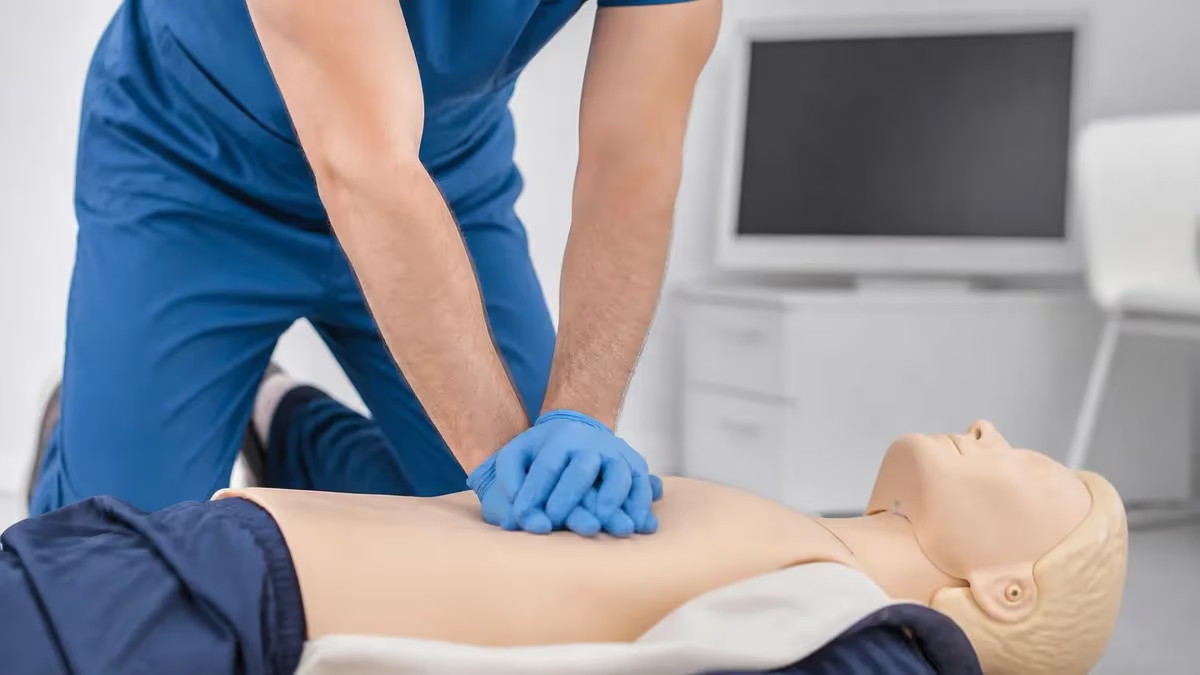
BLS certification online offers healthcare providers, first responders, and workplace safety officers a flexible path to a skill set that directly saves lives. Basic Life Support covers high-quality CPR for adults, children, and infants, along with automated external defibrillator (AED) operation and relief of foreign-body airway obstruction. You can complete the cognitive portion — the knowledge and assessment components — through an online course, though most certifying bodies require an in-person skills check to verify that you can perform compressions and breaths correctly on a manikin.
Understanding the difference between a fully online certificate and an accredited BLS provider card matters enormously depending on your profession. Employers and licensing bodies in healthcare almost universally require certification from an accredited organization — primarily the American Heart Association (AHA) or the American Red Cross — and they specifically require evidence that you passed a hands-on skills evaluation, not just an online written test. If you're in nursing, medicine, respiratory therapy, EMT work, or another clinical field, clarify your employer's exact requirements before enrolling in any course.
That said, online BLS courses do real work. The AHA's HeartCode BLS is a recognized, blended-learning format that pairs online content with a brief in-person skills session. Red Cross offers a fully blended option as well. Both produce the same official BLS provider card that satisfies hospital and clinical credentialing requirements. The key is knowing which format your organization accepts and choosing accordingly. This guide walks you through every major provider and format, so you can choose with confidence.
Before you enroll in any course, it's worth understanding exactly what BLS certification demonstrates. The certification tells your employer, your colleagues, and your patients that you've been tested on the current CPR guidelines and have demonstrated the physical skill to perform them correctly. It's not a credential that certifies expertise in emergency medicine — it's a foundational competency that every clinical team member should have, regardless of specialty. A nurse, a medical assistant, a radiographer, and a hospital security officer might all hold the same BLS card for the same reason: when someone's heart stops, role titles don't matter.
The 2020 American Heart Association Guidelines for CPR and ECC, updated in 2020 and still current, provide the scientific basis for everything taught in BLS. These guidelines are reviewed continuously as new research emerges, which is partly why certifications are time-limited to two years — the skills themselves may be updated as the evidence evolves. Knowing that your certification reflects the current standard of care is part of what makes it meaningful to the institutions that require it.
This complete guide covers everything you need: how the online and blended formats work, which providers carry the most weight, what the written exam and skills check actually test, how much everything costs, and how to stay current once you're certified. Whether you're earning your first BLS card or renewing one that's about to expire, you'll leave with a clear plan for getting it done efficiently and correctly.
One clarification worth making early: online BLS completion certificates sold by discount CPR websites are not the same as provider cards from AHA or Red Cross. The language can be confusing because both are sometimes called BLS certification. The critical difference is accreditation and the skills check requirement. If your employer, school, or licensing board requires BLS, they almost certainly mean the accredited provider card — not an online-only certificate. When in doubt, ask your HR department or licensing body which specific certification format they require before you spend any money.

AHA and Red Cross BLS require a hands-on skills check. You cannot get a valid, accredited BLS provider card through a fully self-paced online-only course. Online content prepares you for the knowledge assessment — the skills check must happen in person, either at a testing center or with a qualified instructor. Plan for a 30-to-60-minute in-person session after completing your online portion.
The American Heart Association's HeartCode BLS is the dominant option for healthcare professionals who want maximum flexibility. The online portion covers the BLS algorithms, CPR technique, team dynamics during resuscitation, and AED operation through a combination of narrated slides, videos, and interactive scenarios. Most learners complete the online module in about two to three hours. After finishing, you schedule an in-person skills check with a certified BLS instructor or at a HeartCode Skills Station — a self-directed manikin station available at many hospitals and training centers.
The AHA's approach ensures that everyone who holds an AHA BLS provider card has physically demonstrated the skills. This is non-negotiable for AHA certification. The card you receive after passing is valid for two years. How long does bls certification last is one of the most commonly asked questions — the answer is two years for both AHA and Red Cross, after which you must complete a renewal course. Renewal courses cover any algorithm updates and recheck your skills, and they're generally shorter than the initial certification course.
The American Red Cross BLS for Healthcare Providers is the other major option. Red Cross offers a blended format — about two hours of online content followed by an in-person skills session. Their digital platform covers the same core material as AHA, and the resulting certification card is accepted by most healthcare employers. Some institutions specifically require AHA certification; others accept either. If your employer hasn't specified, it's worth a quick confirmation before enrolling.
Other organizations — the National CPR Foundation, CPR Savers, and others — offer online-only certificates sometimes marketed as BLS certification. These certificates don't carry the same accreditation and are typically not accepted for professional licensing or hospital credentialing. They may be appropriate for community members who want to learn the skills for personal preparedness, but they're not a substitute for AHA or Red Cross certification in clinical settings. What is a bls certification worth in your specific field depends entirely on which organization issued it and whether your employer or licensing board recognizes it.
HeartCode Skills Stations, where available, offer perhaps the most convenient path through the skills check. These are self-directed stations — essentially a sophisticated manikin connected to a computer that provides real-time feedback on your compressions and breaths. You work through the skills scenarios independently, and the computer generates a completion record. Many hospitals have these stations in staff education centers or nursing units. Ask your employee health or education department if your facility has one before scheduling an off-site session.
If you're choosing between AHA and Red Cross, the practical differences are modest. Both use the same underlying CPR science. Both produce a provider card valid for two years. Both are accepted by the vast majority of healthcare employers. The main edge case is if your institution specifically mandates AHA — some large health systems do this to standardize training. If you're unsure, assume AHA HeartCode BLS is the safer choice, since it's more universally accepted and the blended format is well-established.
International travelers and expatriate healthcare workers should note that AHA and Red Cross certifications are recognized in many countries but not universally. Some countries or healthcare systems require certification from a local provider. If you're taking a position abroad, verify with your prospective employer whether an AHA BLS card satisfies their credentialing requirements or whether a country-specific equivalent is necessary. For most English-speaking countries and international hospitals affiliated with major health networks, AHA certification is widely accepted.
If you work in a high-turnover environment where new hires need BLS quickly, HeartCode BLS is ideal because individuals can complete the online portion at any time and then join the next available skills check session. This decoupled approach is much more efficient than scheduling classroom courses that require a fixed number of participants and a blocked schedule. Training coordinators at large hospitals often use HeartCode as the standard because it scales effortlessly — fifty new hires can complete the online module independently on their own schedules and then come through a skills check station over a single afternoon.
BLS Online Certification Options
The gold standard for healthcare providers. Online module (2–3 hrs) + in-person skills check. Produces official AHA BLS provider card valid for 2 years. Accepted at virtually all US hospitals and clinical employers.
American Red Cross blended-learning format. Online content followed by in-person skills session. Produces Red Cross BLS for Healthcare Providers card, accepted by most healthcare employers. Some AHA-specific institutions may not accept it.
AHA's self-directed manikin station available at many hospitals. Complete your HeartCode online module, then use the station independently. Generates a completion record without a live instructor. Ideal for employed clinical staff.
Courses from non-AHA/Red Cross providers that produce an online-only certificate. NOT accepted for clinical credentialing, hospital employment, or professional licensing. Appropriate only for personal preparedness with no clinical requirement.

BLS Certification Course Structure
| Section | Questions | Time |
|---|---|---|
| Online Content Module | N/A | — |
| Written Knowledge Assessment | 25 | — |
| Adult CPR Skills Station | N/A | — |
| Infant CPR Skills Station | N/A | — |
The BLS written knowledge assessment tests your understanding of the algorithms and guidelines, not memorized facts. You'll be asked to identify when CPR should start, what compression rate and depth are correct for adults versus infants, how to use an AED safely, and how to coordinate two-rescuer CPR. The passing score for the AHA BLS exam is 84%. Most participants who have completed the online content pass on the first attempt — the exam is designed to confirm comprehension, not to eliminate test-takers.
The skills check is where some first-time candidates feel nervous. The instructor or automated skills station assesses whether your compressions reach the correct depth (2–2.4 inches for adults), maintain the correct rate (100–120 compressions per minute), and allow full chest recoil between compressions. Rescue breaths are checked for visible chest rise.
AED operation is checked for correct pad placement and sequence. If you don't pass a component on the first attempt, most instructors will coach you through it immediately. The goal is competence, not attrition. How long does it take to get bls certification from start to finish is typically one day — a few hours online, then the in-person skills check on the same day or a day or two later.
If you already hold a valid certification from another organization and want to switch to AHA or Red Cross, ask whether your existing training satisfies any prerequisites. Some advanced certifications like ACLS or PALS require current AHA BLS as a prerequisite. HeartCode BLS can be completed independently before enrolling in those courses, and many hospitals require staff to have BLS current before they can sit for ACLS class.
Two-rescuer CPR, one of the skills assessed during the BLS check, sometimes catches candidates who are used to thinking of CPR as a single-person activity. In two-rescuer CPR, one person performs compressions while the other manages the airway and delivers rescue breaths via a bag-mask device. The rescuers switch roles every five cycles (about two minutes) to prevent fatigue. Coordinating the switch without interrupting compressions requires brief rehearsal. Most BLS courses practice this sequence explicitly, and the HeartCode online module walks through it with video demonstrations.
BLS Exam Pass Rate
BLS Skills by Patient Type
Adult CPR in BLS uses a compression depth of 2 to 2.4 inches and a rate of 100 to 120 compressions per minute. Allow full chest recoil between compressions — don't lean on the chest. In 1-rescuer CPR, the compression-to-ventilation ratio is 30:2 (30 compressions, then 2 rescue breaths). In 2-rescuer CPR with an advanced airway in place, compressions are continuous at 100–120/min while the airway manager delivers one breath every 6 seconds.
Hand placement is critical for adult CPR: the heel of one hand goes on the lower half of the sternum (breastbone), with the other hand on top and fingers interlaced. Lock your elbows, position your shoulders directly over your hands, and use your body weight — not just arm strength — to deliver compressions. Fatigued compressions lose depth and rate quickly; in two-rescuer CPR, switch compressors every five cycles (about 2 minutes) without interrupting compressions for more than 10 seconds.

BLS Certification at a Glance
Renewals work slightly differently depending on the provider. AHA BLS renewal can also be done via HeartCode online + skills check, or through a classroom renewal course that runs about 3.5 to 4 hours. If your certification is about to expire or has recently expired, check whether your employer requires you to renew before expiration or whether a lapsed certification is acceptable pending renewal.
Most hospitals require continuous current certification for clinical staff and won't allow a lapse, even by a few days. Knowing how long is bls certification good for — two years from your certification date, not from a calendar year — helps you track when to act.
The cost of BLS certification online varies by provider and format. AHA HeartCode BLS, when purchased directly from the AHA, runs approximately $30–$45 for the online module, plus any skills check fee your testing site charges (often $10–$25). Red Cross blended format pricing is similar. Some employers cover the cost entirely and schedule group skills-check sessions on-site. Many hospitals have HeartCode Skills Stations available for employees to use free of charge. Check your employee health or education department before paying out of pocket.
For those who want to learn BLS without a clinical credential requirement, the Red Cross offers a standalone hands-only CPR / AED course that takes about 30 minutes online and involves no skills check requirement. This course doesn't produce a BLS provider card but does provide foundational knowledge for community members, bystanders, and anyone who wants to be prepared to respond in an emergency.
The basic life support bls provider manual published by the AHA also contains the full algorithms and guidelines, and studying it alongside the online course is one of the most effective preparation strategies for the written assessment.
Some candidates ask whether studying the what is heartcode bls reference materials and guidelines in depth is worth the extra time. The answer depends on your goal. For passing the written exam, a focused review of the AHA BLS algorithms — the adult chain of survival, the BLS adult and pediatric sequences, and the AED algorithm — is sufficient.
For actually performing well in an emergency, deeper study of the physiological rationale (why compression depth and rate matter, why continuous compressions without excessive interruption improve outcomes) helps you internalize the guidelines rather than just memorize them. Healthcare providers who understand the why rarely forget the what under pressure.
Specialty practice areas may have additional BLS-adjacent requirements. Pediatric nurses typically need PALS (Pediatric Advanced Life Support) in addition to BLS. ICU and ED staff usually need ACLS (Advanced Cardiovascular Life Support). Both ACLS and PALS use BLS as a foundation — you need current BLS before you can enroll. If you know you'll be pursuing ACLS or PALS in the near future, getting HeartCode BLS done first is the correct order of operations. Some combined ACLS/BLS courses exist, but standalone AHA BLS certification is more universally recognized as the base credential.
Group BLS sessions — where a hospital or clinic brings in an instructor to certify multiple staff members at once — are the most cost-effective option when available. The institution typically covers the cost entirely, and the in-person skills check is conducted on-site during a scheduled session. If you're employed at a healthcare organization, check whether your facility runs scheduled BLS certification days before paying for an individual course. Many institutions schedule these quarterly or on a rolling basis for new hires and renewals.
BLS Certification Study Plan
- ▸Complete AHA HeartCode or Red Cross online module (2–3 hours)
- ▸Take notes on CPR rate, depth, and AED sequence
- ▸Review the BLS algorithms until you can recall them without looking
- ▸Review adult vs. infant compression technique differences
- ▸Practice the AED sequence from memory: power on, attach pads, clear, shock
- ▸Take a practice written assessment — aim for 90%+ before the real exam
- ▸Practice compression depth and rate on a firm surface or manikin if available
- ▸Review bag-mask ventilation technique and head-tilt chin-lift
- ▸Schedule your in-person skills check if not already booked
- ▸Complete written knowledge assessment (25 questions, 84% to pass)
- ▸Complete in-person skills check: adult 1-rescuer, adult 2-rescuer, infant, AED
- ▸Receive BLS provider card — valid for 2 years from this date
Online vs. Classroom BLS Certification
- +Complete the knowledge portion on your own schedule, at your own pace
- +No need to block out a full 4-hour classroom day for initial certification
- +Same AHA or Red Cross card as classroom — accepted by all major healthcare employers
- +HeartCode Skills Stations at many hospitals eliminate need to find external instructor
- +Ideal for candidates who want to review content thoroughly before the skills check
- −Still requires an in-person skills check — not fully remote
- −Some learners miss the classroom environment where an instructor answers questions live
- −Scheduling the skills check adds a logistical step that classroom courses handle automatically
- −Online-only courses from non-AHA/Red Cross providers don't satisfy clinical credentialing
- −Requires self-motivation to complete the online module without an instructor driving the pace
BLS Certification Questions and Answers
About the Author

Registered Nurse & Healthcare Educator
Johns Hopkins University School of NursingDr. Sarah Mitchell is a board-certified registered nurse with over 15 years of clinical and academic experience. She completed her PhD in Nursing Science at Johns Hopkins University and has taught NCLEX preparation and clinical skills courses for nursing students across the United States. Her research focuses on evidence-based exam preparation strategies for healthcare certification candidates.
Join the Discussion
Connect with other students preparing for this exam. Share tips, ask questions, and get advice from people who have been there.
View discussion (8 replies)