
Red Cross BLS Certification: Course, Cost, and Renewal Guide 2026 September
📚 Red Cross BLS certification guide: course formats, cost, what the exam covers, how long certification lasts, and how to renew. For healthcare providers.
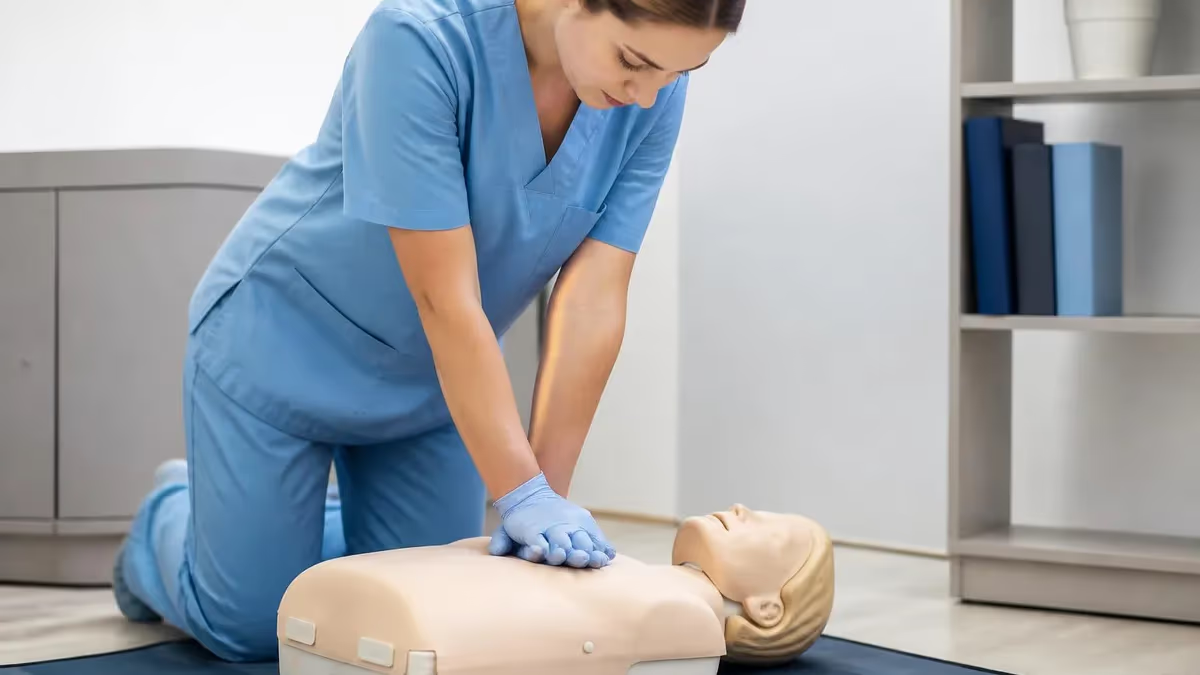
Basic Life Support (BLS) certification from the American Red Cross is a recognized credential for healthcare providers, first responders, and professionals in roles that require demonstrated competency in emergency cardiovascular care. The Red Cross BLS certification course teaches adult, child, and infant CPR and AED use, airway management, relief of choking, and the team dynamics of a multi-rescuer response. It's designed for the same audience as AHA BLS certification — nurses, EMTs, medical students, dental hygienists, physical therapists, and other healthcare professionals who work in clinical settings where cardiac arrest response is a core competency.
The two major BLS certifications in the United States come from the American Heart Association (AHA) and the American Red Cross. Both credentials are widely recognized, both cover the same core life support skills based on the same evidence-based science (the AHA's Highlights of the CPR and ECC Guidelines), and both carry a two-year validity period.
The practical difference is program format, course structure, and which specific employers or credentialing bodies specify one over the other. Most hospital systems and healthcare employers accept both; a smaller number specify AHA BLS by name. If your employer or licensing body requires AHA BLS specifically, you need the AHA course — the Red Cross credential, while equivalent in content, won't satisfy an AHA-specific requirement.
Red Cross BLS certification differs from Red Cross Heartsaver CPR/AED in scope and target audience. Heartsaver CPR/AED is designed for lay responders — people without medical training who want to respond to cardiac emergencies in community settings. It covers adult CPR and AED use with less emphasis on clinical depth.
BLS is designed for healthcare providers and is more comprehensive: it covers adult, pediatric, and infant CPR, two-rescuer CPR coordination, bag-mask ventilation (rather than just rescue breaths), and the two-second assessment pulse check that's specific to provider-level response. Healthcare employers typically require BLS rather than Heartsaver because BLS addresses the clinical realities of hospital and clinical settings where advanced equipment and team response are expected.
Understanding what is a bls certification before registering helps you verify you're taking the right course for your credential requirements. BLS stands for Basic Life Support — a level of emergency cardiac care that forms the foundation of advanced cardiac life support (ACLS) and pediatric advanced life support (PALS). These higher-level certifications require current BLS certification as a prerequisite. If you're working toward ACLS or PALS certification, getting current BLS first is mandatory. The BLS skills you'll demonstrate — especially mask-to-mouth ventilation ratios and two-rescuer CPR team coordination — are the building blocks for those advanced protocols.
Red Cross BLS courses are taught by Red Cross authorized instructors and are available through community locations, healthcare facilities, and Red Cross chapters nationwide. The AHA and the Red Cross run parallel instructor networks — an AHA-certified instructor cannot teach a Red Cross course, and vice versa. Both organizations publish training center directories on their websites to help you find courses near you. Online pre-course learning followed by an in-person skills session is the standard blended format for both organizations' BLS programs, with differences in platform, content delivery style, and pricing.

Full name: BLS for Healthcare Providers (Red Cross)
Target audience: Healthcare professionals, nurses, EMTs, medical students, allied health providers
Format: Blended learning (online + ~4-hour in-person skills session) or classroom instructor-led
Skills covered: Adult/pediatric/infant CPR, AED, bag-mask ventilation, two-rescuer CPR, choking relief
Validity: 2 years
Renewal: Full course retake; no separate renewal course
Employer acceptance: Widely accepted; some employers/programs specify AHA BLS — verify before registering
Red Cross BLS: Four Key Facts
2 years from completion date. Most employers require certification to remain current — don't let it lapse before renewing. Some facilities require 90+ days of remaining validity.
Blended: online knowledge module + 4-hour in-person skills session. Classroom-only: full instructor-led session. Skills checkoff is required in all formats — no purely online BLS credential.
Both cover identical core skills based on the same AHA Guidelines. Most employers accept either. If your employer or licensing board specifies AHA BLS, the Red Cross credential won't fulfill that requirement.
$30–$85 at community training centers. Hospital-based training may be free for employees. Prices vary by region and provider — compare options before registering if paying out of pocket.
The Red Cross BLS certification course covers seven core skill domains across three patient populations — adult, child, and infant. Adult CPR covers compression depth (2–2.4 inches), rate (100–120 compressions per minute), compression-to-ventilation ratio (30:2 for single rescuer, alternating responsibilities in two-rescuer), and minimizing interruptions to maintain perfusion pressure. Pediatric CPR uses two fingers for infant compressions, emphasizes proportional compression depth (approximately one-third the chest depth), and applies a 15:2 ratio for two-rescuer pediatric CPR when ventilation support is available. These ratio and depth distinctions appear on the BLS skills demonstration checkoff, so practice precision matters.
AED use is covered as an integrated component of the CPR sequence, not as a separate skill. The Red Cross curriculum emphasizes the AED pads-on/analyze/shock sequence and the correct CPR-AED integration: apply pads while CPR continues (one rescuer maintains compressions while the other positions pads), pause compressions only during analysis and shock delivery, and immediately resume compressions after each shock without waiting to check pulse. This minimize-interruptions approach reflects current science showing that pausing CPR for more than 10 seconds significantly reduces survival probability.
Bag-mask ventilation is the BLS provider skill that most differentiates BLS from lay responder CPR. Rather than performing mouth-to-mouth rescue breaths, healthcare providers use a bag-mask device (bag-valve-mask or BVM) to deliver ventilations.
The BLS course teaches proper mask seal technique (the C-E clamp method), correct squeeze volume (visible chest rise without overinflation), ventilation rate (10 breaths per minute during CPR with advanced airway, or 30:2 without), and how to manage a BVM alone versus with a second rescuer. BVM competency is a critical BLS exam skill that requires hands-on practice — it's one of the skills most candidates struggle with before their skills station checkoff.
Two-rescuer CPR coordination addresses the healthcare reality that emergencies in clinical settings involve teams, not individuals. The BLS course teaches when and how to switch roles (typically every 2 minutes to prevent compressor fatigue), how to maintain continuous compressions with minimal interruptions during role changes, and how the team communicates during a code. The rescuer not performing compressions manages the airway and ventilations while monitoring compression quality. This team dynamic is what makes BLS provider training distinct from lay CPR — it's preparation for the organized response expected in a hospital code blue, not just solo bystander intervention.
Relief of choking (foreign body airway obstruction, FBAO) for conscious and unconscious adults, children, and infants is part of Red Cross BLS content. Conscious adult/child FBAO: abdominal thrusts (Heimlich maneuver) until the obstruction clears or the victim becomes unconscious. Conscious infant FBAO: alternating back blows and chest thrusts (abdominal thrusts are not used for infants). Unconscious FBAO in any patient transitions to CPR, with mouth inspection before each ventilation attempt to retrieve any visible obstruction. These choking procedures aren't always included in lower-level lay CPR courses but are standard BLS provider content because healthcare settings serve all age groups.

Red Cross BLS Course Formats
The standard and most widely available Red Cross BLS format. Complete the online knowledge module first (at your own pace, typically 2–3 hours), then attend a 4-hour in-person skills session at a Red Cross-authorized training location. The skills session includes manikin practice, instructor demonstration, and a skills checkoff where your technique is evaluated against the standardized skills checklist.
Best for: Most healthcare providers seeking certification for the first time or renewing. Flexible scheduling for the online portion; skills session must be scheduled at a specific location.
BLS certification is required for a broad range of healthcare and clinical roles. Registered nurses and licensed practical nurses employed in hospitals, clinics, and long-term care facilities typically must maintain current BLS certification as a condition of employment. Many State Boards of Nursing require BLS certification for nursing license renewal in addition to continuing education credits. Nursing school programs almost universally require entering students to have current BLS certification by the start of their clinical rotations. Medical students face the same requirement — BLS must be current before hospital clinical rotations begin, and students must maintain it through residency training.
Allied health professionals including physical therapists, occupational therapists, respiratory therapists, dental hygienists, dental assistants, medical assistants, pharmacy technicians, radiology technicians, and phlebotomists are routinely required to maintain BLS certification by their employers, state licensing boards, or accreditation standards. First responders — EMTs, paramedics, firefighters, and law enforcement officers with first responder responsibilities — require BLS certification as a foundation under their higher-level clinical skills. Lifeguards, school nurses, and athletic trainers round out the group of non-physician, non-nurse roles that most commonly require BLS.
Understanding how long does bls certification last matters because lapses in certification can affect employment and clinical rotation eligibility. Red Cross BLS certification, like AHA BLS, is valid for two years from the date of course completion. Most employers and clinical programs require certification to be current — meaning you must renew before the expiration date rather than waiting until it lapses. Some hospitals require certification with at least 90 days of remaining validity rather than accepting a card that expires within a few months. Build your renewal timeline around your employer's specific policy rather than the calendar two-year mark.
The question of whether is bls certification the same as cpr is common among students and job applicants. CPR is a skill — the physical technique of chest compressions and ventilations. BLS certification is a credentialed course that includes CPR plus AED use, choking relief, and provider-level assessment skills. All BLS-certified individuals know CPR, but not all CPR courses produce BLS certification. A lay CPR course from a community Red Cross class produces a Heartsaver certificate, not a BLS certificate. Healthcare employers require BLS specifically because the provider-level skills, team dynamics, and clinical depth differentiate it from lay CPR training.

Red Cross BLS is widely accepted — but not universally. Some hospitals, nursing programs, and credentialing bodies specify "AHA BLS" by name in their requirements. If you're unsure whether your employer accepts Red Cross BLS, check your employment agreement, the program handbook, or ask HR/education directly before registering. Taking the wrong course wastes your time and money — a Red Cross BLS card will not satisfy an AHA-specific requirement. Most general healthcare employer contexts accept either; the issue arises mainly in specific hospital systems with standardized AHA training programs or state-specific certification rules.
Registering for Red Cross BLS certification starts at the American Red Cross website, which has a course locator tool that maps upcoming BLS for Healthcare Providers courses by zip code and date.
You can filter by course format: instructor-led in-person (classroom only), blended learning (online portion plus in-person skills session), or simulation learning (the option for highly experienced providers that allows abbreviated practice before a skills test). Most healthcare facilities that offer training to their own staff maintain internal Red Cross training programs — check with your employer's education or training department before searching externally, as internal courses may be subsidized or free for employees.
The cost of Red Cross BLS certification varies by provider and format. Courses at Red Cross chapters and community training centers typically range from $30–$85 for the blended learning format. Hospital-based employee training programs may provide BLS training as a staff benefit at no cost. Some community colleges include BLS as part of healthcare program prerequisites with the cost bundled into tuition. Private training companies that partner with the Red Cross charge rates that can vary significantly — comparing a few options before registering is worthwhile, especially if you're paying out of pocket.
The blended learning format — Red Cross's standard BLS delivery model — requires completing an online portion first (covering the knowledge content through videos and interactive review), then attending an in-person skills session to demonstrate competency in a hands-on environment. The skills session runs approximately 4 hours and covers all the hands-on components: compression technique on a manikin, BVM use, AED sequence, two-rescuer CPR, and choking relief.
You'll complete a skills checkoff where an instructor evaluates your technique against a standardized skills checklist. Passing both the online assessment and the skills checkoff results in certification. You can find out about how long does it take to get bls certification when you register — most skills sessions can be completed in a single half-day.
Preparing for the Red Cross BLS skills checkoff is straightforward with the right resources. The Red Cross publishes the First Aid and CPR/AED Participant's Manual, which covers all course content. Reviewing the compression depth and rate numbers, the ventilation ratios, and the sequence steps for each skill helps you pass the knowledge assessment.
For the hands-on skills station, there's no substitute for practicing on a manikin — the compression technique, mask seal, and two-rescuer transitions need muscle memory, not just intellectual knowledge. Many Red Cross chapters and training centers allow participants to practice on manikins during open lab sessions before skills checkoff day. If you're nervous about the skills station, asking your instructor about practice opportunities before the session significantly improves performance.
How to Get Red Cross BLS Certified
Step 1: Verify Requirements
Step 2: Register for a Course
Step 3: Complete Online Module (Blended Format)
Step 4: Attend Skills Session
Step 5: Pass Skills Checkoff
Red Cross BLS certification renewal is available through the same course formats as initial certification. Red Cross does not currently offer a BLS-specific renewal course separate from the full course — renewal means retaking the full BLS course. This is consistent with AHA's approach: the renewal (or recertification) course is the same content as the initial course, ensuring all certified providers have current skills regardless of when they first certified. The two-year cycle ensures providers are exposed to any guideline updates since their last course, which occur roughly every five years but can produce interim updates for specific protocols.
Some employers require proof of renewal completion rather than accepting an expiring card as evidence of current certification. Carry your current certification card and know its expiration date. If you lose your Red Cross certification card, you can access a digital certificate through your Red Cross account at redcross.org — creating an account when you complete certification (rather than waiting until you need proof) makes this retrieval faster. Red Cross digital certificates include a QR code that employers can scan to verify certification status directly against Red Cross records.
Scheduling renewal before your certification expires rather than after is important because some employers will require you to step back from clinical activities if certification lapses. If your certification has lapsed, you're not debarred from taking a renewal course — lapsed certification is common and the Red Cross doesn't penalize lapsed providers in how it delivers the course.
But your employer may restrict your role until you can present a current certification card, which creates a gap in your ability to work. Planning renewal 1–2 months before expiration gives you buffer for scheduling conflicts without risking a lapse. Most Red Cross chapters and healthcare training centers offer BLS courses at least weekly in major metro areas, making timely renewal logistically straightforward for most providers.
For nursing students, medical students, and other pre-clinical learners about to enter clinical settings, the basic life support bls provider manual is the primary study reference for course content. The manual covers all knowledge objectives tested in the online assessment portion of the BLS blended learning course, including cardiovascular anatomy basics, why early CPR and defibrillation matter for survival outcomes, and the clinical rationale behind the current guidelines. Reading through the manual before the online portion makes the knowledge assessment faster and more comfortable, leaving more mental bandwidth for the hands-on skills session where competency is actually demonstrated and evaluated.
BLS Pros and Cons
- +BLS certification is recognized by employers as verified competency
- +Provides a structured knowledge framework beyond just the credential
- +Certified professionals report 10–20% salary increases on average
- +Maintenance requirements create ongoing professional development
- +Differentiates candidates in competitive hiring and promotion decisions
- −Certification fees, materials, and renewal costs add up over a career
- −Requirements change — delaying may mean facing updated content
- −Salary ROI varies significantly by geography and industry
- −Preparation requires significant time alongside existing responsibilities
- −Validates knowledge at a point in time, not ongoing real-world performance
BLS Certification Questions and Answers
About the Author

Registered Nurse & Healthcare Educator
Johns Hopkins University School of NursingDr. Sarah Mitchell is a board-certified registered nurse with over 15 years of clinical and academic experience. She completed her PhD in Nursing Science at Johns Hopkins University and has taught NCLEX preparation and clinical skills courses for nursing students across the United States. Her research focuses on evidence-based exam preparation strategies for healthcare certification candidates.
Join the Discussion
Connect with other students preparing for this exam. Share tips, ask questions, and get advice from people who have been there.
View discussion (8 replies)