
BLS Certificate: Cost, Course Length & 2026 Renewal Guide
BLS certificate guide: who needs it, course length, exam pass rate, cost, and how to renew. Get certified in one afternoon and pass first try. 📚
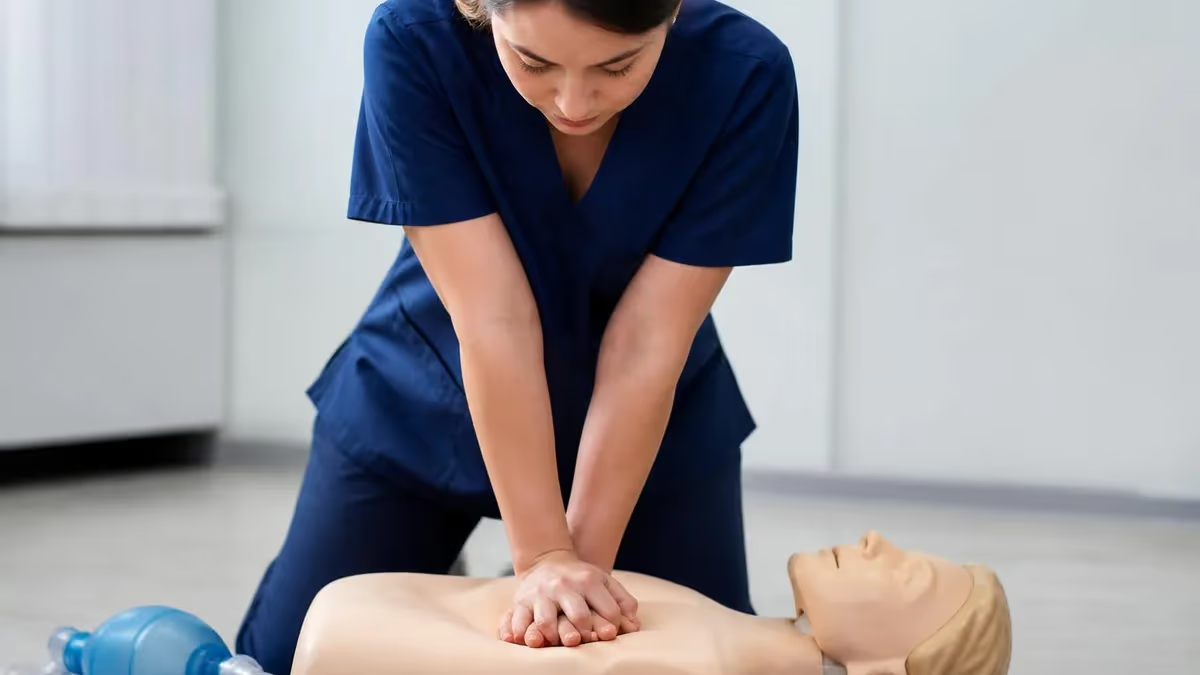
What a BLS Certificate Actually Proves
A BLS certificate isn't just a card you tuck behind your hospital ID. It's documented proof that you can recognize a cardiac arrest, deliver high-quality CPR, run an AED without fumbling, and clear an airway when seconds matter. Employers in healthcare — hospitals, clinics, dental offices, EMS, dialysis units, even some daycares — won't put you on the schedule without one.
You'll see the credential printed two ways: BLS Provider (American Heart Association) or BLS for Healthcare Providers (American Red Cross). Both meet the same baseline. Both follow the most recent 2020 ECC Guidelines, with the 2025 focus updates layered in. And yes — both expire in two years.
The skills you're tested on look simple on paper. Compress hard. Compress fast. Don't lean on the chest. Recognize when a rhythm is shockable. Switch compressors every two minutes. The catch? Doing all of it under pressure, on a real patient, while a code team works around you. That's why the practical exam exists, and it's why the written test isn't just a formality.
If you're prepping right now, run through our How to Pass the BLS Practice Test 2026 May — Exam Prep guide alongside the official Basic Life Support (BLS) Guide: Skills and Certification. They cover the same skills the proctor will grade you on.
Who Needs a BLS Certificate (And Who Just Thinks They Do)
Healthcare students get the BLS requirement on day one. Nursing programs, PA school, dental hygiene, paramedic programs, respiratory therapy — all of them require an active card before clinicals. So do most allied-health roles after graduation. If you're working bedside, in pre-hospital care, or in any setting where a patient could code in front of you, your employer mandates it.
Outside of clinical work, the answer is messier. Lifeguards, personal trainers, and some childcare staff are sometimes asked for BLS instead of regular CPR. That's usually overkill — a Heartsaver CPR/AED card covers them — but if your job description specifies BLS, get BLS. Don't argue with HR.
The People Who Skip It and Regret It
Travel nurses moving between states. Per-diem techs picking up a shift at a new facility. Dental assistants switching from a small private practice to a hospital-affiliated clinic. They all assume their old card is fine, until credentialing flags it. How long does BLS certification last? Two years from the issue date — not the renewal date, not the course date if they're different. Check the back of the card before your hire date, not after.
What the BLS Course Covers
The course itself runs about 4 to 4.5 hours for first-timers. Renewals trim that down to roughly 3. The content breaks into a few core modules:
- High-quality CPR for adults, children, and infants — compression depth, rate, and recoil for each age group.
- AED use — including pediatric pad placement and what to do if pads aren't available for an infant.
- Bag-mask ventilation — single-rescuer and two-rescuer technique.
- Choking relief — conscious and unconscious, all age groups.
- Team dynamics — closed-loop communication, role assignment, and when to switch compressors.
The written exam is 25 questions, multiple choice. You need 84% to pass — that's no more than 4 wrong. The skills test is pass/fail. Skip a critical action like checking for responsiveness, or compress at the wrong depth, and the instructor stops the scenario. You can usually retest the same day.
Online, Blended, or In-Person?
Three formats exist, and they're not interchangeable from an employer's perspective. A fully online BLS course (with no in-person skills check) is rarely accepted by hospitals — most credentialing offices reject it outright. A blended course (HeartCode BLS or Red Cross blended) splits theory online and skills in-person; this is widely accepted. A traditional in-person course covers everything in one sitting. If you're not sure what your employer wants, dig through our breakdown of BLS Certification Online: Courses, Cost, and What Counts before you pay for anything.
Cost varies more than you'd think. AHA in-person courses run $60 to $110 in most cities. Red Cross blended courses sit around $80 to $100. Online-only courses advertise at $20 — but if your job rejects them, that $20 was wasted. Ask your employer's credentialing office before you book.

Sample BLS - Basic Life Support Practice Questions
Try these questions from our free BLS - Basic Life Support practice tests. The correct answer and an explanation follow each question.
After successful resuscitation, a patient regains a pulse. EMS transfers care to the hospital. This transition represents which link in the Chain of Survival?
- A. Early recognition and activation
- B. Early defibrillation
- C. Advanced resuscitation and post-cardiac arrest care
- D. Early high-quality CPR
Answer: C. Advanced resuscitation and post-cardiac arrest care
Advanced resuscitation and post-cardiac arrest care is the link that occurs when the patient reaches a hospital capable of providing targeted temperature management and definitive treatment.
An infant is choking and becomes unresponsive. What is your next step?
- A. Continue back blows and chest thrusts
- B. Begin CPR starting with chest compressions
- C. Call 911 and wait for help
- D. Perform abdominal thrusts
Answer: B. Begin CPR starting with chest compressions
When an infant becomes unresponsive due to choking, begin CPR starting with 30 chest compressions, looking for the object before giving breaths.
You take the meat out of the victim's mouth. After removing the impediment from the airway, you should ___________.
- A. check for responsiveness
- B. check a pulse
- C. place the victim in the rescue position
- D. attach the AED
Answer: A. check for responsiveness
After successfully removing an airway obstruction, the immediate next step is to reassess the victim's condition. This involves checking for responsiveness to see if they have regained consciousness and are breathing normally. Only after confirming responsiveness and normal breathing would you consider other actions like checking a pulse or attaching an AED if needed.
In a two-rescuer BLS scenario, communication is MOST critical when:
- A. Deciding which rescuer performs mouth-to-mouth
- B. Coordinating the switch between compressor and ventilator roles
- C. Choosing which hospital to transport the patient to
- D. Documenting events after the resuscitation
Answer: B. Coordinating the switch between compressor and ventilator roles
Smooth role switches require clear verbal coordination to minimize interruptions in chest compressions and maintain CPR quality.
How to Prep So You Pass the First Time
The pass rate for BLS is high — about 90%-plus on first attempt — but the people who fail almost always make the same mistakes. They skip the pre-course modules. They skim the algorithms instead of memorizing them. They show up rusty on compression depth and let muscle memory take over from the last code they ran two years ago. Don't be that person.
The Three Things That Trip People Up
Compression depth and rate. Adults: at least 2 inches, no more than 2.4 inches, at 100-120 per minute. Kids: about 2 inches. Infants: about 1.5 inches. The instructor's manikin will tell on you if you go too shallow or too deep. Practice on a couch cushion if you have to — get the rhythm of "Stayin' Alive" stuck in your head.
The shockable rhythms. You need to recognize ventricular fibrillation and pulseless ventricular tachycardia at a glance. Asystole and PEA are not shockable, no matter how much the family is begging. The AED will tell you, but you should know before it does.
Switching compressors every two minutes. Quality drops fast — even fit people get sloppy after 90 seconds of real compressions. The two-minute swap isn't a suggestion. Practice the verbal handoff so it doesn't waste compressions when you're tested on the team scenario.
What to Bring on Test Day
- Government-issued photo ID. No ID, no test — instructors won't bend on this.
- Your AHA student workbook or Red Cross participant manual, if you bought one.
- A printed copy of your online module completion certificate, if you did blended.
- Comfortable clothes you can kneel in. You'll be on the floor for at least 30 minutes.
- Cash or a card for the eCard fee, if it wasn't bundled into the course price.
If You Fail
Most testing centers let you retake the written exam once on the same day, free. The skills test is similar — instructors usually walk you through the missed checkpoint, give you 10 minutes to practice, and re-run the scenario. Two failures in a row, though, and you'll need to re-register for the full course. Read the algorithms. Practice with the manikin during the break. Ask the instructor what they're specifically grading on — they'll tell you.
Once you pass, your eCard hits your inbox within 24 hours. Print it, save the PDF, and submit it to your credentialing office before the start of your next shift. If you want a final practice run, our How to Pass the BLS Practice Test 2026 May — Exam Prep mirrors the question style and difficulty of the real thing — better to miss a question now than on test day.
Renewal: When and How
Your BLS card expires on the last day of the month it was issued, two years out. So if you certified on March 14, 2026, you've got until March 31, 2028 — not the 14th. That extra grace at the month's end matters more than you'd think when you're juggling shift swaps and credentialing deadlines.
Renewal courses are shorter, cheaper, and assume you already know the basics. AHA's renewal sits around 2.5 to 3 hours. Red Cross runs similar. The written test is still 25 questions, and the skills check is the same. Don't get cocky because you've done it before — instructors fail renewal students all the time for compression-rate drift, sloppy AED operation, or skipping the pulse check. Two years of habit is plenty of time to develop bad ones.
HeartCode BLS for Renewals
HeartCode BLS is the AHA's blended-renewal flagship. You watch the eLearning modules at home, work through adaptive scenarios, then book a 30 to 45 minute "skills session" at any AHA training center. It's by far the most flexible renewal option — and yes, hospitals accept it. Your eCard is identical to the one you'd get from a full classroom course.
Where Your Card Is Accepted (and Where It Isn't)
This trips people up more than any other part of the credential. AHA cards are accepted nationwide, no questions asked. Red Cross BLS for Healthcare Providers is also accepted by virtually every U.S. hospital. ASHI (American Safety and Health Institute) and NSC (National Safety Council) BLS cards are accepted by some employers, rejected by others. Smaller agencies — National CPR Foundation, ProCPR, ProTrainings — issue cards that look official but get rejected at most major hospitals.
Before you sign up for any course, do this: open your employer's credentialing-policy PDF, search for "BLS," and read the acceptable-issuer list. If your provider isn't on it, walk away. Doesn't matter how cheap or convenient. A $30 card you can't use is more expensive than a $90 card you can.
Cross-State Reciprocity
BLS cards from AHA and Red Cross are valid in all 50 states. There's no state-specific BLS license. That said, individual employers can have stricter standards — a teaching hospital in Boston might require AHA only, while a community clinic in the same city accepts Red Cross. Your nursing license has reciprocity rules; your BLS card just needs to be from an accepted issuer for the specific employer.
Algorithms You Should Know Cold Before Class
The provider manual has a stack of algorithms — flow charts that walk you through every cardiac arrest scenario. You don't need to recite them word-for-word, but the proctor will expect you to follow the steps without prompting. The four you'll be tested on most:
- Adult Basic Life Support algorithm. Verify scene safety, check responsiveness, shout for help, send for AED, check breathing and pulse simultaneously (no more than 10 seconds), start CPR, attach AED, follow prompts.
- Pediatric BLS algorithm (single-rescuer). Same scene safety check, then if you witnessed the collapse, get the AED first; if you didn't, give 2 minutes of CPR before leaving for the AED. Compressions to ventilations: 30:2 single-rescuer, 15:2 with two rescuers.
- Adult and child choking algorithm. Conscious: abdominal thrusts (Heimlich) for adults and kids over 1 year. Unconscious: lower to ground, start CPR, look in the mouth before each set of breaths, remove the object only if you can see it.
- Infant choking and CPR. Conscious infant: 5 back blows, 5 chest thrusts, repeat. Unconscious: same CPR sequence as a child but with two-finger compressions for one rescuer, two-thumb encircling-hands for two rescuers.
If you can sketch these from memory on the back of an envelope, you're ready for the written test. Most failed exams come down to one of these four — usually a misordered step or skipping the pulse check.
Common Mistakes That Get You Failed
Instructors keep informal tallies of why students get stopped during the skills exam. The repeat offenders:
- Forgetting to scan for safety. Sounds dumb. Easy to skip when you're nervous. The proctor watches for it — say "scene is safe" out loud as your first action.
- Pulse check too long or too short. Up to 10 seconds, no more. Don't take 15 because you can't feel anything; if there's no definite pulse in 10, start compressions.
- Hand placement on infant compressions. Just below the nipple line, on the lower half of the sternum. Two fingers (single rescuer) or two-thumb encircling-hands (two rescuer). Wrong spot = automatic re-do.
- Letting the AED interrupt unnecessarily. Resume compressions immediately after a shock. Don't wait for the AED to tell you to. Every paused second is brain cells.
- Sloppy ventilations. Each breath should take about 1 second and produce visible chest rise. Faster than that and you'll over-ventilate and reduce blood flow.
What Happens After You Pass
Your eCard arrives by email within 24 hours, sometimes within an hour if the instructor uploads on the spot. The card has a unique ID number that hospitals can verify online with AHA or Red Cross. Save the PDF in two places — your phone, and a cloud folder you can access from any device. Print one copy for your wallet if your hospital still accepts paper, but most have moved to digital-only verification.
Add the expiration date to your calendar with a 90-day reminder. Most credentialing offices send their own reminder, but don't rely on it. Better to book the renewal early than to discover at 6 AM on a shift day that your card expired last week and you can't legally clock in.
Bottom Line
Get your BLS certificate from AHA or Red Cross. Pick the format that matches your schedule — fully in-person if you want it done in one go, blended if you'd rather knock out the theory at home. Budget $60 to $110 and a single afternoon. Read the provider manual before you walk in. Practice compressions on something firm. Memorize the shockable rhythms. Know the high-quality CPR numbers cold: rate 100-120, depth 2 inches for adults, full recoil, minimize interruptions, switch every two minutes.
Once you've got the card, set a calendar reminder for 90 days before expiration. Renewal is shorter and cheaper than starting over, and you'll keep your credentialing file clean. Two years from now, you'll be glad you did.
About the Author

Registered Nurse & Healthcare Educator
Johns Hopkins University School of NursingDr. Sarah Mitchell is a board-certified registered nurse with over 15 years of clinical and academic experience. She completed her PhD in Nursing Science at Johns Hopkins University and has taught NCLEX preparation and clinical skills courses for nursing students across the United States. Her research focuses on evidence-based exam preparation strategies for healthcare certification candidates.
Join the Discussion
Connect with other students preparing for this exam. Share tips, ask questions, and get advice from people who have been there.
View discussion (8 replies)