
American Red Cross BLS Certification: Complete Guide 2026 September
American Red Cross BLS certification: course content, costs, comparison with AHA BLS, employer acceptance, and what to expect from training. 🧠
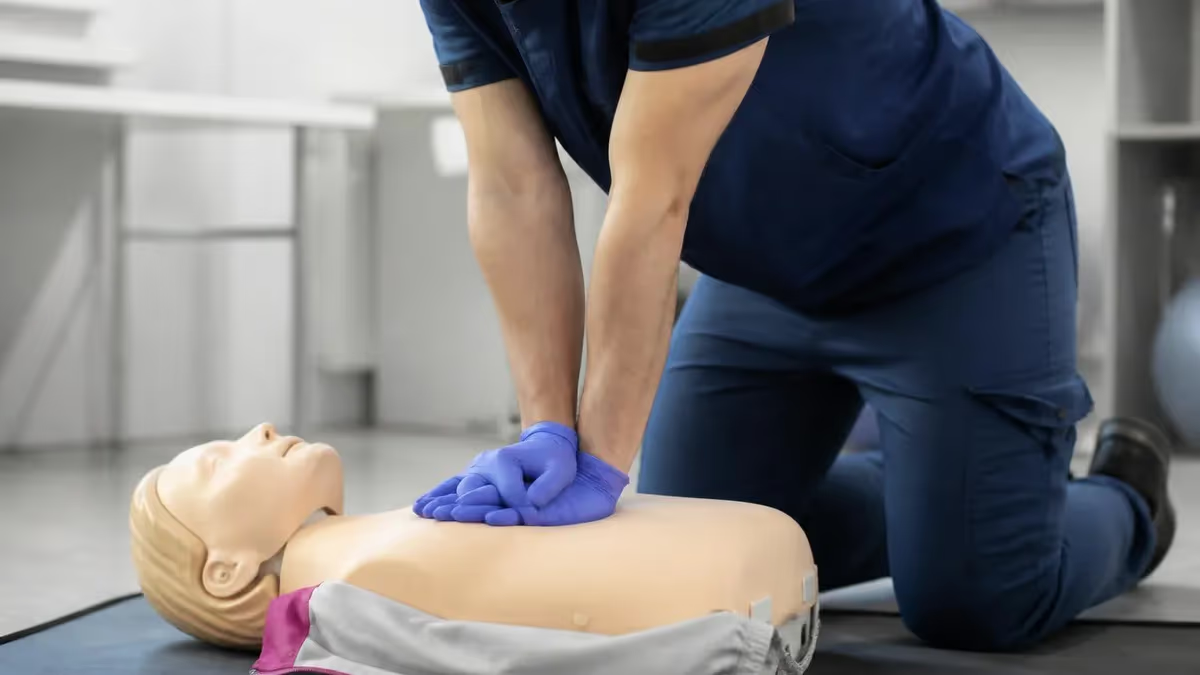
American Red Cross Basic Life Support (BLS) certification is one of the major BLS credentials accepted in healthcare settings throughout the United States. Designed for healthcare professionals — nurses, doctors, paramedics, dental staff, athletic trainers, and similar roles — the Red Cross BLS course covers the same fundamental skills as the American Heart Association's BLS Provider course but with some structural and pedagogical differences. Both organizations align with the same International Liaison Committee on Resuscitation (ILCOR) consensus on resuscitation science, so the actual clinical content is essentially identical between the two providers.
The certification process for Red Cross BLS involves either a fully in-person class or a blended learning format combining online modules with hands-on skills assessment. The blended option appeals to busy healthcare providers who can complete cognitive content at home and attend a shorter in-person session for skills practice and certification testing. The full classroom option provides more time for practice and discussion, valuable for learners new to BLS or those who learn better through extended hands-on practice. Both formats lead to the same Red Cross BLS Provider certification, valid for two years.

Red Cross BLS Quick Facts
Cost: Typically $80-$130 per student at instructor-led courses (varies by location). Duration: 4-5 hours classroom or 2 hours online + 90 minute skills session. Validity: 2 years. Recognition: Widely accepted in U.S. healthcare settings, particularly hospitals that don't specifically require AHA. Renewal: Renewal class about 3-4 hours, $70-$100. Online verification: Digital certificate accessible via Red Cross account.
Red Cross BLS course content covers the standard BLS skill set: high-quality CPR for adults, children, and infants; AED operation; choking relief for conscious and unconscious victims at all age levels; team-based resuscitation with bag-valve-mask ventilation; and special considerations for healthcare contexts. The skills are taught in a structured progression building from individual technique through partner-based scenarios to multi-rescuer team responses. Healthcare-specific elements include integration with code team responses, hospital-specific equipment considerations, and the transition between BLS and ACLS care that healthcare providers manage during real cardiac arrest events.
What's Covered in the Red Cross BLS Course
Recognition of cardiac arrest, high-quality CPR with proper depth and rate, AED pad placement, shock delivery, integration with EMS handover.
Modified depth and force for pediatric anatomy, special AED considerations for children (pediatric pads or adult pads with attenuator).
Two-finger or two-thumb technique, head positioning, modified breath delivery, when AED is appropriate for infants.
Recognition of mild vs severe airway obstruction, abdominal thrusts for adults/children, back blows and chest thrusts for infants, response when victim becomes unconscious.
Communication during code response, role assignment, bag-valve-mask ventilation, alternating compressors to maintain quality.
Drowning, opioid overdose with naloxone, hypothermia, pregnancy, electrical injury — situations requiring modified BLS approach.
Most healthcare employers accept either Red Cross BLS or AHA BLS Provider certifications, treating them as functionally equivalent for purposes of credential verification and renewal requirements. However, some specific employers — particularly larger hospital systems and academic medical centers — explicitly require AHA BLS rather than Red Cross.
The reasoning typically isn't about clinical content quality but about institutional standardization and AHA's longer history as the dominant healthcare-focused BLS provider. Before signing up for Red Cross BLS, verify with your employer or prospective employer that the certification is accepted. If you're certain your employer accepts Red Cross BLS, the choice often comes down to local availability, cost, and personal preference.
The blended learning format from Red Cross combines about two hours of online learning (videos, interactive modules, knowledge checks) with a 90-minute in-person skills session. The online portion covers cognitive content — recognition of emergency situations, sequence of actions, AED operation principles, etc. — that doesn't require physical practice. The in-person session focuses entirely on hands-on practice and skills assessment using manikins and AED training units. This format works particularly well for renewal candidates who already understand the concepts and primarily need skills refresh and assessment.
Course size varies significantly across instructors and Training Centers. Some Red Cross BLS courses are taught one-on-one or with very small groups (2-4 students), allowing extensive individual practice and feedback. Others run with 8-12 students, balancing economics with reasonable instructor attention per student. Larger groups (12+) reduce per-student attention and practice time substantially. For learners new to BLS or those who learn better with detailed feedback, smaller class sizes provide better learning experience even at slightly higher per-student cost.
Full classroom course (4-5 hours): All learning happens at the training site. Includes presentation of cognitive content, video demonstrations, hands-on practice with manikins, scenario-based skill development, and final skills assessment. Allows extended practice time and instructor feedback throughout. Suitable for learners new to BLS or those who prefer fully guided learning. Typical cost $80-$130. Best for first-time BLS learners and those without recent BLS experience.

Red Cross and AHA differ in some pedagogical elements while teaching essentially the same clinical content. Red Cross often uses scenario-based learning more extensively, presenting realistic patient scenarios and asking learners to demonstrate appropriate response. AHA often uses skill-station rotation more extensively, with focused practice on individual techniques.
Both approaches produce competent BLS providers when taught well by skilled instructors. Some learners prefer one approach over the other — those who learn well through scenarios may prefer Red Cross format, while those who prefer focused skill practice may prefer AHA format. The differences are subtle and most learners do fine with either.
Course pass rates are typically very high (90%+) for both Red Cross and AHA BLS courses because the courses are designed to teach to mastery rather than to weed out weak learners. Instructors work with students who struggle until they can demonstrate skills competently. Failure typically occurs only when a student is unwilling or unable to participate adequately in the practice and assessment portions. If you're worried about passing, attending the course prepared (review materials beforehand, practice mental walkthrough of CPR sequence, ensure you're physically able to perform compressions) virtually guarantees success.
Skills assessment in Red Cross BLS uses checklists similar to AHA. The instructor observes you performing each required skill — adult CPR with AED, child CPR, infant CPR, choking relief at multiple ages, team-based resuscitation — and verifies competent performance against established criteria. Compression depth, rate, complete recoil, minimal interruptions, proper hand placement, and coordinated team communication are assessed. Most learners demonstrate competency on first attempt; those who don't receive additional practice and reassessment within the same session.
Before pursuing Red Cross BLS rather than AHA BLS, verify with your employer that Red Cross is accepted. Most employers accept both, but some specifically require AHA. Larger hospital systems and academic medical centers are more likely to require AHA. Smaller community hospitals, urgent care, dental offices, and similar settings typically accept either. Don't pay for Red Cross BLS only to find your employer requires AHA — verify first.
Cost comparison between Red Cross and AHA BLS reveals modest but real differences. Red Cross BLS courses generally run $80-$130 per student at most Training Centers, while AHA BLS Provider courses typically run $60-$120 in similar markets. The difference reflects organizational fee structures, institutional standardization, and market positioning rather than meaningful course quality differences. For most learners, the local availability and instructor quality matter more than the modest price differences. A well-taught Red Cross BLS course at $110 provides better learning than a poorly taught AHA course at $80, regardless of price.
Renewal cycle planning helps avoid certification gaps. Red Cross BLS expires exactly 2 years after issue date. Schedule renewal at least 30-60 days before expiration to allow for any rescheduling needs. Some employers require renewal earlier than expiration date, often 90 days before, so they have buffer time. Failing to renew before expiration typically requires full initial certification rather than renewal, adding time and cost. Set calendar reminders multiple months before expiration to avoid last-minute scrambling and potential certification gaps.
For those teaching BLS regularly, Red Cross instructor certification is a related credential opening side-income or career-development opportunities. Red Cross BLS Instructor certification requires holding current BLS Provider, completing Red Cross Instructor Trainer course, and ongoing teaching minimums. The pathway differs from AHA instructor certification in administrative details. Many healthcare professionals who want to teach BLS hold dual instructor certifications (Red Cross + AHA) to serve diverse client bases with whichever certification each employer prefers.
Before Your Red Cross BLS Course
- ✓Verify employer accepts Red Cross BLS (not just AHA)
- ✓Confirm course type — full classroom, blended, or renewal
- ✓Wear comfortable clothing for floor work and physical activity
- ✓Eat lightly before — physical activity on full stomach is uncomfortable
- ✓Bring water bottle and any required identification
- ✓If blended, complete online modules before in-person session
- ✓Review CPR sequence basics if it's been a while since last training
- ✓Arrive early to handle paperwork and room orientation
Practical preparation for the in-person portion includes physical readiness and mental walkthrough. CPR is genuinely strenuous — you'll perform multiple cycles of chest compressions on manikins during practice, and quality assessment specifically requires proper depth (2-2.4 inches for adults), rate (100-120 per minute), and complete recoil. People with shoulder, back, or wrist limitations sometimes struggle with the physical demands; arrive having considered your physical readiness and any modifications you might need. Most courses can accommodate physical limitations but advance discussion with the instructor helps.
The in-person session typically includes brief introductions, review of cognitive content (or full presentation in classroom-only courses), demonstrations of each skill, individual and team-based practice, and final skills assessment. Total time varies from 90 minutes (blended renewal) to 4-5 hours (full initial classroom). Bring water and wear clothing comfortable for floor work — kneeling next to manikins is essential, and tight or restrictive clothing makes practice harder. Some learners bring knee pads if they have knee sensitivity from prolonged kneeling. Layered clothing accommodates varying room temperatures.
After the course, your Red Cross BLS certificate becomes available digitally through your Red Cross account. The processing time is typically immediate to within hours of course completion. Print or save a digital copy for your employer. If your employer uses Red Cross's verification system, they can verify your certificate authenticity directly without you providing a printed card. Some employers want printed cards anyway for paper records — print the digital certificate if so.

Red Cross BLS curriculum updates align with the periodic ILCOR/AHA guideline updates that drive resuscitation science. Major updates occur every 5 years, with 2010, 2015, 2020, and 2025 being the most recent major revisions. Smaller interim updates occasionally roll out between major cycles. Recent updates have emphasized continuous chest compressions during initial response, expanded scope of opioid overdose response with naloxone, refinements in pediatric protocols, and post-cardiac arrest care considerations. Anyone certified more than 5 years ago without renewal will encounter substantial differences from current practice, even though the core skills remain similar.
The relationship between Red Cross BLS and other Red Cross courses creates pathways for expanded credentials. Red Cross First Aid/CPR/AED for lay rescuers serves non-healthcare audiences with simpler scope. Red Cross Lifeguard Training builds on aquatic-specific BLS skills. Red Cross Wilderness First Aid extends emergency response to remote/limited-resource environments. Red Cross EMR (Emergency Medical Responder) provides broader emergency medical training beyond BLS. Stacking related certifications creates comprehensive emergency response qualifications useful in various professional and volunteer contexts.
For dental professionals, Red Cross BLS is widely accepted as the dental office BLS requirement that ADA accreditation and state regulations specify. Dental hygienists, dental assistants, and dentists all need current BLS, typically renewed every 2 years matching the certification cycle. Dental-specific Red Cross BLS courses sometimes emphasize office-context scenarios rather than hospital-context scenarios, but the underlying skills are identical. The course content is the same; only the framing of practice scenarios may differ between dental-focused and general healthcare-focused courses.
Red Cross BLS Quick Numbers
Red Cross BLS vs AHA BLS Comparison
Essentially identical — both align with ILCOR consensus. Compression depth, rate, AED protocols, choking response, team dynamics: same recommendations.
Red Cross typically $80-130, AHA typically $60-120. Modest difference, not the major factor in choice.
Red Cross emphasizes scenario-based learning more; AHA emphasizes skill-station rotation more. Both produce competent providers.
Most employers accept both. Larger hospitals and academic medical centers often specifically require AHA. Verify before choosing.
Both organizations provide digital verification through their respective online portals. Equally trusted by credentialing offices.
Similar 2-year cycles for both. Renewal courses available; lapsed certifications require full initial recert.
For new graduates entering healthcare careers, Red Cross BLS is often a first professional certification beyond core academic credentials. Nursing students typically obtain BLS during nursing school as part of clinical requirements. Medical students obtain BLS early in their training. Paramedic students obtain BLS as foundation before EMT and paramedic curricula. Physical therapy, occupational therapy, dental hygiene, and similar programs typically require BLS for clinical practice. The BLS certification you obtain during professional education often becomes your entry-level professional credential and gets renewed throughout your career.
Beyond initial education, BLS certification is a recurring requirement throughout healthcare careers. Hospital credentialing requires current BLS for all clinical staff. State licensure boards often require BLS as part of professional licensure renewal in some states for some professions. Joint Commission accreditation requires hospitals to verify staff BLS currency. Insurance providers and managed care organizations require staff BLS for credentialing. The recurring renewal cycle (every 2 years) becomes routine professional maintenance, similar to nursing license renewal or medical license renewal in cadence.
Specific tips for performing well during the skills assessment portion help reduce anxiety and improve practice. Compression depth is one of the most commonly missed criteria — many learners compress too shallowly out of concern about hurting the manikin or actual patient. The required 2-2.4 inches for adults is genuinely deep; if you don't feel like you're working hard, you're probably not compressing deep enough.
Modern manikins with feedback devices give real-time depth feedback during practice. Pay attention to that feedback and recalibrate if you're consistently below target depth. Compression rate should target 100-120 per minute — many people unconsciously slow down to 80-90 per minute when fatigued, so consciously maintaining tempo throughout matters.
Complete recoil between compressions is another commonly missed criterion. Learners often subconsciously lean on the chest between compressions, preventing full chest recoil that allows the heart to refill before the next compression. Lifting your hands fully off the chest between compressions during practice — even slightly more than needed in real situations — develops the habit of letting the chest recoil completely. The manikin feedback shows whether you're maintaining adequate recoil. Watch for this during practice and consciously correct any tendency to lean on the chest.
Hand placement on the chest follows specific rules: lower half of the sternum for adults, between the nipples in most adult anatomy. Hand position too high (over the manubrium or upper sternum) reduces compression effectiveness; position too low (over the xiphoid process or upper abdomen) risks injury and reduces effectiveness. Practice positioning your hands without looking, using anatomical landmarks. The instructor will assess hand placement during your skills evaluation, and inconsistent positioning will require remediation. Once correct positioning becomes automatic through practice, you no longer need to consciously check it.
Bag-valve-mask ventilation technique is one of the harder BLS skills to perform correctly under pressure. Proper mask seal requires good two-handed technique with one rescuer holding the mask while another compresses, or single-rescuer technique if working alone. Inadequate seal results in poor ventilation despite squeezing the bag. Excessive ventilation volume causes gastric distension which complicates resuscitation. The course teaches specific techniques (E-C clamp grip, jaw thrust positioning) that improve seal quality. Practice with the course manikins develops the muscle memory needed for real situations.
Special situations covered in BLS courses include responses to specific scenarios beyond standard cardiac arrest. Drowning victims require ventilation early because their cardiac arrest typically results from hypoxia rather than primary cardiac event. Opioid overdose victims may have respiratory arrest before cardiac arrest, with naloxone (Narcan) administration appropriate when available. Pregnant women in cardiac arrest receive standard CPR with manual left uterine displacement to relieve aortic compression. Hypothermia victims require slower assessment because pulse may be very slow and weak. Each special situation modifies standard BLS in specific ways, and the course covers each modification through scenario practice.
Red Cross BLS: Pros and Cons
- +Widely accepted in U.S. healthcare settings
- +Same clinical content as AHA, equivalent quality
- +Blended learning option saves classroom time
- +Digital verification simplifies credential management
- +Comprehensive scenario-based teaching approach
- +Strong instructor network across U.S.
- −Some employers specifically require AHA instead
- −Slightly higher cost than AHA BLS in many markets
- −Renewal cycle requires planning every 2 years
- −Lapsed certifications require full initial recert
- −Online portal occasionally has technical issues
- −Local Training Center quality varies significantly
Pros and Cons at a Glance
| Pros | Cons |
|---|---|
| Widely accepted in U.S. healthcare settings | Some employers specifically require AHA instead |
| Same clinical content as AHA, equivalent quality | Slightly higher cost than AHA BLS in many markets |
| Blended learning option saves classroom time | Lapsed certifications require full initial recert |
| Digital verification simplifies credential management | Online portal occasionally has technical issues |
| Comprehensive scenario-based teaching approach | Local Training Center quality varies significantly |
BLS Questions and Answers
About the Author

Registered Nurse & Healthcare Educator
Johns Hopkins University School of NursingDr. Sarah Mitchell is a board-certified registered nurse with over 15 years of clinical and academic experience. She completed her PhD in Nursing Science at Johns Hopkins University and has taught NCLEX preparation and clinical skills courses for nursing students across the United States. Her research focuses on evidence-based exam preparation strategies for healthcare certification candidates.
Join the Discussion
Connect with other students preparing for this exam. Share tips, ask questions, and get advice from people who have been there.
View discussion (8 replies)