
CPR Mask: Types, How to Use One, and Where to Buy 2026 September
CPR mask guide — ✍🏼 types of pocket masks and face shields, how to use one for rescue breathing, infection control, and where to buy reliable masks.
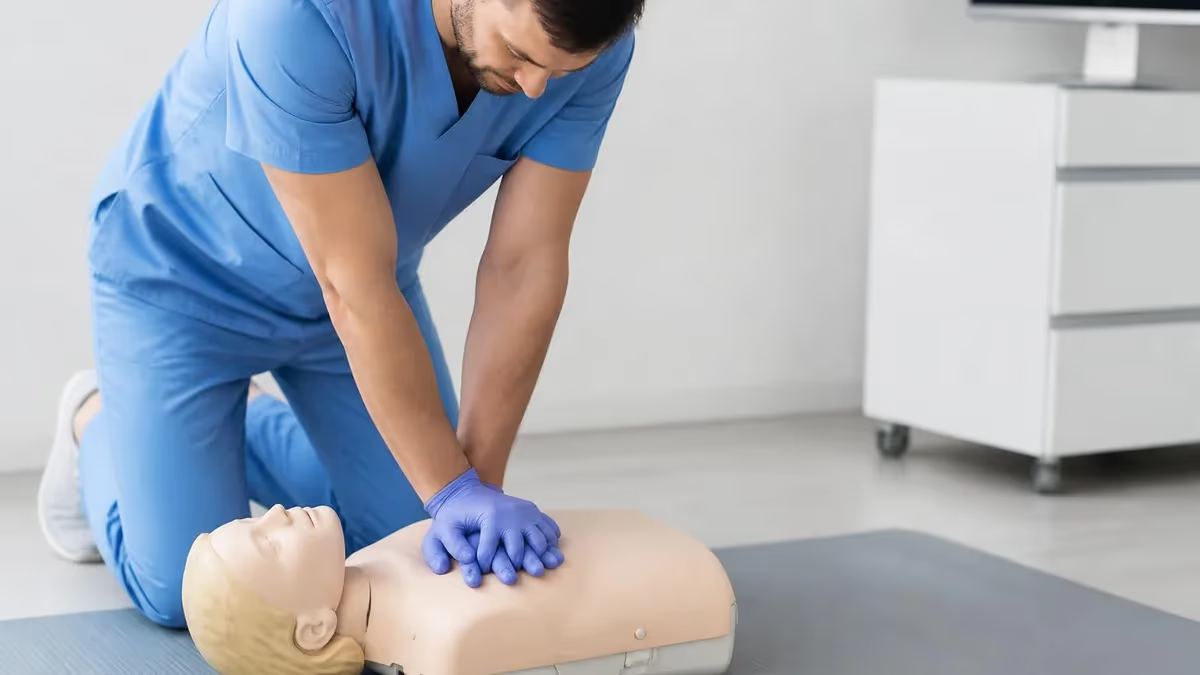
A CPR mask is a barrier device that protects a rescuer from direct mouth-to-mouth contact while performing rescue breathing on a person in cardiac arrest. Modern CPR masks include a one-way valve that lets the rescuer's breath flow into the patient while preventing the patient's exhaled air, vomit, or blood from flowing back. The mask sits over the patient's mouth and nose, and the rescuer breathes into a port on top. Properly used, it preserves the rescuer's safety while delivering effective ventilation during a real emergency.
This guide walks through the main types of CPR masks (keychain face shields, pocket masks with one-way valves, and bag-valve masks), how to use each one correctly, the infection-control rationale behind their use, and how the mask fits into modern CPR protocols. We'll also cover where to buy a quality mask, how much to expect to pay, what kind of expiration date to look for, and how the right mask differs between adult and pediatric patients during a rescue attempt.
The CPR mask is one of the most useful items a CPR-trained rescuer can keep close at hand. A quality pocket mask costs around $12 to $25 and clips to a keychain or fits in a glovebox. Healthcare workers, lifeguards, daycare staff, fitness trainers, flight attendants, and anyone trained to AHA Heartsaver or BLS standards typically carries one in their personal or workplace first-aid kit. Even outside professional settings, many CPR-trained individuals keep a mask in the car or backpack as part of basic preparedness.
Recent updates to CPR guidelines have shifted the emphasis somewhat. The American Heart Association now recommends compression-only ("hands-only") CPR for untrained bystanders responding to adult cardiac arrest, where pushing hard and fast on the chest delivers most of the survival benefit. But for trained rescuers with a mask available — and especially for pediatric, drowning, or asphyxia-related arrests — rescue breathing remains valuable, and the mask is the right tool for delivering those breaths safely.
The mask also matters for the rescuer's own protection. Performing direct mouth-to-mouth on an unknown patient carries real risks of infectious disease transmission. Modern one-way-valve masks essentially eliminate that risk while still permitting effective ventilation.
The handful of seconds it takes to position the mask before delivering breaths is a small price for both rescuer protection and consistently better airway technique than freelance mouth-to-mouth. The mask is a small, cheap, durable piece of safety equipment that pays for itself the first time you actually need it during an emergency response in your home, workplace, or community where someone you know experiences cardiac arrest unexpectedly without warning.
CPR mask at a glance
What it is: a barrier device with a one-way valve that lets a rescuer deliver rescue breaths to a patient in cardiac arrest without direct mouth-to-mouth contact. Three common types: keychain face shields (cheapest, lowest profile), pocket masks with one-way valve and oxygen port (the standard), bag-valve masks (BVMs) used in clinical settings. Cost: $5 to $25 for face shields and pocket masks; $30 to $80 for BVMs. Lifespan: typically 5 years if properly stored and unused.
Types of CPR masks
The simplest barrier is the keychain face shield — a thin plastic sheet with a one-way valve in the center. The shield folds into a small plastic case that clips to a keychain or fits into a wallet. Cost is around $5. Face shields work, but they offer less protection than a true pocket mask and are harder to position correctly under stress. They're better than no barrier and far better than nothing, but most CPR instructors recommend upgrading to a pocket mask if you'll carry the device beyond casual preparedness.
Pocket masks are the standard for trained rescuers. They consist of a soft silicone or PVC dome that fits over the patient's mouth and nose, a one-way valve in a port on top, and often a supplemental oxygen port on the side. Quality pocket masks include a head strap so the rescuer can secure the mask hands-free during compressions. The mask comes in a hard plastic case roughly the size of a hockey puck that fits in a backpack, glovebox, or first-aid kit. Cost is around $12 to $25.
Bag-valve masks (BVMs) — sometimes called Ambu bags after the original brand — are used in clinical and EMS settings. The BVM combines a soft mask with a self-inflating bag that the rescuer squeezes to deliver each breath. BVMs allow ventilation with supplemental oxygen at much higher concentrations than pocket masks and are the standard for hospital code teams, ambulance crews, and any setting with two trained rescuers available to maintain mask seal and bag squeeze separately during the resuscitation effort.
Beyond these three categories, several specialty devices exist for specific scenarios — neonatal masks for newborns, supraglottic airway adjuncts for advanced providers, and CPR feedback masks that include compression-rate sensors. For most lay rescuers and CPR-trained workers, a quality pocket mask is the right choice. For clinical teams, BVMs are mandatory. Face shields are acceptable as a backup or for situations where size and weight matter (firefighter pockets, lifeguard rescue tubes, flight crew kits).

Choosing a CPR mask — comparison
Thin plastic sheet with a one-way valve. Fits in a small case clipped to a keychain or wallet. Cheap ($5 range) and ultra-portable. Works as a basic barrier but offers less protection and harder seal than a real pocket mask. Best as a backup or for situations where bulk is unacceptable, like keychain-only carry kits or wallet-sized first-aid loadouts.
Soft silicone dome with one-way valve. The standard CPR mask for trained lay rescuers and most workplace first-aid kits. Cost $12 to $20. Includes head strap for hands-free use during compressions. Larger than a face shield but still pocket-portable in its protective hard case that prevents the silicone from being damaged in storage.
Same dome and valve plus a side port for supplemental oxygen tubing. Cost $15 to $30. Used by EMS, lifeguards, healthcare workers, and trained workplace first-aid teams that have access to oxygen tanks. The port lets the rescuer deliver breaths supplemented by 10-15 LPM oxygen, raising the inspired oxygen content of each delivered breath substantially.
Self-inflating bag attached to a mask, with reservoir for high-concentration oxygen. Standard in hospital code teams, ambulances, and any clinical setting. Cost $30 to $80 for adult BVMs. Requires two trained rescuers ideally — one maintaining seal, one squeezing bag — for consistent ventilation, though one-rescuer technique works for emergencies in a pinch.
Smaller dome sized for children and infants. Available as standalone pediatric masks or as part of dual-mask kits. Pediatric BVMs use smaller bags to prevent over-ventilation of small lungs. Always size mask to patient — adult mask on pediatric patient produces poor seal and risks gastric distention from misdirected air during the rescue breaths.
Lower-cost masks intended for single-patient use, then discarded. Used widely in healthcare during high-volume code work. Cost $3 to $10 each. Quality varies; choose products that meet AHA or Red Cross specifications. Disposable masks are generally not used by lay rescuers because the per-use cost adds up faster than the annual amortization of a reusable pocket mask in regular preparedness use.
How to use a CPR mask correctly
Using a pocket mask follows a consistent sequence. First, position yourself at the patient's head, kneeling or standing depending on the patient's level. Open the patient's airway using the head-tilt chin-lift maneuver (or jaw thrust if you suspect spinal injury). Place the mask over the patient's nose and mouth with the narrow end of the dome over the bridge of the nose and the wider base over the chin. The mask should cover both nostrils and the mouth completely, sealed against the face.
Maintain seal using the E-C technique with both hands. The thumb and index finger form a "C" pressing the mask down onto the face on each side of the port. The remaining three fingers form an "E" gripping under the jawbone to lift the jaw up into the mask. This combined motion both seals the mask and keeps the airway open. With one rescuer, the E-C is done with one hand on each side of the mask while you're at the patient's head; with two rescuers, the breath-giver does E-C on both sides while the compression rescuer continues compressions.
Deliver each rescue breath over about one second, watching the patient's chest rise. The breath should be just enough volume to make the chest rise visibly — not so forceful that air goes into the stomach (gastric insufflation), which can cause vomiting and aspiration. Pause to let the patient passively exhale before delivering the next breath. Standard adult CPR ratios are 30 chest compressions followed by 2 breaths in single-rescuer scenarios, repeating the cycle continuously until advanced help arrives or the patient recovers signs of life that warrant cessation of CPR.
If the chest doesn't rise on the first breath, reposition the airway and try again. The most common cause of failed ventilation is a poor mask seal or an inadequately tilted head. Don't keep blowing harder — instead, fix the seal and the airway. If the chest still doesn't rise after the second attempt, return to compressions immediately. Rescue breath time is a brief window, and prolonged effort to ventilate at the expense of compressions reduces overall CPR effectiveness in the critical first minutes of arrest.
CPR mask use — different scenarios
Position yourself beside the patient's head. Place the mask over nose and mouth. Use one hand to maintain seal with E-C technique while the other hand keeps the chin lifted and head tilted. After each set of 30 compressions, switch hand position to use both hands on the mask for the two breaths, then return to compressions. The 30:2 ratio applies for single-rescuer adult CPR with a mask.
Why a barrier matters — infection control
Direct mouth-to-mouth resuscitation can transmit a range of infectious diseases — herpes simplex, tuberculosis, meningococcus, hepatitis, and others — even though documented transmission events are uncommon. The CDC and OSHA both recommend barrier devices for any rescuer performing ventilation on a patient whose infectious status is unknown. For workplace CPR responders, OSHA's bloodborne pathogens standard treats CPR as an exposure incident absent appropriate barrier protection, with corresponding documentation and follow-up requirements.
The one-way valve in a quality CPR mask is the critical infection-control feature. Inhaled rescuer breath flows through the valve toward the patient. Patient exhalation, blood, vomit, or sputum is blocked from flowing back through the same opening. The valve usually includes a hydrophobic filter that further protects the rescuer from aerosolized pathogens during patient exhalation between breaths. This design is reliable enough that pocket masks have been used for decades in clinical settings without significant transmission concerns.
Beyond infection control, the mask also makes ventilation easier. The dome shape distributes the rescuer's breath evenly into the patient's airway via the natural facial seal, while a direct mouth-to-mouth seal can leak around the corners of the mouth, fail when the rescuer pulls back to inhale, or produce inconsistent breath volumes between attempts. Pocket masks eliminate most of those technical failure modes and let the rescuer focus on watching for chest rise rather than worrying about seal mechanics during the breath itself.
For workplace responders, OSHA expects employers to provide barrier devices wherever CPR may be required. That means a CPR mask in the first-aid kit at any workplace where staff are trained to provide CPR — most offices, schools, fitness centers, and large public-facing businesses. The masks should be inspected periodically for damage and replaced when they reach their expiration date. Documentation of the inspection cadence and replacement history is part of standard OSHA compliance for workplace first aid programs across most regulated industries.

If you witness an adult cardiac arrest and don't have a CPR mask handy, the right move is compression-only CPR — push hard and fast on the center of the chest, 100-120 per minute, until help arrives or an AED is attached. The American Heart Association explicitly endorses compression-only as the recommended approach for untrained or barrier-less bystanders. Don't delay compressions to find a mask, and don't skip CPR because you don't have one available at the moment.
Where to buy a CPR mask and what to look for
Quality CPR masks are widely available online and through medical-supply retailers. Major brands include Laerdal, Ambu, Adsafe, Mayo, MDF, and Allied Healthcare. Amazon, eBay, and most CPR-training-school websites carry inventory. Expect to pay $12 to $25 for a quality pocket mask in a hard case. Avoid extremely cheap (under $5) masks of unknown provenance — counterfeit or off-brand masks may not meet AHA specifications, may have valves that fail under stress, or may lack the filter that the better-known brands include in their valve assembly as a standard component.
Look for several features when choosing a mask. The dome should be soft silicone or medical-grade PVC for an effective facial seal. The one-way valve must be hydrophobic-filter equipped for full infection-control benefit. A head strap is convenient for hands-free use but not strictly necessary. The hard case should snap closed reliably to keep the mask clean during storage. An expiration date should be printed on the mask or case — quality masks include this date as a routine quality-assurance measure during manufacturing.
For workplace use, buy in quantity through a medical-supply distributor rather than retail. Bulk pricing brings the per-unit cost to $8 to $15. Workplaces stocking multiple first-aid kits should standardize on one brand and model to simplify training and replacement. Lifeguard programs, athletic training rooms, schools, and fitness centers usually maintain a mask inventory with documented inspection and replacement schedules tied into their broader safety compliance programs and required staff training cycles.
Buying and storing a CPR mask — checklist
- ✓Choose a quality brand (Laerdal, Ambu, Adsafe, Mayo, etc.) — avoid no-name knockoffs.
- ✓Verify the mask includes a hydrophobic-filter one-way valve, not just a basic plastic valve.
- ✓Check the listed expiration date — a 5-year shelf life from manufacture is typical for quality masks.
- ✓Confirm the hard case snaps shut securely to keep the mask clean.
- ✓If you'll work with children, buy a pediatric-size mask too — adult masks don't seal on small faces.
- ✓For workplace use, buy in bulk and document inspection cadence and replacement schedule.
- ✓Store in cool, dry locations — avoid hot car interiors that can degrade silicone over time.
- ✓Check the mask quarterly during regular first-aid kit inspections; replace if damaged or expired.
- ✓Practice mask use during CPR refreshers — recall fades quickly without periodic hands-on practice.
- ✓Train family members or coworkers so anyone present in an emergency can deploy the mask.
One small but useful tip: many quality pocket masks ship with one disposable elastic head strap inside the case. Take a moment when you first buy the mask to install the strap properly. Adding the strap takes a few seconds when you're calm and saves you crucial seconds in an emergency. Some masks ship with the strap already installed, but the elastic can stretch out over years of storage. Check the strap when you do the periodic inspection and replace it if it's lost tension or shows any visible damage from age or storage.
When to use a mask vs. compression-only CPR
The decision tree is fairly simple. Adult cardiac arrest, untrained bystander or no mask available: compression-only CPR. Push hard and fast on the chest until an AED is attached or EMS arrives. Adult cardiac arrest, trained rescuer with mask: 30:2 compressions to breaths using the mask. Pediatric arrest: always include rescue breaths since pediatric arrest is more often respiratory in origin. Drowning, choking, or asphyxia: rescue breaths matter substantially because the underlying cause is hypoxia rather than primary cardiac.
The shift toward compression-only for adult arrest came from research showing that interruptions to compressions reduce survival, and that untrained bystanders often deliver poor-quality breaths that aren't worth the compression interruption. For trained rescuers with a quality mask and good seal technique, breaths add value — particularly for arrests in the 4-to-8-minute range where oxygenation has dropped meaningfully and compressions alone can no longer move enough oxygenated blood.
For trained healthcare professionals, the mask is essentially mandatory equipment. Hospital codes use BVMs from the moment the team arrives. EMS crews start with BVMs immediately. Lifeguards keep pocket masks in their rescue kits. Daycare staff, fitness trainers, and school nurses are trained to BLS standards including mask use. The mask is part of the standard rescuer toolkit for anyone whose work involves potential CPR response, and its routine inclusion in first-aid kits reflects that professional norm.

CPR mask — quick numbers
Common CPR mask mistakes
The most common error. Insufficient pressure on the dome, fingers in the wrong position, or not lifting the jaw upward into the mask. The fix is the E-C technique with the C around the port and the E lifting the jaw. Practice on a manikin during training so the muscle memory survives the stress of an actual event when adrenaline takes over.
Blowing too hard or too long. Air goes into the stomach instead of the lungs, distending the abdomen and risking vomit and aspiration. Each breath should be just enough to make the chest rise visibly — about one second of inspiration with normal breath force. Bigger is not better when delivering rescue breaths through a mask in any patient population.
Spending more than 10 seconds delivering breaths cuts into the compression time that drives survival. If a breath doesn't go in on first try, reposition once and try once more, then return to compressions immediately. Don't loop on perfect breaths at the expense of consistent compressions throughout the resuscitation effort.
Adult masks don't seal on small children; pediatric masks don't seal on adults. Buying a dual-size kit or having both pediatric and adult masks in your first-aid kit covers more situations. Size mismatch produces poor seal, leaked air, and ineffective ventilation in the moments when seal matters most for the patient receiving rescue breaths.
Maintenance and replacement
Reusable pocket masks should be cleaned after each training use with a hospital-grade disinfectant, dried completely, and returned to their case. After actual emergency use, most agencies recommend disposing of the mask entirely rather than attempting to clean it — the case may have been contaminated with bodily fluids, and the cost of replacement is small relative to the residual infection risk. Single-use disposable masks are designed for one-patient use and should always be discarded after each event regardless of whether visible contamination is present.
Inspect the mask quarterly as part of normal first-aid kit checks. Look for cracks in the silicone dome, damage to the one-way valve, missing or stretched head straps, and the printed expiration date. Replace any mask that fails inspection or is past its expiration date. Workplace first-aid programs typically log each inspection and replacement in a written record as part of OSHA compliance documentation that auditors may request during workplace safety reviews.
CPR: Pros and Cons
- +how to perform cpr — cPR credential is recognized by employers and industry professionals
- +Higher earning potential compared to non-credentialed peers
- +Expanded career opportunities and professional advancement
- +Structured learning path builds comprehensive knowledge
- +Professional development that stays current with industry standards
- −Preparation requires significant time and study commitment
- −Associated costs for exams, materials, and renewal fees
- −Continuing education needed to maintain credentials
- −Competition for advanced positions can be challenging
- −Requirements and standards may vary by state or region
CPR Questions and Answers
About the Author

Registered Nurse & Healthcare Educator
Johns Hopkins University School of NursingDr. Sarah Mitchell is a board-certified registered nurse with over 15 years of clinical and academic experience. She completed her PhD in Nursing Science at Johns Hopkins University and has taught NCLEX preparation and clinical skills courses for nursing students across the United States. Her research focuses on evidence-based exam preparation strategies for healthcare certification candidates.
Join the Discussion
Connect with other students preparing for this exam. Share tips, ask questions, and get advice from people who have been there.
View discussion (5 replies)