
CPR for Healthcare Providers: Complete 2026 October Guide to BLS, ACLS, and PALS Certification
Complete guide to CPR for healthcare providers. Learn BLS, ❓ ACLS algorithm, PALS certification, infant CPR, AED use, and life support skills for clinicians.
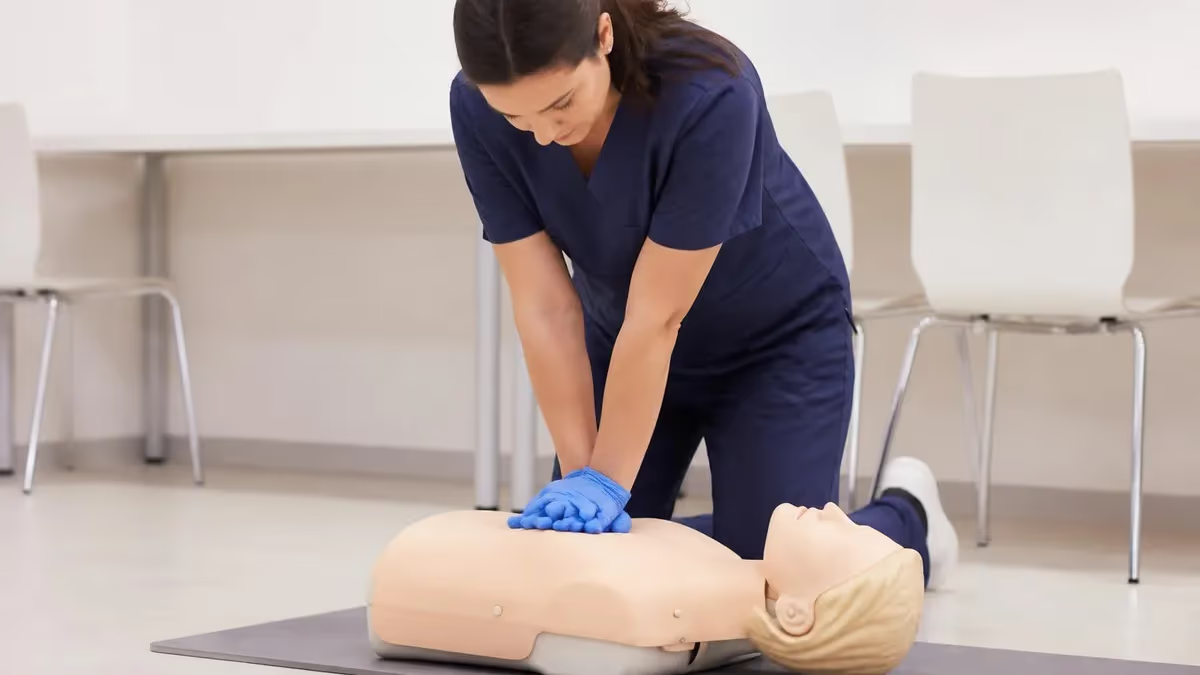
CPR for healthcare providers is a distinct credential that goes far beyond the hands-only technique taught to laypeople, demanding mastery of two-rescuer scenarios, advanced airway adjuncts, pulse checks, and integration with the broader chain of survival. Whether you work as a nurse, paramedic, respiratory therapist, dentist, medical student, or hospital technician, your employer almost certainly requires either Basic Life Support (BLS) for Healthcare Providers or a higher-tier credential such as ACLS or PALS, renewed every two years without exception.
The acls algorithm sits at the heart of advanced clinical resuscitation, layering rhythm interpretation, vasopressor timing, and reversible-cause analysis on top of the foundational compression-and-ventilation skills you already know. Healthcare providers must be able to switch fluidly between basic and advanced roles depending on team composition, available equipment, and the patient's presenting rhythm — whether that is ventricular fibrillation, pulseless electrical activity, asystole, or a peri-arrest bradyarrhythmia threatening to deteriorate.
Unlike community-level training, provider-level CPR emphasizes team dynamics, closed-loop communication, and quantitative feedback on compression depth and rate. Compressions must be at least two inches deep on adults, delivered at 100 to 120 per minute, with complete chest recoil and minimal interruptions. Ventilations are typically given via bag-valve-mask at a 30:2 ratio without an advanced airway, or once every six seconds when an endotracheal tube or supraglottic device is in place during continuous compressions.
The American Heart Association, American Red Cross, and the national cpr foundation all offer healthcare-provider courses that meet Joint Commission and CMS requirements, but their formats, costs, and recognition vary meaningfully between hospital systems. Some employers accept only AHA cards, while others honor any OSHA-aligned program. Understanding which credential your facility recognizes — and which version is current for the 2025–2030 guidelines cycle — saves money, frustration, and last-minute scrambling before a contract starts.
This guide walks through every element a clinician needs to know in 2026: the differences between BLS, ACLS, and PALS, exact compression and ventilation parameters, AED operation, pediatric and neonatal modifications, special resuscitation circumstances such as pregnancy and opioid overdose, and the documentation requirements that follow every code. We'll also cover renewal timelines, online versus in-person formats, and what to expect on the skills station, where most candidates fail not from lack of knowledge but from inadequate practice with the manikin.
If you are renewing for the third or fourth time, do not assume the curriculum is unchanged. The 2025 guidelines updates revised recommendations on dual sequential defibrillation, post-arrest temperature targets, and the timing of epinephrine in non-shockable rhythms. Even seasoned providers benefit from a structured refresher because muscle memory degrades within six to nine months, and resuscitation outcomes correlate directly with how recently the team last drilled. For a comparison of foundational versus provider-level training, see our breakdown of cpr fix phones certification differences.
By the end of this article you will know precisely which credential to pursue, what each course covers, how to prepare for written and skills exams, and how to maintain competency between renewal cycles. We'll also link to free practice questions you can use the night before your test to identify weak spots in rhythm recognition, drug dosing, and pediatric weight-based calculations.
CPR for Healthcare Providers by the Numbers
Key Facts at a Glance
| Item | Value | Details |
|---|---|---|
| Compressions Per Minute | 100-120 | Adult and pediatric rate |
| Minimum Compression Depth | 2 inches | Adults; ≥1/3 chest depth for children |
| Certification Validity | 2 years | BLS, ACLS, and PALS |
| Course Cost Range | $65-$295 | BLS lowest, ACLS/PALS higher |

Healthcare Provider Certification Levels
Foundational two-rescuer CPR with bag-valve-mask ventilation, AED use, adult/child/infant compressions, and team-based resuscitation. Required for nearly every clinical role from CNA to surgeon.
Builds on BLS with rhythm interpretation, defibrillation, pharmacology (epinephrine, amiodarone, atropine), advanced airways, and post-cardiac-arrest care. Required for ICU, ER, and many med-surg nurses.
Pediatric Advanced Life Support covers infant and child resuscitation, respiratory emergencies, shock recognition, and weight-based drug dosing. Standard for pediatric nurses, ER staff, and pediatricians.
Neonatal Resuscitation Program for delivery-room emergencies in newborns under 28 days. Required for L&D nurses, NICU staff, and obstetric providers attending births.
Pediatric Emergency Assessment, Recognition and Stabilization — a shorter alternative to PALS for providers who occasionally encounter sick children but don't run pediatric codes.
BLS for Healthcare Providers is the bedrock credential and the prerequisite for ACLS, PALS, and most advanced certifications. The course typically runs four to five hours in person, or two to three hours online plus a mandatory in-person skills check. You will be evaluated on adult, child, and infant CPR; one-rescuer and two-rescuer scenarios; bag-valve-mask technique; AED operation including pad placement on small chests; and recognition of foreign body airway obstruction in conscious and unconscious patients across all age groups.
Compression quality is the single most important metric. The current standard for adults is a rate of 100 to 120 per minute, depth of at least 2 inches but no more than 2.4 inches, full chest recoil between compressions, and minimal interruptions — ideally a chest compression fraction above 80% of total code time. The 30:2 compression-to-ventilation ratio applies until an advanced airway is in place; afterward, providers deliver continuous compressions with one breath every six seconds, a deliberate cadence that prevents hyperventilation and preserves coronary perfusion pressure.
Infant cpr requires noticeable modifications. For infants under one year, use two fingers (single rescuer) or the two-thumb encircling-hands technique (two rescuers) at a depth of approximately 1.5 inches, or one-third the anteroposterior chest diameter. The compression-to-ventilation ratio shifts to 15:2 when two healthcare providers are present, reflecting the respiratory etiology of most pediatric arrests. Ventilations should produce visible chest rise without excessive volume, which can cause gastric distention and worsen oxygenation.
AED use for healthcare providers follows the same fundamental sequence as lay rescuer use, but providers should know what does aed stand for at a deeper level: automated external defibrillator, a device that analyzes heart rhythm and delivers a biphasic shock when it detects ventricular fibrillation or pulseless ventricular tachycardia. Pediatric pads or a pediatric attenuator key are preferred for patients under 8 years or 25 kilograms; if unavailable, adult pads can be used with anterior-posterior placement to avoid pad-to-pad contact on a small torso.
Healthcare provider BLS introduces team dynamics that lay courses skip entirely. The American Heart Association emphasizes closed-loop communication: the team leader gives a clear order, the receiver acknowledges and repeats it back, and confirms completion. Role assignment — compressor, ventilator, AED operator, recorder, medication, leader — should rotate every two minutes to prevent compressor fatigue, which dramatically reduces depth and rate after about 90 seconds of continuous effort even in fit clinicians.
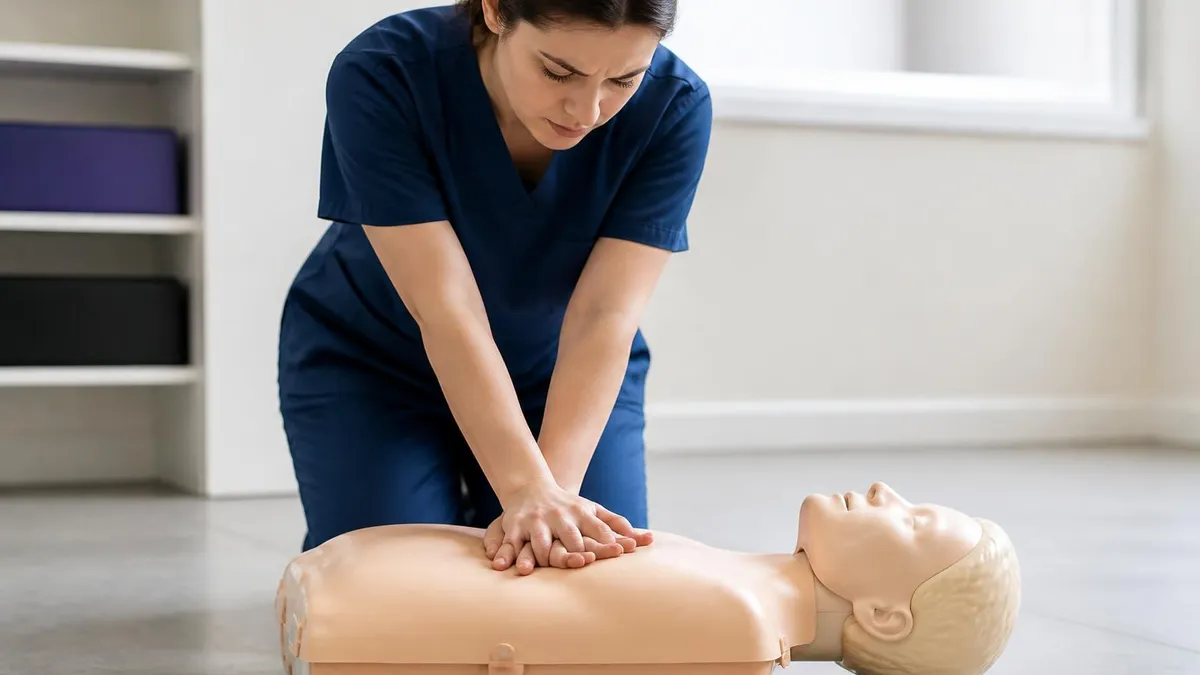
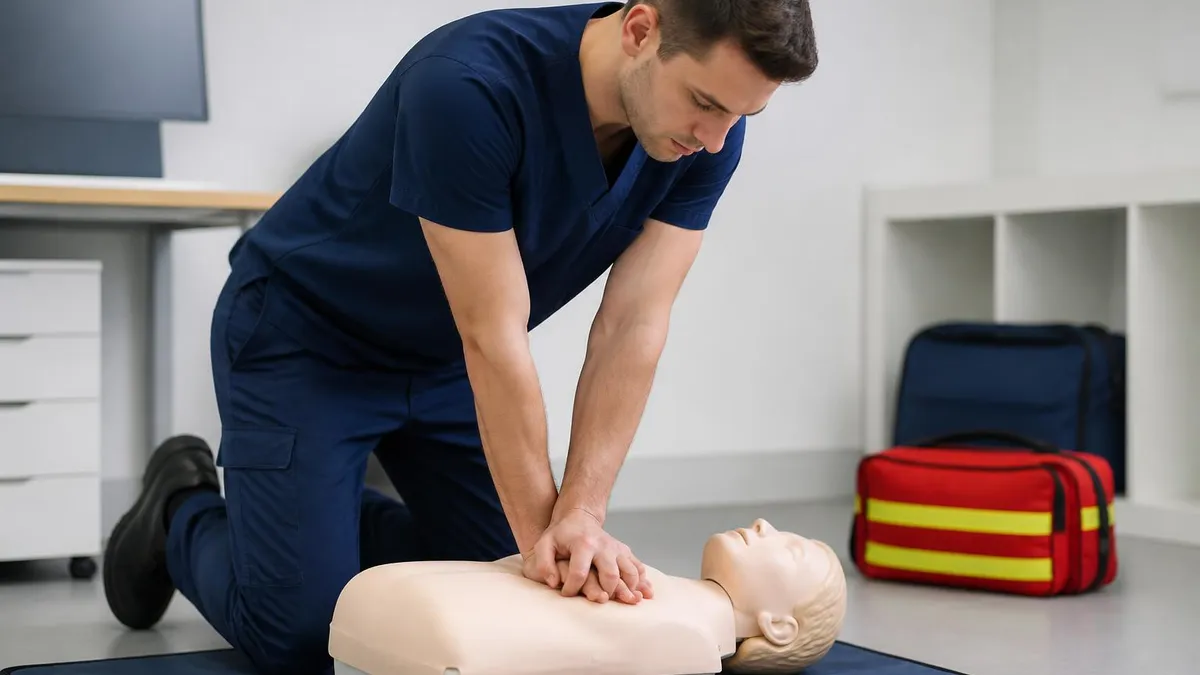
The skills assessment is where most candidates stumble. Evaluators watch for hand placement on the lower half of the sternum, locked elbows, vertical force, and rate consistency. Many provider courses now use real-time feedback manikins that display rate, depth, and recoil on a screen, so practicing with similar equipment beforehand pays off. The written portion runs 25 to 35 questions and requires roughly 84% to pass, with most failures clustering around two-rescuer infant CPR sequences and choking algorithm branches.
If you're comparing healthcare-provider BLS against the layperson Heartsaver course, the differences matter for employment. Heartsaver does not satisfy hospital, EMS, dental, or nursing school requirements. Always confirm with your employer or program that your card reads "BLS Provider" or "BLS for Healthcare Providers" — not "Heartsaver CPR/AED" — to avoid losing clinical time. You can what is aed certification status through AHA's eCard system using your unique 10-digit code.

CPR Practice Test Questions
Prepare for the CPR Cardiopulmonary Resuscitation Practice exam with our free practice test modules. Each quiz covers key topics to help you pass on your first try.
CPR Basic CPR
CPR Exam Questions covering Basic CPR. Master CPR Test concepts for certification prep.
CPR and First Aid
Free CPR Practice Test featuring and First Aid. Improve your CPR Exam score with mock test prep.
CPR (Cardiopulmonary Resuscitation) Adult ...
CPR Mock Exam on (Cardiopulmonary Resuscitation) Adult CPR and AED Usage. CPR Study Guide questions to pass on your first try.
CPR (Cardiopulmonary Resuscitation) Airway...
CPR Test Prep for (Cardiopulmonary Resuscitation) Airway Obstruction and Choking. Practice CPR Quiz questions and boost your score.
CPR (Cardiopulmonary Resuscitation) Cardio...
CPR Questions and Answers on (Cardiopulmonary Resuscitation) Cardiopulmonary Emergency Recognition. Free CPR practice for exam readiness.
CPR (Cardiopulmonary Resuscitation) Child ...
CPR Mock Test covering (Cardiopulmonary Resuscitation) Child and Infant CPR. Online CPR Test practice with instant feedback.
CPR (Cardiopulmonary Resuscitation) High-P...
Free CPR Quiz on (Cardiopulmonary Resuscitation) High-Performance Team Dynamics. CPR Exam prep questions with detailed explanations.
CPR (Cardiopulmonary Resuscitation) Legal ...
CPR Practice Questions for (Cardiopulmonary Resuscitation) Legal and Ethical Considerations. Build confidence for your CPR certification exam.
CPR for Specific Populations
CPR Test Online for for Specific Populations. Free practice with instant results and feedback.
CPR Airway & Breathing Management
CPR Exam Questions covering Airway & Breathing Management. Master CPR Test concepts for certification prep.
CPR Assessment & Recognition of Cardiac Ar...
Free CPR Practice Test featuring Assessment & Recognition of Cardiac Arrest. Improve your CPR Exam score with mock test prep.
CPR Chest Compressions & Defibrillation
CPR Mock Exam on Chest Compressions & Defibrillation. CPR Study Guide questions to pass on your first try.
CPR Post-Resuscitation Care & Recovery
CPR Test Prep for Post-Resuscitation Care & Recovery. Practice CPR Quiz questions and boost your score.
ACLS Algorithm, PALS Certification, and Life Support Pathways
Advanced Cardiovascular Life Support builds directly on BLS and centers on the acls algorithm, which branches based on whether the patient's rhythm is shockable (ventricular fibrillation or pulseless ventricular tachycardia) or non-shockable (asystole or pulseless electrical activity). The algorithm specifies compression cycles of two minutes between rhythm checks, epinephrine 1 mg IV every three to five minutes, and amiodarone 300 mg IV bolus after the third shock in refractory ventricular fibrillation.
ACLS also covers bradycardia, tachycardia with and without a pulse, acute coronary syndromes, and stroke care. Courses run roughly 14 hours over one or two days, cost $225 to $325, and require successful completion of a 50-question written exam plus megacode skills stations. Providers must demonstrate team leadership, identify rhythms within seconds, and select appropriate drug doses without referring to pocket cards during simulation — though pocket cards are permitted and encouraged in real practice.
Online-Blended vs In-Person Healthcare Provider Courses
- +Self-paced cognitive portion fits around clinical shifts and family schedules
- +Lower total time commitment — typically 2 hours online plus 1-2 hour skills check
- +Identical AHA eCard credential as fully in-person courses
- +Reduces classroom anxiety for visual and independent learners
- +Often $20-$50 cheaper than fully instructor-led options
- +Allows review and replay of difficult concepts before the skills station
- −Requires separate scheduling and travel for the mandatory skills check
- −Less peer practice time during scenarios and megacodes
- −Some employers and nursing schools require fully in-person formats
- −Online portion can feel rushed if you have not practiced compressions recently
- −Technical issues with proctoring or video can delay completion
- −Reduced opportunity to ask nuanced clinical questions of an experienced instructor

Pre-Course Preparation Checklist for BLS, ACLS, and PALS Certification
- ✓Confirm your employer accepts the credentialing body (AHA, Red Cross, or other)
- ✓Download the current provider manual at least two weeks before class
- ✓Complete the pre-course self-assessment and identify weak ECG strips
- ✓Review the 2025 guideline updates on compression depth, rate, and post-arrest care
- ✓Memorize core drug doses: epinephrine 1 mg, amiodarone 300 mg/150 mg, atropine 1 mg
- ✓Practice rhythm recognition for VF, pulseless VT, asystole, PEA, and SVT
- ✓Refresh pediatric weight-based dosing using a Broselow tape or app
- ✓Bring photo ID, payment confirmation, and any prerequisite cards to class
- ✓Wear comfortable clothing that allows kneeling and reaching across a manikin
- ✓Get a full night's sleep before the skills station — fatigue ruins compression depth
Push hard, push fast, allow full recoil, minimize interruptions
Studies consistently show that survival to hospital discharge correlates more strongly with compression quality and chest compression fraction than with any drug or advanced airway intervention. Aim for at least 80% of code time spent compressing, with rate between 100 and 120 per minute and depth of 2-2.4 inches. Leaning on the chest between compressions reduces coronary perfusion pressure by up to 30%.
Healthcare providers encounter resuscitation scenarios that lay rescuers never face: pregnant patients, opioid overdoses, drowning victims, hypothermia, electrocution, and patients with implanted devices or tracheostomies. Each situation modifies the standard algorithm in clinically important ways, and provider-level courses dedicate significant time to these special circumstances because they appear frequently in real practice and predictably on certification exams.
For pregnant patients in cardiac arrest, perform manual left uterine displacement to relieve aortocaval compression by the gravid uterus, which can reduce cardiac output by up to 30% in the supine position. Continue standard CPR with hands slightly higher on the sternum if the fundus is above the umbilicus. Perimortem cesarean delivery should be considered within four minutes of arrest if return of spontaneous circulation has not occurred and the fetus is potentially viable — a decision that requires immediate obstetric and neonatal involvement.
Opioid-associated cardiac arrest has surged with the fentanyl crisis. For unresponsive patients with a pulse but inadequate breathing, naloxone 2-4 mg intranasal or 0.4 mg IV/IM is appropriate while supporting ventilation with bag-valve-mask. If the patient is pulseless, standard CPR takes priority; naloxone does not restore a perfusing rhythm but may help post-arrest if hypoventilation persists. Healthcare providers should anticipate withdrawal-driven agitation as the antagonist takes effect and prepare for rapid airway re-management.
Hypothermic arrest follows a unique principle: "not dead until warm and dead." Continue resuscitation through extended downtimes with active rewarming, ideally via extracorporeal membrane oxygenation if available. Defibrillation may be ineffective below 30°C core temperature, and drug metabolism slows dramatically, so most algorithms recommend withholding repeat epinephrine until the patient is warmer than 30°C. Survival with intact neurologic function has been documented after hours of CPR in profoundly hypothermic patients.
Post-cardiac-arrest care begins immediately after return of spontaneous circulation. Targeted temperature management between 32°C and 36°C for at least 24 hours improves neurologic outcomes. Avoid hyperoxia (target SpO₂ 92-98%), maintain normocapnia, treat hypotension with fluids and vasopressors to keep mean arterial pressure above 65 mmHg, and obtain an immediate 12-lead ECG to identify ST-elevation myocardial infarction that may benefit from emergent cardiac catheterization. The normal average respiratory rate in adults of 12-20 breaths per minute should guide ventilator initial settings — see our overview of normal average respiratory rate in adults for additional context.
Patients with implanted cardioverter-defibrillators or pacemakers complicate AED pad placement. Position pads at least 8 centimeters from any pulse generator visible under the skin, typically using anterior-posterior or anterolateral configurations. A firing ICD can cause minor shocks to a rescuer touching the patient — uncomfortable but not dangerous. Continue compressions regardless; the patient's life takes priority over a transient tingle.
Tracheostomy and laryngectomy patients require ventilation through the neck stoma, not the mouth. Cover the mouth and nose during stoma ventilation if the upper airway remains anatomically connected (tracheostomy); laryngectomy patients have no upper-airway connection and require stoma-only ventilation. Suction the stoma if obstructed, and use a pediatric mask sealed over the stoma if a tracheostomy tube has been displaced and cannot be quickly replaced.
BLS, ACLS, and PALS cards expire exactly 24 months after the issue date. Working clinically with an expired card can trigger licensure complaints, immediate loss of privileges, and termination depending on facility policy. Set calendar reminders 90 days before expiration and book renewal courses early — popular weekend slots fill up months in advance in major metro areas.
Renewal cycles for healthcare provider certifications run on strict two-year intervals from the original issue date, not the course completion date. Most providers schedule renewals 60 to 90 days before expiration to absorb scheduling delays, sick days, or family emergencies. The American Heart Association does not offer grace periods; an expired card means starting over with a full initial course rather than the shorter renewal format, costing additional time and tuition.
Documentation matters as much as the credential itself. Hospital credentialing offices typically require a scanned copy of both sides of the eCard, the unique 10-digit AHA verification code, and the instructor's name and training center ID. Travel nurses and locums should maintain a personal digital folder with current copies of every certification, because credentialing for a new contract often hinges on producing these documents within 48 hours of agency request.
Healthcare professionals should ignore those results and focus on AHA, Red Cross, ASHI, or other clinically recognized providers. Always verify your training center is on the AHA's official list before paying tuition; unlicensed "CPR mills" issue cards that hospitals routinely reject during credentialing audits.
Career impact of maintaining current credentials is substantial. Charge nurse, rapid response team, and code blue team assignments require current ACLS in addition to BLS. Travel-nursing pay differentials often hinge on holding ACLS and PALS, with hourly rates rising $5 to $15 for clinicians who can independently run codes. Emergency department techs and paramedics with BLS-only credentials are typically capped at lower wage tiers than those who carry ACLS, even though scope of practice is limited by state regulations.
Instructor pathways open up after two to three years of provider-level experience. AHA instructor courses cost $150 to $400, take 6 to 12 hours, and require alignment with a training center that monitors your teaching frequency. Active instructors typically earn $25 to $75 per learner taught, which translates to $300 to $900 for a standard 12-person BLS class — a meaningful side income for nurses, paramedics, and respiratory therapists with flexible schedules. Learn more about the career pathway through our cpr compression rate instructor guide.
Some specialties require ongoing competency assessment beyond the two-year card cycle. Hospitals with Joint Commission accreditation often run mock codes every quarter, and individual units maintain skills logs documenting that staff have practiced compressions, defibrillation, and bag-valve-mask ventilation within the past 6 to 12 months. Failing to participate in unit-based drills can affect performance reviews and clinical-ladder advancement even when the formal card is current.
Finally, document continuing education credits earned through ACLS and PALS courses. Most state nursing boards accept these toward biennial license renewal, sometimes covering 8 to 16 of the required hours. Save certificates separately from your eCard, and confirm acceptance rules with your specific state board because some require pre-approval of the provider organization before credits count toward licensure.
Practical preparation in the final week before your provider course determines whether you breeze through the skills station or scramble through repeat attempts. Start with the pre-course assessment in the AHA student website or printed manual — these self-tests highlight ECG strips, drug doses, and algorithm branches you have forgotten since your last renewal. Most candidates need three to five hours of focused review, not the full 14-hour course content again, to feel sharp on test day.
Build a study schedule around your weakest content areas rather than reading the manual cover to cover. For ACLS, that usually means rhythm strips, the bradycardia and tachycardia algorithms, and acute coronary syndrome timing. For PALS, focus on respiratory distress versus failure thresholds, shock categorization, and the position recovery considerations for pediatric patients with altered mental status who are still breathing adequately. Use flashcard apps to drill drug doses; spaced repetition cements these numbers far better than passive rereading.
Practice compressions on any firm surface — a couch cushion folded over a textbook works in a pinch — for two minutes at a stretch while a partner counts your rate aloud. Most candidates compress too slowly under stress because they have not practiced the cadence in 18 to 24 months. A metronome app set to 110 beats per minute or the chorus of "Stayin' Alive" provides the right tempo. Build endurance to two minutes without slowing because that is the rotation interval in real codes.
The night before the course, sleep at least seven hours, eat a normal breakfast, and pre-pack your bag with photo ID, course payment confirmation, a current copy of any prerequisite card, a watch with a second hand, and a light snack for the lunch break. Arrive 15 minutes early to find parking, locate the classroom, and settle in before the instructor begins. Late arrivals are often turned away because AHA rules require full course attendance — no exceptions even by one minute.
During the skills station, narrate your actions aloud as if you are leading a real code. Examiners want to hear "Scene is safe. Patient unresponsive. Calling for help and AED. Checking pulse and breathing simultaneously — no pulse, no breathing. Beginning compressions." This running commentary demonstrates the systematic approach examiners are scoring, and it slows you down just enough to prevent skipping steps when nerves take over.
If you fail any portion, remediation is straightforward. Instructors are required to provide focused retraining and a second attempt the same day in most cases. Failure of the retest converts the course to incomplete, and you reschedule a full session — usually within 30 days. Failure on a renewal does not invalidate your current card if it has not yet expired; you simply attend a full initial course before the expiration date.
After certification, integrate ongoing practice into your routine. Volunteer for unit mock codes, attend monthly skills check-ins offered by many hospital education departments, and review one rhythm strip per shift if you work in a monitored setting. Resuscitation skills decay measurably within six to nine months, so periodic touch-ups between formal renewals translate directly into faster, more confident performance when a real code is called overhead.
CPR Questions and Answers
CPR vs BLS: Complete Comparison Guide for 2026 — Which Certification Do You Need?
CPR Card Lookup: How to Verify, Replace, and Access Your CPR Certification in 2026
AHA CPR: What It Is, Which Course You Need, and How to Get Certified
CPR Instructor Jobs 2026: How to Become a Certified Instructor, Salary Expectations, and Career Pathways
Adult CPR: Complete Step-by-Step Guide to Hands-Only and Standard CPR in 2026
About the Author

Registered Nurse & Healthcare Educator
Johns Hopkins University School of NursingDr. Sarah Mitchell is a board-certified registered nurse with over 15 years of clinical and academic experience. She completed her PhD in Nursing Science at Johns Hopkins University and has taught NCLEX preparation and clinical skills courses for nursing students across the United States. Her research focuses on evidence-based exam preparation strategies for healthcare certification candidates.
Join the Discussion
Connect with other students preparing for this exam. Share tips, ask questions, and get advice from people who have been there.
View discussion (5 replies)