
When to Perform CPR: Recognize the Signs and Act Fast in 2026 October
Learn when to perform CPR with clear signs, ACLS algorithm steps, and AED timing. Adult, child, and infant CPR triggers explained for 2026 October rescuers. 🎯
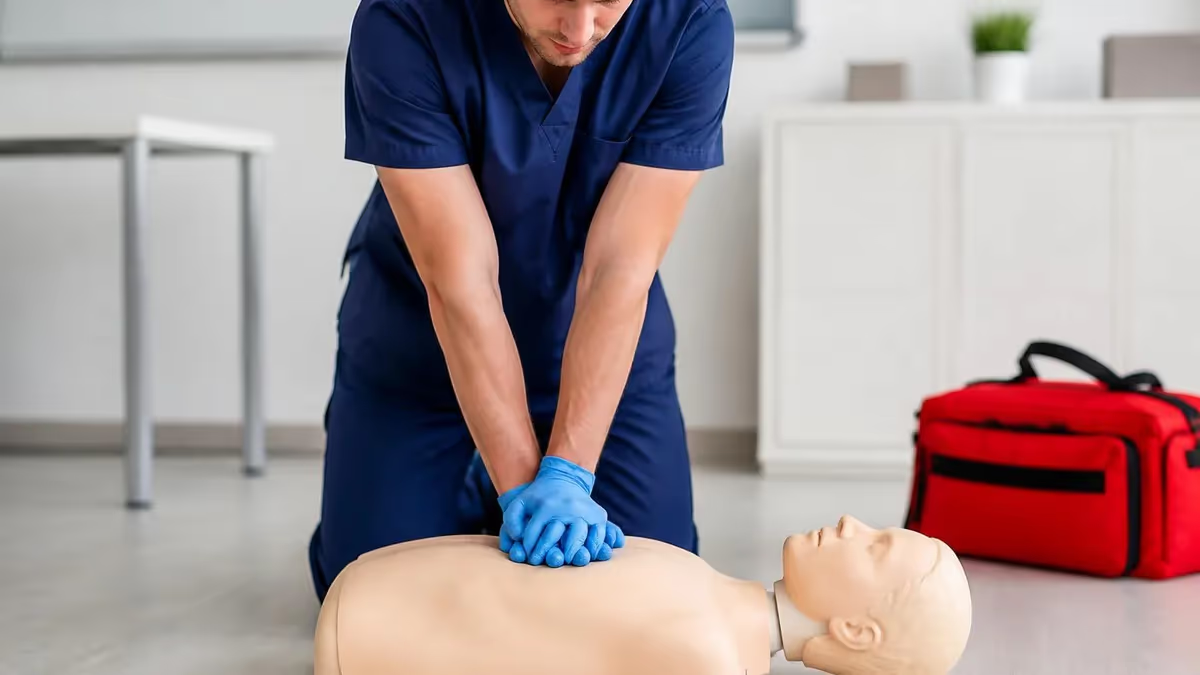
Knowing when to perform CPR is the single most important skill any bystander, healthcare worker, or trained rescuer can carry. The decision usually comes down to two simple observations made in under ten seconds: is the person unresponsive, and are they not breathing normally? If both answers are yes, you start chest compressions immediately. Hesitation is the enemy of survival. For every minute that passes without CPR after sudden cardiac arrest, the chance of survival drops by roughly seven to ten percent, which is why fast recognition matters more than perfect technique.
The American Heart Association, the Red Cross, and the heart attack vs cardiac arrest guidance all converge on the same trigger criteria. You do not need to confirm a pulse as a lay rescuer. You do not need to wait for paramedics. You do not need to be certified to legally help in any U.S. state, thanks to Good Samaritan laws. What you need is the confidence to recognize sudden collapse and respond within seconds rather than minutes.
Cardiac arrest looks different from what most people imagine. There is rarely a dramatic clutch of the chest. Often the person simply slumps, gasps a few times, and stops moving. Those gasps, called agonal breathing, fool untrained bystanders into thinking the victim is still breathing normally. They are not. Agonal breaths are a sign that CPR is needed right now, not a reason to delay it. Recognizing this pattern is what separates a survivor from a statistic.
The acls algorithm used by paramedics and hospital teams begins exactly where lay rescuer CPR begins: check for response, call for help, start compressions, attach a defibrillator. Whether you are a parent watching a toddler in the bathtub, a coworker in an office hallway, or a nurse on a med-surg floor, the first thirty seconds look identical. The only thing that changes downstream is who arrives next and what equipment they bring with them.
This guide walks through every scenario where CPR is appropriate, every situation where it is not, and the small but critical adjustments you make between adult, child, and infant cpr. We cover drowning, opioid overdose, electrical injury, choking that has progressed to unresponsiveness, and the moments when stopping CPR is the right call. By the end you will know exactly when to start, when to switch tasks with another rescuer, and when to hand off to advanced life support.
Practice is what makes the recognition automatic. Reading a guide builds awareness; running scenarios builds reflex. We strongly recommend pairing this article with hands-on instructor-led training or a verified hybrid course. Until you can do that, the practice quizzes linked throughout this page are the next best thing for cementing the decision tree in long-term memory.
When to Perform CPR by the Numbers

The First 60 Seconds: Recognition Timeline
Scene Safety (0-5 sec)
Check Responsiveness (5-10 sec)
Call 911 and Get an AED (10-20 sec)
Check Breathing (20-30 sec)
Begin Compressions (30 sec)
Attach AED When It Arrives
The core trigger for CPR is unresponsive plus not breathing normally. That is the entire rule. Everything else is detail. The national cpr foundation, AHA, and Red Cross all agree on this two-step gate because it is simple enough to remember under stress and broad enough to catch every cause of cardiac arrest. Drowning, electrocution, drug overdose, trauma, anaphylaxis, choking, and primary heart events all funnel into the same final pathway, and they all respond to the same initial intervention.
Sudden cardiac arrest is the most common scenario the average bystander will face. It often strikes without warning in people who appeared healthy moments before. The collapse is silent, the pulse is absent, and the heart is usually in ventricular fibrillation. This is the rhythm an AED can fix, but only if compressions are keeping blood moving in the meantime. Without that bridge, the rhythm degrades into asystole within minutes and the chance of survival approaches zero.
Drowning is the second major trigger and the one most people misunderstand. A drowning victim pulled from water who is not breathing needs CPR with rescue breaths immediately, even if the submersion time was short. Unlike cardiac arrest, drowning is a hypoxic event, meaning the heart stopped because oxygen ran out. Restoring oxygen through ventilations is therefore critical, and chest compressions alone are less effective than the standard 30:2 cycle.
Opioid overdose has become a leading cause of cardiac arrest in U.S. adults under 50. When you find someone unresponsive with shallow or absent breathing and pinpoint pupils, start CPR and administer naloxone if available. Do not wait for the naloxone to work before beginning compressions. Naloxone restores the drive to breathe but does nothing to circulate blood if the heart has already stopped. Both interventions belong on the same timeline.
Choking that progresses to unresponsiveness is another clear trigger. As long as the victim is conscious and coughing, you encourage forceful coughing and deliver back blows and abdominal thrusts. The moment they collapse, you lower them to the ground and begin CPR. Each time you open the airway to give breaths, look inside the mouth for a visible obstruction and remove it only if you can see it. Blind finger sweeps cause more harm than good.
Electrical injury and lightning strike round out the common scenarios. These victims may have a fixed dilated pupil and look unsalvageable, but they often respond beautifully to CPR and defibrillation because the underlying tissue is intact. Reverse triage applies here: in a mass casualty scene from lightning, prioritize the apparently dead first because they are the ones whose hearts can still be restarted. The walking wounded can wait.
For practice scenarios that walk through these triggers with realistic timing and decision points, the leather cpr question bank offers video-explained answers that reinforce the recognition patterns clinicians rely on.

CPR Practice Test Questions
Prepare for the CPR Cardiopulmonary Resuscitation Practice exam with our free practice test modules. Each quiz covers key topics to help you pass on your first try.
CPR Basic CPR
CPR Exam Questions covering Basic CPR. Master CPR Test concepts for certification prep.
CPR and First Aid
Free CPR Practice Test featuring and First Aid. Improve your CPR Exam score with mock test prep.
CPR (Cardiopulmonary Resuscitation) Adult ...
CPR Mock Exam on (Cardiopulmonary Resuscitation) Adult CPR and AED Usage. CPR Study Guide questions to pass on your first try.
CPR (Cardiopulmonary Resuscitation) Airway...
CPR Test Prep for (Cardiopulmonary Resuscitation) Airway Obstruction and Choking. Practice CPR Quiz questions and boost your score.
CPR (Cardiopulmonary Resuscitation) Cardio...
CPR Questions and Answers on (Cardiopulmonary Resuscitation) Cardiopulmonary Emergency Recognition. Free CPR practice for exam readiness.
CPR (Cardiopulmonary Resuscitation) Child ...
CPR Mock Test covering (Cardiopulmonary Resuscitation) Child and Infant CPR. Online CPR Test practice with instant feedback.
CPR (Cardiopulmonary Resuscitation) High-P...
Free CPR Quiz on (Cardiopulmonary Resuscitation) High-Performance Team Dynamics. CPR Exam prep questions with detailed explanations.
CPR (Cardiopulmonary Resuscitation) Legal ...
CPR Practice Questions for (Cardiopulmonary Resuscitation) Legal and Ethical Considerations. Build confidence for your CPR certification exam.
CPR for Specific Populations
CPR Test Online for for Specific Populations. Free practice with instant results and feedback.
CPR Airway & Breathing Management
CPR Exam Questions covering Airway & Breathing Management. Master CPR Test concepts for certification prep.
CPR Assessment & Recognition of Cardiac Ar...
Free CPR Practice Test featuring Assessment & Recognition of Cardiac Arrest. Improve your CPR Exam score with mock test prep.
CPR Chest Compressions & Defibrillation
CPR Mock Exam on Chest Compressions & Defibrillation. CPR Study Guide questions to pass on your first try.
CPR Post-Resuscitation Care & Recovery
CPR Test Prep for Post-Resuscitation Care & Recovery. Practice CPR Quiz questions and boost your score.
Infant CPR vs Child vs Adult: Recognition Differences
Adult CPR is triggered by the same two-step check: unresponsive plus not breathing normally or only gasping. You do not need to confirm a pulse as a lay rescuer. Compressions go in the center of the chest, between the nipples, at least two inches deep and at 100 to 120 per minute. The compression to ventilation ratio is 30:2 for a single rescuer with a barrier device available.
If you are uncomfortable with rescue breaths or do not have a mask, hands-only CPR is acceptable and proven effective for witnessed adult arrests. The reasoning is that adults usually arrest from a primary cardiac cause, so their blood remains oxygenated for several minutes. Continuous chest compressions circulate that oxygen to the brain and heart muscle, buying time until an AED arrives or paramedics can intubate and ventilate properly.
Starting CPR When You Are Uncertain: Should You?
- +Brain damage begins within 4-6 minutes of arrest, so action beats analysis
- +Good Samaritan laws protect lay rescuers in all 50 U.S. states
- +Hands-only CPR causes no significant harm if the person was not actually arrested
- +Bystander CPR doubles or triples survival rates in witnessed arrests
- +Most people in true arrest will not regain consciousness from compressions, so accidental over-treatment is rare
- +911 dispatchers will coach you in real time and confirm whether to continue
- −Compressions on a person with a pulse may cause bruising or rib soreness
- −Rib fractures occur in roughly 30% of properly performed adult CPR
- −A conscious victim will resist compressions, which is itself a clear stop signal
- −Performing CPR on someone with severe trauma may worsen internal bleeding
- −Untrained rescue breaths can introduce gastric inflation and aspiration
- −Emotional aftermath of performing CPR, successful or not, is significant and often underestimated
Pros and Cons at a Glance
| Pros | Cons |
|---|---|
| Hands-only CPR causes no significant harm if the person was not actually arrested | Compressions on a person with a pulse may cause bruising or rib soreness |
| Bystander CPR doubles or triples survival rates in witnessed arrests | A conscious victim will resist compressions, which is itself a clear stop signal |
| Most people in true arrest will not regain consciousness from compressions, so accidental over-treatment is rare | Performing CPR on someone with severe trauma may worsen internal bleeding |

Pre-CPR Safety and Decision Checklist
- ✓Scan the scene for traffic, fire, electrical wires, water, or hostile bystanders before approaching
- ✓Verify the person is on a firm flat surface; move them off a bed or couch if needed
- ✓Tap shoulders or flick infant feet and shout to confirm unresponsiveness within five seconds
- ✓Look at the chest for ten seconds maximum to confirm absent or abnormal breathing
- ✓Treat agonal gasps, snoring, or gurgling as no breathing and start compressions immediately
- ✓Delegate 911 call and AED retrieval to specific named bystanders, not the crowd
- ✓Place your phone on speaker so the dispatcher can coach you hands-free
- ✓Expose the chest fully before placing AED pads or starting compressions
- ✓Switch compressors every two minutes to prevent fatigue and shallow depth
- ✓Continue CPR until the person breathes normally, EMS takes over, or you physically cannot continue
If it looks weird, it counts as no breathing
The single most common reason bystanders fail to start CPR is mistaking agonal gasps for normal breathing. These slow, irregular, gurgling or snoring sounds occur in roughly 40% of witnessed cardiac arrests and they are a sign of a dying brainstem, not a recovering victim. If you are unsure whether breathing is normal, assume it is not and start compressions. You will not harm someone who is breathing properly because they will resist or wake up almost immediately.
The AED is the single most powerful intervention available to a lay rescuer, and timing is everything. Defibrillation within three to five minutes of collapse can produce survival rates above 70% for witnessed ventricular fibrillation arrests. After ten minutes without a shock, those numbers collapse below 10%. This is why every public AED matters, and why the question of what does aed stand for, automated external defibrillator, is worth knowing even if you never expect to use one.
Modern AEDs are designed for people who have never seen one before. Open the lid, the device powers on automatically, and a calm voice walks you through every step. It will tell you to expose the chest, attach the pads exactly as pictured, stand clear, and deliver a shock if one is advised. The device analyzes the rhythm itself and will refuse to shock anyone who does not need it, so you cannot accidentally harm a victim by attaching one.
Continue chest compressions while the pads are being placed, pausing only when the AED says to stop for analysis. The total pause for analysis and shock delivery should be under ten seconds. After the shock, resume compressions immediately without checking for a pulse. The heart may need two more minutes of perfusion before it can sustain a rhythm on its own, and pulse checks waste precious time that should be spent moving blood.
If two AED pads will not both fit on a small child's chest, place one on the front of the chest and one on the back. Pediatric pads or a pediatric key reduce the energy dose to a child-appropriate level, but adult pads and adult energy doses are acceptable if pediatric equipment is unavailable. The AHA position is unambiguous: a shock at adult dose is always better than no shock at all when a shockable rhythm is present.
For drowning victims, dry the chest before applying pads, but do not delay shock delivery to find a perfectly dry surface. Move the victim out of standing water and onto a dry surface if possible. For victims with implanted pacemakers or defibrillators, you will see a small lump under the skin near the collarbone; place the AED pad at least one inch away from the device but do not skip defibrillation. The implanted device will not interfere meaningfully.
Once advanced life support arrives, the team takes over with the full acls algorithm: intubation, IV access, epinephrine, amiodarone or lidocaine, and continued defibrillation as needed. Your role shifts to providing high-quality compressions while they work, or stepping aside to let a fresh provider take over. The handoff should be smooth and verbal, with you reporting estimated downtime, number of shocks delivered, and any known medical history. Knowing how to communicate this clearly is what the cpr songs mnemonic training reinforces during certification courses.
Pulse checks by lay rescuers are notoriously unreliable and waste critical seconds. Once you start compressions, do not stop unless the person is moving and breathing on their own, EMS takes over, an AED tells you to clear, or you physically cannot continue. Even after a shock, resume compressions immediately without checking pulse for a full two minutes. Every interruption longer than ten seconds measurably reduces the chance of survival.
Knowing when to stop CPR is just as important as knowing when to start. The first and most welcome stop signal is the return of normal breathing and movement. If the victim coughs, gasps cleanly, opens their eyes, or starts purposeful motion, stop compressions and roll them into the position recovery on their side. Monitor breathing closely until EMS arrives, because re-arrest within minutes is common and you may need to restart compressions immediately.
The second stop signal is the arrival of trained EMS or hospital providers who take over. Give them a verbal handoff: time of collapse, time CPR started, number of AED shocks, any medications administered, and known history if you have it. Step back only when they explicitly take over compressions, not when they walk in the door. Premature handoff creates dangerous gaps in chest compression continuity that hurt the patient.
The third stop signal is your own physical inability to continue safely. CPR is exhausting. Compression quality drops measurably after two minutes of continuous work, which is why rescuer rotation every two minutes is the standard. If you are alone and have been compressing for ten or fifteen minutes with no help arriving, you may have to stop simply because your arms cannot maintain effective depth and rate. This is a real limit, not a failure.
A fourth and less commonly discussed stop signal is the presence of valid do-not-resuscitate documentation. In the U.S., a properly executed DNR order, POLST form, or MOLST form indicates the patient's prior wish to forgo resuscitation. If you are a lay rescuer and the documentation is clearly visible and unambiguous, you may withhold or stop CPR. When in doubt, start CPR; the order can be verified by EMS, and partial CPR is not legally or ethically problematic.
You should not start CPR in the rare cases of obvious irreversible death: rigor mortis, dependent lividity, decapitation, decomposition, or injuries clearly incompatible with life. These signs mean the heart stopped hours ago and resuscitation will not succeed. Trust your eyes. A pulseless person whose body is warm and pliable deserves CPR; a person who is cold, stiff, and discolored does not.
Hypothermia is the major exception to obvious-death rules. A cold-water drowning or avalanche victim who appears dead may still be salvageable because cold protects the brain. The saying in emergency medicine is, 'They are not dead until they are warm and dead.' Continue CPR through extended downtime and let the hospital team make the final call after rewarming. Pediatric drowning in cold water has produced full neurological recoveries after more than an hour of submersion when CPR was sustained.
If you are looking to expand your training beyond awareness and into hands-on practice, the baby cpr hybrid certification model lets you learn theory online and complete skills check-offs in person, which is the only format that produces real-world competence under stress.
Practical preparation for the moment you need to perform CPR comes down to three habits: locate AEDs in the places you frequent, practice the decision tree until it is automatic, and keep your hands-on skills current with regular refreshers. Every gym, school, airport, and large workplace in the U.S. is required by various state laws to have an AED accessible. Knowing where the nearest one is in your office, your kids' school, and your own neighborhood gym shaves precious seconds off response time.
Mental rehearsal is the most underrated preparation tool. Walk through scenarios in your head: what would you do if a coworker collapsed at the conference table, if your child went limp in the bathtub, if a stranger fell at the gym? Naming the steps out loud, even to yourself, transfers them from declarative memory into procedural memory. When the real moment arrives, the steps execute without conscious thought, which is exactly what you want under the cognitive load of an emergency.
Respiratory rate awareness is part of this preparation. A normal adult breathes 12 to 20 times per minute, a child 18 to 30, and an infant 30 to 60. If the rate is dramatically slower than that, or if breaths are absent for more than ten seconds, you are looking at imminent or actual arrest. Learning to count breaths quickly in non-emergency settings, on a sleeping family member, for example, builds the baseline sense of what normal looks like so abnormal jumps out at you.
Keep a pocket mask or face shield in your car, home first-aid kit, and workplace desk drawer. These barriers cost under ten dollars and remove the hesitation many bystanders feel about mouth-to-mouth contact with a stranger. Most modern AEDs include a small pocket mask in their cabinet, but having your own ensures you are never without one. Bring it to certification class so you can practice with your actual gear.
Refresh your skills every twelve to twenty-four months even if your certification is technically valid for two years. The evidence is clear that compression depth, rate, and recoil decay measurably within six months of training. A short online refresher plus a quick hands-on session with a manikin restores those skills to peak performance. Many employers and life support training centers offer free skill check sessions that take less than an hour.
Finally, remember that doing something imperfectly is dramatically better than doing nothing perfectly. The single biggest threat to a cardiac arrest victim is bystander hesitation. You will not be judged for cracked ribs or imperfect technique. You will be remembered for the seconds you saved by starting compressions when no one else would.
CPR Questions and Answers

About the Author

Registered Nurse & Healthcare Educator
Johns Hopkins University School of NursingDr. Sarah Mitchell is a board-certified registered nurse with over 15 years of clinical and academic experience. She completed her PhD in Nursing Science at Johns Hopkins University and has taught NCLEX preparation and clinical skills courses for nursing students across the United States. Her research focuses on evidence-based exam preparation strategies for healthcare certification candidates.
Join the Discussion
Connect with other students preparing for this exam. Share tips, ask questions, and get advice from people who have been there.
View discussion (5 replies)