
C.A.B CPR Technique: The Complete 2026 October Guide to Compressions, Airway, and Breathing
Master the C.A.B CPR technique with step-by-step compressions, airway, and breathing instructions for adult, child, and infant CPR in 2026 October. ✅
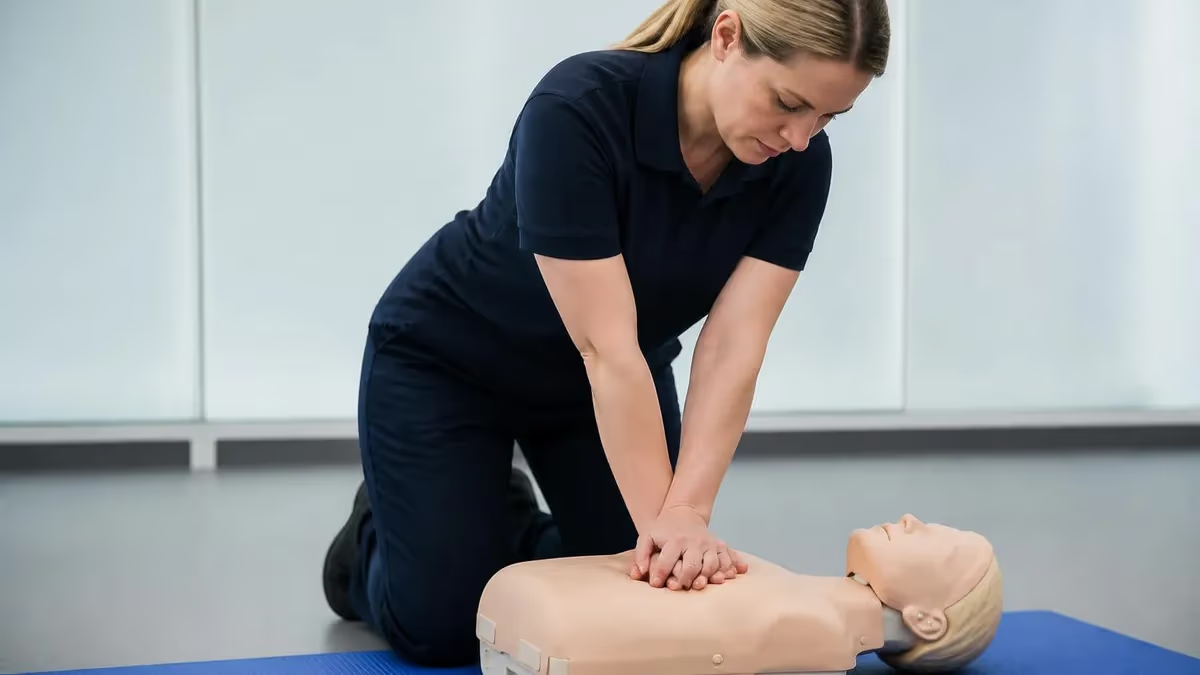
The c.a.b cpr technique reversed decades of resuscitation tradition when the American Heart Association moved Compressions before Airway and Breathing in 2010, and the 2025 update reaffirmed why this order saves the most lives. By beginning chest compressions within ten seconds of recognizing cardiac arrest, rescuers restore circulation to the brain and coronary arteries during the precious window when oxygen already dissolved in the bloodstream can still reach vital tissue. This single sequencing change increased bystander CPR rates by roughly 40 percent in observational studies.
Understanding C-A-B is more than memorizing letters. It is internalizing the physiology of sudden cardiac arrest, the mechanics of effective compressions, and the decision tree that branches based on whether the victim is an adult, a child, or an infant. The acls algorithm built on top of this foundation guides advanced providers through rhythm checks, drug timing, and reversible cause hunting, but everything still hinges on uninterrupted, high-quality compressions delivered by the first responder on scene.
This guide walks through every element of the modern CPR technique with the precision a layperson, healthcare student, or recertifying nurse needs. We cover hand placement, compression depth and rate, recoil mechanics, ventilation ratios, and the integration of an AED into the sequence. Whether you are preparing for a Basic Life Support exam, an instructor course, or a community certification class, the material below mirrors current AHA, Red Cross, and ILCOR consensus guidelines.
For credentialed providers, the technique extends into the pals certification and ACLS pathways, where the same C-A-B foundation supports rhythm-driven interventions, vasopressors, and post-arrest care. Mastering compressions first means every algorithm above it has a chance of working. Skip or weaken the foundation and even the most advanced drug regimen will fail because perfusion never reaches the tissues that need it.
You will also see how respiratory rate, recovery position, and post-resuscitation monitoring fit into the broader chain of survival. Each link matters: early recognition, early CPR, early defibrillation, advanced care, and integrated recovery. C-A-B is the second link, but it is the link that most often determines whether the chain holds. The numbers are stark — survival drops 7 to 10 percent for every minute compressions are delayed.
Throughout this article we reference the national cpr foundation training framework, the AHA 2020 and 2025 guideline updates, and field data from out-of-hospital cardiac arrest registries. We translate the science into actions you can rehearse tonight on a manikin or remember in a parking lot at 2 a.m. when a stranger collapses. The goal is competence under pressure, not memorized trivia.
By the end you will understand not just what C-A-B means, but why it works, when it changes for pediatric patients, how to coordinate with an AED, and how to transition smoothly into recovery position once spontaneous circulation returns. Bookmark this page, run through the practice quizzes, and consider scheduling hands-on validation with a certified instructor within the next 90 days.
CPR Technique by the Numbers

The C-A-B Sequence Step by Step
Scene Safety and Responsiveness
C — Compressions First
A — Airway Open
B — Breathing Delivered
Defibrillation and Cycles
High-quality chest compressions are the single most important determinant of survival in out-of-hospital cardiac arrest, outweighing every other intervention including drugs and advanced airways. The current standard demands a rate of 100 to 120 per minute, a depth of at least two inches in adults, complete recoil between compressions, and minimal interruptions of less than ten seconds. Each of these metrics is measurable, and each is independently associated with neurologically intact survival in registry data.
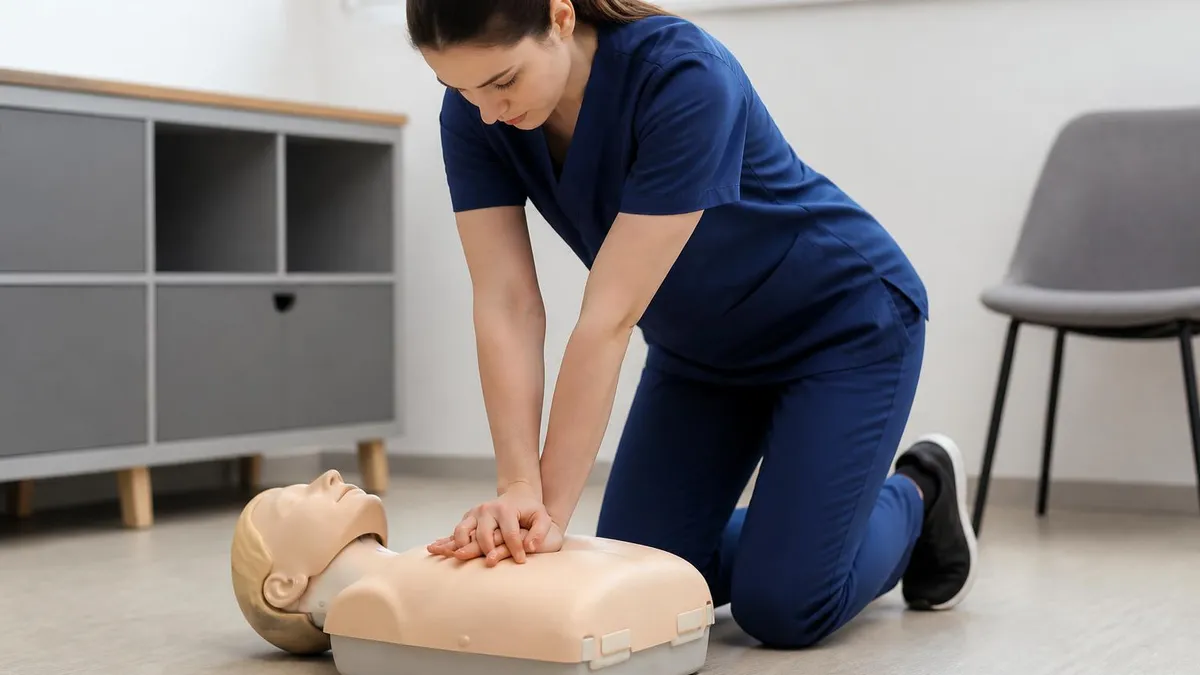
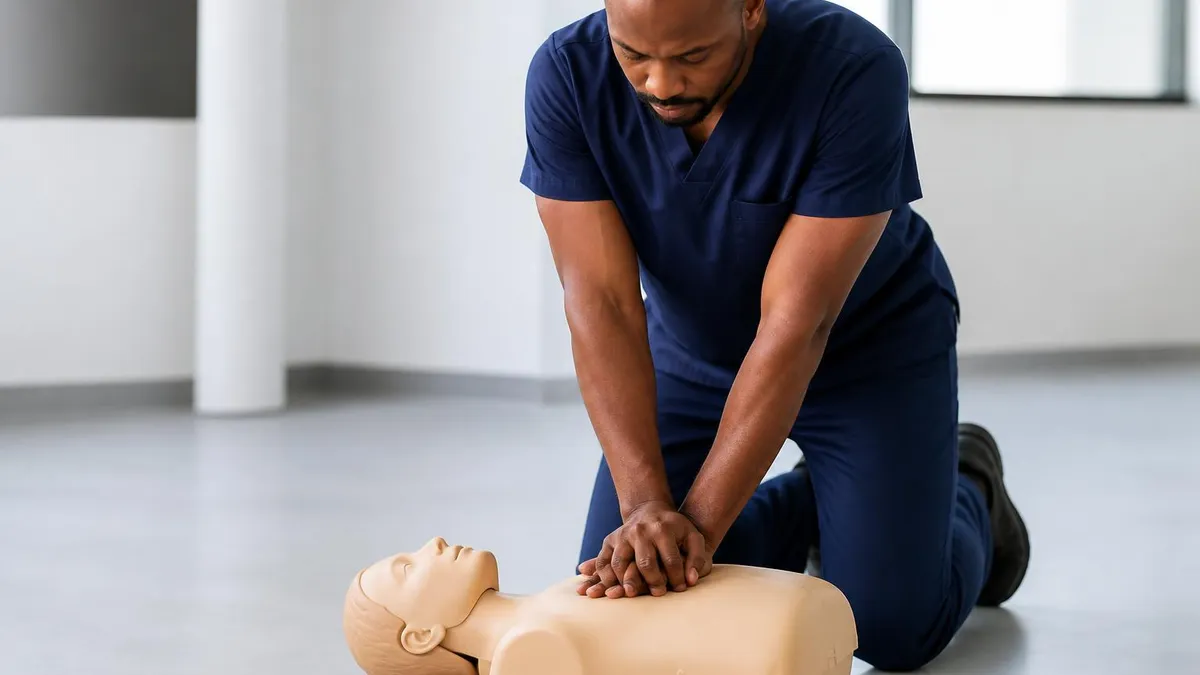
Hand placement matters more than most rescuers realize. The heel of the dominant hand sits on the lower half of the sternum, roughly between the nipples on an adult. Compressing too high reduces stroke volume; compressing too low risks xiphoid fracture and liver laceration. Lock your elbows, position your shoulders directly over your hands, and use the weight of your upper body rather than arm strength. Proper biomechanics let you sustain quality for the full two-minute cycle without exhausting your forearms.
Compression rate sits in a narrow therapeutic window. Below 100 per minute, coronary perfusion pressure never builds high enough to restart a stunned heart. Above 120 per minute, depth invariably decreases because the chest does not have time to fully recoil. Metronome feedback, either from a CPR feedback device or a song with the right tempo, dramatically improves real-world performance. Several smartphone apps now provide visual depth and rate cues that integrate with the acls algorithm timing requirements.
Full chest recoil is the most commonly missed element. Leaning on the chest between compressions, even slightly, prevents venous return and starves the next compression of preload. Watch any video of a fatigued rescuer and you will see the elbows bend less, the rebound shorten, and the depth shallow within ninety seconds. This is precisely why the two-minute compressor swap exists: not because anyone collapses at the two-minute mark, but because quality silently degrades long before the rescuer feels tired.
Minimizing interruptions is equally critical. Every pause for pulse checks, ventilation, or rhythm analysis collapses coronary perfusion pressure that took dozens of compressions to build. The goal is a chest compression fraction above 80 percent, meaning compressions are occurring more than 80 percent of the elapsed code time. Modern AEDs analyze rhythm in under ten seconds, and providers should plan their next move during the analysis so the pause never extends.
Ventilation technique is the second pillar. Two breaths over one second each, just enough to produce visible chest rise, delivered between cycles of 30 compressions for single rescuers. With an advanced airway in place, breaths shift to one every six seconds without pausing compressions, a respiratory rate of ten per minute. Hyperventilation is dangerous: it raises intrathoracic pressure, reduces venous return, and worsens outcomes. Slow and shallow is correct, not fast and forceful.
Finally, monitor the team and the patient continuously. End-tidal CO2 readings above 10 mmHg indicate adequate compression quality and forward flow; values below that threshold suggest you need to push harder or rotate compressors. Diastolic blood pressure during invasive monitoring should exceed 20 mmHg. These objective markers, used in advanced settings, all trace back to one principle: compressions that move blood are the only thing that buys time for definitive treatment.

CPR Practice Test Questions
Prepare for the CPR Cardiopulmonary Resuscitation Practice exam with our free practice test modules. Each quiz covers key topics to help you pass on your first try.
CPR Basic CPR
CPR Exam Questions covering Basic CPR. Master CPR Test concepts for certification prep.
CPR and First Aid
Free CPR Practice Test featuring and First Aid. Improve your CPR Exam score with mock test prep.
CPR (Cardiopulmonary Resuscitation) Adult ...
CPR Mock Exam on (Cardiopulmonary Resuscitation) Adult CPR and AED Usage. CPR Study Guide questions to pass on your first try.
CPR (Cardiopulmonary Resuscitation) Airway...
CPR Test Prep for (Cardiopulmonary Resuscitation) Airway Obstruction and Choking. Practice CPR Quiz questions and boost your score.
CPR (Cardiopulmonary Resuscitation) Cardio...
CPR Questions and Answers on (Cardiopulmonary Resuscitation) Cardiopulmonary Emergency Recognition. Free CPR practice for exam readiness.
CPR (Cardiopulmonary Resuscitation) Child ...
CPR Mock Test covering (Cardiopulmonary Resuscitation) Child and Infant CPR. Online CPR Test practice with instant feedback.
CPR (Cardiopulmonary Resuscitation) High-P...
Free CPR Quiz on (Cardiopulmonary Resuscitation) High-Performance Team Dynamics. CPR Exam prep questions with detailed explanations.
CPR (Cardiopulmonary Resuscitation) Legal ...
CPR Practice Questions for (Cardiopulmonary Resuscitation) Legal and Ethical Considerations. Build confidence for your CPR certification exam.
CPR for Specific Populations
CPR Test Online for for Specific Populations. Free practice with instant results and feedback.
CPR Airway & Breathing Management
CPR Exam Questions covering Airway & Breathing Management. Master CPR Test concepts for certification prep.
CPR Assessment & Recognition of Cardiac Ar...
Free CPR Practice Test featuring Assessment & Recognition of Cardiac Arrest. Improve your CPR Exam score with mock test prep.
CPR Chest Compressions & Defibrillation
CPR Mock Exam on Chest Compressions & Defibrillation. CPR Study Guide questions to pass on your first try.
CPR Post-Resuscitation Care & Recovery
CPR Test Prep for Post-Resuscitation Care & Recovery. Practice CPR Quiz questions and boost your score.
Infant CPR vs Child vs Adult Technique
Adult CPR applies to anyone showing signs of puberty and older. Compress the lower half of the sternum at least two inches deep, no more than 2.4 inches, at 100 to 120 per minute. Use two hands stacked with fingers interlaced. The single rescuer ratio is 30 compressions to 2 breaths, repeated for five cycles before a rhythm check.
For adult arrest the most likely cause is a primary cardiac event, so defibrillation timing is critical. Attach the AED the moment it arrives, even mid-cycle if a second rescuer can manage it without interrupting compressions for more than ten seconds. The first shock plus uninterrupted compressions in the following two minutes is the highest-yield intervention in the entire resuscitation algorithm and dramatically increases survival to discharge.
C-A-B Sequence: Strengths and Limitations
- +Starts circulation within seconds of recognition
- +Easier for laypeople to remember and execute without training
- +Compatible with compression-only CPR for untrained bystanders
- +Maximizes coronary perfusion pressure before any pause
- +Aligns with AED workflow and rhythm analysis timing
- +Increases bystander CPR rates by reducing fear of mouth-to-mouth
- −Less ideal for primary respiratory arrests like drowning or opioid overdose
- −Requires immediate hard physical effort that fatigues quickly
- −Pediatric patients still benefit more from early ventilation in many cases
- −Misses early oxygenation window for asphyxial causes
- −Demands strict attention to depth and recoil quality
- −Can mislead untrained rescuers into skipping breaths entirely when they help

C.A.B CPR Technique: Step-by-Step Action Checklist
- ✓Confirm scene safety before approaching the victim
- ✓Tap shoulders, shout, and check for response within 5 seconds
- ✓Activate 911 and request an AED before beginning compressions
- ✓Place victim supine on a firm flat surface, removing clothing from chest
- ✓Position heel of hand on lower half of sternum between nipples
- ✓Compress at least 2 inches deep at 100-120 per minute with full recoil
- ✓Open airway with head-tilt chin-lift after 30 compressions
- ✓Deliver 2 rescue breaths over 1 second each, watching for chest rise
- ✓Resume compressions immediately, minimizing interruptions to under 10 seconds
- ✓Attach AED when available, follow prompts, and continue 2-minute cycles
Push hard, push fast, allow recoil, minimize interruptions
Every additional 1 cm of compression depth increases survival odds by roughly 45 percent in registry analyses. Every interruption longer than 10 seconds reduces it. The four quality metrics — rate, depth, recoil, and continuity — are not equal priorities. They are simultaneous requirements, and missing any one undermines all the others.
The automated external defibrillator transforms a witnessed arrest from a near-certain fatality into a survivable event when integrated correctly with the C-A-B sequence. Modern AEDs analyze rhythm in under ten seconds, deliver biphasic shocks, and coach rescuers through every step with voice prompts. The question is not whether to use one, but how to use it without sacrificing compression continuity. Knowing what does aed stand for — automated external defibrillator — is just the first sentence of a much longer story about pad placement and timing.
When the AED arrives, the second rescuer powers it on while the first continues compressions. Expose the chest fully, wipe dry if wet, and shave excessive hair only if pads will not adhere. Place one pad on the upper right chest below the clavicle and the other on the lower left lateral chest at the mid-axillary line. For pediatric patients under eight, use child pads or the pediatric attenuator if available; if not, adult pads are still better than no shock at all and may be placed front-and-back to avoid contact between them on a small chest.
Once pads are attached, the AED prompts everyone to clear the patient for analysis. This is the moment to plan rather than wait. The compressor lifts hands but stays in position. If a shock is advised, ensure no one is touching the patient, deliver the shock, and immediately resume compressions for two full minutes before any further rhythm check. Resuming compressions instantly after a shock is one of the most evidence-based interventions in modern resuscitation and is heavily emphasized in life support courses.
Rhythm analysis happens every two minutes, synchronized with compressor changes. Shockable rhythms include ventricular fibrillation and pulseless ventricular tachycardia. Non-shockable rhythms — asystole and pulseless electrical activity — call for continued compressions, search for reversible causes, and in advanced settings, epinephrine every three to five minutes. The acls algorithm formalizes this branching logic with the Hs and Ts mnemonic covering hypovolemia, hypoxia, hydrogen ion, hypothermia, hypo/hyperkalemia, tension pneumothorax, tamponade, toxins, thrombosis pulmonary, and thrombosis coronary.
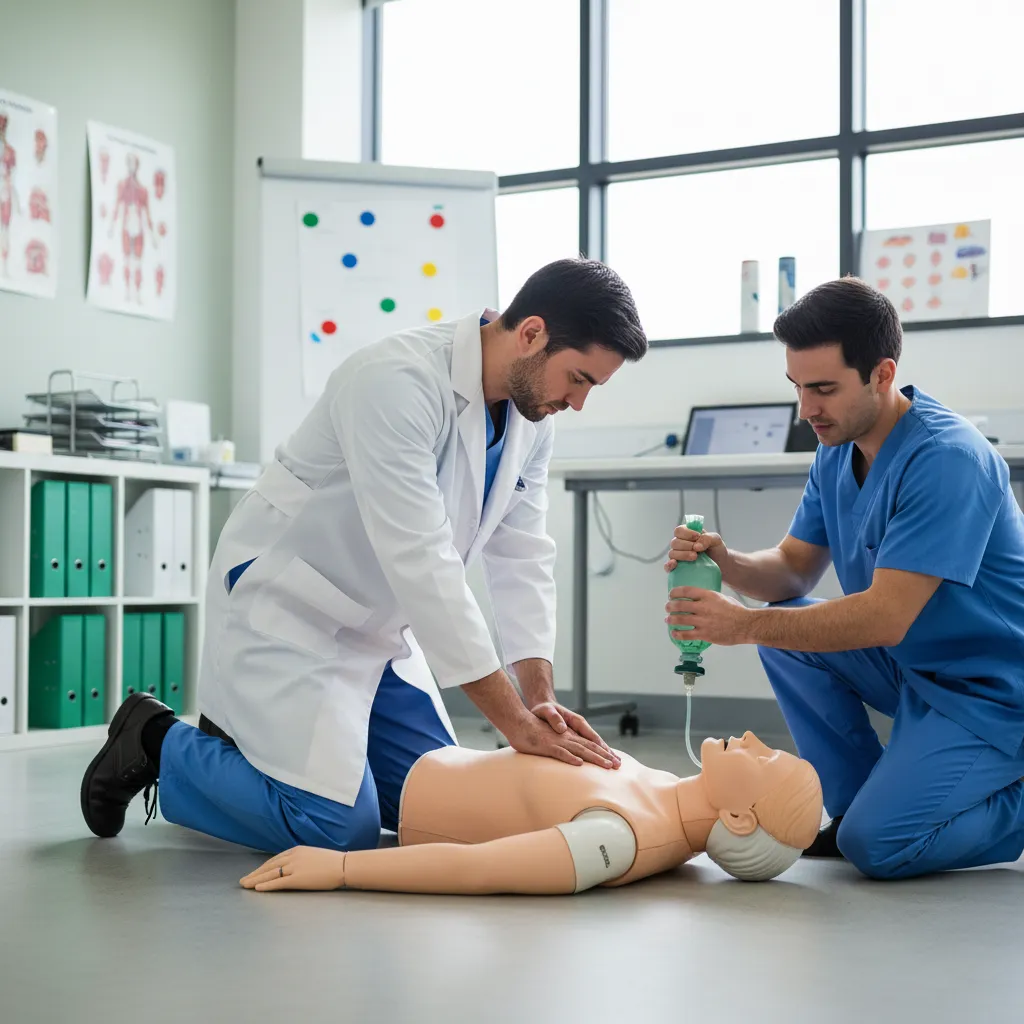
Coordination between the compressor, the ventilator, the AED operator, and the team leader is what separates a good code from a great one. High-performance teams call out vitals, time intervals, and drug doses aloud. They use closed-loop communication, repeating orders back before executing. They rotate compressors at exactly the two-minute mark to maintain quality. And they brief continuously so that whoever takes over the next role knows what has been done, what is pending, and what the suspected etiology is.
Special considerations include implanted devices, transdermal medication patches, and wet or hairy chests. Place pads at least one inch away from an implanted pacemaker or defibrillator. Remove medication patches with a gloved hand and wipe the skin. Dry the chest thoroughly before pad placement to prevent arcing. Each of these small adjustments reflects lessons learned from real arrests where shocks failed or rescuers were injured by improper technique.
Finally, document everything when EMS arrives or in the post-event review. Time of collapse, time CPR started, time of first shock, total shocks delivered, drugs administered, and return of spontaneous circulation if achieved. This data drives quality improvement, refines local protocols, and ultimately raises survival rates across entire systems of care. The chain of survival only closes when each link, including documentation, is forged tightly.
The three most frequent errors observed in real arrests are insufficient depth, leaning on the chest preventing recoil, and excessive interruptions exceeding 10 seconds. Each one independently reduces coronary perfusion pressure to subtherapeutic levels. Use feedback devices during training and audit performance with CPR-recording defibrillators whenever possible.
Return of spontaneous circulation marks a victory, but not the end of the resuscitation. The minutes immediately after ROSC determine whether the patient walks out of the hospital neurologically intact or suffers anoxic injury during transport. Position recovery, airway management, and hemodynamic monitoring all begin the moment a pulse returns. Standing up and celebrating is not an option — vigilance is. Many patients re-arrest within minutes, and the team must be ready to restart compressions instantly.
The recovery position, used only for unresponsive patients who are breathing adequately on their own, protects the airway from aspiration of vomit, blood, or secretions. Place the patient on their side with the lower arm extended forward, the upper leg flexed to stabilize, and the head tilted slightly back to keep the airway open. Monitor breathing continuously and be ready to roll the patient supine and resume CPR if breathing stops or becomes agonal. For an in-depth refresher on terminology and certification basics, the what is a bls certification overview is a strong starting point.
Respiratory rate after ROSC should be carefully targeted, not maximized. Adults typically need 10 to 12 assisted breaths per minute, enough to maintain an end-tidal CO2 between 35 and 45 mmHg. Hyperventilation after arrest worsens cerebral perfusion by lowering CO2 and constricting cerebral vessels, exactly the opposite of what an injured brain needs. Aggressive bag-valve-mask ventilation is one of the most common and most damaging post-arrest errors that providers make.
Twelve-lead ECG, blood glucose, temperature, and serial blood pressure measurements anchor the next phase of care. Targeted temperature management between 32 and 36 degrees Celsius for at least 24 hours is the standard of care for comatose survivors. Avoid hyperthermia at all costs, as even brief elevations above 38 degrees worsen neurological outcomes. Sedation and neuromuscular blockade may be needed to maintain temperature targets and prevent shivering, which itself drives metabolic demand upward.
Cause-directed therapy follows. If ST-elevation appears on ECG, emergent cardiac catheterization within 90 minutes is indicated. If a pulmonary embolism is suspected from the clinical picture, anticoagulation or thrombolysis may be considered. Sepsis, toxicology, and metabolic derangements each have their own treatment pathways, and the post-arrest team must hunt for the underlying cause while simultaneously supporting end-organ function in the ICU. This integrated approach is what registries call bundled post-arrest care.
Family communication starts early and continues throughout. Honest, compassionate updates reduce trauma for relatives and align expectations about neurological recovery. The prognosis after ROSC depends on time to CPR, time to defibrillation, downtime, comorbidities, and post-arrest care quality. Definitive neurological prognostication should be delayed at least 72 hours after rewarming, and even then requires multimodal evidence including clinical exam, EEG, imaging, and biomarkers before any decision about withdrawal of life-sustaining therapy is considered.
For rescuers, the post-event debrief is essential. Run through what went well, what could have been faster, and what to practice next. Emotional processing matters too — sudden cardiac arrest is intense, and the people who respond to one frequently carry the experience for years. Peer support, formal debriefing, and continued training all build the resilience that lets responders show up again on the next call with full focus and confidence.
Translating C-A-B knowledge into reflexive skill requires deliberate practice on manikins, simulated scenarios, and ideally feedback devices that score depth and rate. Reading about compressions is not the same as feeling your shoulders burn at minute six of a real arrest. Schedule at least one hands-on session every six months even if your certification is still valid, because muscle memory degrades faster than written knowledge and the difference shows up in real outcomes.
Use a metronome app set to 110 beats per minute during practice, or memorize a song with that tempo. Songs commonly recommended include Stayin' Alive by the Bee Gees, Crazy in Love by Beyonce, and Cecilia by Simon and Garfunkel. The tempo is more important than the song choice — what matters is hitting the 100 to 120 window every cycle without thinking about it. Drift toward 130 is the most common error and signals fatigue or inadequate training.
Practice transitions between roles. Move from compressor to ventilator to AED operator without breaking flow. In high-performance teams, the swap happens in less than five seconds, with the incoming compressor positioning their hands while the outgoing one delivers the final compression. Rehearsing these handoffs in drills makes them automatic when adrenaline is high and seconds matter. Hospital codes that practice this routine see measurably higher chest compression fractions during real events.
Audit your performance. CPR feedback devices, smartphone apps, and modern defibrillators record every compression and replay the data. Look at depth distribution, rate variability, and pause duration. Identify the specific element where you fell short and target it in your next practice session. This data-driven approach to skill improvement separates competent rescuers from exceptional ones, and it is the same approach that elite emergency teams use to refine performance across hundreds of cases. You can deepen scenario familiarity with the cpr index video walkthrough library.
Maintain your certification through reputable providers including the American Heart Association, American Red Cross, and the national cpr foundation. Verify that the program aligns with current ILCOR guidelines and includes a hands-on skills validation, not just an online quiz. Employer requirements vary, so confirm acceptance with your specific workplace before paying for a course. Many healthcare employers require AHA-branded BLS specifically, while community responders have more flexibility in their choice of program.
Build a personal action plan. Identify the AEDs in your workplace, gym, school, and home neighborhood. Know where they are kept, whether they are pediatric-capable, and whether anyone has trained on them. Many sudden cardiac arrests occur in homes where the nearest AED is hundreds of feet away and unknown to family members. Awareness and locating these devices in advance saves crucial seconds when seconds are everything.
Finally, share what you learn. Teach family members the basic C-A-B sequence and compression-only CPR. Encourage workplace training events. Advocate for AED placement in community spaces. The single biggest predictor of survival in a community is the percentage of citizens trained to act in the first three minutes of an arrest. Every person you train multiplies the chain of survival far beyond your own response capability and represents a tangible contribution to public health.
CPR Questions and Answers

About the Author

Registered Nurse & Healthcare Educator
Johns Hopkins University School of NursingDr. Sarah Mitchell is a board-certified registered nurse with over 15 years of clinical and academic experience. She completed her PhD in Nursing Science at Johns Hopkins University and has taught NCLEX preparation and clinical skills courses for nursing students across the United States. Her research focuses on evidence-based exam preparation strategies for healthcare certification candidates.
Join the Discussion
Connect with other students preparing for this exam. Share tips, ask questions, and get advice from people who have been there.
View discussion (5 replies)