
ACLS Algorithms 2026 October: Complete Cardiac Arrest, Bradycardia & Tachycardia Guide
📝 Master every ACLS algorithm for 2026 October — cardiac arrest, VF/VT, PEA, bradycardia, tachycardia, ACS, and stroke. Doses, sequences, and free practice.
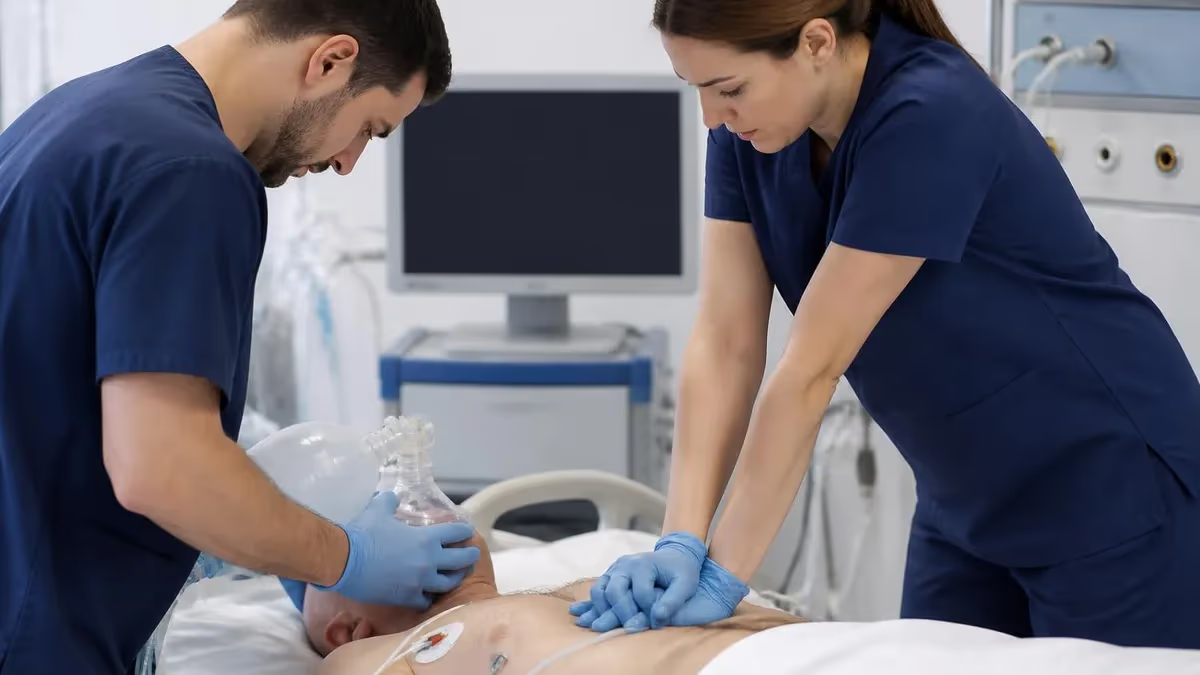
ACLS Algorithms 2026: The Complete Working Guide
The AHA ACLS algorithms are step-by-step decision flowcharts for adult cardiac arrest (VF/pVT and asystole/PEA), bradycardia and tachycardia with a pulse, and post-cardiac-arrest care. This guide follows the 2025 AHA Guidelines for CPR and ECC, published October 2025.
You hear the code call. The clock starts. In ninety seconds you need to know if you're treating a shockable rhythm, a pulseless rhythm with electrical activity, an unstable bradycardia, or something else entirely — and your hands need to move before your brain finishes the sentence. That's why the AHA ACLS algorithms are built the way they are. They aren't textbook pages. They're decision trees that survive panic.
This guide walks through every 2026 algorithm an ACLS provider is expected to know cold: adult cardiac arrest, the VF/pulseless VT pathway, asystole and PEA, post-cardiac-arrest care, symptomatic bradycardia, stable and unstable tachycardia, acute coronary syndromes, and the suspected stroke chain. We'll also cover the changes in the 2025 AHA guidelines, the drug doses examiners actually quiz on, and the team-leader habits that turn a chaotic code into a clean run.
If you're studying for an AHA aha acls certification exam, prepping for renewal, or refreshing memory before a shift, treat this page as a working bench. Every section maps to the 2025 ECC Guidelines and reflects what shows up on the acls precourse self assessment answers. We mark the spots where students lose points and the rhythms that get mixed up under stress.
One more thing before we open the algorithms. The AHA describes cardiac arrest care as a chain of survival of linked actions, and every algorithm assumes the earlier links are already happening, including recognition, activation, high-quality CPR, defibrillation, and advanced care. If chest compressions are weak or interrupted, no algorithm in this guide will save the patient. Hands first, then drugs, then thinking.
Why Algorithms — Not Memorized Lists — Run Modern Codes
Decades of resuscitation research kept showing the same uncomfortable pattern. Skilled providers, working alone, performed worse than less experienced providers working from a shared algorithm. The reason wasn't competence. It was cognitive load. A cardiac arrest fires a flood of decisions at the team in seconds, and the human brain isn't built to hold ten branching possibilities in working memory while also leading compressions.
So the AHA pulled the decisions out of memory and put them on paper. Each algorithm is a flowchart with one entry point and one or two branching questions per node. Is the rhythm shockable? Is the patient stable? Is the QRS narrow or wide? Each answer leads to one action, and each action loops back to the next decision. The provider's job stopped being to remember what to do next. The job became running the ACLS protocol exactly as written.
That's why ACLS exams test algorithm recognition more than rote facts. Examiners want to see if you can identify the entry point, follow the branch, and recognize when a patient has moved from one algorithm to another (bradycardia to cardiac arrest, for example, or tachycardia to ROSC).
Key points from the 2025 AHA Guidelines for CPR and ECC (Part 9 Adult Advanced Life Support, Part 10 Special Circumstances, Part 11 Post-Cardiac Arrest Care) that show up on exams:
- Epinephrine timing: 1 mg every 3 to 5 minutes. Give it as soon as feasible in non-shockable rhythms; in shockable rhythms give it after initial defibrillation attempts have failed (after the second shock in the AHA algorithm).
- Calcium, sodium bicarbonate and magnesium: routine use in cardiac arrest is not recommended. Specific causes such as hyperkalemia or toxic ingestions are covered in Part 10.
- Defibrillation energy: biphasic energy follows the device manufacturer (for example an initial 120 to 200 J); if unknown, use the maximum available. A single-shock strategy is preferred to stacked shocks.
- Double sequential defibrillation and vector change: usefulness for VF/pVT persisting after 3 or more shocks has not been established.
- Post-arrest care: temperature control at 32 to 37.5 °C for at least 36 hours; maintain MAP of at least 65 mm Hg; the old systolic-pressure target was removed.
- Cardioversion: 200 J for atrial fibrillation and flutter, 100 J for narrow-complex tachycardia and monomorphic VT.
ACLS Algorithm Facts at a Glance
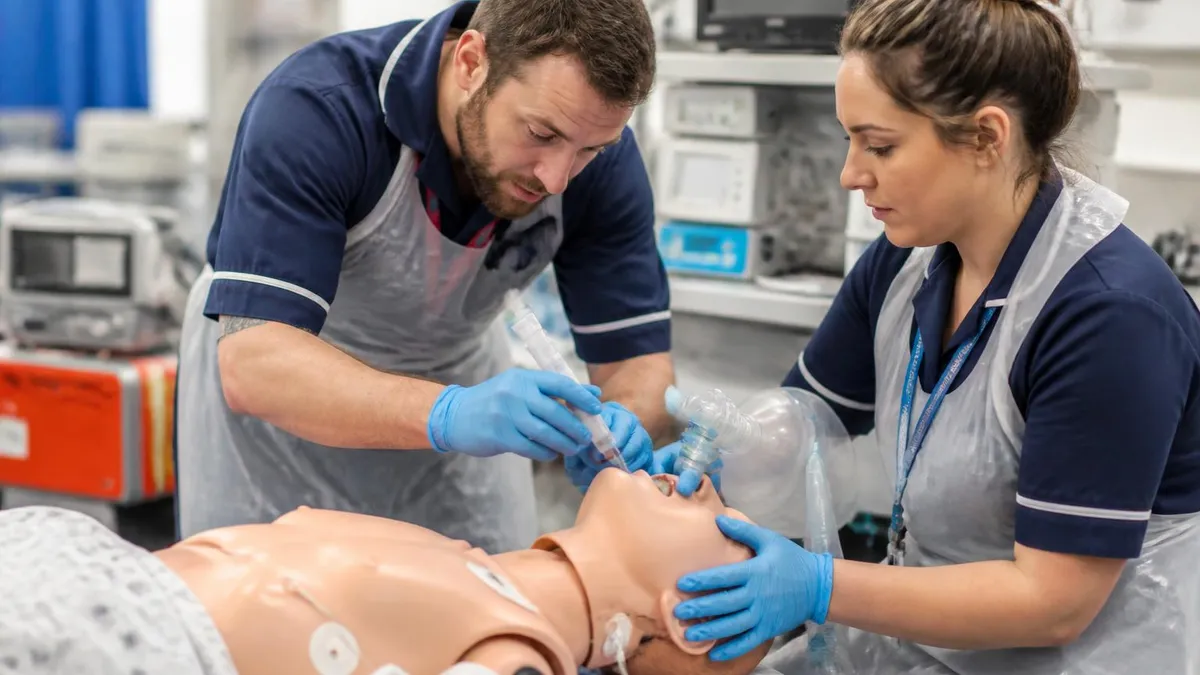
The Eight Core ACLS Algorithms
The master algorithm. Branches at the first rhythm check into shockable (VF/pulseless VT) and non-shockable (asystole/PEA) pathways. Every other arrest decision flows from here.
Sequence: start CPR → attach monitor/defib → identify rhythm → shock or no shock → 2 minutes of CPR → recheck rhythm → cycle until ROSC or termination.
The Adult Cardiac Arrest Algorithm — Step by Step
This is the algorithm everything else hangs on. Whether the code is running in a hospital corridor or a parking lot, the structure is identical. Begin chest compressions immediately, attach the monitor/defibrillator the instant it arrives, and let the rhythm dictate the next move.
If the first analyzed rhythm is shockable, you're going down the VF/pVT branch. If not, you're treating asystole or PEA. Both branches loop back to the same two-minute cycle of compressions, rhythm check, drug, repeat.
The compressor switches every two minutes, no exceptions. Fatigue tanks compression depth faster than people admit, and depth correlates directly with survival. Use a metronome, a defib feedback pad, or a designated counter — anything that keeps the rate between 100 and 120 per minute.
The chest must fully recoil between compressions, and pauses (rhythm check, intubation attempt, pulse check) should be kept as short as possible. Continuous waveform capnography is part of the algorithm: if ETCO₂ is low or falling, reassess CPR quality. With an advanced airway, give 1 breath every 6 seconds with continuous compressions; without one, use a 30:2 ratio.
Reversible Causes — The Hs and Ts
Every algorithm tells you to identify and treat reversible causes, but the cue gets lost in the noise. Memorize them as a checklist your team runs out loud during the two-minute compression cycle.
The Hs are hypovolemia, hypoxia, hydrogen ion (acidosis), hypo/hyperkalemia, and hypothermia. The Ts are tension pneumothorax, tamponade (cardiac), toxins, thrombosis (pulmonary), and thrombosis (coronary). Strong teams assign one team member to call these out during every two-minute round.
When to Stop
Termination of resuscitation is one of the hardest decisions in medicine. The 2025 AHA guidelines provide validated termination-of-resuscitation rules for out-of-hospital arrest (BLS, ALS and universal rules) rather than a single universal time limit.
In intubated adults, failure to reach an ETCO₂ above 10 mm Hg after 20 minutes of ALS resuscitation may be considered as one part of a multimodal decision, and ETCO₂ should not be used in isolation to end resuscitation.
Reversible Causes — Hs & Ts at a Glance
- Hypovolemia: Volume resuscitation
- Hypoxia: Confirm airway, ventilate and oxygenate
- Hydrogen ion (acidosis): Ensure effective ventilation; bicarbonate is not routine
- Hypo/Hyperkalemia: Check potassium; treat per Part 10 (Special Circumstances)
- Hypothermia: Rewarm per Part 10 (Special Circumstances)
- Tension pneumothorax: Decompress the chest
- Tamponade (cardiac): Pericardiocentesis
- Toxins: Reversal agent or treatment per Part 10 if known
- Thrombosis (pulmonary): Consider thrombolysis per Part 10
- Thrombosis (coronary): Coronary angiography and PCI after ROSC
The VF / Pulseless VT Pathway
If the first rhythm is ventricular fibrillation or pulseless ventricular tachycardia, defibrillate immediately at the manufacturer's biphasic energy (an initial 120 to 200 J on many devices; use the device maximum if unknown). Don't wait for IV access. Don't wait for an airway. Resume CPR the second the shock is delivered.
After two minutes, recheck the rhythm. If still shockable, shock again, then start epinephrine 1 mg IV every 3–5 minutes. After the third shock, give amiodarone 300 mg IV bolus (second dose 150 mg) or lidocaine 1–1.5 mg/kg.
The detailed shockable pathway is mapped out in the acls vf vt algorithm walkthrough. Refractory VF — VF that persists after three appropriately-delivered shocks — is where the 2025 guidelines say the usefulness of double sequential defibrillation and of changing pad position (vector change) has not been established.
What Makes VF Refractory
True refractory VF often has a reversible driver: ongoing ischemia, electrolyte derangement (especially low magnesium or potassium), acidosis, hypothermia, or drug toxicity. While compressions continue, the team should be checking labs, reviewing the medication history, and considering whether the patient needs ECMO transfer if available locally.
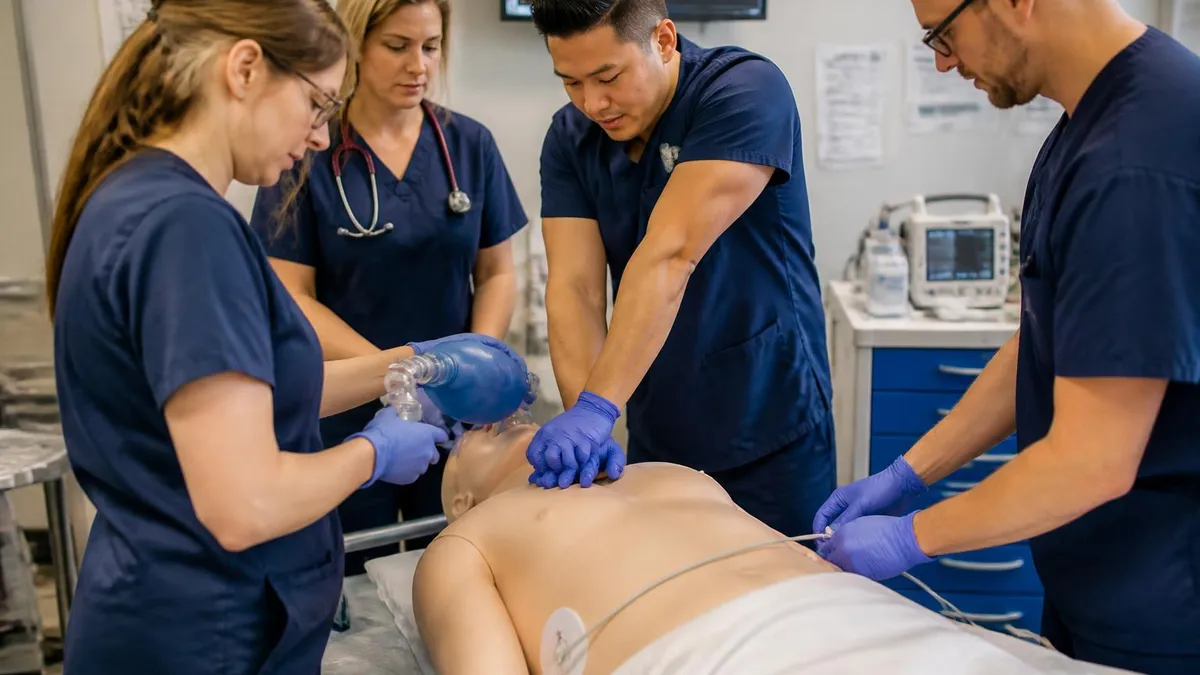
Two-Minute Cycle: What Happens Inside Each Round
00:00 — Rhythm check
00:10 — Compressions resume
00:30 — Drug round
01:00 — Hs & Ts review
01:50 — Compressor swap prep
02:00 — Rhythm check
Asystole and PEA — The Non-Shockable Branch
No shock will fix asystole or PEA. Compressions and reversible-cause hunting are the entire treatment, with epinephrine 1 mg IV every 3–5 minutes layered on top. Check lead connections and gain before calling asystole, because fine VF can look flat.
For PEA, the rhythm on the monitor is organized but the patient has no pulse. The diagnosis lives in the absent pulse, not in the QRS shape. PEA outcomes hinge almost entirely on finding the H or T that caused it.
ACLS Bradycardia Algorithm — Bradycardia With a Pulse
The bradyarrhythmia acls algorithm starts with one question: is the patient unstable? Hypotension, acute altered mental status, signs of shock, ischemic chest discomfort, or acute heart failure earn the unstable label.
Bradycardia with cardiopulmonary compromise gets atropine 1 mg IV bolus, repeated every 3 to 5 minutes (maximum 3 mg total). If atropine is ineffective, move to transcutaneous pacing or a dopamine (5–20 mcg/kg/min) or epinephrine (2–10 mcg/min) infusion.
Stable bradycardia gets monitoring and a workup for cause — drug effect, electrolyte derangement, ischemia, increased intracranial pressure, or hypothyroidism are the usual suspects.
Pacing Pitfalls
Transcutaneous pacing fails more often than students expect. Capture isn't just a pacer spike on the monitor — it's a QRS that follows every spike and a palpable femoral pulse that matches the pacing rate.
Confirm both. Sedate the patient as soon as possible; conscious pacing is brutally uncomfortable. And do not wait on capture that isn't coming: consider expert consultation, transvenous pacing, or a chronotropic infusion.
Synchronized Cardioversion Energies (2025 AHA Algorithm)
- Atrial fibrillation: 200 J
- Atrial flutter: 200 J
- Narrow-complex tachycardia: 100 J
- Monomorphic VT: 100 J
- Polymorphic VT: Unsynchronized high-energy shock (defibrillation)
Tachycardia With a Pulse — The Decision Tree
Tachycardia algorithms split on two questions: is the patient stable, and is the QRS narrow or wide? Unstable tachycardia (defined by the same criteria as unstable bradycardia) goes directly to synchronized cardioversion.
Stable narrow regular tachycardia gets vagal maneuvers first, then adenosine 6 mg rapid IV push (then 12 mg if needed). Stable wide-QRS tachycardia is treated as ventricular tachycardia until proven otherwise. Adenosine is considered only if the rhythm is regular and monomorphic; otherwise use an antiarrhythmic infusion (procainamide 20–50 mg/min up to 17 mg/kg, or amiodarone 150 mg over 10 minutes then 1 mg/min for 6 hours) and get expert consultation. Verapamil and diltiazem should not be given for wide-complex tachycardia.
Stable irregular tachycardia (often atrial fibrillation with rapid ventricular response) typically gets rate control with a beta blocker or calcium channel blocker.
Synchronized Cardioversion Energies
Energy levels matter because they're tested constantly. The 2025 AHA cardioversion algorithm lists atrial fibrillation 200 J, atrial flutter 200 J, narrow-complex tachycardia 100 J and monomorphic VT 100 J, and polymorphic VT gets an unsynchronized high-energy shock (defibrillation). Always follow your device's recommended energy; if unknown, use the maximum setting.
Always sedate the patient if conscious, and always confirm the synchronizer is engaged before pressing shock. A common test trap is the candidate who forgets to re-enable sync after an earlier defibrillation in the same case.
The Adenosine Window
Adenosine is unique. It's a rapid IV push followed by a normal saline flush. Patients often describe flushing and a feeling of dread.
Warn them. Have the defibrillator pads on, sync mode ready, just in case. If 6 mg fails, give 12 mg. The 2025 algorithm lists adenosine 6 mg first and 12 mg second dose if required.
Post-ROSC Targets at a Glance
Post-Cardiac-Arrest Care
ROSC is the start of a new algorithm, not the end of the code. The post-arrest priorities are airway optimization with appropriate oxygenation (once SpO₂ can be measured reliably, titrate to 90–98%, PaO₂ 60–105 mm Hg; use 100% oxygen until then). Keep PaCO₂ in the normal range of about 35–45 mm Hg.
Hemodynamic support avoids hypotension by keeping a mean arterial pressure of at least 65 mm Hg (the 2025 guidelines removed the older systolic target). Obtain a 12-lead ECG as soon as feasible to identify STEMI candidates for cath lab activation. Temperature control is recommended for adults not following commands after ROSC, at 32 to 37.5°C for at least 36 hours.
Multimodal neurologic prognostication should be consolidated no sooner than 72 hours after normothermia and discontinuation of sedatives, because early exams can mislead. Pupillary response, motor exam, and EEG patterns all become more reliable once sedation and hypothermia have worn off.
Acute Coronary Syndromes
The ACS algorithm is a clock from the moment the patient hits the door. Get a 12-lead ECG promptly. STEMI identified → cath lab activation for primary PCI, or fibrinolytics if PCI cannot be done in the guideline time window (see the ACC/AHA ACS guideline for exact targets).
Aspirin is given early unless contraindicated. Beta blockers, statins, and anticoagulation per local protocol. The drugs and doses examiners love to test are summarized in our acls algorithms reference. NSTEMI patients still require urgent risk stratification — they're not low priority.
Suspected Stroke — The Time Targets That Matter
Stroke care lives or dies on speed. Urgent brain imaging, a fast read, and a rapid fibrinolytic or thrombectomy decision all have time targets set by the AHA/ASA stroke guideline and your course manual.
Pre-hospital, the priority is recognizing FAST signs (face droop, arm weakness, speech difficulty, time to call) and transporting to a stroke-capable center. Blood pressure must be controlled before fibrinolytics are given, per the stroke guideline.
Drug Doses You Must Know Cold
Examiners test the same doses every cycle. Epinephrine 1 mg IV/IO every 3–5 minutes in arrest. Amiodarone 300 mg IV/IO first dose, 150 mg second dose.
Lidocaine 1–1.5 mg/kg first, 0.5–0.75 mg/kg second. Atropine 1 mg IV every 3–5 minutes for bradycardia, max 3 mg. Adenosine 6 mg rapid IV push, then 12 mg if needed.
Routine calcium, sodium bicarbonate and magnesium are not recommended in cardiac arrest; use them only for specific causes covered in Part 10.
Team Dynamics — The Hidden Algorithm
Every published study on resuscitation outcomes points to the same conclusion: team performance matters more than any single drug or maneuver. The AHA codifies this with team-leader and team-member roles, closed-loop communication, clear role assignments, and constructive intervention.
The leader stays hands-off the compressions, keeps the algorithm in their head, calls drug orders by name and dose, and rotates compressors before fatigue degrades depth. Team members repeat orders back, announce when interventions are complete, and speak up if they see something wrong.
Closed-Loop Communication in Practice
Closed loop sounds bureaucratic on paper. In a real code it's the only thing that prevents the wrong drug, the wrong dose, or the same drug given twice. The leader says: "Give 1 mg of epinephrine IV."
The team member says: "1 mg of epinephrine IV, giving now." When the push is done: "1 mg of epinephrine IV, given." Three sentences. Every order. Every time. It feels theatrical for thirty seconds, then the structure carries the room.
Common Algorithm Mistakes Under Stress
Watch for these failure modes during megacode and in real arrests: confusing PEA with asystole, failing to switch the compressor at the two-minute mark, and giving epinephrine too early in a shockable rhythm (it goes after the second shock, not the first).
Also: forgetting to engage sync mode after an earlier defibrillation, mismanaging the bradycardia pacing transition, and skipping the Hs and Ts huddle because the team is focused on the monitor. Strong teams build these checks into the cycle so they happen even when attention is exhausted.
Studying the Algorithms Effectively
The fastest way to internalize the algorithms isn't to read flashcards. It's to draw them. Get a blank piece of paper, pick a rhythm — say, refractory VF — and write out every step, every drug, every energy, every reversible cause check from memory. Then compare against the official flowchart in the AHA ACLS algorithms PDF that ships with your provider manual and circle the gaps. Repeat tomorrow. Once the flowcharts are solid, add ACLS algorithms practice strips to the routine: read a six-second rhythm strip, name the algorithm it enters (arrest, bradycardia, or tachycardia), then say the first two actions out loud before checking the answer.
ACLS Algorithm Comparison: Drugs, Doses and Key Interventions (2025 AHA)
| Algorithm | Key drugs and doses | Key interventions |
|---|---|---|
| Cardiac arrest: VF/pVT | Epinephrine 1 mg IV/IO every 3–5 min (after 2nd shock); amiodarone 300 mg then 150 mg, or lidocaine 1–1.5 mg/kg then 0.5–0.75 mg/kg (after 3rd shock) | Shock at manufacturer energy (monophasic 360 J); CPR 2 min between shocks at 100–120/min, depth at least 2 in; treat Hs and Ts |
| Cardiac arrest: asystole/PEA | Epinephrine 1 mg IV/IO as soon as feasible, then every 3–5 min | No shock; high-quality CPR, IV/IO access, capnography, treat reversible causes |
| Bradycardia with a pulse | Atropine 1 mg IV, repeat every 3–5 min (max 3 mg); dopamine 5–20 mcg/kg/min or epinephrine 2–10 mcg/min infusion | Airway, oxygen, monitor; transcutaneous pacing if atropine ineffective; consider transvenous pacing |
| Tachycardia with a pulse | Adenosine 6 mg rapid IV push, then 12 mg; procainamide 20–50 mg/min (max 17 mg/kg) or amiodarone 150 mg over 10 min for stable wide-QRS | Unstable: sedate and synchronized cardioversion (AF/flutter 200 J; narrow-complex and monomorphic VT 100 J) |
| Post-cardiac arrest care | No routine drug; avoid hypotension and hyperoxemia | MAP at least 65 mm Hg; SpO₂ 90–98%; PaCO₂ 35–45 mm Hg; 12-lead ECG; temperature control 32–37.5 °C for at least 36 h; prognostication at least 72 h after normothermia |
Exam-prep content based on the 2025 AHA Guidelines for CPR and ECC, not clinical guidance; always follow current AHA materials, your protocols and medical direction.
AHA ACLS Algorithms vs. Your Hospital's ACLS Protocol
Students use "algorithm" and "protocol" interchangeably, but the exam does not. The AHA ACLS algorithms are the official flowcharts published with the ACLS Provider Manual and the AHA Guidelines for CPR and ECC: Adult Cardiac Arrest, Adult Bradycardia With a Pulse, Adult Tachycardia With a Pulse, Post-Cardiac Arrest Care, Opioid-Associated Emergency, Acute Coronary Syndromes, and Suspected Stroke. They are written for every provider in every setting, so they only specify what the evidence supports: epinephrine 1 mg every 3–5 minutes, amiodarone 300 mg then 150 mg, adenosine 6 mg then 12 mg, biphasic shocks at the manufacturer's energy (an initial 120–200 J on many devices), and 2-minute CPR cycles at 100–120 compressions per minute.
An ACLS protocol is what your hospital or EMS agency layers on top: which antiarrhythmic is stocked on the cart, when to call for ECMO, who activates the cath lab, and how far you can deviate before a physician order is required. Protocols can be stricter than the algorithm but never looser. On the written test, answer from the AHA algorithm, not from the way your unit runs codes.
Where to get the official flowcharts: the AHA distributes the current algorithm set inside the provider manual and on its CPR and ECC Guidelines site, updated as each guideline revision is published. Any ACLS algorithms PDF you download from a third-party site should carry the guideline year on the page; if it still lists 33°C as the only cooling target or routine bicarbonate in arrest, it predates the current guidelines and will cost you exam points.
Memorizing Algorithms vs. Running Them in Real Codes
- +Memorization gives speed under stress — no fumbling for a card
- +Tests reward verbatim recall, especially for drug doses and energies
- +Confident recall lets the team leader focus on the patient, not the chart
- +Algorithms link together — knowing one cements the others
- −Rote memorization fails when a patient deviates from the script
- −Some learners memorize without understanding the 'why' behind each step
- −Algorithm cards in the pocket can become a crutch that slows decisions
- −Real codes always have surprises — adaptive thinking beats pure recall
Pre-Code Mental Checklist — Run This Before Every Shift
- ✓Know the location of the nearest defibrillator and crash cart
- ✓Verify epinephrine, amiodarone, and atropine are stocked and unexpired
- ✓Confirm your role on the code team (compressor, airway, drugs, recorder, leader)
- ✓Refresh the compression rate (100–120) and depth (at least 2 in) targets
- ✓Review reversible causes — Hs and Ts — for the patients on your assignment
- ✓Locate the BVM and ensure a working suction setup
- ✓Identify the closest IV/IO access supplies
- ✓Note the patient's baseline rhythm if telemetry is available
ACLS Algorithm Flashcards
⚡ First shock for VF or pulseless VT?
Defibrillate immediately at the manufacturer's biphasic energy (an initial 120–200 J on many devices; maximum if unknown) before IV access or an airway. Resume compressions the instant the shock is delivered and recheck the rhythm after 2 minutes.
START ACLS PRACTICE TEST💉 Epinephrine dose and timing in cardiac arrest?
1 mg IV/IO every 3–5 minutes. In asystole and PEA give it as soon as feasible; in shockable rhythms it comes after the second shock, not the first.
START ACLS PRACTICE TEST🧪 Amiodarone doses for refractory VF/pVT?
300 mg IV/IO bolus for the first dose, then 150 mg for the second. Lidocaine 1–1.5 mg/kg (then 0.5–0.75 mg/kg) is the accepted alternative.
START ACLS PRACTICE TEST❤️ Compression rate, depth, and cycle length?
100–120 per minute, at least 2 inches (5 cm) deep with full chest recoil. Change compressors every 2 minutes (sooner if fatigued) and keep pauses as short as possible.
START ACLS PRACTICE TEST🐢 Unstable bradycardia — first drug and its ceiling?
Atropine 1 mg IV, repeated every 3–5 minutes to a maximum of 3 mg. If it is ineffective, go to transcutaneous pacing and/or a dopamine or epinephrine infusion.
START ACLS PRACTICE TEST💓 Stable narrow-complex SVT — what comes after vagal maneuvers?
Adenosine 6 mg rapid IV push followed by a saline flush, then 12 mg if the first dose fails. Have pads on and sync mode ready in case the patient becomes unstable.
START ACLS PRACTICE TEST🔄 Unstable tachycardia — what do you do?
Synchronized cardioversion, not drugs. 2025 AHA algorithm: atrial fibrillation 200 J, atrial flutter 200 J, narrow-complex tachycardia 100 J, monomorphic VT 100 J; polymorphic VT gets an unsynchronized high-energy shock.
START ACLS PRACTICE TEST🔍 What are the Hs and Ts in the ACLS protocol?
Hypovolemia, hypoxia, hydrogen ion (acidosis), hypo/hyperkalemia, hypothermia; tension pneumothorax, tamponade, toxins, thrombosis (pulmonary) and thrombosis (coronary). One team member calls them out every 2-minute cycle.
START ACLS PRACTICE TEST🌡️ Post-ROSC targets in the AHA ACLS algorithms?
MAP at least 65 mm Hg, SpO₂ 90–98% once reliably measured, a 12-lead ECG as soon as feasible, and temperature control at 32–37.5°C for at least 36 hours. Delay multimodal prognostication to at least 72 hours after normothermia and stopping sedatives.
START ACLS PRACTICE TEST📈 How do you confirm asystole on a practice strip?
Check lead connections and gain, because fine VF can look like a flat line. Asystole and PEA are non-shockable: compressions, epinephrine every 3–5 minutes, and a reversible-cause hunt.
START ACLS PRACTICE TESTACLS Questions and Answers
Official Resources
- AHA CPR & ECC Guidelines — the American Heart Association's guideline hub where the current ACLS algorithms and focused updates are published.
- ILCOR — the International Liaison Committee on Resuscitation, whose evidence reviews (CoSTR) form the scientific basis of the AHA algorithms.
This page is exam-prep content following the 2025 AHA Guidelines for CPR and ECC, not clinical guidance.
More From the ACLS Hub
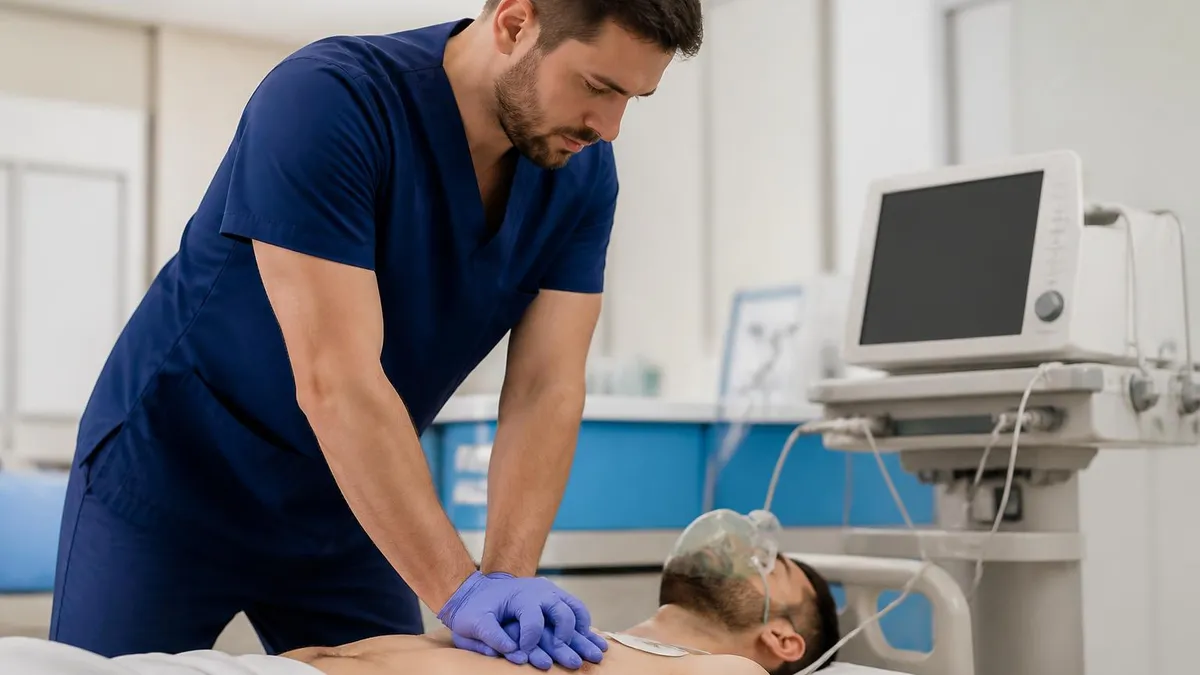
ACLS VF/VT Algorithm: Step-by-Step Cardiac Arrest Pathway
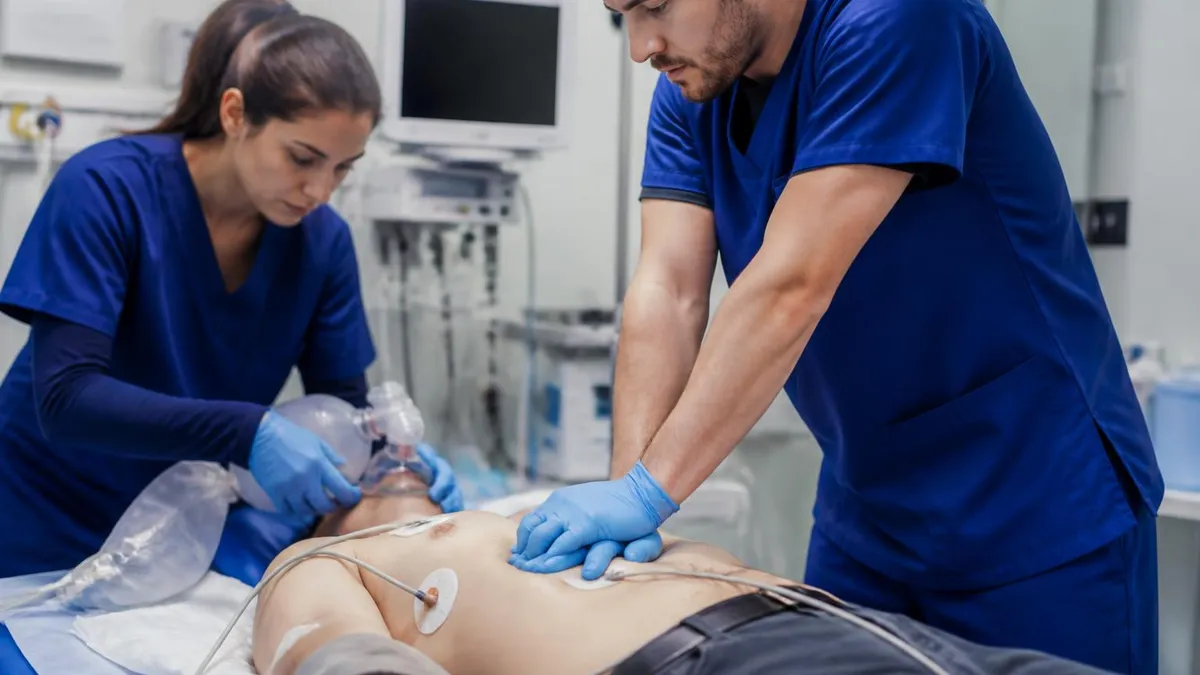
ACLS Bradycardia and Tachycardia Algorithms: Complete 2026 Provider Guide

ACLS Drugs and Medications: Complete Pharmacology Reference 2026

ACLS Certification: How to Get Certified, Recertified & Stay Current
ACLS Precourse Self-Assessment Answers — Your Complete 2026 Study Resource
About the Author

Registered Nurse & Healthcare Educator
Johns Hopkins University School of NursingDr. Sarah Mitchell is a board-certified registered nurse with over 15 years of clinical and academic experience. She completed her PhD in Nursing Science at Johns Hopkins University and has taught NCLEX preparation and clinical skills courses for nursing students across the United States. Her research focuses on evidence-based exam preparation strategies for healthcare certification candidates.
Join the Discussion
Connect with other students preparing for this exam. Share tips, ask questions, and get advice from people who have been there.
View discussion (8 replies)