
Free BLS Certification: Where to Get It, What's Legitimate, and What to Avoid
Free BLS certification guide for 2026 October: which programs are legit, what employers accept, AHA vs Red Cross fees, and how to lower your BLS cost. ✅
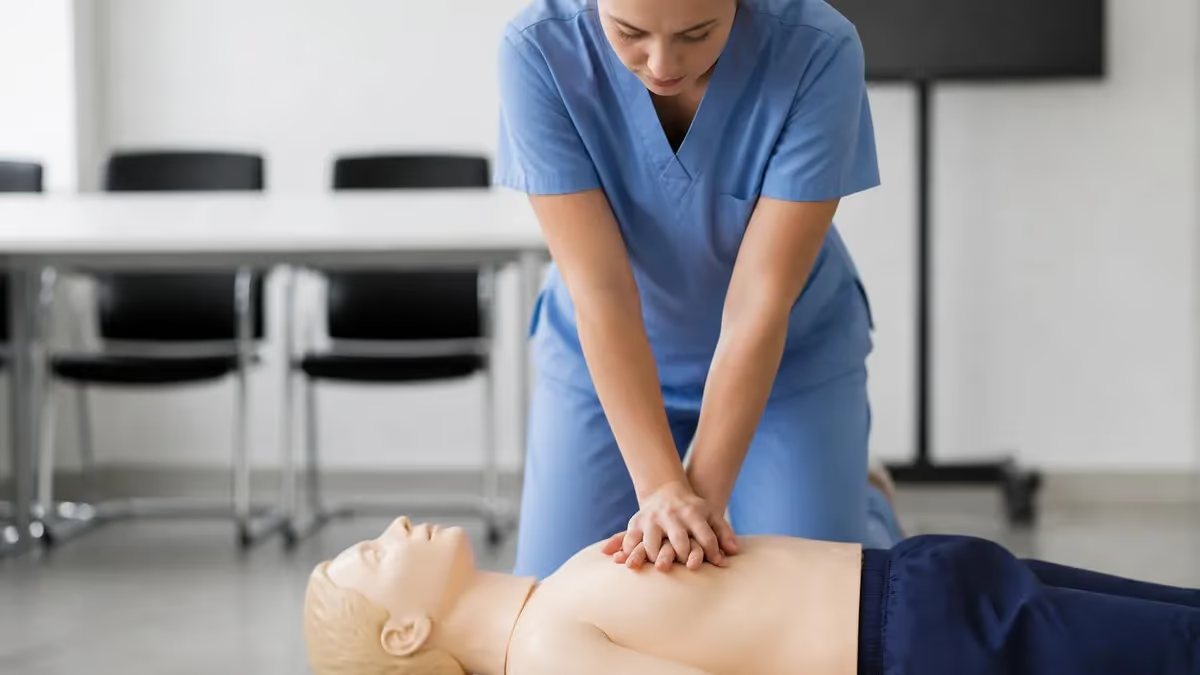
The phrase free BLS certification sounds great when you're staring at a job posting that says "BLS required" and rent is due Friday. But here's the catch most search results bury: a truly free, employer-accepted BLS card with hands-on skills validation basically does not exist in the United States. The reason isn't greedy training centers — it's the way the American Heart Association and the American Red Cross structure their courses, and the way hospital HR departments verify what shows up on your card.
This guide walks through every angle of "free" BLS — the courses that advertise it, the ones that are partly free, the legitimate scholarships and reimbursements, and the workarounds healthcare students actually use. You'll see what passes a credentialing check, what doesn't, and exactly where the line between "cheap" and "fake" sits. If you only have ten minutes, skip to the BLS certification overview and our free BLS certification practice test to start studying right now.
Here's what makes the "free" question messy. The skills portion of BLS — chest compressions on a manikin, bag-mask ventilation, AED pad placement, two-rescuer rotation — has to be observed by a credentialed instructor. That instructor's hour is the actual cost. The online theory is cheap; the proctored skills check is what you're really buying. Once you understand that, the whole pricing landscape suddenly makes sense, and so do the legitimate workarounds.
BLS Cost Reality Check 2026

Why a truly free BLS card is so rare
The American Heart Association doesn't run classes itself — it licenses Training Centers and instructors to deliver the material. Those Training Centers pay AHA for each certification card they issue. So even when an employer "pays" for your BLS, somebody is paying. The card you walk away with has a real per-unit cost attached to it, which is why instructors who try to give them away tend to lose their training-site agreement quickly.
Red Cross works similarly. Their digital BLS cards are tied to a paid course code, and the skills check has to be observed by a certified instructor. That instructor's time is the other expensive piece. A two-hour skills validation for ten students costs the Training Center several hundred dollars whether you charged the students $0 or $100. Free without a sponsor is not sustainable.
So when a website screams "100% Free BLS Certification!" at the top of the page, three things are usually true. First, the course is not AHA or Red Cross. Second, you take an online quiz with no skills demonstration — no compressions, no bag-mask ventilation, nothing physical. Third, the "card" you download is from a private brand most hospitals have never approved. Read more about what employers actually want on our BLS certification page.
There's another wrinkle. Even when an instructor wants to do a free skills check as a goodwill gesture, the Training Center they work under is required to log every card issued through the AHA's eCard system. Each entry triggers a fee. So an instructor running a "free" night class on her own dime still owes the Training Center per student. Hospitals and large EMS agencies absorb that overhead because they bulk-order eCards at volume discounts, which is why employer-sponsored BLS is the only path that's truly free for the trainee.
Watch the wording
Sites advertising "free BLS certification" often mean a free course you can take, but the certification card itself costs $20 to $40 at the end. Always scroll to the checkout step before you commit two hours of training time.
The four kinds of "free" BLS you'll actually find
Not every "free" claim is a scam. There's a real spectrum, and once you can tell the categories apart, the choice becomes easier. Below is how the offers break down in practice, ranked from most useful to least useful for someone who needs an employer-accepted card.
The 4 Categories of Free BLS
Hospitals, EMS agencies, nursing homes and many dental offices pay the entire BLS fee for new hires. This is the gold standard — real card, real skills check, zero cost to you. Ask in your offer letter or first-day onboarding packet.
You study the material for free but pay $20–$40 to download the final certificate. Skills check still required if your employer needs hands-on validation. Useful for refreshers or self-study only.
100% online, instant download, no skills test, no AHA logo. Some employers reject these outright. Confirm with your HR or licensing board before relying on one.
Local Red Cross chapters, community health foundations, EMS Explorers programs, and nursing schools sometimes sponsor free skills days. Limited slots, usually require an application.
What hospitals and licensing boards actually accept
This is the question that matters more than price. Saving $80 on a course is meaningless if HR throws your card in the trash on day one. Almost every U.S. hospital network requires either an American Heart Association BLS for Healthcare Providers card or an American Red Cross BLS for Healthcare Providers card. A few accept Health & Safety Institute (HSI/ASHI) cards. Nearly none accept cards from private online-only "academies" without skills validation.
Why so picky? Joint Commission and state nursing boards audit personnel files. If an auditor finds a BLS card from a provider that doesn't meet the 2020 AHA Guidelines for CPR and ECC with documented skills assessment, the facility risks a citation. So credentialing offices play it safe. If you want the long form on which cards count where, see our BLS certification lookup guide — it walks through how recruiters verify cards in 2026.
State boards add another layer. The California Board of Registered Nursing, for example, lists only AHA, ARC, and ASHI as approved BLS providers. Texas Department of State Health Services maintains a similar narrow list. New York City's Department of Health enforces the same restriction for daycare staff. Bottom line: if the card isn't AHA, Red Cross, or HSI, you're rolling dice with your employer.
Insurance is the unspoken reason credentialing offices are strict. Hospitals carry malpractice and general liability policies that require staff to hold cards from "nationally recognized" CPR programs. When a private online-only provider has no published instructor standards, no skills assessment, and no documented compliance with current resuscitation guidelines, the carrier won't honor the credential during a claim.
So when HR says "AHA or Red Cross only," they're really saying "or our insurance won't cover you." That's why even compassionate managers can't bend the rule. One useful exception: military medics and some federal agency staff hold equivalent credentials issued through their service or agency, and many civilian hospitals accept those during the transition out of service. If you're a veteran, ask the Veteran Liaison at the hospital you're applying to.

Free BLS Options by Audience
Many nursing programs include BLS in tuition or as part of clinical orientation. If yours doesn't, ask the simulation lab — most schools own AHA instructor licenses and run free or low-cost ($25) cohort classes for current students. Skills check is built into your existing clinical hours.
How to get BLS certified for free (or close to it)
If you're motivated and willing to do some legwork, here's the realistic playbook. Most people who say they got BLS for free used one of these paths — none of them involve a sketchy online-only card.
7 Ways to Lower or Eliminate Your BLS Cost
- ✓Ask your future employer in writing if BLS is covered during onboarding — most healthcare jobs cover it.
- ✓Check your school's simulation lab or student health office for sponsored BLS days.
- ✓Contact your local American Red Cross chapter about scholarships for low-income students.
- ✓See if your fire department or EMS agency offers community CPR/BLS days, especially during Heart Month in February.
- ✓Search Eventbrite and your local library calendar for free CPR/AED community classes — many lead to a low-cost BLS upgrade.
- ✓Ask if your union (SEIU, NYSNA, CNA) sponsors free certifications for members.
- ✓Use a HeartCode BLS blended course on sale and pair with a friendly Training Center's skills check.
The HeartCode trick: where "blended" learning saves money
HeartCode BLS is the AHA's official online portion of the BLS course. It costs around $35 to $40 retail. You complete the cognitive material at home, then book a 30-minute skills session with a local instructor for $25 to $50. Total: $60 to $90, often cheaper than a classroom-only course, and the card is fully AHA-issued.
The trick is finding instructors who do skills-only checks at a lower rate. Many independent instructors list on the AHA Atlas tool by ZIP code. Some run pop-up skills days at coffee shops, gyms, or community centers — they make their margin on volume, not on individual fees. Search "BLS skills check near me" and call around. Several readers reported paying under $25 for skills validation when they found an instructor willing to do 8 students in a 90-minute block.
HeartCode also works for renewal. If you've held a BLS card before, the cognitive material is half-length and you may qualify for a shorter skills review. See our BLS recertification online page for the renewal-specific flow, which is often cheaper than initial certification.
Worth noting: the HeartCode online portion is officially called a "blended" course because it combines self-paced study with required in-person skills. Some employers misunderstand this and tell new hires "we don't accept online BLS." Politely clarify that HeartCode BLS is an AHA-issued blended program that includes mandatory in-person skills validation by a certified AHA instructor. Once HR sees the AHA logo on the eCard, the conversation usually ends quickly.
Another HeartCode tip: the online cognitive component is good for a full year after purchase, even if you delay the skills session. So if your start date keeps shifting or you're between schools and clinical placements, you can buy the cognitive module on sale during November or February (the two predictable AHA discount windows), keep the access live, and book skills closer to when you actually need the card.
Free Non-AHA BLS Courses
- +Genuinely $0 — pay nothing for the course or card
- +Instant — finish and download in under an hour
- +Convenient — no scheduling, no driving, no in-person skills test
- +Decent for self-study or as a knowledge refresher between AHA renewals
- −Rarely accepted by hospitals, dental offices, or state boards
- −No hands-on skills validation — you may not actually know the rhythm of compressions
- −Card may not display the AHA or Red Cross logo HR is told to look for
- −Some boards (CA BRN, TX DSHS) explicitly disqualify these providers
Pros and Cons at a Glance
| Pros | Cons |
|---|---|
| Instant — finish and download in under an hour | Rarely accepted by hospitals, dental offices, or state boards |
| Convenient — no scheduling, no driving, no in-person skills test | No hands-on skills validation — you may not actually know the rhythm of compressions |
| Decent for self-study or as a knowledge refresher between AHA renewals | Card may not display the AHA or Red Cross logo HR is told to look for |
Red flags that the "free" course won't be accepted
Before you spend two hours of your evening on a free BLS website, scan for these warning signs. They almost always mean the card won't pass an HR review.
First, look for the issuing organization. If the certifying body's name is something like "National CPR Foundation" or "Online BLS Academy," and you can't find a single hospital that lists it as accepted, walk away. Genuine programs are issued by AHA, Red Cross, or HSI (the parent organization for ASHI and MEDIC First Aid). Anything else needs employer-specific approval before you commit time.
Second, watch for the words "no skills test required." AHA and Red Cross both require an in-person psychomotor skills assessment for BLS for Healthcare Providers. A program that lets you certify entirely online with no hands-on demonstration is not following the 2020 AHA Guidelines and won't be honored where those guidelines are mandatory. The free practice path is fine — but the real card must include a skills check.
Third, check the expiration date logic. All legitimate BLS cards are valid for two years from the date of completion. If a site offers cards that "never expire" or are valid for five years, that's a sign the provider isn't following industry standards. Run.
Submitting a counterfeit or unrecognized BLS card to an employer or licensing board can be classified as fraud — grounds for termination, license revocation, and in some states criminal charges. Pay $80 for the real thing or use one of the legitimate free paths above.
Free study materials vs. free certification — know the difference
Even if a free certification card isn't realistic for most healthcare workers, free study materials absolutely are. The AHA BLS Provider Manual sells for around $19, but you don't have to buy it to pass. Online flashcards, algorithm posters, and full-length practice tests are widely available at no cost, and they map to the same 2020 Guidelines content the paid exam covers.
That's where Practice Test Geeks fits in. Our free BLS certification practice test includes timed full-length exams, algorithm drills, and adult/child/infant scenario questions modeled on actual AHA test banks. Use it the night before your skills session, and you'll walk in knowing exactly what to expect. No login, no payment, no email capture.
Combine free practice with a paid HeartCode course or an employer-sponsored class, and you can keep total out-of-pocket cost under $25 even without a sponsor — much better than the typical $80 to $110 retail price most people end up paying because they didn't know the alternatives existed. See our BLS class guide for course-by-course pricing.
One pattern shows up again and again in reader emails: people who pass BLS on the first attempt usually took 60 to 90 minutes of practice tests beforehand, even when their employer told them the in-class skills session would cover everything. The reason is simple.
The cognitive portion of the exam is multiple choice, and the wording trips people up if they haven't seen it before. Questions about high-quality CPR rates (100-120 compressions per minute), depth (at least 2 inches for an adult), and team dynamics are easy to miss when you're tired after a clinical shift. Free practice questions burn the answers into memory.
BLS Cost Options Compared
Free renewal: easier than free initial certification
Once you've earned an AHA or Red Cross BLS card the first time, keeping it active is much cheaper. Most employers cover renewals as a routine cost of doing business, and the renewal course itself is shorter — typically 60 to 90 minutes of cognitive content plus a quick skills review. Some hospitals run renewals in-house during clinical staff meetings.
If you've left a healthcare job and need to renew on your own, look at HeartCode BLS Renewal ($30 cognitive + $25 skills). Or check whether your state nursing association offers free renewals at conferences — many do. Florida Nurses Association and the Texas Nurses Association both ran free renewal booths at their 2026 annual meetings. Conference registration may have a fee, but the renewal is bundled in.
Letting your card lapse beyond 30 days past expiration usually means starting over with full initial certification, so renewal is always cheaper than letting it expire. Set a calendar reminder 60 days before your two-year expiration — read our BLS renewal guide for the timeline.
One last renewal hack worth mentioning: if you're job-hopping between hospitals, ask the new employer to honor your existing BLS card until its current expiration date even if their preferred provider differs. Most large systems will, because the card itself is valid for two years from any AHA or Red Cross Training Center. You're not required to re-certify just because your employer changed.
BLS Questions and Answers
The honest bottom line on free BLS
"Free BLS certification" is one of the most-searched healthcare phrases in America, and that's because people genuinely need this card to work — sometimes within a week of being hired. The honest answer is that a free, employer-accepted BLS card almost always means somebody else is paying. Your hospital, your school, your union, or a charity. That's fine; just don't be surprised when a private "free" online site can't compete with the real thing.
If you're a few weeks out from a clinical job, the smart sequence is: ask your employer first, study the cognitive material for free using our practice tests, then either accept the employer-paid course or buy HeartCode BLS plus a skills session. Total time invested: about four hours. Total cost: usually zero. That's the playbook nearly every successful healthcare worker followed, and it's the one we'd recommend to a friend.
Ready to start studying? Begin with the free BLS practice test, then review our BLS certification overview and BLS renewal page for the next steps after you pass.
About the Author

Registered Nurse & Healthcare Educator
Johns Hopkins University School of NursingDr. Sarah Mitchell is a board-certified registered nurse with over 15 years of clinical and academic experience. She completed her PhD in Nursing Science at Johns Hopkins University and has taught NCLEX preparation and clinical skills courses for nursing students across the United States. Her research focuses on evidence-based exam preparation strategies for healthcare certification candidates.
Join the Discussion
Connect with other students preparing for this exam. Share tips, ask questions, and get advice from people who have been there.
View discussion (8 replies)