
AHA BLS Provider Manual: 2026 October Edition, Ebook & Buying Guide
✍🏼 AHA BLS Provider Manual guide: what it covers, 2015/2026 October/2026 October editions, ebook vs print, authorized buyers. Skip the PDF piracy traps.
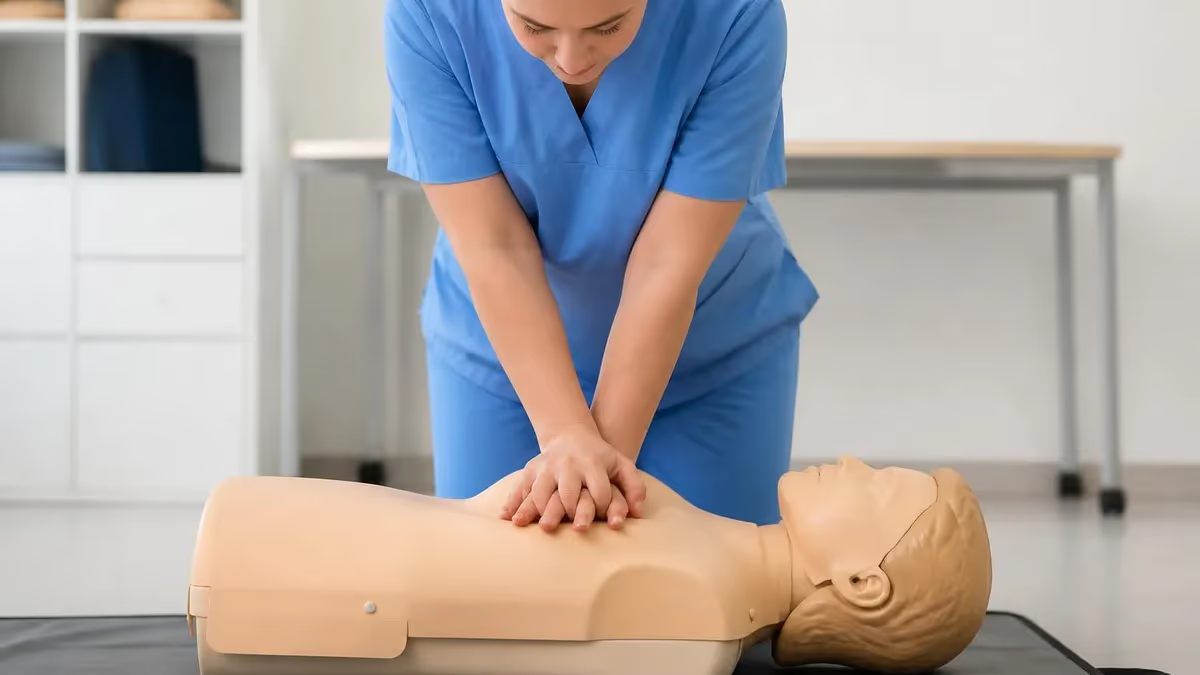
Walk into any hospital break room, fire station, or community CPR class and you’ll see the same slim book on the table. White cover, red cross, the words BLS Provider Manual stamped across the front. It’s the official course handbook for the American Heart Association’s Basic Life Support program — the one nurses, EMTs, lifeguards, dental staff, and medical students all crack open at some point during their training.
So what’s actually inside it? And why do instructors insist on it — sometimes requiring students to bring it to class, sometimes bundling a digital copy with the course fee, sometimes selling it separately at a steep markup? This guide unpacks everything: the chapters and skills the manual covers, how the AHA’s edition cycle works (2015, 2020, and the 2025 Guidelines update), the ebook vs print decision, where to buy the real thing without getting scammed, and what you actually need before class day.
One thing this article will not do is point you toward pirated PDF copies. There are plenty of those floating around the open web, and they tend to be outdated, mis-stitched scans, or watermarked review copies that violate the AHA’s copyright. More importantly, an outdated manual is genuinely dangerous in this field — compression depth, rate, and AED protocols have all changed between editions. Spending $20–$30 on the current version is small money for a credential that may sit on your scrub pocket for the next two years.
If you’re here because you’re prepping for a class next week, scroll to the “Where to Get It Legitimately” section. If you’re researching the edition history because your employer is asking whether your manual is current, the timeline section is what you need. If you just want to know what’s actually in this thing before you commit to a course, start at the top and read straight through. Each section answers a specific question students keep asking, in roughly the order they ask them.
AHA BLS Provider Manual at a Glance

What the BLS Provider Manual Actually Covers
The manual is structured around the AHA’s Chain of Survival and the skills a provider needs to recognize a cardiac arrest, deliver high-quality CPR, use an AED, and relieve a foreign-body airway obstruction. It’s deliberately concise — the AHA stripped out a lot of theoretical material in the 2015 redesign and tightened it further in 2020. You’re not getting a paramedic textbook here. You’re getting the protocols, the algorithms, and just enough physiology to make the protocols stick.
Chapter coverage typically includes: the systems of care framework, high-quality CPR for adults (compressions, ventilations, the 30:2 ratio for single rescuer), CPR for children and infants (with the age cutoffs and the two-thumb-encircling technique), AED operation and pad placement, choke relief for conscious and unconscious victims of all ages, two-rescuer CPR with role rotation, opioid-associated emergencies, and special situations like drowning or hypothermia. There’s also a section on team dynamics — the AHA hammers on closed-loop communication and clear role assignment because in-hospital resuscitations rise or fall on whether the team actually functions like one.
Every chapter includes algorithm diagrams (the rectangular flowcharts you’ll see again in your written test), photographs of correct hand placement, and the rate/depth numbers you’re expected to memorize. The compression numbers haven’t budged in years — at least 100–120 per minute, at least 2 inches deep for adults — but always check your edition because the AHA does occasionally tweak the precise wording.
The end of the manual contains a practice written exam, an answer key, and sometimes a tear-out reference card. Some editions ship with an access code for AHA digital supplements — videos of the skills demonstrations, a digital algorithm reference, and post-course resources you can pull up on your phone during a code if needed.
What’s NOT in the Manual
The BLS Provider Manual is not an ACLS textbook. It does not cover advanced airways (intubation), rhythm interpretation, drug administration, or post-arrest care. It is also not a first-aid manual — bleeding control, splinting, and wound care belong in the AHA Heartsaver First Aid course materials. If you need those topics, you’re looking at the wrong book. The BLS manual’s scope is deliberately tight: recognize arrest, push hard and fast, shock when indicated, manage choking. That’s it.
The Edition History: 2015, 2020, and the 2025 eCC Update
The AHA updates its Guidelines on a roughly five-year cycle, and the Provider Manual gets revised to match. Knowing which edition you have — and whether it’s still considered current — matters because employers sometimes audit BLS records and instructors will reject outdated materials at class check-in.
The 2015 BLS Provider Manual (catalog number 15-1010) was a major redesign. The AHA shrank the book significantly, moved a lot of theory online, and reorganized the chapters around skills rather than victim age. It introduced the “high-quality CPR” framing and emphasized the importance of minimizing pauses in chest compressions. If you bought a manual any time from late 2015 through 2020, this is what you got.
The 2020 BLS Provider Manual (catalog number 20-1102) refreshed the algorithms based on the 2020 AHA Guidelines for CPR and ECC. The biggest visible changes were the inclusion of opioid-associated emergencies as a formal section, expanded language around team dynamics and debriefing, and refreshed photography. The compression rate and depth numbers stayed the same. Most BLS courses run today still use the 2020 manual unless the training site has migrated to the newer materials.
The AHA moved to a continuous evidence evaluation (eCC) model in 2020, which means science updates are now published more frequently — the Focused Updates — and the manual revisions follow. Watch for new printings as the AHA rolls 2025-era guidance into the next manual edition. The Provider Manual itself is the source of truth for what your instructor will teach and what the written exam will test, so always confirm which edition the class is running before you buy anything.
What Each Section Teaches
30:2 compressions-to-breaths for single rescuer, 15:2 for two-rescuer pediatric. Compress at 100–120/min, depth at least 2 inches. Full chest recoil between compressions.
Age cutoffs: infant under 1 year, child age 1 to puberty. Two-thumb encircling technique for infants. Compression depth one-third the chest depth.
Power on, attach pads (adult vs pediatric placement), let it analyze, deliver shock if advised, resume compressions immediately. Special cases: wet skin, hairy chest, pacemakers, transdermal patches.
Conscious adult/child: abdominal thrusts (Heimlich). Conscious infant: 5 back blows and 5 chest thrusts. Unconscious victim: begin CPR with airway check before breaths.
Closed-loop communication, clear role assignment, knowing your limits, constructive intervention. Tested via simulation in instructor-led classes.
Recognition (pinpoint pupils, slow breathing, blue lips), naloxone administration, sustained ventilation while waiting for response. Added formally in the 2020 edition.
Ebook vs Print: Which Should You Buy?
The AHA sells the Provider Manual in both formats and they cost about the same. The ebook is a license code redeemed inside the AHA’s eBooks reader (or the Vital Source Bookshelf app, depending on edition). The print copy is the physical book. Both are official, both are current, both are accepted at any AHA-aligned training site. The decision is about how you study and what you need on class day.
The ebook wins on portability and search. You can keyword-search the algorithms, bookmark the choking flowchart on your phone, and pull it up at work if you need a quick reference. The reader app works offline once you’ve downloaded the content. Where ebooks lose is the testing room — many instructors prohibit phones and laptops during the written exam, so an ebook-only student may find themselves staring at a paper test with no manual in hand. If your class allows open-book testing, that’s less of an issue.
The print manual wins on physical reliability. You can highlight, dog-ear, jot notes in the margins, and bring it to a class with no batteries to worry about. It’s heavier in a backpack but instructors generally let you reference it during scenarios. The downside is once you’re recertifying in two years, you may want the newer edition anyway, and the old print copy ends up on a shelf.
A pragmatic move many students make: buy the ebook for study, and ask the instructor whether a print loaner is available on the day of the written exam. Many training sites keep a few class-set print copies on hand for exactly this. Failing that, you can print a few key pages — algorithms, compression numbers, choking flowchart — from your ebook viewer for personal reference.

Buying Channels Compared
The AHA’s consumer storefront sells both formats directly. Pricing is set by the AHA but you’re paying retail. Advantage: 100% guaranteed current edition, official ebook codes, no third-party risk. Disadvantage: the AHA itself doesn’t always offer the cheapest price — authorized distributors often beat it.
How the Manual Fits Into the Class
The BLS Provider course is typically a single session lasting 3.5 to 4.5 hours. You arrive having read the manual, the instructor delivers a brief lecture using the AHA-issued video clips, and the bulk of class time goes into hands-on skills stations — mannequins for adult, child, and infant compressions, AED simulators, choking scenarios. The course ends with a skills check (the instructor watches you run a code on a mannequin) and a written exam (25 multiple-choice questions on a typical version).
The AHA explicitly designs the course assuming students have pre-read the manual. Showing up cold and trying to absorb the protocols in a four-hour session is possible but stressful. Most students who fail the written exam didn’t fail because the material was hard — they failed because they skipped pre-reading and got blindsided by the specific numbers (compression rate, depth, AED pad placement details) that appear verbatim on the test.
Plan to spend roughly two to three hours with the manual before your class day. Read straight through, work the practice exam at the back, and check your answers against the key. If you’re scoring above 85% on the practice exam, you’re ready. Below that, re-read the chapters where you missed questions before walking into class.
Renewal: Do You Need a New Manual?
BLS certifications expire after two years. When you recertify, you have a choice: take a full renewal course (similar to the original course, abbreviated) or run a HeartCode BLS online module plus an in-person skills check. Either path requires access to current manual content. If you bought an ebook two years ago, the AHA may have released a new edition in the meantime — check the catalog number on the renewal course’s prerequisites list before assuming your old copy still applies.
Searching for “BLS provider manual PDF free download” will surface dozens of file-host links, often hosted on grey-market academic sites. Avoid them. The reasons stack up fast: (1) many are outdated — you might download a 2010 or 2015 edition when your class requires 2020; (2) they’re copyrighted and distribution violates the AHA’s licensing; (3) PDF scans are often mis-stitched with missing pages, low-resolution algorithm diagrams, or skipped chapters; and (4) many file hosts bundle malware into the download. A real ebook from an authorized distributor costs about the same as a meal out. Spend the money.
What You Actually Need on Class Day
Walking into a BLS class for the first time can feel like packing for a school field trip. The actual list is short. You need the manual (print or ebook, same edition the instructor specified), a photo ID, comfortable clothing you can kneel in (you’ll be on the floor doing compressions on a mannequin), and an open mind for the team-dynamics scenarios — they catch a lot of solo-clinician students off guard.
You do not need to bring a stethoscope, a pocket mask of your own, gloves, or any other clinical gear. The training site supplies all of that for in-class use. Some students bring a notebook to jot notes during the lecture, which is fine but optional — the manual itself has space in the margins.
If you’re bringing the ebook, charge your tablet or phone the night before and download the content for offline access. Wi-Fi at training centers is hit-or-miss, and you don’t want to be the student who can’t open the algorithm reference when the instructor calls for it.
Practice Questions and Self-Testing
The practice exam at the back of the manual is your single best self-test before class. Work it under timed conditions — 25 questions in roughly 25 minutes — without referencing the chapters. Then mark your wrong answers and re-read those sections. Repeat the practice exam two days later and compare your score.
Many students supplement the in-manual practice with online question banks. The PracticeTestGeeks BLS test library is one option — it covers compression numbers, AED protocols, choking algorithms, and team-dynamics scenarios in the same multiple-choice format you’ll see on test day. Use external practice as a supplement, not a replacement — the official manual content is what the exam draws from.
BLS Provider Manual Buying Checklist
- ✓Confirm the edition the class is using (catalog number, e.g., 20-1102 for 2020)
- ✓Verify the seller is the AHA or an authorized distributor (Channing Bete, Worldpoint, Laerdal)
- ✓Decide on ebook vs print based on how you study and exam-day rules
- ✓If buying ebook, save the redemption code email — you’ll need it on class day
- ✓Allow 5–7 days for print shipping; ebook delivers instantly
- ✓Avoid “PDF free download” sites — outdated, mis-stitched, or pirated
- ✓Check the renewal class prerequisites — new edition may be required
- ✓Plan 2–3 hours of pre-class reading before the course day
- ✓Work the practice exam at the back of the manual before class
- ✓Bring the manual to class — some instructors check at sign-in

How the Manual Differs from Other AHA Course Books
The AHA publishes a parallel set of course manuals, and it’s easy to grab the wrong one if you’re not paying attention. The BLS Provider Manual is for healthcare providers and is what nurses, EMTs, doctors, dental staff, and medical/nursing students need. The Heartsaver CPR AED Manual is for lay rescuers and workplace teams — same skills, lighter on the team-dynamics and two-rescuer content. The ACLS Provider Manual is the next step up: it assumes BLS competence and adds rhythm interpretation, ECG, IV pharmacology, and advanced airways.
If you’re a healthcare professional taking a CPR class for credential renewal, BLS Provider is almost certainly the one you want. If you’re a teacher or office worker taking CPR as a workplace safety requirement, Heartsaver is the correct fit. If you’re a paramedic, ICU nurse, or anesthesia provider, you’ll likely need both BLS and ACLS, in that order.
Languages and Regional Editions
The AHA publishes the BLS Provider Manual in multiple languages — English, Spanish, and a handful of others depending on the edition. The Spanish edition (catalog number ending differently) covers the same content with the same algorithms; you’ll see “Spanish” called out in the product listing. International editions exist for some markets but the U.S. edition is the standard one cited in U.S. hospital credentialing.
If your training site is bilingual or you’re more comfortable studying in Spanish, the Spanish edition is fully equivalent for AHA certification purposes — same exam, same skills check, same card. Confirm with the instructor that the class will run in your preferred language so you’re not the only Spanish-edition student in an English-language class.
BLS Manual Ebook: Pros and Cons
- +Searchable — find any algorithm or term in seconds
- +Portable — lives on your phone, no extra weight
- +Often delivered instantly after purchase
- +Easy to update — download new editions as they release
- +Includes embedded video and digital algorithm references
- −Not allowed in some written-exam rooms (no phones/laptops)
- −Single-redemption license — cannot resell or share
- −Requires charged device and (initially) internet to download
- −Highlighting and margin notes feel clunkier than paper
- −Subject to platform changes — reader apps occasionally retire
Pros and Cons at a Glance
| Pros | Cons |
|---|---|
| Searchable — find any algorithm or term in seconds | Not allowed in some written-exam rooms (no phones/laptops) |
| Portable — lives on your phone, no extra weight | Single-redemption license — cannot resell or share |
| Often delivered instantly after purchase | Requires charged device and (initially) internet to download |
| Easy to update — download new editions as they release | Highlighting and margin notes feel clunkier than paper |
| Includes embedded video and digital algorithm references | Subject to platform changes — reader apps occasionally retire |
What to Do After You Pass
Once you’ve completed the course and the AHA-aligned training center issues your eCard, the manual becomes a reference book. Keep it. The algorithms inside are exactly what you’ll teach junior staff, what you’ll glance at when a code happens on your unit, and what you’ll skim two years from now when your renewal class shows up on the calendar.
Some providers keep a copy at home and a copy at work. Others photograph the key algorithm pages and save them to their phone as a quick-reference album. Either approach works — the point is that the protocols you learned in class start fading from active memory within weeks if you’re not running codes regularly. Having the manual within reach means you can refresh in two minutes when needed.
For ACLS candidates, the BLS manual remains relevant. ACLS assumes you’ve mastered the BLS algorithms and builds on top of them. Many ACLS instructors will quiz the room on BLS protocols at the start of class day one, and a quick re-read of the BLS manual the week before ACLS pays off in confidence and accuracy.
Common Buyer Mistakes
A few traps to watch for. Buying the wrong edition — always check the catalog number against what the class is using. Buying ebook when the class requires print — rare but it happens; ask the instructor first. Assuming Amazon listings are current — third-party sellers on Amazon sometimes list older editions; check the publication year. Buying both formats unnecessarily — if your class bundles the ebook, you don’t need to also buy print. Skipping the manual entirely and relying on YouTube videos — the videos are great supplements, but the written exam pulls verbatim from the manual.
None of these are catastrophic. The worst case is a delayed class start or a slightly higher total cost. But getting the manual right the first time is one less thing to think about on a day that’s already going to involve pretending to defibrillate a plastic torso in front of five strangers.
If you want more targeted practice, the aha bls practice questions page covers the same material with additional questions and explanations.
Bringing It Together
The AHA BLS Provider Manual is small, focused, and almost everything you need for a successful BLS course lives inside it. The chapters cover adult, child, and infant CPR, AED use, choking relief, team dynamics, and opioid emergencies. The edition cycle moves on roughly five-year increments — 2015, 2020, and the eCC-era updates feeding into the next printing — so confirming the catalog number against what your class requires is step one.
Buy ebook or print, whichever fits your study style and your testing room rules. Buy from the AHA or an authorized distributor — Channing Bete, Worldpoint, Laerdal — not from a random search-result PDF site. Plan two to three hours of pre-reading before class day, work the practice exam at the back, and you’ll walk into the skills room feeling like you know what’s coming.
After you pass, hang on to the book. Two years from now it’s the easiest way to refresh before your renewal, and even sooner than that it’s the fastest reference when a code happens and your brain needs the rhythm of push hard, push fast, shock when advised in front of you on paper.
BLS isn’t a credential you can fake. The card on your scrub pocket says you can run a real code on a real person, and the manual is what teaches you to do that. Treat it like the working document it is — read it, highlight it, refer back to it — and the course is the easy part.
Sample BLS - Basic Life Support Practice Questions
Try these questions from our free BLS - Basic Life Support practice tests. The correct answer and an explanation follow each question.
A BLS provider at a community event finds a victim unresponsive with no pulse and a prominent tattoo reading 'DNR.' How should the provider respond?
- A. Honor the tattoo as a valid DNR and withhold CPR
- B. Begin CPR because a tattoo is not a legally recognized DNR order
- C. Call poison control for guidance before acting
- D. Only apply an AED but skip chest compressions
Answer: B. Begin CPR because a tattoo is not a legally recognized DNR order
Tattoos are not legally recognized DNR documents; without a valid written order, BLS providers should initiate CPR.
A healthcare provider fails to initiate CPR on a patient with a treatable cardiac arrest and the patient dies. This could constitute:
- A. Assault
- B. Negligence by omission
- C. Battery
- D. Informed consent violation
Answer: B. Negligence by omission
Negligence by omission occurs when a provider fails to perform a duty of care that a reasonably prudent provider would have performed.
In which of the following situations can an emergency medical provider give treatment without consent?
- A. When the person is conscious
- B. If the person is unconscious or unresponsive
- C. When the person is a minor
- D. If the person is under arrest
Answer: B. If the person is unconscious or unresponsive
Emergency medical providers can provide treatment without explicit consent when a person is unconscious or unresponsive, based on the principle of implied consent. In such critical situations, it is presumed that the person would want to receive life-saving care. This allows for immediate intervention to preserve life and prevent further harm.
Which ethical principle is MOST directly upheld when a BLS provider honors a patient's valid advance directive refusing CPR?
- A. Beneficence
- B. Nonmaleficence
- C. Autonomy
- D. Justice
Answer: C. Autonomy
Autonomy is the patient's right to make their own medical decisions, including refusing treatment through an advance directive.
BLS Questions and Answers
About the Author

Registered Nurse & Healthcare Educator
Johns Hopkins University School of NursingDr. Sarah Mitchell is a board-certified registered nurse with over 15 years of clinical and academic experience. She completed her PhD in Nursing Science at Johns Hopkins University and has taught NCLEX preparation and clinical skills courses for nursing students across the United States. Her research focuses on evidence-based exam preparation strategies for healthcare certification candidates.
Join the Discussion
Connect with other students preparing for this exam. Share tips, ask questions, and get advice from people who have been there.
View discussion (8 replies)