
CPR Compression Ratio: Complete Guide to Compression-to-Ventilation Rates for Adults, Children, and Infants in 2026 October
Master the CPR compression ratio for adults, children, and infants. 🎓 Learn 30:2, 15:2, ACLS algorithm rates, and rescue breathing depth in 2026 October.
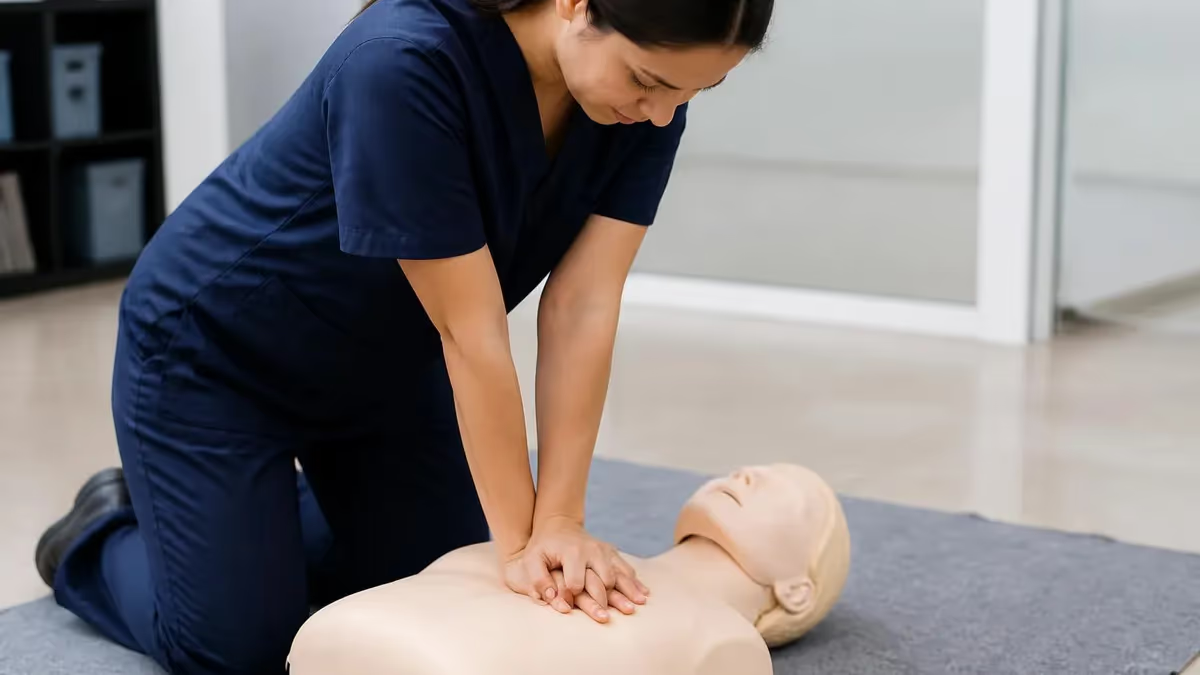
The cpr compression ratio is the foundational rhythm that decides whether a cardiac arrest victim survives or slips away in those first critical minutes. It refers to the precise number of chest compressions a rescuer delivers between rescue breaths, and the exact value changes based on the victim's age, the number of rescuers present, and whether an advanced airway has been placed. Understanding this ratio is not optional knowledge — it is the heartbeat of every certified resuscitation course offered in the United States today.
For most adults experiencing sudden cardiac arrest, the universally accepted ratio is 30 compressions to 2 breaths, delivered at a rate of 100 to 120 compressions per minute. This single-rescuer standard has been validated by the American Heart Association across more than two decades of resuscitation science and remains the cornerstone of the acls algorithm taught in hospitals and certification centers nationwide. The simplicity of 30:2 makes it memorable, but the precision required to execute it correctly demands real practice.
Children and infants follow different rules because their physiology, oxygen demand, and likely cause of arrest differ from adults. A single rescuer still uses 30:2 for pediatric victims, but two trained rescuers switch to 15:2 to deliver more frequent ventilations. This subtle but critical distinction reflects the reality that most pediatric arrests stem from respiratory failure rather than primary cardiac events, making oxygenation more urgent than in typical adult scenarios.
The compression ratio also shifts dramatically once an advanced airway — such as an endotracheal tube or supraglottic device — is in place. At that point, compressions become continuous and uninterrupted at 100 to 120 per minute, while ventilations are delivered separately at one breath every six seconds. This change eliminates the pauses that reduce coronary perfusion pressure, which is the single biggest predictor of return of spontaneous circulation.
Many learners confuse compression ratio with compression rate, but they are two different measurements working together. The ratio governs how compressions and breaths are interleaved, while the rate controls the tempo of compressions themselves. Both must align perfectly for blood to circulate effectively and for oxygen to reach the brain within the four-to-six-minute window before irreversible neurological damage begins.
This guide breaks down every compression ratio scenario taught in modern Basic Life Support, Advanced Cardiovascular Life Support, and pediatric resuscitation courses. We will examine the science behind each ratio, the common mistakes that compromise survival, and the practical drills you can use to lock the rhythm into muscle memory. Whether you are a first-time student or a renewing professional, the numbers below could one day save a life on a sidewalk, in a classroom, or beside a hospital bed.
CPR Compression Ratio by the Numbers

Compression Ratios by Age Group and Rescuer Count
Deliver 30 chest compressions followed by 2 rescue breaths at a rate of 100-120 per minute. Compress at least 2 inches deep, allowing full chest recoil between each compression for maximum venous return.
Maintain the same 30:2 ratio but switch compressors every 2 minutes or every 5 cycles to prevent fatigue-related quality loss. The second rescuer manages the airway and delivers breaths.
Use 30:2 for children ages 1 to puberty with one hand or two depending on body size. Compress about 2 inches deep — roughly one-third the depth of the chest cavity.
Switch to 15:2 because pediatric arrests are usually respiratory. More frequent ventilations restore oxygen faster. Use two-thumb encircling technique for infants when two rescuers are present.
Stop cycle-based ratios entirely. Deliver continuous compressions at 100-120 per minute while a separate rescuer ventilates once every 6 seconds (10 breaths per minute) without pausing compressions.
The reason the cpr compression ratio matters so much comes down to a concept called coronary perfusion pressure, the force that pushes oxygenated blood through the heart's own arteries during cardiac arrest. Every time compressions pause — even for a breath — that pressure drops nearly to zero and must be rebuilt from scratch. The 30:2 standard was specifically engineered to maximize compression time while still allowing meaningful oxygenation, balancing two competing physiological demands within the same minute of resuscitation.
Research from the national cpr foundation and parallel American Heart Association studies consistently shows that survival to hospital discharge nearly doubles when rescuers maintain the correct ratio compared to those who deliver too many or too few breaths. Over-ventilation is one of the most common errors in lay-rescuer CPR, and it actively reduces blood flow by raising intrathoracic pressure. Sticking to exactly two breaths per 30 compressions prevents this dangerous physiological cascade from undermining your effort.
The ratio also has a psychological function: it gives rescuers a countable rhythm in a chaotic emergency. Counting aloud — "one, two, three…" up to thirty — anchors attention, prevents panic, and creates a shared cadence between multiple rescuers. Without that structure, even trained professionals tend to drift toward shallow, fast, or interrupted compressions that fail to perfuse vital organs effectively during the first crucial minutes of arrest.
Compression ratio is also tied to the chain of survival in measurable ways. Bystander CPR delivered at the correct ratio increases the likelihood that defibrillation, advanced care, and post-arrest hospital interventions will succeed. The downstream benefit is enormous: every minute of high-quality CPR roughly doubles the chance that an automated external defibrillator shock will restore a viable rhythm when emergency medical services finally arrive on scene.
For healthcare professionals pursuing pals certification or BLS renewal, mastering ratio changes is non-negotiable. Pediatric advanced life support exams specifically test the transition from 30:2 to 15:2 once a second rescuer arrives, and ACLS exams require fluency in continuous-compression CPR after airway placement. Examiners deliberately design scenarios where the candidate must announce the ratio change verbally to demonstrate competency under cognitive load and time pressure during simulation.
Finally, the ratio matters because it scales with the most likely cause of arrest. Adult arrests are usually cardiac in origin, so compressions take priority. Pediatric arrests are usually respiratory, so breaths come more frequently. Drowning, drug overdose, and asphyxiation victims of any age benefit from added ventilations because hypoxia — not arrhythmia — caused the collapse, and oxygen delivery is the limiting factor in their recovery from the very first cycle.
CPR Practice Test Questions
Prepare for the CPR Cardiopulmonary Resuscitation Practice exam with our free practice test modules. Each quiz covers key topics to help you pass on your first try.
CPR Basic CPR
CPR Exam Questions covering Basic CPR. Master CPR Test concepts for certification prep.
CPR and First Aid
Free CPR Practice Test featuring and First Aid. Improve your CPR Exam score with mock test prep.
CPR (Cardiopulmonary Resuscitation) Adult ...
CPR Mock Exam on (Cardiopulmonary Resuscitation) Adult CPR and AED Usage. CPR Study Guide questions to pass on your first try.
CPR (Cardiopulmonary Resuscitation) Airway...
CPR Test Prep for (Cardiopulmonary Resuscitation) Airway Obstruction and Choking. Practice CPR Quiz questions and boost your score.
CPR (Cardiopulmonary Resuscitation) Cardio...
CPR Questions and Answers on (Cardiopulmonary Resuscitation) Cardiopulmonary Emergency Recognition. Free CPR practice for exam readiness.
CPR (Cardiopulmonary Resuscitation) Child ...
CPR Mock Test covering (Cardiopulmonary Resuscitation) Child and Infant CPR. Online CPR Test practice with instant feedback.
CPR (Cardiopulmonary Resuscitation) High-P...
Free CPR Quiz on (Cardiopulmonary Resuscitation) High-Performance Team Dynamics. CPR Exam prep questions with detailed explanations.
CPR (Cardiopulmonary Resuscitation) Legal ...
CPR Practice Questions for (Cardiopulmonary Resuscitation) Legal and Ethical Considerations. Build confidence for your CPR certification exam.
CPR for Specific Populations
CPR Test Online for for Specific Populations. Free practice with instant results and feedback.
CPR Airway & Breathing Management
CPR Exam Questions covering Airway & Breathing Management. Master CPR Test concepts for certification prep.
CPR Assessment & Recognition of Cardiac Ar...
Free CPR Practice Test featuring Assessment & Recognition of Cardiac Arrest. Improve your CPR Exam score with mock test prep.
CPR Chest Compressions & Defibrillation
CPR Mock Exam on Chest Compressions & Defibrillation. CPR Study Guide questions to pass on your first try.
CPR Post-Resuscitation Care & Recovery
CPR Test Prep for Post-Resuscitation Care & Recovery. Practice CPR Quiz questions and boost your score.
ACLS Algorithm and Compression Ratio Changes
During the initial phase of the acls algorithm, the team uses the standard 30:2 ratio with a bag-valve-mask. The compressor delivers 30 chest compressions at 100-120 per minute, pauses briefly, and the airway manager delivers 2 breaths over one second each. This phase typically continues for the first one to two cycles while the team prepares intubation equipment and confirms IV or IO access for medication delivery.
During this stage, minimizing the pause for breaths is critical. The American Heart Association recommends keeping any compression interruption to under 10 seconds. Rescuers should be ready to resume compressions instantly after the second breath, and the team leader should verbally call out compression depth and rate corrections as needed. Effective communication keeps the ratio sharp throughout this transitional period of resuscitation.

Strict 30:2 Ratio — Strengths and Limitations
- +Easy to remember and count aloud under stress
- +Balances compressions with adequate oxygenation
- +Universally taught across BLS, ACLS, and CPR certifications
- +Works for lay rescuers with minimal training
- +Maintains coronary perfusion pressure effectively
- +Standardized across hospitals, EMS, and bystander CPR programs
- −Pauses for breaths reduce blood flow temporarily
- −Inexperienced rescuers often over-ventilate during breath phase
- −Counting can be disrupted by environmental noise or panic
- −Not optimal once an advanced airway is in place
- −Requires switching to 15:2 with two pediatric rescuers
- −May delay defibrillation if not coordinated with AED use
High-Quality CPR Compression Ratio Checklist
- ✓Confirm scene safety and unresponsiveness before starting compressions
- ✓Place the heel of your hand on the lower half of the sternum
- ✓Compress at least 2 inches deep for adults, one-third chest depth for children
- ✓Maintain a rate of 100 to 120 compressions per minute
- ✓Deliver exactly 2 rescue breaths after every 30 compressions for single-rescuer CPR
- ✓Allow full chest recoil between each compression to maximize venous return
- ✓Minimize compression interruptions to under 10 seconds during breath delivery
- ✓Switch compressors every 2 minutes or 5 cycles to prevent fatigue-induced quality loss
- ✓Switch to 15:2 ratio when a second rescuer joins for pediatric CPR
- ✓Transition to continuous compressions once an advanced airway is confirmed in place
Why rotating compressors every two minutes saves lives
Studies show compression quality drops measurably after just 60 seconds of continuous effort, even though rescuers rarely notice their own fatigue. Switching compressors every 2 minutes — coordinated with rhythm checks — keeps depth, rate, and recoil consistent throughout the resuscitation, dramatically improving the likelihood of return of spontaneous circulation and meaningful neurological recovery for the patient.
Infant cpr and child CPR follow the same core compression ratio philosophy as adult CPR, but the technique, depth, and breath frequency change in important ways. For infants under one year of age, single rescuers use 30:2 with two fingers placed just below the nipple line, compressing about 1.5 inches deep. When two trained rescuers are present, the ratio becomes 15:2 and the technique shifts to the two-thumb encircling method, which produces deeper, more consistent compressions than the two-finger technique alone.
For children between one year and puberty, the rescuer uses one hand for smaller children and two hands for larger ones, just like adult CPR. The single-rescuer ratio remains 30:2, and the two-rescuer ratio is 15:2. Depth is approximately 2 inches or about one-third the anteroposterior diameter of the chest. The rate stays at 100 to 120 compressions per minute, identical to adult and infant rates, because that cadence optimizes cardiac output across all ages.
The reason pediatric ratios prioritize more frequent breaths is rooted in cause. Adults usually arrest from primary cardiac events like ventricular fibrillation, where compressions and rapid defibrillation matter most. Children typically arrest from progressive respiratory failure — drowning, asthma, foreign body aspiration, severe pneumonia. In these cases, hypoxia drives the arrest, so restoring oxygen quickly through more frequent ventilations directly addresses the underlying mechanism that caused the cardiopulmonary collapse in the first place.
Respiratory rate during pediatric rescue breathing is another area where students often stumble. The recommended ventilation rate during ratio-based CPR is whatever fits naturally into 15:2 or 30:2 cycles. Once an advanced airway is placed, however, the rate becomes one breath every 2 to 3 seconds — faster than the adult rate of every 6 seconds — to match the higher metabolic oxygen demand of pediatric patients. Each breath should produce visible chest rise without forceful over-inflation.
Position recovery is also part of pediatric resuscitation, but only after return of spontaneous circulation. If a child or infant regains a pulse and adequate breathing, place them on their side in the recovery position to protect the airway from aspiration while monitoring continuously. Never use the recovery position during active arrest — compressions and ventilations take absolute priority, and any pause to reposition wastes valuable perfusion time that the brain cannot afford to lose.
Finally, AED use changes slightly in pediatric CPR. Pediatric pads or a pediatric dose attenuator should be used for children under 8 years old when available, but standard adult pads can be used if pediatric pads are unavailable. The compression ratio does not change when an AED is attached — you continue 30:2 or 15:2 between shocks, resuming compressions immediately after each defibrillation attempt to maintain coronary and cerebral perfusion throughout the resuscitation.

The three most dangerous errors are over-ventilation (giving more than 2 breaths per cycle), shallow compressions (less than 2 inches in adults), and excessive interruption time during breath delivery. Each of these mistakes drops coronary perfusion pressure and measurably reduces the chance of return of spontaneous circulation. Counting aloud and using a metronome app helps prevent all three errors.
Real-world application of the cpr compression ratio looks very different from the clean simulations performed during classroom training. On a hard floor with bright fluorescent lighting and an instructor watching, hitting 30:2 at 110 compressions per minute feels straightforward. In a real emergency — in a cramped bathroom, on a soft mattress, with a panicking family member screaming nearby — the same rescuer often loses count, compresses too shallowly, or pauses too long between cycles without realizing it during the unfolding crisis.
One of the most effective drills for cementing ratio accuracy is the metronome drill. Set a free metronome app to 110 beats per minute, place a manikin on the floor, and practice 30:2 cycles for a full 10 minutes without stopping. This builds both the muscle memory and the cardiovascular endurance needed for real resuscitation. Most students are shocked at how quickly fatigue sets in — usually within the first three minutes of continuous high-quality compressions on a properly weighted training manikin.
Another useful technique is to pair compressions with a familiar song that has a known tempo around 100 to 120 beats per minute. Classic options include "Stayin' Alive" by the Bee Gees and "Another One Bites the Dust" by Queen. These songs anchor the rate without requiring conscious counting, freeing your attention for depth, recoil, and breath delivery during real emergencies when cognitive load is highest and panic can derail otherwise well-trained rescuers very quickly.
Life support training also emphasizes verbal communication during multi-rescuer scenarios. The compressor should announce each set of 30 — "twenty-eight, twenty-nine, thirty" — and the airway manager should respond with "breath one, breath two" while delivering ventilations. This call-and-response pattern prevents missed beats, accidental over-ventilation, and accidental triple-breath errors that occur when two rescuers lose synchronization during the chaos of a real cardiac arrest event in any clinical environment.
If you are pursuing certification through the American Heart Association, Red Cross, or national cpr foundation, expect skills-test examiners to evaluate ratio precision with a CPR feedback manikin that measures depth, rate, recoil, and interruption time digitally. Pass scores typically require 75 to 80 percent compliance across all four metrics. Practicing with these manikins before testing day eliminates the surprise of seeing real-time feedback and dramatically improves your first-attempt pass rate during the practical evaluation portion of certification.
One final practical tip: in a true emergency, hands-only CPR — continuous compressions at 100-120 per minute with no rescue breaths — is acceptable and even encouraged for untrained or hesitant bystanders during adult cardiac arrest. The cpr compression ratio of 30:2 is the gold standard for trained rescuers, but compressions alone are vastly better than nothing. Never let uncertainty about the ratio prevent you from acting when seconds matter most for a collapsed victim awaiting professional help.
Final preparation for any CPR certification or recertification exam should focus on three layers of mastery: knowing the ratios, executing them under pressure, and adapting them when the scenario changes. Begin by memorizing the four core ratios — 30:2 for adult single rescuer, 30:2 for pediatric single rescuer, 15:2 for pediatric two-rescuer, and continuous compressions with one breath every 6 seconds after advanced airway placement. These four numbers cover roughly 90 percent of exam questions and clinical encounters.
Next, layer in the supporting metrics: compression rate of 100 to 120 per minute, adult depth of at least 2 inches, pediatric depth of one-third chest diameter, full chest recoil between compressions, and interruption time of less than 10 seconds. Write these on a single index card and review it daily for two weeks before your skills test. Consistency of review beats marathon study sessions every time during certification preparation across all major resuscitation training pathways.
Practice scenario-based thinking with a study partner. Have them describe a situation — "adult collapses at the gym, you are alone" or "toddler found unresponsive in pool, lifeguard is helping" — and respond verbally with the correct ratio, rate, depth, and next steps. This builds the rapid pattern recognition examiners look for during oral testing and the kind of fast decision-making real cardiac arrests demand when there is absolutely no time to consult a textbook or app.
Avoid the common trap of confusing CPR-related acronyms with unrelated brands. Stick to verified medical sources like the American Heart Association, American Red Cross, and accredited certification providers when studying ratios, depths, and rates. Cross-check any online information against current 2025-2026 AHA guidelines before relying on it for exam preparation.
If you are preparing for advanced certifications like pals certification or ACLS, dedicate extra time to ratio transitions. Examiners specifically design scenarios where you must verbally announce the ratio change from 30:2 to 15:2 when a second rescuer arrives, or from cycle-based CPR to continuous compressions when an airway is placed. Practicing these transitions aloud in front of a mirror or recording yourself eliminates hesitation during the actual practical test.
On exam day, arrive early, eat a light meal, and bring a water bottle. Skills tests are physically demanding — performing 10 minutes of high-quality compressions raises your heart rate significantly. Wear comfortable clothing that allows full shoulder and arm movement. If you feel fatigued mid-test, examiners generally allow a brief pause to reset. Stay calm, count aloud confidently, and trust the muscle memory you have built through deliberate, repeated practice on manikins and simulation devices.
Finally, remember that certification is just the beginning. The cpr compression ratio you memorize today is meant to be deployed years from now in a moment you cannot predict. Refresh your skills every six months, even between renewal cycles, using free online refreshers and manikin practice when possible. Resuscitation skills decay quickly without reinforcement, and the difference between a confident bystander and a hesitant one is often measured in lives saved on scene before EMS arrives.
CPR Questions and Answers

CPR Card Lookup: How to Verify, Replace, and Access Your CPR Certification in 2026
AHA CPR: What It Is, Which Course You Need, and How to Get Certified

Adult CPR: Complete Step-by-Step Guide to Hands-Only and Standard CPR in 2026

CPR - Cardiopulmonary Resuscitation: Complete Study Guide 2026
Inappropriate CPR Songs: What Not to Play, Why It Matters, and Better Beat-Per-Minute Alternatives
About the Author

Registered Nurse & Healthcare Educator
Johns Hopkins University School of NursingDr. Sarah Mitchell is a board-certified registered nurse with over 15 years of clinical and academic experience. She completed her PhD in Nursing Science at Johns Hopkins University and has taught NCLEX preparation and clinical skills courses for nursing students across the United States. Her research focuses on evidence-based exam preparation strategies for healthcare certification candidates.
Join the Discussion
Connect with other students preparing for this exam. Share tips, ask questions, and get advice from people who have been there.
View discussion (5 replies)