
Pediatric CPR: Complete 2026 October Guide to Infant and Child Resuscitation
📚 Master pediatric CPR with our 2026 October guide covering infant CPR, child compressions, AED use, and the acls algorithm. Includes free practice quizzes.
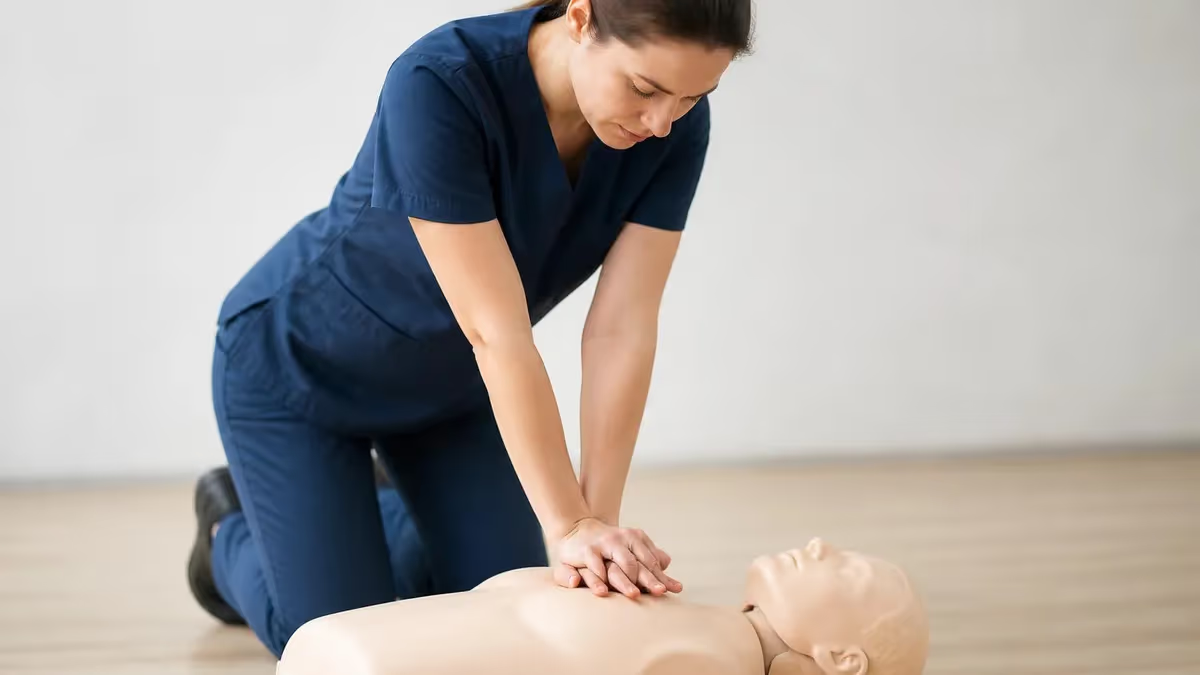
Pediatric CPR is a specialized lifesaving skill that every parent, caregiver, teacher, coach, and healthcare provider should master because children are not just small adults. Their airways are narrower, their bones more pliable, and their physiology responds differently to cardiac emergencies than adults do. Roughly 7,000 children experience out-of-hospital cardiac arrest in the United States each year, and survival rates climb dramatically when a bystander begins compressions before EMS arrives. This guide walks you through the complete 2026 protocols for infants under one year and children up to puberty.
Unlike adult arrest, which usually stems from a primary cardiac event, pediatric arrest is most often secondary to respiratory failure, drowning, choking, or trauma. That distinction matters because it shapes the entire resuscitation approach. The American Heart Association emphasizes high-quality ventilations alongside compressions for pediatric victims, and understanding the difference between primary cardiac and respiratory causes helps you understand heart attack vs cardiac arrest in the context of pediatric patients.
The compression depth, hand placement, ventilation rate, and compression-to-ventilation ratio all change depending on whether you are working on an infant, a child, or an adolescent who has reached puberty. Getting these details right can be the difference between a meaningful neurological recovery and a tragic outcome. Pediatric CPR also requires you to remain calm enough to communicate with terrified parents while you work, which is an emotional skill rarely taught in standard courses.
This article covers everything from initial scene assessment through advanced life support handoff. You will learn the two-finger and two-thumb encircling techniques for infant compressions, the one-hand versus two-hand methods for children, when to use an AED with pediatric pads, how to recognize agonal breathing, and how to integrate the acls algorithm when shockable rhythms appear. We also cover the recovery position, choking response, and post-resuscitation care.
Whether you are pursuing pals certification, refreshing skills before a babysitting job, or preparing for a clinical rotation, the information here matches current AHA, Red Cross, and national cpr foundation guidelines. We have included real numbers, common mistakes, and the latest 2026 protocol updates that emerged after the most recent ILCOR evidence review. Each section builds on the last, so even readers with no medical background can follow along.
Pediatric arrest is rare in everyday life, which is precisely why preparation matters. Most people who perform pediatric CPR will do it once in their lifetime, often on a child they love. The minutes between collapse and ambulance arrival are the ones that determine outcome, and those minutes belong entirely to the bystander. The goal of this guide is to make you that confident, competent bystander who knows exactly what to do.
By the end of this article you will understand age-based technique differences, AED considerations, two-rescuer dynamics, and the emotional dimension of pediatric resuscitation. You will also have access to free practice quizzes that mirror the questions on actual certification exams, so you can test your knowledge before walking into a classroom or clinical setting.
Pediatric CPR by the Numbers
Age Categories and Technique Differences
For infants, use two fingers just below the nipple line for single rescuer, or the two-thumb encircling technique for two rescuers. Compression depth is 1.5 inches, about one-third the chest depth. Cover both nose and mouth for ventilations.
Use one or two hands on the lower half of the sternum, whichever achieves 2-inch compression depth. Pinch the nose and seal the mouth for rescue breaths. Avoid hyperextending the neck on small children with floppy airways.
Treat as adults: two hands stacked on the lower sternum, 2 to 2.4 inches deep, 30:2 ratio regardless of rescuer count. Signs of puberty include breast development in girls and underarm hair in boys, not strict age cutoffs.
Neonatal resuscitation uses a 3:1 compression-to-ventilation ratio with 90 compressions and 30 breaths per minute. This is a distinct protocol from infant CPR and is taught in NRP rather than standard pediatric BLS courses.
Compressions are the engine of any resuscitation, and pediatric compressions demand precision because the margin for error is so small. For infants, place two fingers on the breastbone just below an imaginary line connecting the nipples and press straight down approximately 1.5 inches, or about one-third the depth of the chest. The two-thumb encircling technique, used by two trained rescuers, generates higher coronary perfusion pressure and is now the preferred method in hospital settings. Allow full chest recoil between every compression.
For children between one year and puberty, place the heel of one hand on the lower half of the sternum. If the child is large or you are smaller, use two hands stacked as you would on an adult. The target depth is 2 inches, again about one-third the chest depth, never exceeding 2.4 inches. Compression rate stays at 100 to 120 per minute for every age group, matching the cadence of the song Stayin Alive. Maintaining this rate while delivering effective breaths is harder than it sounds.
Ventilations are uniquely critical in pediatric arrest because most events are caused by hypoxia. For infants, seal your mouth over both their nose and mouth and deliver a gentle puff just large enough to make the chest visibly rise, about one second per breath. For children, pinch the nose and form a tight seal over the mouth. Overinflating causes gastric distension, which pushes against the diaphragm and worsens ventilation while increasing aspiration risk.
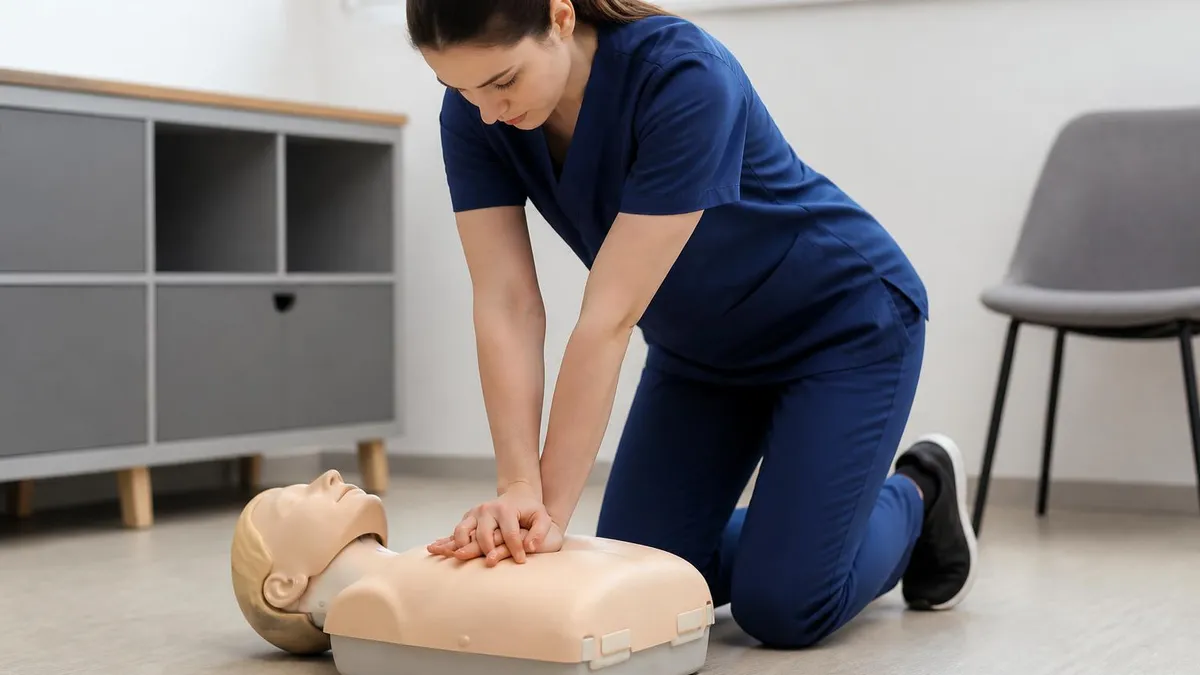
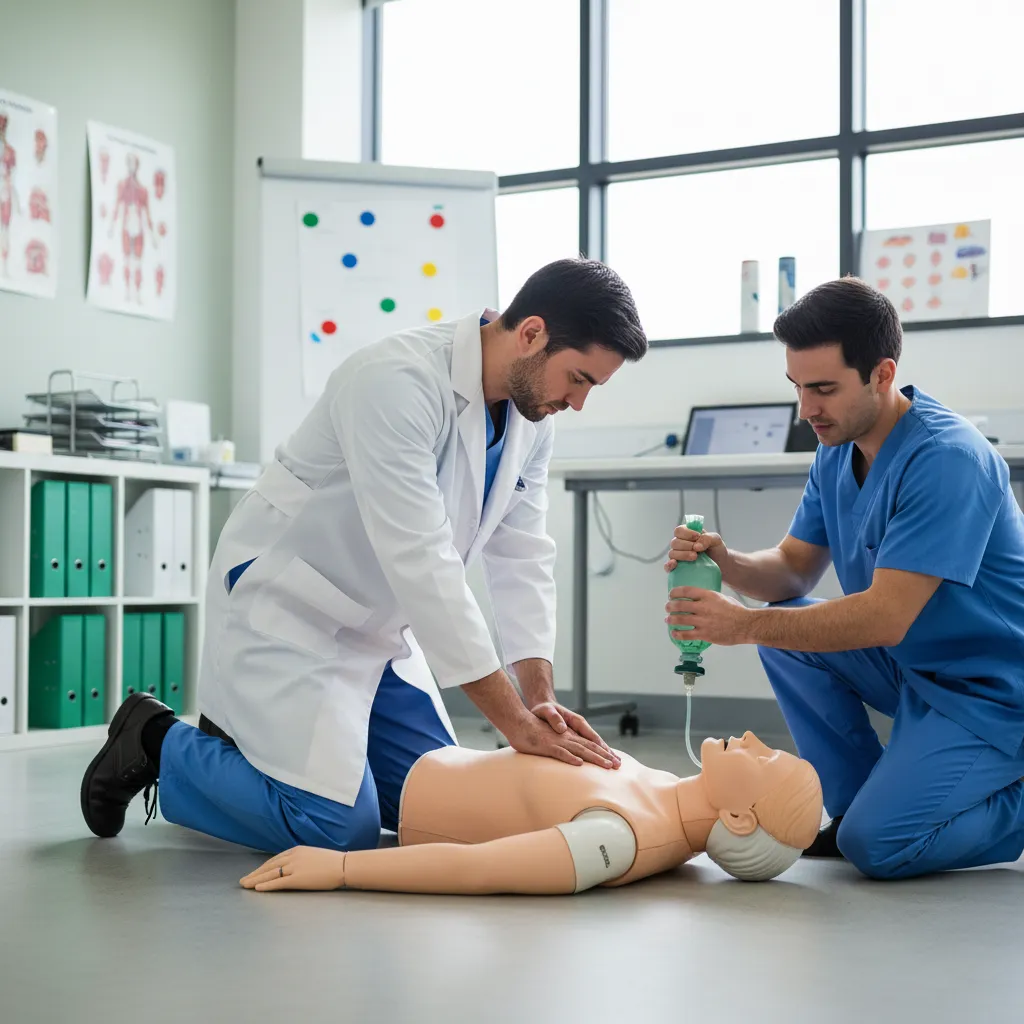
The compression-to-ventilation ratio shifts based on how many rescuers are present. A single rescuer uses 30:2 for all ages, mirroring adult CPR. Two rescuers switch to 15:2 for infants and children, recognizing that more frequent breaths matter when respiratory failure caused the arrest. This is one of the most tested concepts on certification exams and one of the most commonly mixed up in real emergencies. Practice it on a manikin if you can.
The respiratory rate after advanced airway placement changes again. Once an endotracheal tube or supraglottic airway is in place, compressions become continuous and ventilations are delivered asynchronously at one breath every 2 to 3 seconds, which equals 20 to 30 breaths per minute. This 2026 update from AHA replaced the older 6-second interval to better match physiologic needs. Track the rate with a metronome or timer to avoid hyperventilation, which reduces cerebral blood flow.
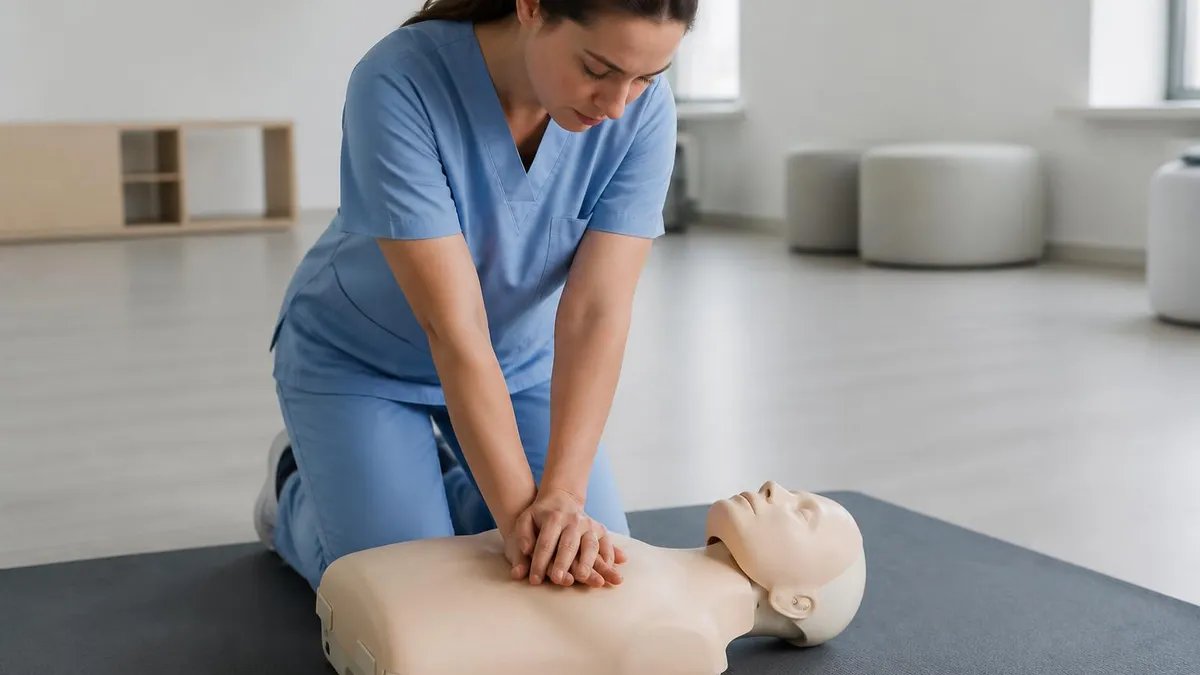
Recoil is the silent killer of pediatric CPR quality. Rescuers tense their arms and lean on the chest between compressions, preventing the heart from refilling. This drops cardiac output by as much as 25 percent. Lift your palms slightly off the chest at the top of each upstroke without losing hand position. Many manikins now provide real-time feedback on recoil, and even pocket-sized CPR coaches can keep your technique honest during a real arrest.
Switching compressors every two minutes maintains quality because fatigue degrades depth and rate within just 90 seconds, even though rescuers rarely feel tired. If you are alone, you cannot switch, so focus on maintaining tempo and depth as long as possible. Resources like baby cpr hybrid courses now offer at-home manikin kits that build the muscle memory needed for sustained, high-quality compressions.

CPR Practice Test Questions
Prepare for the CPR Cardiopulmonary Resuscitation Practice exam with our free practice test modules. Each quiz covers key topics to help you pass on your first try.
CPR Basic CPR
CPR Exam Questions covering Basic CPR. Master CPR Test concepts for certification prep.
CPR and First Aid
Free CPR Practice Test featuring and First Aid. Improve your CPR Exam score with mock test prep.
CPR (Cardiopulmonary Resuscitation) Adult ...
CPR Mock Exam on (Cardiopulmonary Resuscitation) Adult CPR and AED Usage. CPR Study Guide questions to pass on your first try.
CPR (Cardiopulmonary Resuscitation) Airway...
CPR Test Prep for (Cardiopulmonary Resuscitation) Airway Obstruction and Choking. Practice CPR Quiz questions and boost your score.
CPR (Cardiopulmonary Resuscitation) Cardio...
CPR Questions and Answers on (Cardiopulmonary Resuscitation) Cardiopulmonary Emergency Recognition. Free CPR practice for exam readiness.
CPR (Cardiopulmonary Resuscitation) Child ...
CPR Mock Test covering (Cardiopulmonary Resuscitation) Child and Infant CPR. Online CPR Test practice with instant feedback.
CPR (Cardiopulmonary Resuscitation) High-P...
Free CPR Quiz on (Cardiopulmonary Resuscitation) High-Performance Team Dynamics. CPR Exam prep questions with detailed explanations.
CPR (Cardiopulmonary Resuscitation) Legal ...
CPR Practice Questions for (Cardiopulmonary Resuscitation) Legal and Ethical Considerations. Build confidence for your CPR certification exam.
CPR for Specific Populations
CPR Test Online for for Specific Populations. Free practice with instant results and feedback.
CPR Airway & Breathing Management
CPR Exam Questions covering Airway & Breathing Management. Master CPR Test concepts for certification prep.
CPR Assessment & Recognition of Cardiac Ar...
Free CPR Practice Test featuring Assessment & Recognition of Cardiac Arrest. Improve your CPR Exam score with mock test prep.
CPR Chest Compressions & Defibrillation
CPR Mock Exam on Chest Compressions & Defibrillation. CPR Study Guide questions to pass on your first try.
CPR Post-Resuscitation Care & Recovery
CPR Test Prep for Post-Resuscitation Care & Recovery. Practice CPR Quiz questions and boost your score.
AED Use and the ACLS Algorithm in Pediatrics
The acls algorithm guides advanced providers, but the AED is the bystander's most powerful tool. Many people ask what does aed stand for: automated external defibrillator. For children 1 to 8 years or under 55 pounds, use pediatric pads with a dose attenuator that reduces energy delivery. If pediatric pads are unavailable, adult pads are acceptable and recommended over withholding shocks, but place one pad on the chest and the other on the back to prevent overlap.
For infants under one year, a manual defibrillator operated by a trained provider is preferred. If only an AED is available, use one with a pediatric attenuator. Never delay defibrillation searching for the perfect device. The chance of survival drops 7 to 10 percent for every minute defibrillation is delayed in a shockable rhythm. Turn the AED on, follow the voice prompts, and resume compressions immediately after each shock or no-shock advisory.
Single Rescuer vs Two Rescuer Pediatric CPR
- +Two rescuers can maintain higher compression quality through 2-minute switches
- +Two-thumb encircling technique generates better coronary perfusion in infants
- +One rescuer can manage airway while the other compresses
- +Faster AED application without interrupting compressions
- +Less rescuer fatigue means more consistent depth and rate
- +Ratio shifts to 15:2 allowing more frequent ventilations
- +Better real-time coaching and quality monitoring between providers
- −Single rescuer must alternate compressions and breaths alone
- −30:2 ratio means fewer ventilations per minute when alone
- −Greater fatigue degrades quality within 90 seconds
- −Cannot effectively use bag-valve-mask without a partner
- −Difficult to call 911 and perform CPR simultaneously
- −No one to retrieve and operate the AED quickly
- −Higher cognitive load increases risk of protocol errors
Pros and Cons at a Glance
| Pros | Cons |
|---|---|
| Two-thumb encircling technique generates better coronary perfusion in infants | Single rescuer must alternate compressions and breaths alone |
| One rescuer can manage airway while the other compresses | Cannot effectively use bag-valve-mask without a partner |
| Faster AED application without interrupting compressions | No one to retrieve and operate the AED quickly |
| Less rescuer fatigue means more consistent depth and rate | Higher cognitive load increases risk of protocol errors |

Pediatric CPR Skills Checklist
- ✓Verify scene safety before approaching the child or infant
- ✓Check responsiveness by tapping shoulders or flicking foot soles on infants
- ✓Call 911 and request an AED, or send a bystander to do both
- ✓Check for breathing and a pulse for no more than 10 seconds
- ✓Begin compressions immediately if no pulse or only agonal gasps
- ✓Use correct hand placement for age: two fingers, one hand, or two hands
- ✓Compress to one-third chest depth at 100-120 per minute with full recoil
- ✓Open the airway with head-tilt chin-lift unless trauma is suspected
- ✓Deliver rescue breaths that make the chest visibly rise
- ✓Attach AED with pediatric pads as soon as it arrives and follow prompts
Hypoxia Drives Most Pediatric Arrests
Unlike adults, where sudden cardiac events dominate, more than 80 percent of pediatric arrests are secondary to respiratory failure. This means high-quality ventilations are not optional. Every effective breath that makes the chest rise can restore oxygenation faster than compressions alone, especially in drowning, choking, and asthma scenarios.
Special situations are where rote training meets reality. Choking is the most common pediatric emergency that escalates to CPR, and recognizing the difference between a mild and severe obstruction determines your response. A child who can cough forcefully, cry, or speak has a partial obstruction and needs encouragement to keep coughing. Intervening too aggressively in a mild obstruction can convert it into a complete one. Stand by, monitor closely, and call for help if the cough weakens.
A complete obstruction is silent because no air moves. The child cannot cry, cough, or speak. For children over one year, deliver up to five abdominal thrusts above the navel and below the ribcage until the object dislodges or the child becomes unresponsive. For infants, alternate five back blows between the shoulder blades with five chest thrusts using two fingers on the breastbone. Never perform abdominal thrusts on an infant because their liver position makes serious internal injury likely.
If the child becomes unresponsive during a choking episode, lower them gently to the ground and begin CPR starting with chest compressions. Before each set of ventilations, look inside the mouth for the object and remove it only if visible. Never perform a blind finger sweep because you can push the obstruction deeper. This sequence, sometimes called CPR with airway check, is a critical skill tested on every certification exam.
Drowning is another high-stakes pediatric scenario. Begin with five rescue breaths before starting compressions because the underlying problem is profound hypoxia. After the initial breaths, switch to standard 30:2 or 15:2 CPR. Continue resuscitation efforts longer than you would for an adult cardiac arrest because cold water drownings have produced remarkable neurological recoveries even after 30 minutes of submersion, particularly in young children.
Sudden infant death syndrome and apparent life-threatening events require immediate CPR even when the infant looks peaceful and pink. Do not assume the baby is sleeping. Tap the foot, call their name, and check for breathing for no more than 10 seconds. If unsure, begin CPR. Erring on the side of resuscitation has no downside, while waiting to be certain costs irreplaceable seconds.
Trauma adds layers of complexity. Maintain cervical spine stabilization with a jaw thrust rather than head-tilt chin-lift if you suspect a neck injury. Control catastrophic bleeding before compressions if blood loss caused the arrest. For penetrating chest trauma, the heart may not respond to compressions until the underlying injury is addressed, so transport priority becomes critical. Resources like the leather cpr video library demonstrate these advanced scenarios in slow motion.
Anaphylaxis can cause pediatric arrest within minutes of exposure. If you have access to an epinephrine auto-injector and recognize the signs, use it immediately, even during CPR. Epinephrine is the only definitive treatment for anaphylactic shock, and CPR alone cannot reverse the cascading airway swelling and vascular collapse. Always carry the appropriate dose for the child's weight if they have known allergies.
The position recovery, also called the lateral recovery position, is reserved for unresponsive patients who are breathing normally on their own. Never place a non-breathing child in recovery position. If breathing is absent or abnormal, begin CPR immediately. Reassess every two minutes during any wait for EMS.
Certification pathways for pediatric CPR vary depending on your role and goals. The American Heart Association offers Heartsaver Pediatric First Aid CPR AED for laypeople like babysitters, teachers, and parents. This course takes about 4 to 6 hours and provides a 2-year certification card. Healthcare providers complete BLS for Healthcare Providers, which covers adult, child, and infant CPR as well as two-rescuer techniques and bag-valve-mask ventilation. The Red Cross offers equivalent courses with the same recognition.
For advanced practitioners, pals certification is the gold standard. PALS covers systematic assessment, recognition of respiratory and circulatory failure, the acls algorithm adapted for pediatrics, vascular access, and team dynamics. The course runs 14 hours over two days and is required for pediatric emergency nurses, pediatric ICU staff, pediatricians, and emergency physicians. Recertification every two years includes a written exam and skills demonstration with megacode scenarios.
Online and hybrid options have multiplied since the pandemic, and the national cpr foundation offers fully online certification for laypeople. While convenient, purely online courses without hands-on skills verification are not recognized by most employers. Always check with your school, hospital, or workplace before enrolling to ensure the certificate will be accepted. AHA, Red Cross, and Health and Safety Institute certifications carry the broadest recognition.
Cost varies widely. Basic Heartsaver courses run $50 to $90, BLS for Healthcare Providers runs $60 to $100, and PALS runs $200 to $300. Renewal courses are typically half the price and half the time of initial certification. Some employers pay for certification as a condition of employment, and some hospitals offer free internal courses for staff. Always factor in textbook costs, which add $30 to $50 unless included.
The exam itself focuses on protocol details rather than memorization. Expect questions on compression depth by age, ratios for single versus two rescuers, AED pad placement, energy doses, and reversible causes. The questions are scenario-based, asking what you would do next given specific findings. Spending an hour with a free practice quiz before the exam catches most weak spots and builds confidence. Look for sites that offer detailed answer explanations.
Pediatric simulation training has grown rapidly and represents the future of certification. High-fidelity manikins respond to your interventions with physiologic feedback, letting you see the effect of compression depth and ventilation rate in real time. Some programs use virtual reality to simulate chaotic scenes with crying parents and distracting environments. This kind of training closes the gap between classroom skill and real-world performance, where adrenaline and emotion change everything.
Maintaining skills after certification is the hardest part. Studies show CPR proficiency degrades within 3 to 6 months without practice. Brief monthly self-refreshers using YouTube videos or pocket manikins keep skills sharp. Some hospitals require quarterly mock codes for staff. For laypeople, scheduling refresher courses every 6 to 12 months even before the 2-year renewal keeps you ready when an actual emergency demands fast, accurate action without hesitation. The cpr fix phones study guide offers month-by-month review plans.
Practical tips separate competent rescuers from heroic ones, and most of them come from real-world experience rather than textbooks. First, designate roles immediately if more than one person is present. One person performs compressions, one ventilates, one calls 911 and retrieves the AED, and one manages bystanders. Without role clarity, the scene devolves into chaos within 30 seconds. Even strangers can be assigned tasks with a calm, direct voice and pointed finger.
Second, use the floor. Performing CPR on a bed, couch, or car seat compresses the surface instead of the heart, wasting energy and reducing depth. Lower the child to the firmest available surface within arm's reach, even if that means the dirty floor of a public restroom. If they are in a car seat or stroller, remove them quickly. The few seconds spent moving the child are recovered through dramatically better compressions.
Third, talk through what you are doing. Verbalize the compression count, the breath delivery, and the AED prompts. This serves three purposes: it keeps you on tempo, it signals to bystanders that help is being given competently, and it provides clear handoff information to arriving EMS. Saying out loud the time you started CPR, how many cycles you have completed, and any rhythm analyses speeds the transition to paramedic care.
Fourth, do not stop for the parents emotional response. Parents may scream, beg, faint, or interfere. Assign a bystander to support them physically and emotionally while you keep working. If you must address them directly, brief reassurance like helping their child works better than long explanations. Stopping compressions to talk costs lives, and parents universally support your full focus on the child once they later understand why.
Fifth, prepare your environment in advance. Know where the nearest AED is at your school, workplace, gym, or place of worship. Pediatric AED pads should be stocked alongside adult pads in any facility serving children. Verify pad expiration dates twice a year, and ensure battery indicators show green. The AED that saves your child's life is the one whose location and condition you confirmed before the emergency happened.
Sixth, integrate the recovery position into your training. After successful resuscitation, a breathing but unresponsive child should be rolled onto their side with the upper leg bent forward to stabilize them. This position prevents aspiration if they vomit, which is common after cardiac events. Monitor breathing continuously and be ready to flip them back and resume CPR if their condition deteriorates before EMS arrives.
Finally, debrief afterward. Pediatric resuscitations, even successful ones, leave rescuers traumatized. Talk with friends, family, or a counselor about what happened. Many hospitals offer critical incident stress debriefings for staff after pediatric arrests, and similar resources exist for laypeople through Red Cross peer support. The emotional impact is real and lasting, but processing it with support transforms a traumatic memory into the foundation of confidence for future emergencies you may face.
CPR Questions and Answers

About the Author

Registered Nurse & Healthcare Educator
Johns Hopkins University School of NursingDr. Sarah Mitchell is a board-certified registered nurse with over 15 years of clinical and academic experience. She completed her PhD in Nursing Science at Johns Hopkins University and has taught NCLEX preparation and clinical skills courses for nursing students across the United States. Her research focuses on evidence-based exam preparation strategies for healthcare certification candidates.
Join the Discussion
Connect with other students preparing for this exam. Share tips, ask questions, and get advice from people who have been there.
View discussion (5 replies)