
CPR vs BLS: Key Differences, Certification, and Which One You Need 2026 October
CPR vs BLS explained: 💯 key differences, who needs each certification, course costs, exam format, and how to choose the right training for your career.
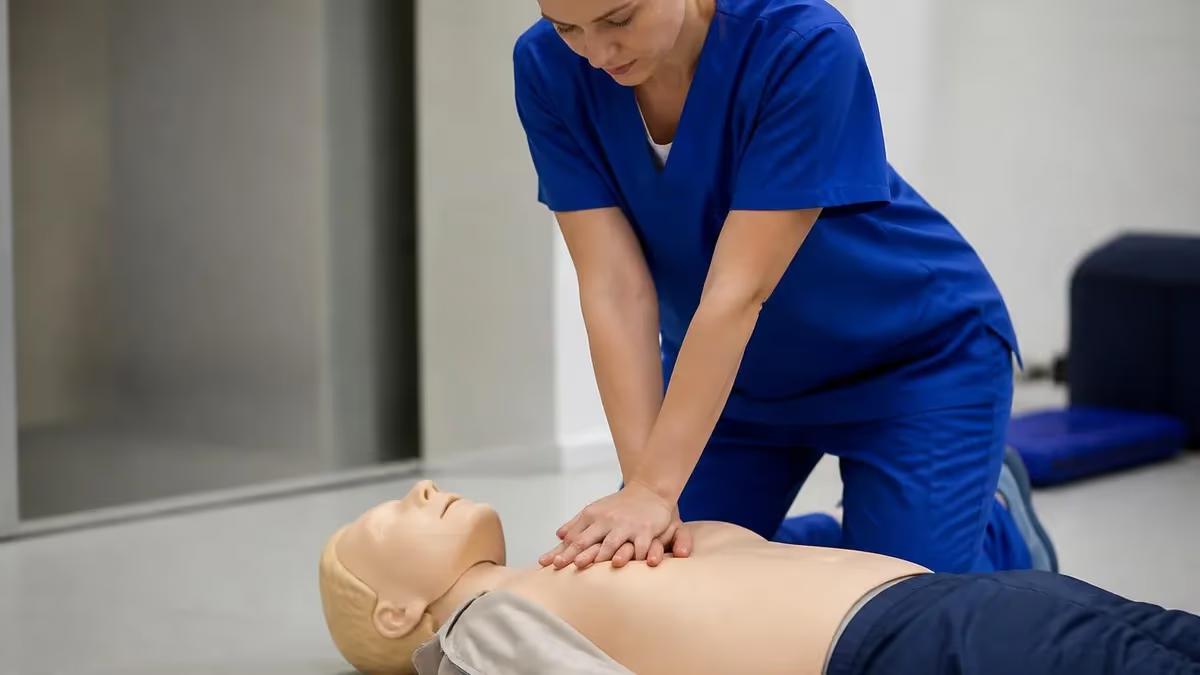
Understanding cpr vs bls is one of the first questions most healthcare students, new nurses, lifeguards, and even concerned parents ask before signing up for a class. Both certifications teach you how to respond to a sudden cardiac arrest, but they are not interchangeable. CPR (cardiopulmonary resuscitation) is the umbrella skill, while BLS (Basic Life Support) is a more advanced, profession-focused version of CPR designed for healthcare providers, first responders, and clinical staff who must perform resuscitation as part of their job.
The confusion is understandable. Both courses cover chest compressions, rescue breathing, and automated external defibrillator (AED) use. Both follow the same American Heart Association (AHA) and Red Cross science guidelines that are updated every five years. Both result in a wallet card that employers ask for. Yet the depth of training, the patient populations covered, the testing rigor, and the price are meaningfully different. Picking the wrong one can mean repeating training within a few months.
Heartsaver CPR (sometimes called CPR/AED for the lay rescuer) is built for people without a clinical background: teachers, coaches, security guards, daycare workers, parents, gym staff, and corporate office volunteers. The pace is slower, the medical terminology is minimal, and the focus is on single-rescuer response in a community setting. You learn what to do until paramedics arrive, then you hand off care.
BLS, on the other hand, is the foundational resuscitation course for the healthcare workforce. Nurses, physicians, medical assistants, respiratory therapists, dental hygienists, paramedics, EMTs, and nursing students are typically required to hold a current BLS card. The course assumes you will work as part of a resuscitation team, communicate using closed-loop commands, recognize cardiac rhythms on a monitor, and integrate seamlessly with advanced cardiac life support (ACLS) providers.
The two courses also differ in how they treat infants and special populations. Lay-rescuer CPR introduces infant compressions and choking briefly, but BLS dives deeper into two-rescuer infant CPR, neonatal considerations, opioid-associated emergencies, and team dynamics. BLS candidates must also pass a written exam with a minimum score of 84 percent in addition to a hands-on skills test, while Heartsaver CPR usually has no written test at all.
Cost and renewal cycles look similar at first glance. Both certifications are valid for two years, and both run roughly $50 to $90 depending on your provider and location. But BLS requires more class time, more practice with bag-valve masks, and instructor sign-off on team-based scenarios. If your employer says "BLS for Healthcare Providers," do not show up with a Heartsaver card — it will not count.
This guide walks through every meaningful difference between the two courses so you can pick correctly the first time. We compare audience, skills, exam format, cost, renewal, and career value, then close with a practical checklist and the questions students ask most often.
CPR vs BLS by the Numbers
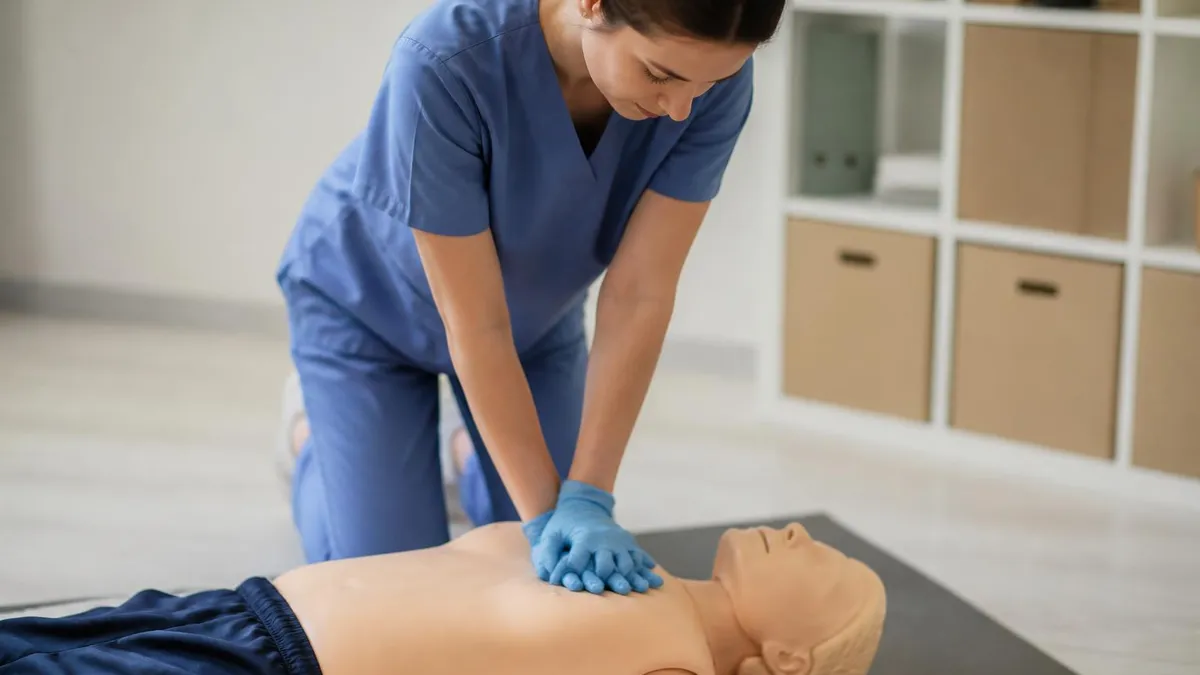
CPR vs BLS at a Glance
Designed for lay rescuers — teachers, coaches, parents, security, fitness staff. Covers adult, child, and infant compressions plus AED use. 2-3 hour course, skills test only, no written exam, $40-$70.
Required for nurses, doctors, EMTs, dental staff, and clinical students. Adds two-rescuer CPR, bag-mask ventilation, team dynamics, and opioid response. 4-hour course, written test plus skills, $60-$90.
Both courses offer a blended option (HeartCode) where you complete online modules first, then a 30-60 minute in-person skills check. Most employers accept blended BLS, but some hospital systems require fully instructor-led.
Both cards expire 24 months from the end of the issue month. Renewal courses are shorter (1-2 hours) but still require a skills test. Letting a BLS card lapse usually means retaking the full course.
The American Heart Association (AHA) and American Red Cross are the two dominant providers in the U.S. AHA cards are most commonly required by hospitals; Red Cross is widely accepted by schools, camps, and corporate employers.
Knowing who actually needs BLS versus standard CPR saves money and headaches. The rule of thumb is simple: if your job description includes the word "clinical," "patient," or "healthcare," you almost certainly need BLS. If you work with the public but not as a medical professional, Heartsaver CPR/AED is usually sufficient. Always confirm with your employer or licensing board before registering, because the wrong card can delay a job start date by weeks.
Nurses are the largest single group of BLS holders in the country. Every state board of nursing requires an active BLS card for licensure renewal in most clinical roles, and hospitals verify it during onboarding. Nursing students must show proof before their first clinical rotation, which is why many schools build a BLS class into the first semester. Travel nurses, agency nurses, and per diem staff often need to maintain BLS continuously to remain assignment-ready.
Physicians, physician assistants, nurse practitioners, dentists, and dental hygienists are also required to hold current BLS, and many add ACLS or PALS on top. Even outpatient providers — dermatologists, ophthalmologists, podiatrists — typically must maintain BLS because state medical boards consider it a baseline competency for licensure. Some specialty boards, like anesthesiology, require BLS as a prerequisite to board certification renewal.
EMTs, paramedics, firefighters, and law enforcement officers fall into a special category. They need BLS as a foundation, but their job training adds layers far beyond the standard course. Many fire departments require BLS plus an additional EMR (Emergency Medical Responder) certification. Lifeguards usually need a hybrid called CPR/AED for the Professional Rescuer, which sits between Heartsaver and BLS in depth.
If you are pursuing a healthcare career and not sure where to start, the CPR certification pathway begins with BLS for almost every clinical role. Skipping straight to BLS, even if you have never taken CPR before, is perfectly normal — BLS instructors assume zero prior knowledge and teach the fundamentals before adding the healthcare-specific skills.
On the other side, teachers, daycare workers, personal trainers, group fitness instructors, coaches, scout leaders, and corporate first-aid team members should choose Heartsaver CPR/AED. OSHA-required workplace responders almost always fall in this category too. Heartsaver is faster, cheaper, and covers the exact scenarios these rescuers will face — collapsed adult at the gym, choking child at lunch, unresponsive infant at daycare.
Parents and grandparents who simply want to be prepared at home do not need BLS. A community CPR/AED class or even a free online refresher from a reputable source gives you the muscle memory to save a loved one. The bystander statistics are sobering: only about 40 percent of out-of-hospital cardiac arrest victims receive CPR before EMS arrives. Any training, formal or informal, doubles or triples survival odds.
CPR Practice Test Questions
Prepare for the CPR - Cardiopulmonary Resuscitation exam with our free practice test modules. Each quiz covers key topics to help you pass on your first try.
CPR Adult CPR
CPR Exam Questions covering Adult CPR. Master CPR Test concepts for certification prep.
CPR AED Use
Free CPR Practice Test featuring AED Use. Improve your CPR Exam score with mock test prep.
CPR Basic CPR Principles
CPR Mock Exam on Basic CPR Principles. CPR Study Guide questions to pass on your first try.
CPR Child and Infant CPR
CPR Test Prep for Child and Infant CPR. Practice CPR Quiz questions and boost your score.
Course Content Compared: CPR vs BLS Skills
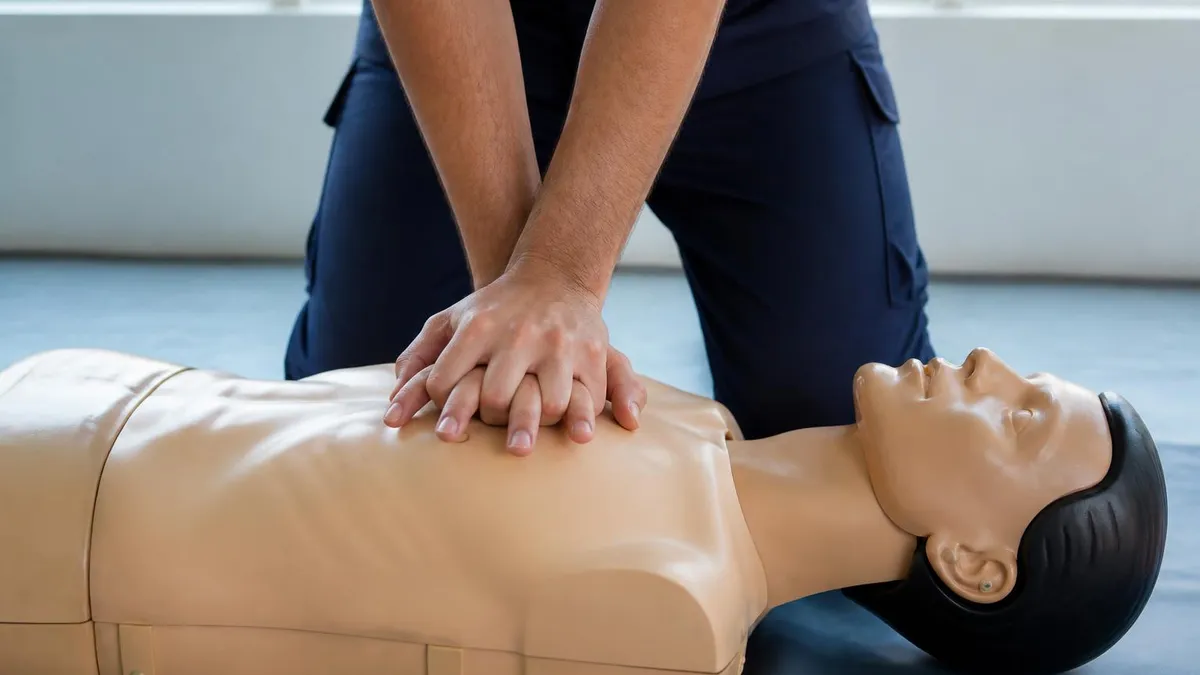
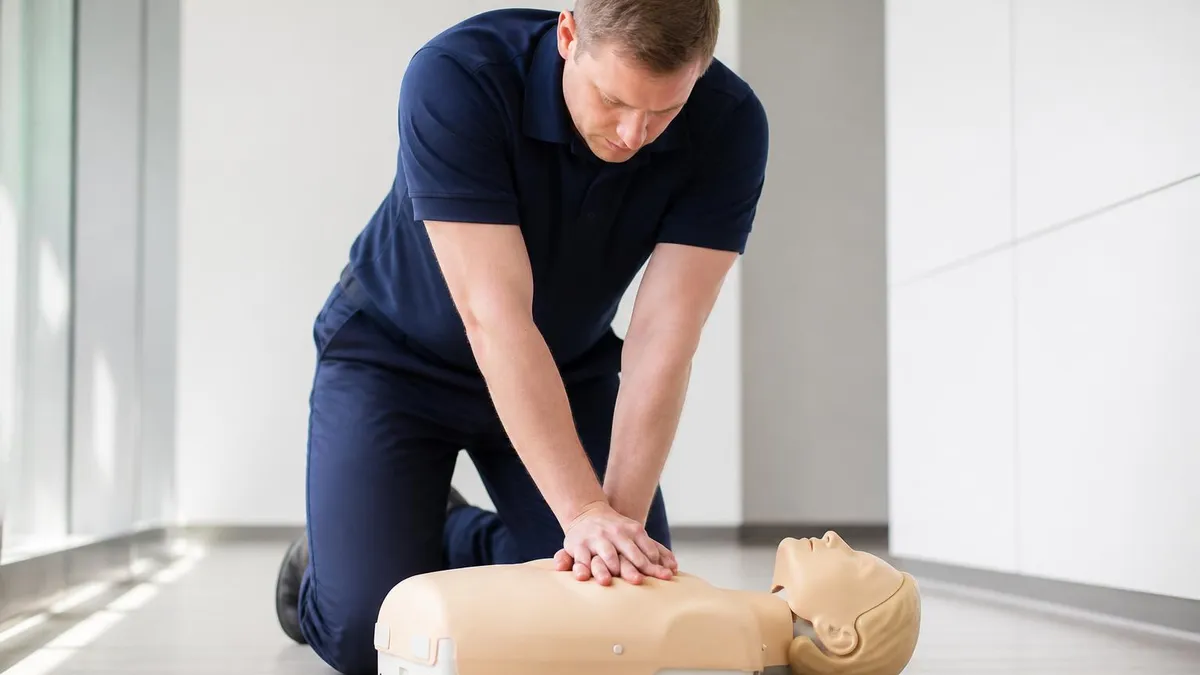
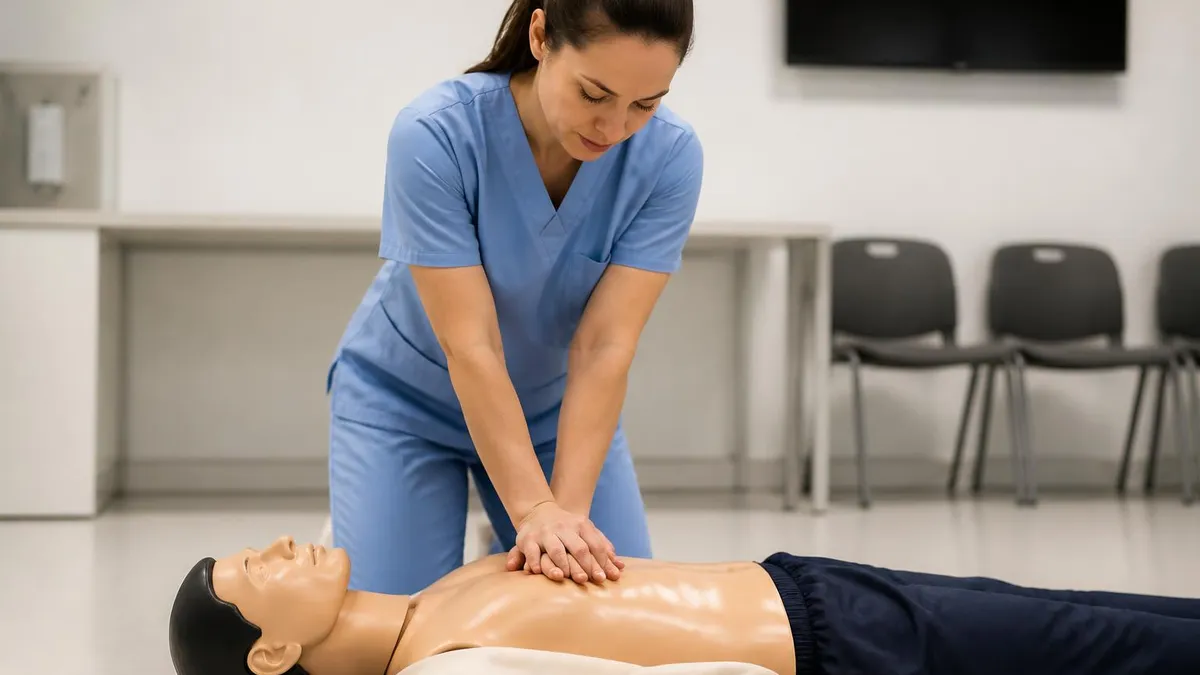
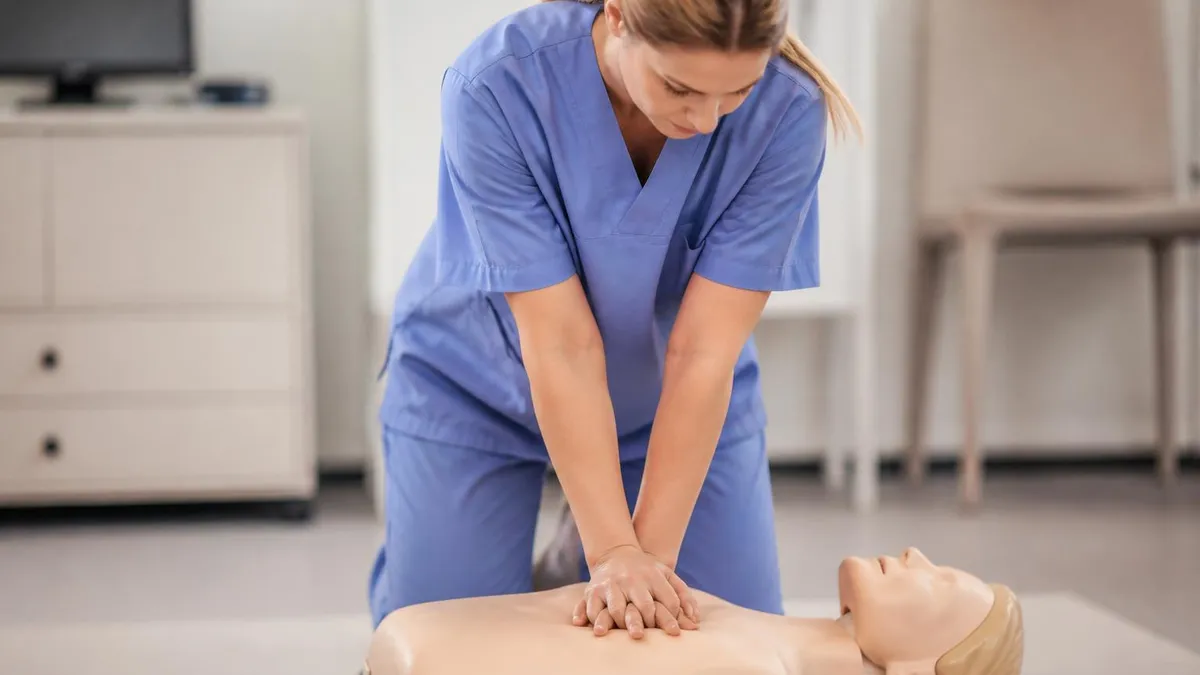
Both courses teach adult one-rescuer CPR with a compression depth of at least 2 inches, a rate of 100-120 per minute, full chest recoil, and minimizing interruptions. Both include adult AED operation, pad placement, and handling special situations like a hairy chest, implanted pacemaker, or transdermal medication patch. The science is identical — what changes is the depth of practice and the assessment standard.
BLS adds adult two-rescuer CPR with a switch every 2 minutes (5 cycles), bag-valve-mask ventilation with proper E-C clamp technique, and integration with an advanced airway where compressions become continuous and breaths are delivered every 6 seconds. BLS candidates must also recognize agonal gasping as a sign of cardiac arrest, not breathing, and respond accordingly. Heartsaver covers these concepts conceptually but does not require demonstration.
Should You Take BLS Even If You Are Not in Healthcare?
- +Deeper skill development and more hands-on practice time
- +Accepted by every employer that requires CPR — counts as both
- +Covers two-rescuer scenarios useful in any team setting
- +Includes opioid-associated emergency response and naloxone use
- +Better preparation if you plan to enter a healthcare career later
- +Same two-year renewal cycle as Heartsaver, no extra maintenance
- +Stronger resume credential for jobs that prefer medical training
- −Costs $15-$30 more than standard Heartsaver CPR
- −Course is 1-2 hours longer and includes a written exam
- −Pace assumes some comfort with medical terminology
- −Some skills (team CPR, bag-mask) rarely used by lay rescuers
- −Renewal still requires the written test, not just skills
- −May feel intimidating to first-time learners with no clinical background
- −Overkill for parents or office volunteers who just want basics
Pros and Cons at a Glance
| Pros | Cons |
|---|---|
| Deeper skill development and more hands-on practice time | Pace assumes some comfort with medical terminology |
| Accepted by every employer that requires CPR — counts as both | Some skills (team CPR, bag-mask) rarely used by lay rescuers |
| Covers two-rescuer scenarios useful in any team setting | Renewal still requires the written test, not just skills |
| Includes opioid-associated emergency response and naloxone use | May feel intimidating to first-time learners with no clinical background |
| Better preparation if you plan to enter a healthcare career later | Overkill for parents or office volunteers who just want basics |
Choosing the Right CPR or BLS Course Checklist
- ✓Read your job description or licensure rules and look for the exact words "BLS" or "BLS for Healthcare Providers"
- ✓Confirm whether your employer accepts AHA, Red Cross, or both
- ✓Decide between fully in-person, blended (online + skills check), or virtual hybrid format
- ✓Verify the instructor is a current AHA Training Center faculty or Red Cross authorized provider
- ✓Check that the course includes a hands-on skills test, not just an online certificate
- ✓Confirm the wallet card or eCard is issued within 24 hours of passing
- ✓Compare costs across at least three local providers before booking
- ✓Ensure the course covers adult, child, and infant CPR if any apply to your role
- ✓Schedule the class at least two weeks before your start date or license deadline
- ✓Bring a photo ID, a pen, and arrive 15 minutes early — late arrivals are usually turned away
If a hospital, clinic, or licensing board is involved, take BLS.
Heartsaver CPR cards are not accepted for clinical roles, nursing school clinicals, or hospital onboarding. When in doubt, take BLS — it satisfies every requirement Heartsaver does, plus more. The extra $20 and one extra hour of class time is far cheaper than rescheduling a job start or repeating a class.
Cost is usually the first practical question after "which one do I need." In 2026, Heartsaver CPR/AED averages $55 in most metro markets, with a range of $40 to $80. BLS for Healthcare Providers averages $70, ranging from $60 to $95 depending on the city, the training center, and whether materials are included. Online-only courses advertised at $19.99 should be treated with skepticism — most employers and state boards will not accept a card that lacks a hands-on skills verification.
The American Heart Association does not issue cards directly to students. Instead, certified AHA instructors operating through Training Centers issue eCards through the AHA Atlas system. You should receive an email within 24 hours of passing with a link to claim and print your card. Red Cross uses a similar digital system. Always download a PDF backup and save the verification URL — losing a card in the AHA system is a common headache that takes weeks to resolve.
Renewal is straightforward but easy to forget. Both cards expire on the last day of the issue month exactly 24 months later. AHA strongly recommends renewing before expiration to maintain continuous certification; if you let it lapse, you may be required to take the full initial course rather than the shorter renewal version. Set a calendar reminder for 60 days before expiration and another for 30 days, then book your renewal class.
Career value differs significantly between the two credentials. BLS is a baseline expectation in healthcare — it does not boost your salary, but lacking it disqualifies you from clinical roles. Heartsaver CPR/AED can actually be a differentiator on non-clinical resumes; gym managers, summer camp directors, and corporate safety officers often prefer candidates who already hold a current card because it shortens onboarding time and lowers liability insurance premiums.
For students planning a healthcare path, getting BLS-certified before applying to nursing school, PA school, or medical school is a smart, inexpensive way to demonstrate commitment. It also makes clinical shadowing and volunteer EMT work possible. Some pre-health programs even host on-campus BLS classes at a steep discount through their student health center or AHA Training Center partnership.
Group rates can dramatically lower the per-person cost. Many AHA Training Centers offer 10-20 percent discounts for groups of six or more, and some employers reimburse 100 percent of the course fee upon submission of a passing wallet card. Always ask your HR department or program coordinator about reimbursement before paying out of pocket — even small organizations frequently have a CPR training budget line.
Finally, beware of "lifetime" certifications and unaccredited online-only courses. No legitimate provider issues a CPR or BLS card that does not expire. Any course that does not require a hands-on skills demonstration in person or via live video proctor is not compliant with AHA or Red Cross standards. If a card from such a course is presented to an employer, it will almost certainly be rejected.
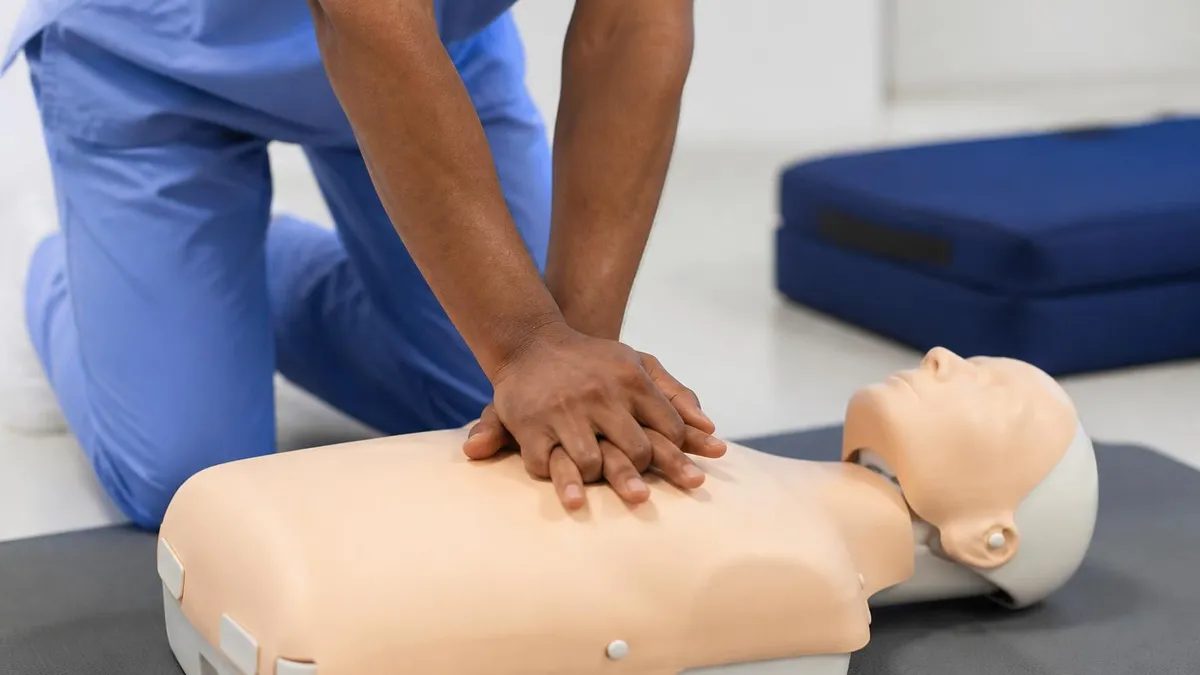
Hospitals routinely audit BLS cards through the AHA Atlas verification portal. Cards purchased from sites promising "instant BLS certification, no class required" are usually fraudulent and can result in immediate termination and reporting to your state licensing board. Always train with an authorized AHA Training Center or American Red Cross provider, and verify your eCard appears in the official lookup tool before submitting it to an employer.
Passing the BLS exam is straightforward if you understand the format and prepare deliberately. The written test is 25 multiple-choice questions covering adult, child, and infant resuscitation, AED use, team dynamics, opioid emergencies, and special situations. You need 84 percent — meaning 21 of 25 correct — to pass. You may retest the written portion once on the same day if you fail. The skills test is pass/fail and requires demonstrating one-rescuer adult CPR with AED, two-rescuer adult CPR with bag-mask, child CPR, and infant CPR.
The most commonly missed written questions involve compression rates, depths, and ratios across age groups. Memorize this grid: adults — 2 inches, 100-120/min, 30:2 single rescuer, 30:2 two rescuer; children — 2 inches, 100-120/min, 30:2 single, 15:2 two rescuer; infants — 1.5 inches, 100-120/min, 30:2 single, 15:2 two rescuer. Knowing these cold removes 6 to 8 easy questions worth of risk.
Team dynamics questions trip up first-timers. Expect scenarios about closed-loop communication ("Give 1 milligram of epinephrine" → "Giving 1 milligram of epinephrine now"), knowing your role, knowing your limitations, mutual respect, and constructive intervention. The AHA emphasizes these soft skills heavily on the 2020 and 2025 guidelines, and the exam reflects that. Free practice questions from a quality bank — like our free CPR practice test — drill these scenarios efficiently.
Skills test failures usually come down to depth, rate, recoil, or hand placement, not knowledge. Practice on a feedback-capable mannequin if your training center has one — the audible click and visual indicator dramatically improve performance. If your local center uses non-feedback mannequins, count out loud ("one and two and three…") to keep your rate near 110, and push hard enough that you feel the mannequin's chest bottom out cleanly on every compression.
Bag-mask ventilation is the single skill most adult learners struggle with. The E-C clamp — thumb and index finger forming a C over the mask, the other three fingers forming an E along the jaw to lift it into the mask — takes practice to seal correctly. Squeeze the bag over 1 second, just enough to make the chest rise visibly. Over-ventilation is a documented failure point and a common reason instructors stop you mid-skill to retry.
On exam day, eat a real breakfast, hydrate, and arrive 15 minutes early. Bring your driver's license, a pen, a printed registration confirmation, and wear loose clothing — you will be on your knees on the floor for 60 to 90 minutes of practice and testing. If your training center charges separately for the AHA Provider Manual (about $18), buy it ahead of time and skim chapters 1 through 4 the night before.
If you fail the skills test on the first attempt, most instructors will let you retest the same day after additional practice, especially for minor depth or rate issues. If you fail the written test twice, you will typically be asked to re-enroll in a future class at a discounted rate. Either way, do not panic — failure rates on BLS are low, around 5 percent first-time, because the AHA designed the course to be passable with focused effort.
You can continue preparing with the cpr practice test, which includes answer explanations for every question.
Final practical advice for choosing and passing your course: be honest about your learning style. If you absorb material better with a live instructor and immediate feedback, book a fully in-person class even if blended is cheaper. The HeartCode online modules are detailed but dry, and many students report retaining less than they expected. The 30-60 minute skills check that follows blended learning is not enough time to repair fundamental gaps if you did not engage deeply with the online portion.
If you are renewing rather than taking BLS for the first time, build in real practice time. Skills atrophy fast — research shows compression quality declines noticeably within 3 to 6 months of certification. A few short practice sessions on a home mannequin (basic models cost $35-$50) or at your workplace's training room keep your hands sharp. Many hospitals offer monthly "open skills" sessions for staff that are free and require no registration.
For students stacking certifications, the smart order is BLS → ACLS → PALS, with each building on the prior. Do not attempt ACLS without current BLS — most training centers will not even let you register. If your career path is pediatric (NICU, PICU, pediatric ED, pediatric clinic), PALS is essential. If you are in adult critical care, anesthesia, ED, or cardiology, ACLS is required. NRP (Neonatal Resuscitation Program) is the standard for labor and delivery and NICU staff.
Document everything. Keep digital and physical copies of every CPR or BLS card you have ever held. Hospital credentialing committees occasionally ask for proof of continuous certification, and the AHA Atlas system only shows your current and most recent cards. Save PDF backups in a cloud folder, and snap a photo of every wallet card the day you receive it. This habit takes 30 seconds and has saved nurses from losing weeks of work over administrative gaps.
Watch for guideline updates. The AHA and ILCOR publish updated resuscitation science every five years (the next major update lands in late 2025-2026). Renewal classes incorporate the latest changes, so even if your skills feel sharp, the renewal is the easiest way to stay current on evolving recommendations like compression-only CPR for lay rescuers, double sequential defibrillation, and post-arrest care basics.
Finally, consider the human element. The reason these courses exist is that bystander and provider CPR saves lives — every minute without compressions drops survival by about 10 percent in out-of-hospital cardiac arrest. The skills you learn in a 3- or 4-hour class can mean the difference between a coworker, patient, child, or stranger going home or not. That perspective makes the cost and time investment trivial, and it tends to make students engage more deeply with the material.
Whichever course you choose, complete it before you think you need it. Cardiac arrest does not schedule itself, and the worst time to wish you had taken the class is during the emergency. Block off the date, pay the fee, and show up ready to learn. Your future self — or someone else's family — will thank you.
CPR Questions and Answers
About the Author

Registered Nurse & Healthcare Educator
Johns Hopkins University School of NursingDr. Sarah Mitchell is a board-certified registered nurse with over 15 years of clinical and academic experience. She completed her PhD in Nursing Science at Johns Hopkins University and has taught NCLEX preparation and clinical skills courses for nursing students across the United States. Her research focuses on evidence-based exam preparation strategies for healthcare certification candidates.