
Forklift Mechanics Explained: Fulcrum, Load Capacity, and How Forklifts Really Work
Master forklift mechanics — fulcrum, load charts, electric forklift systems & more. ✅ Prep for certification with real operator insights.

If you've ever searched for a forklift rental or watched a seasoned forklift operator navigate a crowded warehouse, you may have wondered what actually makes these machines work so reliably under extreme loads. At the heart of every forklift's engineering is a deceptively simple concept: the fulcrum on a forklift. Understanding this principle — along with the mechanical systems that support it — is essential for anyone pursuing a certification of forklift, operating one safely, or evaluating forklifts for sale or rental.
The fulcrum on a forklift is the front axle, which acts as the pivot point in a lever system. When a load is placed on the forks, the machine balances that weight against the counterweight at the rear. This balance is governed by basic physics: the product of load weight and its distance from the fulcrum must never exceed the product of the counterweight and its distance. Every forklift operator must internalize this relationship because violating it — even briefly — can cause a tip-over accident that injures workers and damages property.
Modern forklifts come in many configurations, from the compact electric forklift found in food distribution centers to the towering stand up forklift used in narrow-aisle warehouses. Each design applies the same mechanical principles, yet the specifics of how the hydraulic system, mast assembly, and drive train work together vary considerably. Recognizing these differences is not just academic — it directly affects how operators load cargo, navigate inclines, and respond to emergencies on the floor.
Forklift training programs in the United States are structured around OSHA 29 CFR 1910.178, which mandates that every powered industrial truck operator be formally evaluated before operating any equipment. That standard covers not only safe operating procedures but also the mechanical concepts behind load stability, braking distances, and fuel system safety. Workers who understand the underlying mechanics tend to pass their certification of forklift evaluations faster and make better real-time decisions during operation.
Whether you are an employer weighing the pros and cons of forklift rental versus purchasing forklifts outright, a new hire preparing for your first forklift training class, or a veteran operator refreshing your knowledge before a recertification evaluation, this guide covers the mechanical fundamentals you need. We'll walk through the fulcrum principle in depth, explain the main mechanical systems on common forklift types, and connect those concepts directly to the questions you'll face during your OSHA-required operator assessment.
Understanding forklift mechanics is not just about passing a test — it's about building the mental model that keeps you and your coworkers safe every single shift. A forklift moving at even 5 mph carries enough momentum to cause catastrophic injuries if the operator misreads a load or misjudges the floor surface. The mechanical awareness this guide provides gives you the foundation to anticipate problems before they become emergencies, making you a more valuable and safer member of any warehouse team.
Throughout this article we'll reference real load capacities, actual mast travel speeds, and industry-standard maintenance intervals so you have concrete numbers to anchor your understanding. Abstract principles are easier to remember — and easier to apply — when they're attached to specific figures you can visualize on the job. Let's start with the physics that make every lift truck function.
Forklift Mechanics by the Numbers

How the Fulcrum Principle Works on a Forklift
Identify the Fulcrum (Front Axle)
Measure the Load Center Distance
Apply the Lever Equation
Check the Stability Triangle
Account for Mast Tilt and Height
Verify with the Nameplate Capacity
Beyond the fulcrum principle, a forklift is a sophisticated assembly of interdependent mechanical systems. The hydraulic system is arguably the most critical, as it powers every lift, tilt, and attachment function the operator uses throughout a shift. A typical counterbalanced forklift uses a gear pump or piston pump driven by the engine or electric motor to pressurize hydraulic fluid — commonly a mineral-oil-based ISO VG 46 fluid — to pressures between 2,000 and 3,500 PSI during heavy lifts. Any degradation in fluid quality or pump performance directly translates to slower lift speeds and reduced load control.
The mast assembly is the vertical structure that carries the carriage and forks. Standard masts come in several configurations: simplex (single-stage) masts with no free lift, duplex (two-stage) masts with one free-lift stage, and triplex (three-stage) masts that allow full container height stacking in very low-clearance buildings. Mast chains — usually leaf-style roller chains — must be inspected every 500 operating hours for wear, elongation beyond 3% of nominal length, and corrosion. A broken mast chain under load is one of the leading causes of fatal forklift accidents in the United States.
The drive system varies significantly between internal combustion and electric forklifts. Cushion-tire LP-gas forklifts use a torque converter connected to a powershift transmission, giving operators smooth modulation of drive force without clutching. Electric forklifts — increasingly the default choice for indoor forklift rental fleets — use series-wound DC motors or, in modern designs, AC induction motors controlled by a transistorized motor controller. AC systems offer regenerative braking, which recovers energy during deceleration and extends battery runtime by up to 15% compared to older DC designs.
Steering on most counterbalanced forklifts is rear-wheel steering, which is the opposite of a car and is one of the most important behavioral differences new operators must internalize during forklift training. Because the rear wheels steer, the rear of the machine swings outward during turns — sometimes dramatically. Operators must always check swing clearance behind them before initiating a turn, especially in tight aisles or near pedestrian walkways. Failure to account for tail swing is a common cause of collisions in warehouses with mixed pedestrian and forklift traffic.
The braking system on an internal combustion forklift typically uses hydraulically actuated drum or disc brakes on the front drive axles, supplemented by a parking brake that locks the rear axle. Electric forklifts increasingly use plugging (reversing the motor to create braking torque) as the primary service brake, with friction brakes acting as a backup and parking mechanism only. Plug braking is highly effective but requires operators to develop a feel for the deceleration curve, which differs from conventional friction braking and must be practiced during initial forklift training sessions.
Tire selection profoundly affects both the mechanical performance and the safe load capacity of a forklift. Cushion tires — solid rubber bonded to a steel band — are designed exclusively for smooth indoor floors and cannot handle outdoor terrain safely. Pneumatic tires, whether solid or air-filled, are required for outdoor use, ramps, and rough surfaces. Using cushion-tired forklifts outdoors changes the effective fulcrum geometry because the machine can flex and tilt on uneven ground in ways the stability triangle calculation does not anticipate, dramatically increasing tip-over risk.
Understanding these interconnected mechanical systems is what separates a minimally compliant forklift operator from a genuinely skilled one. Employers who invest in deeper mechanical training — beyond the OSHA minimum — consistently report lower incident rates, lower maintenance costs because operators catch early warning signs during pre-shift inspections, and fewer costly load drops. For any organization managing a fleet — whether through forklift rental or ownership — mechanical literacy among operators is one of the highest-return investments available.
Forklift Types: Electric, Stand Up, and IC Compared
The electric forklift dominates indoor warehouse environments because it produces zero direct emissions, operates quietly enough for food-grade and pharmaceutical facilities, and has significantly lower per-hour fuel costs than LP-gas alternatives. Modern 48-volt and 80-volt lithium-ion battery systems can sustain a full two-shift operation — roughly 16 hours — on a single charge, eliminating the battery swap downtime that plagued older lead-acid fleets. Regenerative braking further extends runtime by recapturing energy every time the operator slows or lowers a load.
From a mechanical standpoint, electric forklifts have far fewer moving parts than internal combustion models — no engine, no transmission, no exhaust system — which translates into lower scheduled maintenance costs (typically 30–40% less annually) and fewer unplanned breakdowns. The primary maintenance items are battery health management, motor brush replacement on DC models, and hydraulic fluid quality. For companies evaluating forklift rental options, electric models command a small premium in daily rate but usually save money over multi-month rentals due to avoided fuel costs.

Forklift Rental vs. Buying: Mechanical Cost Perspective
- +No large upfront capital expenditure — preserve cash for operational needs
- +Rental companies maintain the fleet, so mechanical repairs are covered
- +Easy to upgrade to newer electric forklift models as technology improves
- +Scale fleet size up or down seasonally without owning underutilized equipment
- +Short-term forklift rental near me options allow project-specific deployment
- +Rental agreements often include operator training resources and compliance support
- −Long-term rental costs exceed purchase price over a 5+ year horizon
- −Rental units may have higher hours and more wear than a new forklift for sale
- −Less control over maintenance schedules and fluid replacement intervals
- −Availability of specific models like stand up forklifts can be limited locally
- −Some rental agreements restrict modifications such as adding specialized attachments
- −Operators must re-familiarize themselves with different units each rental cycle
Pros and Cons at a Glance
| Pros | Cons |
|---|---|
| No large upfront capital expenditure — preserve cash for operational needs | Rental units may have higher hours and more wear than a new forklift for sale |
| Rental companies maintain the fleet, so mechanical repairs are covered | Less control over maintenance schedules and fluid replacement intervals |
| Easy to upgrade to newer electric forklift models as technology improves | Availability of specific models like stand up forklifts can be limited locally |
| Scale fleet size up or down seasonally without owning underutilized equipment | Some rental agreements restrict modifications such as adding specialized attachments |
| Short-term forklift rental near me options allow project-specific deployment | Operators must re-familiarize themselves with different units each rental cycle |
Forklift Pre-Shift Inspection Checklist for Operators
- ✓Inspect the data plate — verify rated capacity matches the intended load and load center distance.
- ✓Check hydraulic fluid level and look for leaks at hose fittings, cylinders, and pump seals.
- ✓Examine mast chains for wear, elongation, corrosion, and proper lubrication along full travel.
- ✓Test all horn, lights, and backup alarm functions before moving the forklift under any load.
- ✓Inspect fork blades for cracks, bends, and heel wear exceeding 10% of original thickness.
- ✓Verify tire condition — check for chunking, cuts, or flat spots on pneumatic and cushion tires.
- ✓Test the service brake and parking brake for full stopping power before entering traffic areas.
- ✓Check battery charge level (electric forklift) or fuel level (IC) and record in the shift log.
- ✓Inspect overhead guard for cracks, missing bolts, or structural damage from previous impacts.
- ✓Confirm load backrest extension is present and secured firmly to the carriage plate.
- ✓Document all deficiencies on the pre-shift inspection form and remove the forklift from service if any safety-critical defect is found.
The 80% Rule: Never Load Beyond 80% of Rated Capacity
OSHA and most forklift manufacturers recommend treating 80% of the nameplate rated capacity as the practical operational limit. This buffer accounts for load shifting during travel, minor floor imperfections, and the real-world variability in load center distance that rarely matches the 24-inch or 36-inch standard. Operators who consistently work near 100% capacity dramatically increase tip-over risk and accelerate wear on the hydraulic pump, mast chains, and front axle bearings.
Obtaining a certification of forklift in the United States is not a single standardized national exam — it is an employer-administered evaluation process governed by OSHA 29 CFR 1910.178(l). This means your forklift operator certification is specific to the types of trucks you were evaluated on, at the specific workplace where the evaluation occurred. If you change employers or are asked to operate a different class of forklift, you must be re-evaluated by a qualified trainer before unsupervised operation. This requirement surprises many experienced operators who assume their existing certification transfers automatically.
OSHA requires that forklift training include three components: formal instruction (lecture, video, written materials), practical training (hands-on operation under direct supervision), and an evaluation performed by a qualified person who assesses both the operator's knowledge and actual operating performance. The formal instruction component is where mechanical concepts like the fulcrum on a forklift, load capacity calculations, and hydraulic system basics are typically covered. Practical training then connects those concepts to real equipment under real warehouse conditions.
Recertification is required at least every three years, or immediately when an operator is observed operating unsafely, is involved in an accident or near-miss, receives an evaluation revealing deficiencies, or when conditions in the workplace change in a way that could affect safe operation. Many employers set their internal recertification interval at two years to maintain a comfortable buffer before the OSHA three-year deadline. Some industries — automotive manufacturing, cold storage, and food distribution — require annual re-evaluation as part of their internal safety programs.
The forklift training industry in the United States is served by a mix of employer-delivered programs, community college courses, third-party training companies, and online certification platforms. Online-only forklift training can satisfy the formal instruction component but cannot replace the practical evaluation — OSHA is explicit that hands-on evaluation must be performed in person by a qualified trainer. Programs that claim to issue a full certification entirely online are not OSHA-compliant, and employers who accept them face significant liability exposure during OSHA inspections.
Forklift training costs vary widely by format. A group session at an employer's facility with a visiting trainer typically costs $150–$300 per operator. Individual enrollment in a community college or third-party program may run $200–$500. Some forklift dealers bundle complimentary operator training with a new forklift for sale or a long-term forklift rental agreement, making this a factor worth asking about when comparing equipment suppliers. Regardless of cost, the return on investment from reducing even a single incident — which can cost $38,000 or more in direct workers' compensation costs alone — is overwhelming.
Mechanical knowledge is tested during the formal instruction phase, with questions covering load chart reading, stability triangle concepts, the fulcrum principle, hydraulic system indicators, and pre-shift inspection requirements. Operators who score well on these topics consistently outperform their peers during the practical evaluation because they can articulate why they are making specific operating decisions — a quality that qualified evaluators notice and reward. Practice questions from resources like PracticeTestGeeks help candidates build fluency with these concepts before their evaluation day.
For workers who operate multiple forklift types — for example, a sit-down counterbalanced forklift and a stand up reach truck — separate evaluations are required for each class. Many warehouses operate Class 1 (electric counterbalanced), Class 2 (electric narrow aisle), and Class 5 (IC counterbalanced) trucks simultaneously, which means some operators must maintain three separate certifications. Keeping track of evaluation dates, qualified trainer credentials, and the specific trucks covered by each certification is a compliance responsibility that falls on the employer's safety department, not the individual operator.

A forklift operator certification issued by your previous employer is not valid at a new workplace under OSHA regulations. Your new employer must evaluate your skills on their specific equipment in their specific facility before you can operate unsupervised. Never assume your existing card covers you — operating uncertified, even with years of experience, exposes both you and your employer to OSHA citations and significant legal liability if an incident occurs.
When businesses evaluate whether to purchase forklifts or pursue forklift rental near me options, the mechanical maintenance cost picture is one of the most important financial variables in the decision. New electric forklifts carry purchase prices ranging from $25,000 for a basic 3,000-lb capacity sit-down model to $75,000 or more for a high-capacity, high-lift reach truck with lithium-ion battery. Internal combustion models in comparable capacity ranges typically run $20,000–$55,000 new. Used forklifts for sale can be found at auction or through dealers for 30–60% less, but hidden mechanical issues in high-hour machines can erode those savings quickly.
The total cost of ownership for a purchased forklift includes scheduled maintenance (averaging $2,000–$4,000 per year for electric, $3,500–$6,000 for IC), tires ($500–$1,500 per set every 2,000–4,000 hours), battery replacement for electric models ($3,000–$8,000 for lead-acid, $12,000–$20,000 for lithium-ion packs every 5–10 years), and eventual engine or motor overhaul. Many fleet managers use a lifecycle cost model that targets full machine replacement at 10,000–12,000 operating hours, after which maintenance costs typically accelerate sharply regardless of how well the machine was serviced.
Forklift rental rates in 2025–2026 range from approximately $400–$700 per month for a basic electric sit-down forklift on a long-term lease, up to $2,500–$4,500 per month for specialized equipment like high-reach trucks or rough-terrain telehandlers. Short-term forklift rentals — day or week rates — carry a significant premium, often $150–$350 per day for standard models. The mechanical advantage of rental is that all covered maintenance, including hydraulic system service, mast chain lubrication, and brake adjustment, is handled by the rental company, removing the need for in-house forklift mechanics or third-party service contracts.
Fleet managers who choose to own their forklifts should budget for a preventive maintenance program that includes 250-hour, 500-hour, and annual service milestones. At 250 hours: inspect hydraulic fluid, check mast chain tension, lubricate carriage and lift cylinders, inspect tires for wear. At 500 hours: change hydraulic filter, test all safety systems, inspect brake linings, check battery electrolyte levels or cell voltages. At 1,000 hours (annual): perform a full mast overhaul inspection, replace hydraulic fluid, check transmission fluid on IC models, and conduct a thorough electrical system inspection on electric forklifts.
For small businesses operating a single forklift, a service contract with a local dealer or independent forklift mechanic is often more cost-effective than maintaining in-house expertise. Service contracts typically run $1,200–$2,500 per year for a standard electric forklift and cover all scheduled maintenance plus priority response for breakdowns. For fleets of five or more machines, hiring a dedicated in-house forklift mechanic becomes economically competitive, especially when you factor in the downtime cost of waiting for an outside technician during a busy shipping period.
The rise of telematics systems — onboard computers that track operating hours, impact events, and system fault codes in real time — has transformed how forward-thinking fleet managers approach maintenance scheduling. Modern electric and IC forklifts from major brands like Toyota, Crown, Hyster, and Yale offer factory telematics that alert fleet managers when hydraulic pressure drops below threshold, when battery state-of-health degrades, or when an impact event occurs that warrants a mechanical inspection. These systems can reduce unplanned downtime by 25–40% in high-utilization fleets by catching problems before they cause failure.
Whether your organization leases, rents, or owns its lift trucks, understanding the mechanical systems covered in this guide empowers you to ask better questions of your equipment supplier, write better service contract terms, and make smarter decisions about when to repair versus replace aging equipment. Every dollar saved on unnecessary emergency repairs or avoidable accidents goes directly to the bottom line, making mechanical literacy one of the most financially valuable skills a warehouse manager or fleet coordinator can develop.
Practical preparation for your forklift operator evaluation starts well before you step onto the warehouse floor with a qualified trainer. The most effective candidates spend time reviewing their specific machine's operator manual — which details the exact capacity chart, hydraulic fluid specifications, tire type requirements, and mast chain inspection intervals for that model. Manufacturer manuals are available free from most dealers and directly from brand websites, and reading just the safety and maintenance sections (typically 40–60 pages) provides a significant knowledge advantage over operators who show up without any preparation.
Load chart reading is one of the most tested skills in forklift certification evaluations, and it's also one of the most commonly misunderstood. The capacity plate on a forklift shows the rated capacity at a specific load center distance — almost always 24 inches for loads up to 2,000 lb or 36 inches for heavier loads. But real-world loads rarely conform to these standards.
A 42-inch-deep pallet pushed all the way back on 48-inch forks has a load center of approximately 21 inches — improving effective capacity. A 60-inch-deep crate with its center of gravity at 30 inches reduces effective capacity significantly. Practicing these mental calculations during forklift training is essential.
Mast chain inspection is a practical skill that evaluators specifically observe during the hands-on portion of certification assessments. A chain elongation gauge — available for under $20 at most industrial supply stores — allows you to quickly check whether a section of chain has stretched beyond the 3% elongation limit that indicates replacement is needed. During your pre-shift inspection, run the forks up slowly and observe the mast channels for uneven travel, side drift, or jerking — all symptoms of uneven chain wear or hydraulic cylinder sealing problems that require immediate attention from a qualified forklift mechanic.
Battery management is a critical practical skill for operators of electric forklifts. Lead-acid batteries should never be discharged below 20% of rated capacity (often indicated by a discharge indicator alarm) because deep discharge permanently reduces plate capacity and shortens battery life.
After each shift, the battery must be allowed to complete its full charge cycle — typically 8 hours — and then given an additional equalization charge once per week to balance cell voltages across the pack. Interrupting charge cycles, a common practice in busy facilities with a single battery per truck, causes chronic undercharging and premature battery failure that costs thousands of dollars in early replacement.
When it comes to operating on grades and ramps, the practical rule every operator must memorize is: drive with the load uphill. When ascending a ramp with a load, drive forward so the load is on the uphill side. When descending, reverse so the load remains uphill. This keeps the loaded forks from pulling the machine forward and over — a potentially fatal mistake on grades steeper than 10 degrees. The maximum safe grade for most standard forklifts is 15 degrees with a load and 20 degrees unloaded, though always defer to the manufacturer's specification for your specific machine.
Situational awareness drills are a practical technique used in advanced forklift training programs to build the scanning habits that prevent collisions. Before entering an aisle, slow to a walking pace, sound the horn, and look in both directions before proceeding. Before reversing, physically turn and look — not just check a mirror — in the direction of travel. Before raising a load above shoulder height, verify overhead clearance for sprinkler heads, light fixtures, and racking cross-beams. These habits, practiced consistently from day one, become automatic reflexes that prevent accidents even in moments of distraction or time pressure.
Finally, document everything. Keep a personal log of your training sessions, the equipment you were evaluated on, the date of your evaluation, and the name of your qualified trainer. OSHA requires employers to maintain these records, but smart operators maintain their own copies as career documentation.
When you apply for a new job and can produce a well-organized training record showing your certification history, the forklifts you're qualified on, and your recertification dates, you signal to every potential employer that you take safety and professionalism seriously — exactly the qualities that command higher starting wages and faster advancement in the material handling industry.
Sample Forklift certification Practice Questions
Try these questions from our free Forklift certification practice tests. The correct answer and an explanation follow each question.
The load capacity of a forklift is found on the:
- A. Operator's badge
- B. Data (capacity) plate
- C. Warehouse door
- D. Fuel gauge
Answer: B. Data (capacity) plate
The manufacturer's data plate lists the rated load capacity.
When operating a forklift on a ramp or incline with a load, what is the correct procedure to ensure stability?
- A. Drive down the ramp in reverse, keeping the load pointed up the incline.
- B. Turn the forklift sideways to navigate the ramp slowly.
- C. Drive down the ramp forward, keeping the load pointed down the incline.
- D. Raise the load as high as possible for better visibility.
Answer: A. Drive down the ramp in reverse, keeping the load pointed up the incline.
According to OSHA guidelines, when descending a ramp with a load, the operator should drive in reverse with the forks pointed upgrade. This keeps the heavy part of the forklift and the load on the uphill side, maximizing stability and preventing the forklift from tipping forward.
The combined center of gravity of a loaded forklift moves in which direction as the load weight increases?
- A. Forward, toward the front wheels
- B. Backward, toward the counterweight
- C. Straight up only
- D. It does not move
Answer: A. Forward, toward the front wheels
Adding load weight pulls the combined center of gravity forward toward the drive wheels and load.
The standard load center used to rate most forklift capacities is measured at:
- A. 12 inches from the face of the forks
- B. 24 inches from the face of the forks
- C. 36 inches from the mast
- D. The tip of the forks
Answer: B. 24 inches from the face of the forks
Most forklift capacities are rated at a 24-inch load center measured from the fork face.
Forklift Questions and Answers
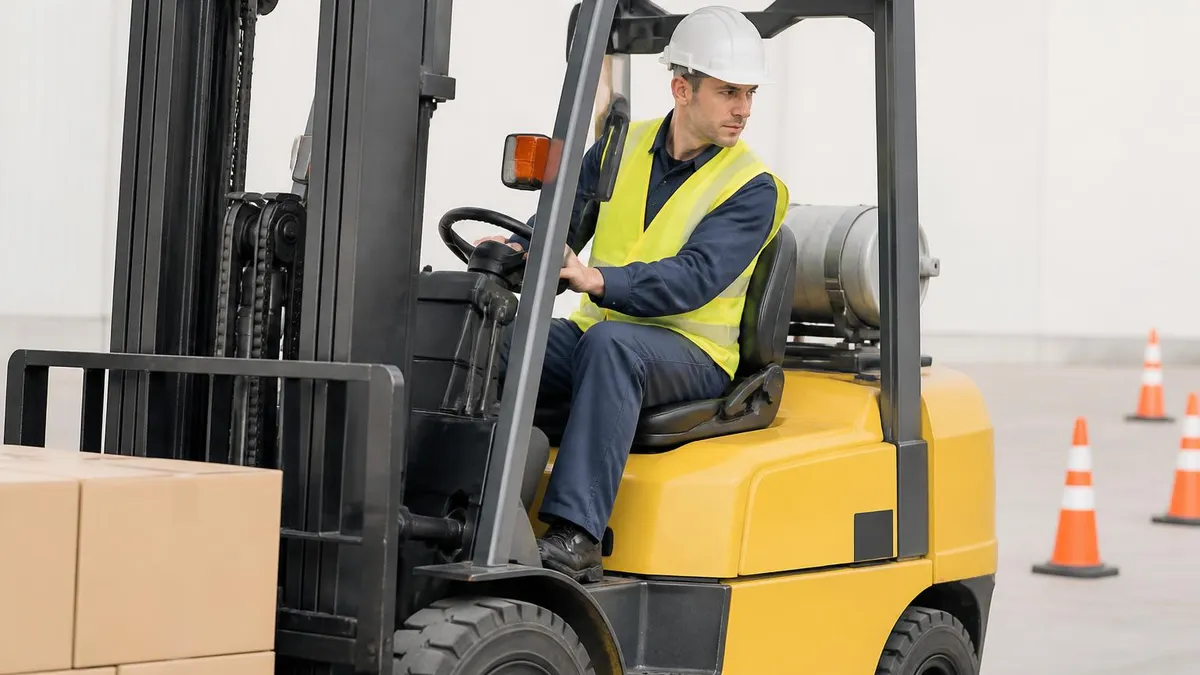
Forklift Rentals: Complete Guide to Pricing, Types, and Operator Requirements
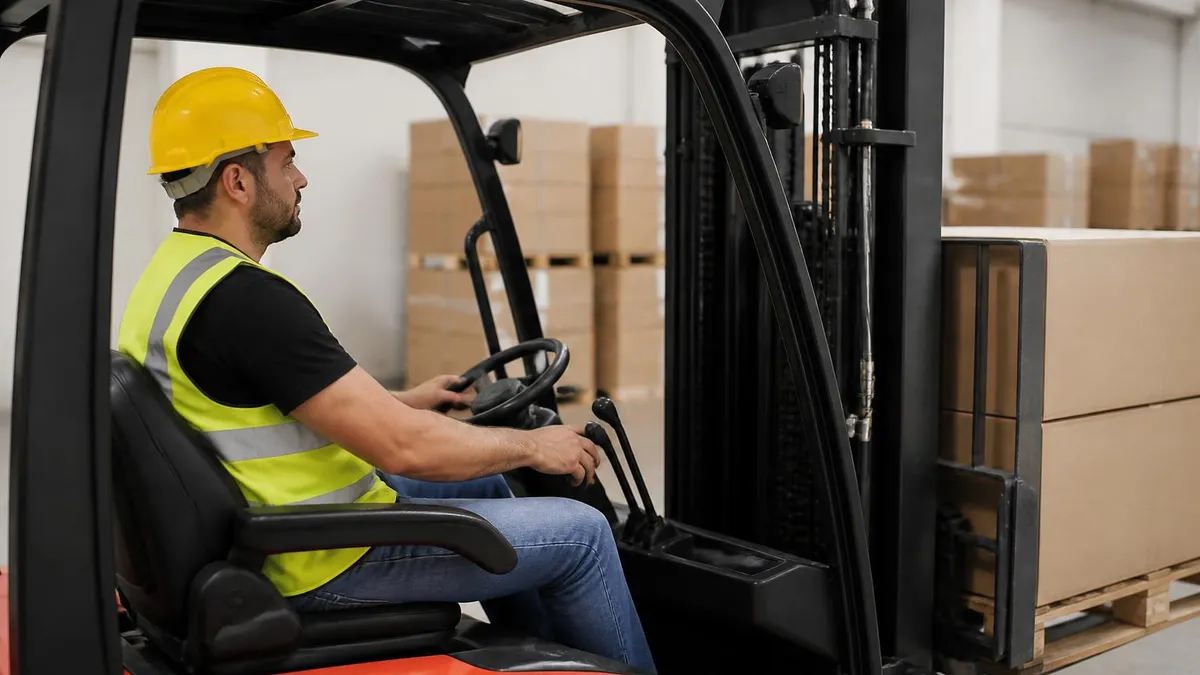
Forklift Hydraulic Fluid: Complete Guide to Types, Specifications, Change Intervals, and Troubleshooting for 2026
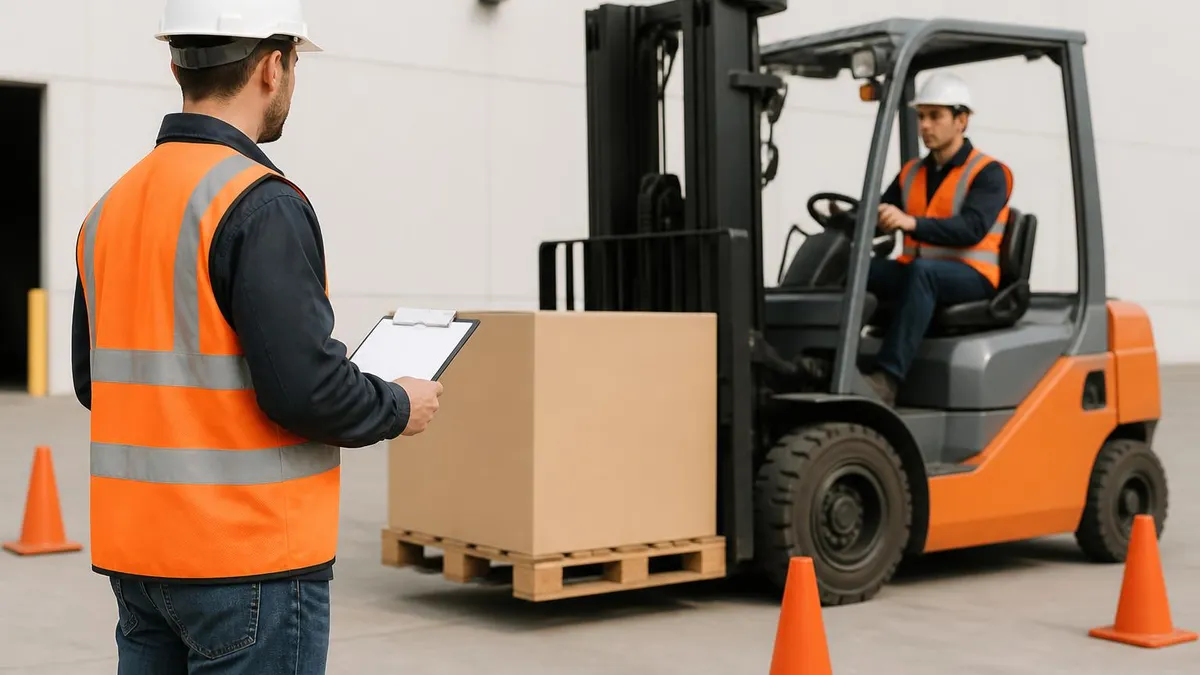
Forklift Parts and Maintenance: Complete Guide to Batteries, Chargers, and Replacement Components
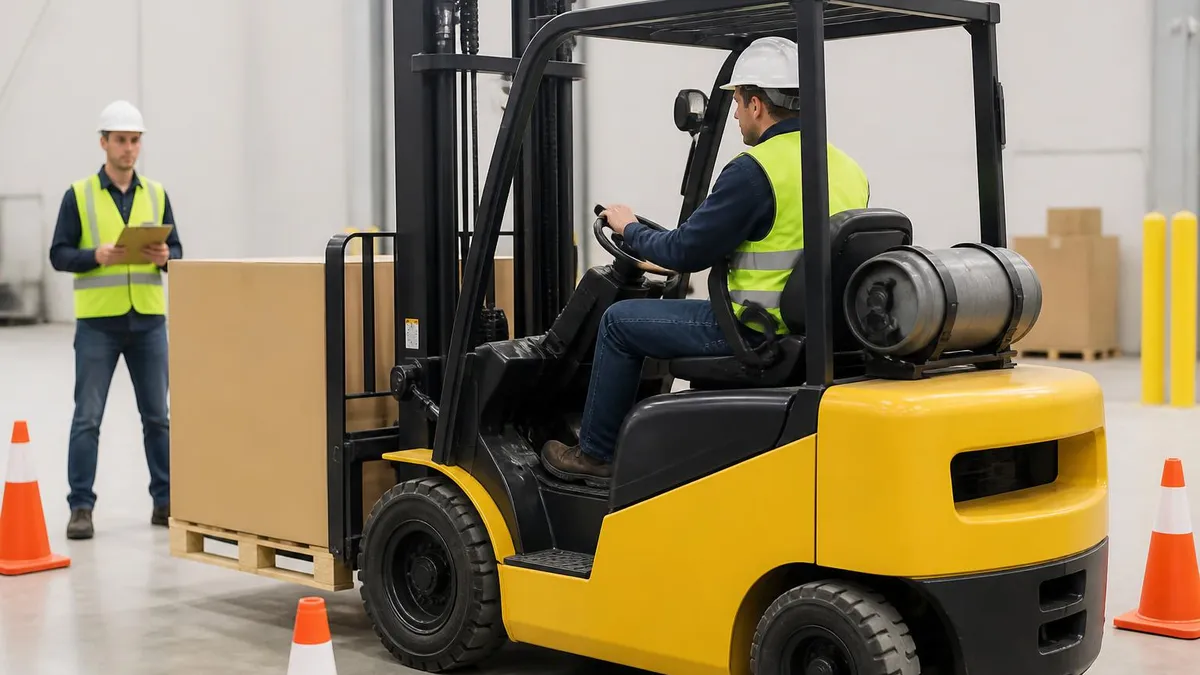
Big Forklift Guide: Heavy-Duty Lift Trucks, Capacity Classes, Rental Costs, and Operator Requirements
Forklift License Renewal: Complete Guide to Forklift License Expiry, OSHA Recertification, and Operator Requirements for 2026
About the Author

Certified Crane Operator & Skilled Trades Exam Specialist
Ferris State UniversityRobert Martinez is a Journeyman Ironworker, NCCCO-certified crane operator, and forklift trainer with a Bachelor of Science in Construction Technology from Ferris State University. He has 21 years of ironworking, rigging, and heavy equipment operation experience across high-rise and industrial construction sites. Robert prepares candidates for crane operator, rigger, forklift, and skilled trades certification examinations.