
Forklift Certification Cost 2026 October: What You Pay Online, In-Person, and for OSHA-Compliant Training
Forklift certification cost ranges $50-$600 in 2026 October. 🏆 Compare online OSHA courses, in-person training, employer-paid options, and recertification fees.
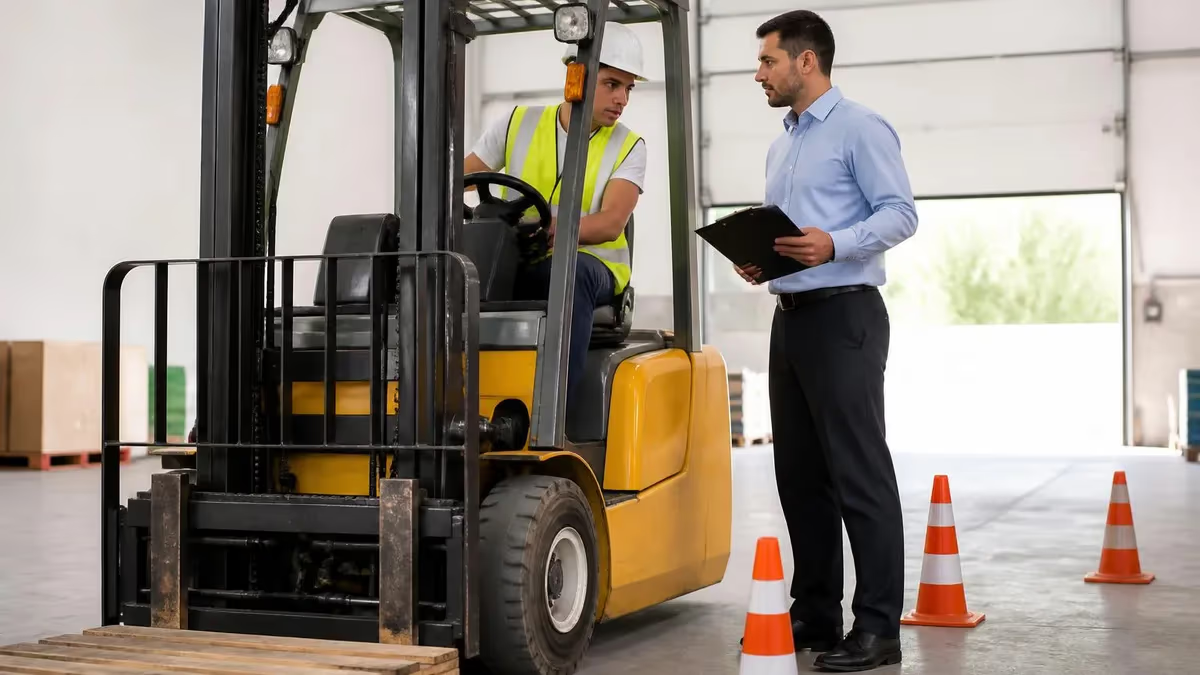
Forklift certification cost in 2026 lands somewhere between $50 and $600. That spread is wider than most first-time operators expect, and the reason is simple: training providers package the same OSHA-mandated content very differently. Online courses run cheap. In-person hands-on programs cost more because someone has to physically watch you operate a real truck. Employer-paid training? That's actually the most common path, and it shouldn't cost you anything at all.
Here's the catch. OSHA's standard, 29 CFR 1910.178(l), requires three things before you can legally operate a powered industrial truck: formal instruction, practical hands-on training, and a performance evaluation conducted by a qualified person at the workplace. No single online video, no matter how cheap, can satisfy all three. That's where buyers get confused — and where shady sites cash in on the confusion.
This guide breaks down every realistic price point for forklift certification in 2026, what you actually receive at each tier, why employer-paid training is often the smartest route, and how to spot the cheap online scams that leave operators technically uncertified despite holding a printed card. You'll also see state-specific notes, recertification math, and what changes when you need certification on multiple truck classes.
Quick context on why this matters now: warehouse hiring is up, automation pressures are accelerating, and operators with multi-class certifications command better starting wages than they did three years ago. Pricing for training has held remarkably steady even as wages have climbed, meaning the return on training investment is stronger in 2026 than at any point in the last decade. Treating the $300-$500 spend as a career investment rather than a regulatory cost shifts the entire conversation.
Forklift Certification Cost at a Glance

Five Ways to Get Forklift Certified
Self-paced video instruction covering OSHA 1910.178 standards, forklift classes, pre-shift inspection, and load handling. Provides written-exam component only. You still need on-site practical evaluation by a qualified person before legal operation.
Half-day to full-day instructor-led training at training centers, community colleges, or dealer facilities. Covers theory and written exam. Many programs charge extra for the practical evaluation, so confirm pricing covers both portions before paying.
The gold standard. Combines classroom theory, written exam, hands-on equipment operation, and the OSHA-required performance evaluation. Result: a fully compliant certification you can present to any employer in any state.
OSHA explicitly requires employers to provide and pay for training. If your workplace operates forklifts, your boss is legally on the hook for training cost. This route also produces the most relevant certification because evaluation happens on your actual job equipment.
Career-focused programs that bundle forklift certification with broader warehouse, logistics, or supply-chain coursework. Higher upfront cost but often includes job placement assistance, multi-class endorsements, and employer partnerships that translate to faster hiring after completion.
Why such a wide price range for what amounts to the same federal certification? Three reasons. First, online providers carry near-zero marginal cost per student — the video plays the same whether one person or ten thousand watch it. Second, in-person training requires instructor time, classroom space, and often equipment access. Third, the practical evaluation step demands a qualified evaluator physically present to watch you operate a real truck under load. That's the expensive piece, and it's the piece online-only providers cannot deliver.
Sticker price isn't the whole story. A $60 online certificate that doesn't include workplace evaluation leaves the operator out of compliance, the employer exposed to OSHA penalties starting at $16,131 per serious violation in 2026, and the certification effectively worthless. Compare that to a $400 full program that lands you a card recognized by any employer in any state for the full three-year validity period. The math tilts hard toward the complete program every time.
Pricing also shifts based on truck class scope. A single Class I sit-down certification runs cheaper than multi-class endorsements covering Class I, II, IV, and V. Operators planning warehouse careers usually want at least Class I (electric sit-down), Class II (narrow-aisle reach), and Class IV (cushion-tire propane). Bundling these in a single training event saves $80-$150 versus separate sessions but adds 4-6 hours of seat time. Worth it for anyone pursuing serious warehouse work.
Hidden costs catch many first-time buyers off guard. Some training providers charge separately for the wallet card ($10-$25), the printable certificate PDF ($5-$15), retake fees if you fail the written or practical exam ($35-$75), and bilingual delivery upgrades ($15-$40). Reputable providers bundle all of this into the headline price; budget operators frequently surface these add-ons at checkout. Always read the fine print before paying. A $59 course that turns into $145 after add-ons is no longer the cheap option you thought you were buying.
Popular Online Forklift Certification Providers Compared
Online vs In-Person vs Employer-Paid Training
Online forklift certification courses cost $50-$200 and cover the formal instruction and written-exam portions of OSHA 1910.178(l). They work best for operators whose employer will conduct the practical evaluation in-house. Pros: cheapest path, self-paced, available 24/7, instant access. Cons: you still need a qualified evaluator at your workplace, and several disreputable sites issue certificates that don't actually satisfy OSHA at all.
The key question for any online program: does it include downloadable employer evaluation forms, sample checklists, and clear language stating that workplace evaluation is required before independent operation? If the site claims 'instant full certification' with no evaluation step, walk away. That's an osha compliant red flag.
Cheap Online vs Full Hands-On Program
- +Online courses cost 70-85% less than full hands-on programs
- +Self-paced format works around shift schedules and family commitments
- +Instant certificate download speeds up job applications when paired with employer evaluation
- +Bilingual English/Spanish options widely available at no extra cost
- +Materials remain accessible for 30-90 days for refresher review
- +Bulk-discount pricing drops per-seat cost to $25-$40 for group orders of 10+ operators
- −Online-only certificates do not satisfy OSHA without the in-person practical evaluation step
- −Disreputable sites sell certificates that hiring managers immediately recognize as worthless
- −Limited interaction means real-world questions about specific job sites go unanswered
- −No actual seat-time on a real truck means muscle memory and visual judgement remain undeveloped
- −Employer may still require their own evaluation, effectively duplicating the cost in time
- −Some certifying bodies have been cited by OSHA for misrepresenting their certification scope
Pros and Cons at a Glance
| Pros | Cons |
|---|---|
| Self-paced format works around shift schedules and family commitments | Online-only certificates do not satisfy OSHA without the in-person practical evaluation step |
| Instant certificate download speeds up job applications when paired with employer evaluation | Disreputable sites sell certificates that hiring managers immediately recognize as worthless |
| Bilingual English/Spanish options widely available at no extra cost | Limited interaction means real-world questions about specific job sites go unanswered |
What a Complete Forklift Certification Should Include
- ✓Formal instruction covering OSHA 29 CFR 1910.178 standards in full
- ✓Written examination with documented passing score retained by the employer for 3 years
- ✓Hands-on practical training on the same truck class the operator will use at work
- ✓Performance evaluation conducted by a qualified person per OSHA definition
- ✓Wallet card showing operator name, truck classes, evaluator name, and certification date
- ✓Printable certificate suitable for HR personnel file documentation
- ✓Truck-class endorsements clearly listing each of Class I through VII the operator is approved for
- ✓Bilingual delivery if the operator's primary language is not English (OSHA requires comprehension)
- ✓Three-year validity period with automatic recertification reminder from the issuing provider
- ✓Documentation package the employer can present to OSHA inspectors during workplace audits

Your Employer Pays — Not You
OSHA standard 29 CFR 1910.178(l)(1)(i) places forklift training squarely on the employer. If you're already working at a facility that runs forklifts, you should not be paying out of pocket for certification. Ask HR or your safety officer about the next scheduled training session. The only legitimate scenarios where you pay yourself: pre-employment certification to strengthen a job application, contract work jumping between sites, or specialized endorsements your current employer doesn't offer in-house.
Recertification math surprises a lot of operators. OSHA requires renewal every three years under 1910.178(l)(4)(iii), or sooner if the operator is observed performing unsafely, is involved in an accident or near-miss, gets reassigned to a different type of truck, or workplace conditions change. Recertification typically runs $30-$100 and consists of a refresher module plus a fresh practical evaluation. Many employers run these as quarterly group sessions, knocking the per-operator cost down toward $25-$50.
One reassignment trap to watch: moving from a sit-down counterbalance to a stand-up reach truck triggers a fresh evaluation, even if your existing certification hasn't expired. The same applies to moving from electric to internal-combustion power, or from indoor to outdoor environments. Each stand up forklift reassignment effectively resets the evaluation clock for that specific truck class.
Forklift class differences matter for both training scope and pricing. OSHA recognizes seven classes of powered industrial trucks: Class I electric motor rider trucks (sit-down counterbalance), Class II electric motor narrow-aisle trucks (reach trucks, order pickers), Class III electric motor hand trucks (walkies), Class IV internal combustion engine trucks with cushion tires, Class V internal combustion engine trucks with pneumatic tires, Class VI tractors, and Class VII rough-terrain forklifts. Each requires separate training and evaluation.
Most warehouse operators need Class I and Class IV at minimum. Construction operators usually focus on Class VII rough-terrain units, where training costs climb to $400-$700 because of equipment complexity and the higher-risk outdoor environment. Specialized telehandler training tops out near $900-$1,200 for full operator certification, though many programs combine telehandler with Class VII certification at a bundled discount.
State requirements add a small wrinkle. There's no state-issued forklift license because OSHA's federal standard preempts state-level licensing for powered industrial trucks. Some states with OSHA-approved state plans — California, Michigan, Washington, Oregon, and 21 others — enforce slightly stricter recordkeeping or training documentation requirements, but the underlying $50-$600 training cost band holds nationwide. California programs occasionally cost $25-$75 more due to Cal/OSHA documentation overhead. Florida and Texas pricing tracks the national average closely.
The online certification scam landscape deserves a careful look. Several sites advertise instant certification with no practical evaluation, sometimes for as little as $19.99. These certificates fail OSHA scrutiny during workplace audits because they skip the hands-on evaluation step OSHA explicitly requires. Hiring managers in warehouse and logistics roles recognize these certificates instantly and discard the applications. If a site promises full legal certification with no in-person component, that promise contradicts federal regulation. Your money buys a piece of paper with no compliance value.
If a site promises full OSHA-compliant forklift certification for under $40 with no in-person evaluation step, the certificate is effectively worthless. OSHA 1910.178(l)(3)(ii) explicitly requires a workplace performance evaluation by a qualified person before the operator can work independently. No online vendor can complete that step remotely. Reputable online providers acknowledge this clearly and supply employer evaluation forms; scam sites pretend the requirement doesn't exist. Penalties for operating uncertified start at $16,131 per serious violation and climb to $161,323 for willful violations in 2026.
Bulk and group discounts reshape the cost picture for businesses certifying multiple operators at once. Most online providers offer tiered pricing that drops per-seat cost meaningfully past five operators. A typical structure: 1-4 operators at full price near $60 each, 5-9 operators at $45 each, 10-24 operators at $35 each, and 25+ operators at $25-$28 each. In-person training centers offer similar volume pricing but usually require minimum group sizes of 6-8 to schedule a dedicated session at the discounted rate.
Companies running annual certification training for 20+ operators typically negotiate flat-rate contracts with regional training providers. The contract usually covers initial certification, mid-cycle refresher modules, post-incident retraining, and recertification at three-year marks. Expect $4,000-$8,000 annually for a 20-person fleet, with cost dropping further at 50+ operators where major providers compete aggressively for the contract.
Career-track operators planning to pursue warehouse, logistics, or supply-chain roles should consider becoming fully forklift certified across multiple truck classes before applying. Hiring managers consistently prefer applicants with Class I and Class II certifications already in hand because that signals job readiness and shifts training cost off the employer's onboarding budget. The $400-$500 pre-employment investment often pays for itself in higher starting wage offers, faster hiring decisions, and stronger position when negotiating shift preferences.
Career advancement opportunities depend heavily on which certifications you carry. Warehouse leads, shift supervisors, and material-handling trainers usually hold endorsements on Class I, II, IV, and V trucks. Cross-docking and distribution-center floor managers add Class III walkies and Class VII rough-terrain for yard work. Each additional truck class on your card adds $40-$80 to training cost but typically corresponds to a $0.50-$1.50 hourly wage premium for the matching job assignments. Operators earn back the training investment within 60-90 days of promotion to a higher-tier assignment.
Veterans (GI Bill), unemployed workers (WIOA), apprentices, and registered tradesmen often qualify for fully-funded forklift certification through state workforce development boards, community-college bridge programs, and equipment dealer training events. Always check eligibility before paying out of pocket.
Reimbursement is the other angle worth chasing. Several large warehouse employers including Amazon, Walmart, Costco, FedEx, and UPS reimburse pre-employment forklift certification cost up to $400-$500 once new hires complete their probationary period, typically 60-90 days. Smaller logistics employers run similar programs at the regional manager's discretion. Save your receipts, ask HR about reimbursement during the offer stage, and you may recover your full out-of-pocket training investment within the first three months of employment. Asking for reimbursement after starting carries less use than negotiating it into the original offer letter.
Veterans and registered apprentices unlock another funding channel. The GI Bill and most state veterans' education benefits cover OSHA-approved forklift certification programs delivered through approved trade schools and community colleges. Workforce development boards in most states also run free or subsidized forklift training programs for unemployed workers, dislocated workers, and adults seeking new careers. The WIOA program funnels federal dollars through local one-stop career centers that contract directly with training providers.
If you qualify for any of these programs, you walk in paying nothing and walk out with a fully compliant card. Check with your state workforce agency before paying out of pocket — eligibility is broader than most operators realize, especially for displaced workers and those re-entering the workforce after long gaps.
Equipment dealer programs add another no-cost option overlooked by many job-seekers. Major forklift dealers including Toyota, Crown, Yale, Hyster, and Cat run periodic training events for fleet customers that include extra seats for prospective new operators. These programs are often free or low-cost because the dealer's goal is building a pipeline of trained operators for their customer accounts. Ask your local dealer's service department whether they have an upcoming training cohort with open seats. Even if you're not currently employed, dealers sometimes welcome additional attendees as a way to support local hiring partnerships with nearby warehouses.
So what should you actually spend? Three rules. First, if you already have a job at a facility with forklifts, your employer pays. Don't spend a dollar on certification without first asking HR about the existing training schedule. Second, if you're job-hunting and need certification to strengthen applications, budget $300-$500 for a full hands-on program from a reputable training center rather than $60 for an online-only certificate that hiring managers won't trust. Third, if your employer prefers third-party training but provides workplace evaluation in house, the $150-$200 sweet spot for in-person classroom-only training works perfectly.
Cost should never be the only filter when picking a training provider. Verify three things before paying: explicit reference to OSHA 1910.178 compliance, clear documentation of what the practical evaluation step looks like (whether bundled or supplied as employer forms), and a wallet card or certificate template you can preview before purchase. Any provider hiding those details behind a paywall is hiding for a reason. The cheap online scam sites cost you twice — once at purchase and once when your employer makes you retake the certification with a real provider before letting you operate.
Forklift certification cost is one of those areas where the cheapest option is rarely the best value, and the most expensive option isn't always necessary either. Match the training tier to your specific situation — employed versus job-seeking, single class versus multi-class, in-house evaluation available versus needed external — and you'll land somewhere between $0 and $500 with a fully compliant card in your wallet. Anything outside that range deserves a closer look at whether the provider is either gouging or skipping the OSHA-required steps.
Already employed at a forklift facility → $0, employer pays. Job-hunting → $300-$500 full hands-on program. Existing employer wants third-party classroom with in-house evaluation → $150-$200 classroom-only. Recertification at three-year mark → $30-$100 refresher plus practical re-evaluation.
Geographic price differences exist but stay smaller than most operators assume. California and New York metro areas price 10-20 percent above the national average because instructor wages and facility rents drive up delivery cost. Texas, Florida, Georgia, and most southern states track the national average tightly. Rural pricing occasionally runs lower because of cheaper facility rents but suffers from limited provider selection, often leaving operators traveling 60-90 miles to reach a reputable hands-on training center.
Mobile training providers that visit your workplace charge $500-$900 per session covering 4-8 operators, which works out to $80-$150 per head when scheduled against a full group — a strong value for rural employers with multiple operators to certify.
Insurance considerations occasionally push training cost higher than the OSHA minimum. Commercial property insurers increasingly require documented OSHA-compliant operator certification before activating coverage on powered industrial trucks. Some carriers add specific endorsement requirements like documented annual refresher training (above the OSHA three-year cadence), formal pre-shift inspection logging, or written competency verification for each new truck added to the fleet.
These insurance-driven extras add $50-$150 annually per operator and should be priced into any total-cost-of-certification calculation. Insurance underwriters review training documentation during annual policy renewals and after claims events, so the paperwork quality matters as much as the training depth.
The most common mistake new operators make is underestimating documentation. A wallet card sitting in a physical wallet does nothing during an OSHA workplace inspection. The employer also needs the operator's name, training date, evaluation date, truck classes covered, the qualified evaluator's name and credentials, and current contact information for the issuing provider on file. Online providers should email you a complete documentation package, not just the wallet card image.
If the file you receive doesn't include evaluator name, evaluator credentials, or evaluation date fields, the certificate is missing the OSHA-required metadata and won't pass an inspection. Reputable providers structure their PDF certificates with all these fields visible at top.
One question that comes up constantly: does forklift certification transfer between employers? Yes and no. The training credential itself transfers, meaning the new employer can accept that you've completed formal instruction and a prior practical evaluation. However, OSHA 1910.178(l)(4)(ii)(B) requires a new evaluation when an operator is assigned to a different type of truck or when workplace conditions differ materially from the original evaluation environment.
In practice, most new employers run a fresh practical evaluation on day one to confirm competence on their specific equipment. Budget 1-2 hours of unpaid orientation time rather than a fresh training cost. Your certificate doesn't expire when you switch jobs, but the evaluation requirement may.
Sample Forklift certification Practice Questions
Try these questions from our free Forklift certification practice tests. The correct answer and an explanation follow each question.
An employee has been operating the same counterbalanced forklift safely for five years. Workplace conditions and the type of forklift have not changed. According to OSHA 29 CFR 1910.178(l)(4), what is the MAXIMUM interval at which this operator must receive refresher training and an evaluation?
- A. Every year.
- B. Only after an accident or near-miss.
- C. Every five years.
- D. At least once every three years.
Answer: D. At least once every three years.
OSHA standard 1910.178(l)(4)(iii) mandates that all forklift operators must be evaluated at least once every three years to ensure their skills are current. Refresher training is also required sooner if the operator is involved in an accident, is observed operating unsafely, is assigned to a different truck, or if workplace conditions change.
An operator must leave a forklift to speak with a supervisor who is 30 feet away, but the forklift remains in the operator's direct line of sight. According to OSHA 29 CFR 1910.178(m)(5), the forklift is considered 'unattended'. What specific actions must the operator take?
- A. Lower the forks, set the parking brake, and keep the engine running.
- B. Set the parking brake and turn on the hazard lights.
- C. Neutralize controls, lower the forks, set the brake, and shut off the power.
- D. Lower the forks to the ground and place the controls in neutral.
Answer: C. Neutralize controls, lower the forks, set the brake, and shut off the power.
OSHA defines a forklift as 'unattended' when the operator is 25 feet or more away, or out of sight. The regulations require that when a truck is left unattended, the load engaging means (forks) must be fully lowered, controls neutralized, power shut off, and brakes set.
What must forklift training include regarding the specific types of trucks an operator will use?
- A. Training on all possible forklift models worldwide
- B. Training specific to each type of truck the operator will actually operate
- C. Only generic forklift safety concepts
- D. Manufacturer contact information
Answer: B. Training specific to each type of truck the operator will actually operate
Training must be tailored to the exact types of forklifts the operator will use, since different truck types have different operating characteristics.
What is the main penalty for operating a forklift without proper certification?
- A. Warning notice
- B. OSHA fines up to $13,653 per violation
- C. Suspension without pay
- D. Jail time for operators
Answer: B. OSHA fines up to $13,653 per violation
Operating a forklift without proper certification is a serious safety violation. OSHA (Occupational Safety and Health Administration) enforces strict regulations for workplace safety, including equipment operation. Non-compliance with these certification requirements can result in significant financial penalties for employers, with fines potentially reaching up to $13,653 per violation.
Forklift Certification Questions and Answers
More Forklift Career and Training Guides
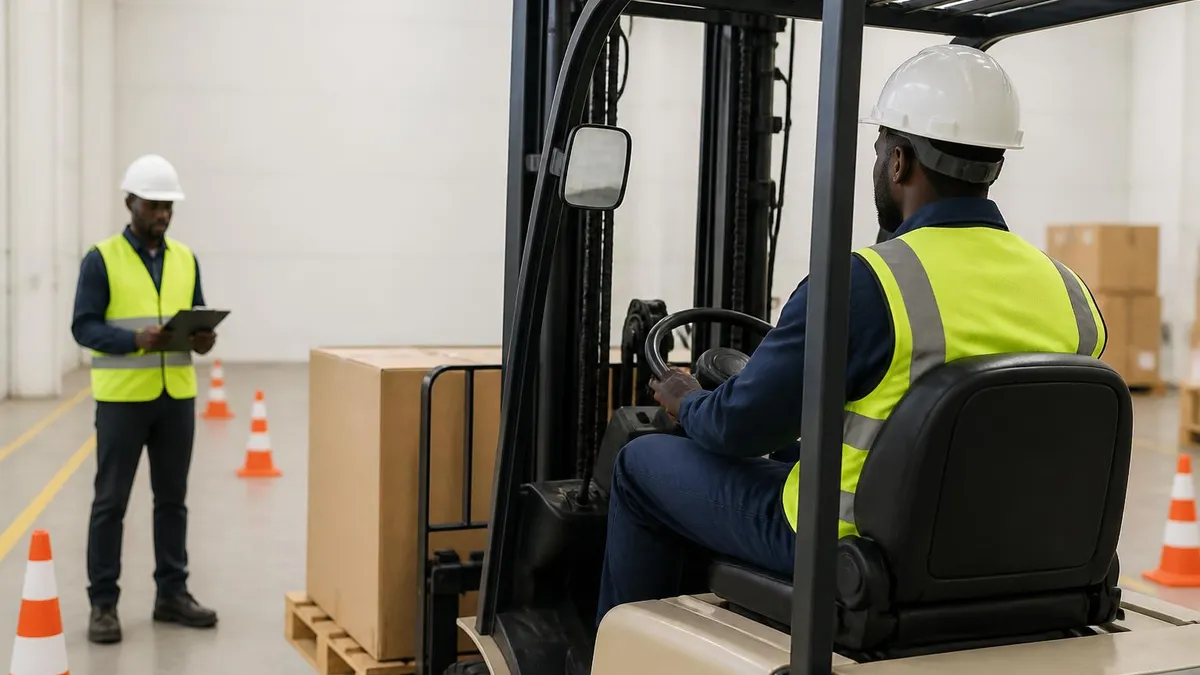
Forklift Certification by State: Complete 50-State Guide to OSHA-Compliant Operator Training, Costs, and Renewal Requirements
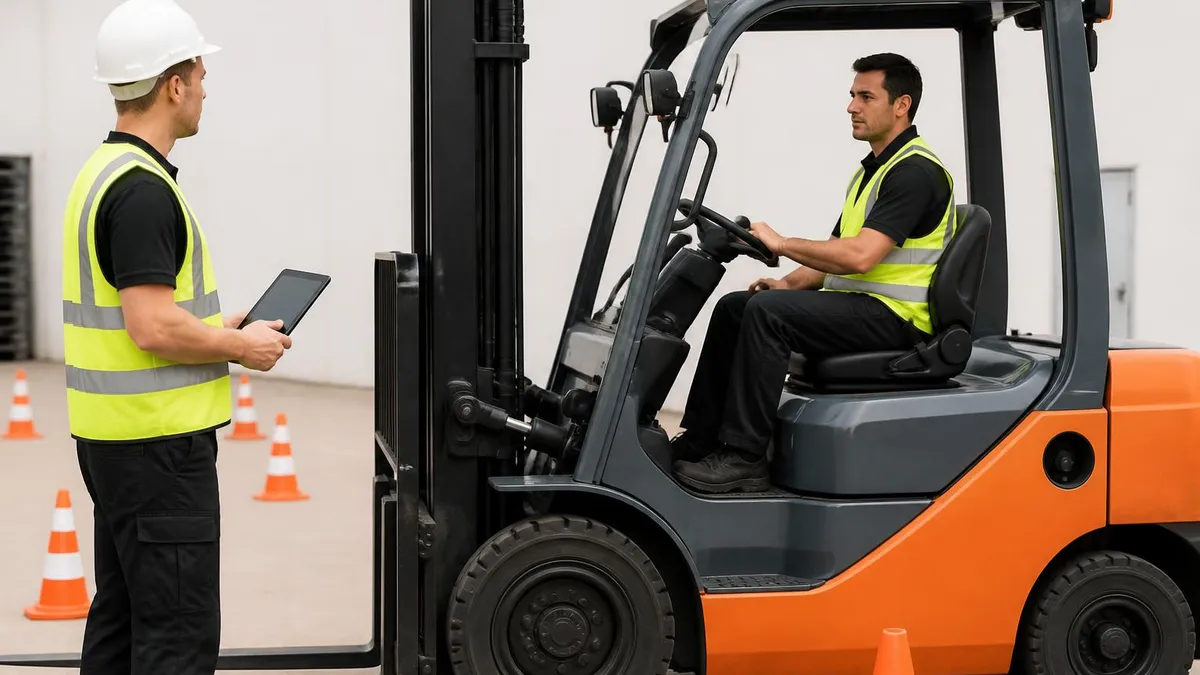
Forklift Safety Training: Complete OSHA Compliance Guide for Operators and Employers
Forklift Certification Online: Complete 2026 Guide to OSHA-Compliant Training, Costs, and Certification in Under 2 Hours
Do You Need a License to Drive a Forklift? Complete US Requirements Guide for Operators and Employers
Forklift Operator Salary: Pay Rates, Raises, and How to Earn More in 2026
About the Author

Certified Crane Operator & Skilled Trades Exam Specialist
Ferris State UniversityRobert Martinez is a Journeyman Ironworker, NCCCO-certified crane operator, and forklift trainer with a Bachelor of Science in Construction Technology from Ferris State University. He has 21 years of ironworking, rigging, and heavy equipment operation experience across high-rise and industrial construction sites. Robert prepares candidates for crane operator, rigger, forklift, and skilled trades certification examinations.