
Forklift Dealers: Complete Guide to Buying, Renting, and Servicing Material Handling Equipment
Forklift rental, sales, and service from authorized forklift dealers. Compare brands, prices, certification options, and find the right dealer near you. 🏆
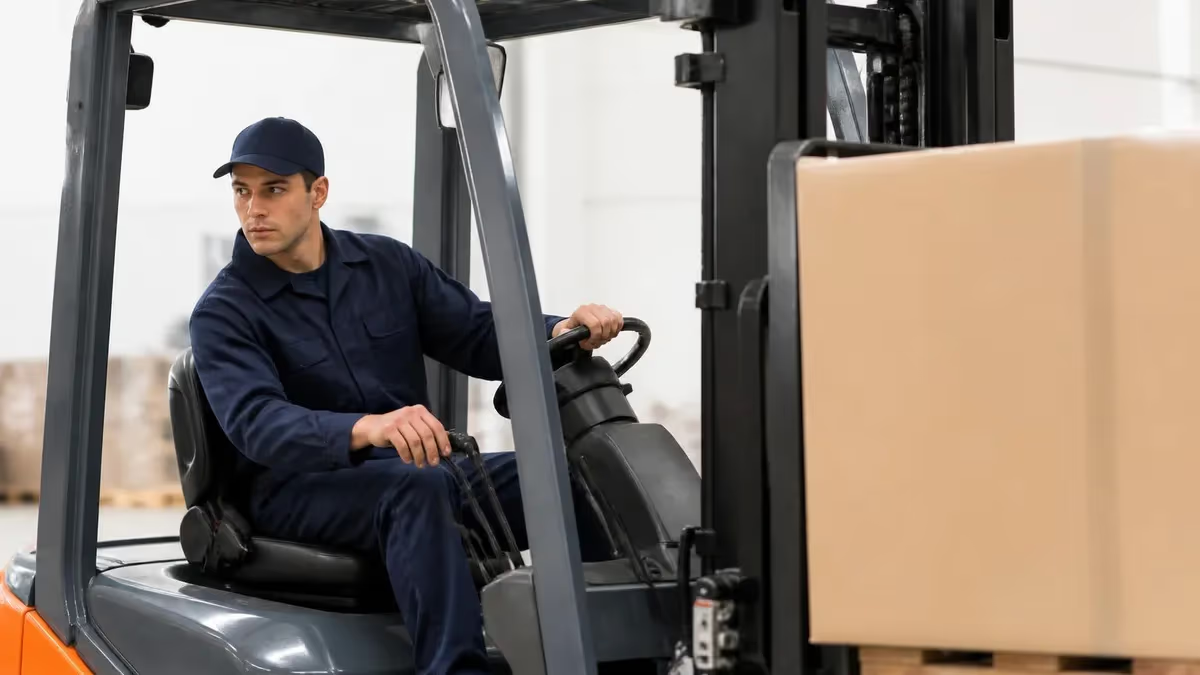
Finding the right forklift dealers can make or break your warehouse operations, and with the U.S. material handling market exceeding $35 billion annually, the choices have never been more abundant or more confusing. Whether you are sourcing a single electric forklift for a small distribution center or fleet-leasing 200 units across multiple facilities, the dealer you select dictates uptime, total cost of ownership, and how quickly you can respond to demand spikes. This guide walks you through everything you need to know about working with dealers in 2026.
Modern forklift dealers function as far more than equipment sellers. They are full-service partners offering forklift rental, certified pre-owned sales, parts distribution, on-site maintenance, telematics integration, and operator training programs. The best dealers carry multiple brands and price tiers, which means you can compare a Toyota 8FGCU25 against a Hyster H50FT or a Crown SP series without leaving the showroom floor. Understanding what each dealer brings to the table helps you negotiate smarter and avoid hidden lifetime costs.
Geography matters enormously when selecting a dealer. A high-volume operator within 30 miles of a major service center will have parts delivered overnight, while a remote facility may wait days for a hydraulic seal kit. That is why operators in metropolitan areas often search forklift rental near me when they need a unit fast for a seasonal surge or a broken-down primary lift. Proximity to service technicians is one of the single best predictors of fleet reliability.
Pricing transparency among forklift dealers has improved dramatically over the past five years, largely thanks to OEM mandates and online configurators. Still, sticker price is just the beginning. A new 5,000-pound capacity internal combustion forklift typically retails between $22,000 and $38,000, while comparable electric models range from $28,000 to $48,000 depending on battery technology and charging infrastructure. Rentals run $175 to $650 per week, with monthly leases often dropping the per-hour cost by 30% or more for committed users.
Beyond equipment, today's leading dealers bundle compliance services that protect you from OSHA penalties, which now exceed $16,131 per serious violation. Many dealers offer turnkey operator certification programs, written safety policies, daily inspection checklists, and even refresher courses scheduled automatically every three years as required by 29 CFR 1910.178. Choosing a dealer with a strong training arm saves administrative overhead and reduces injury risk simultaneously.
This guide is written for purchasing managers, warehouse supervisors, and small business owners who need actionable comparisons rather than marketing fluff. We cover dealer networks, brand differences, lease versus buy math, rental logistics, maintenance contracts, certification requirements, and ten frequently asked questions readers send us each week. By the end, you will know exactly how to vet a dealer, what questions to ask before signing, and how to negotiate terms that favor your operation rather than the dealer's commission structure.
One final note before we dive in: the forklift industry is consolidating. Large national networks like Toyota Material Handling, Raymond, and Crown now own most regional dealerships, while independents focus on multi-brand servicing and specialty equipment. This consolidation has standardized warranties and parts availability but reduced the use individual buyers used to enjoy. Knowing how the modern dealer landscape works is the first step toward getting a fair deal in 2026.
Forklift Dealer Market by the Numbers

Types of Forklift Dealers You Will Encounter
Single-brand dealers exclusively representing manufacturers like Toyota, Hyster, Crown, or Yale. Offer factory warranties, OEM parts overnight, certified technicians, and direct access to engineering support for unusual applications or custom attachments.
Carry several brands plus used equipment. Best for buyers wanting brand comparisons in one stop. Often more flexible on pricing and trade-ins, though warranty work may require coordination with the original manufacturer.
Specialize in short-term and long-term forklift rentals with large standby fleets. Ideal for seasonal operations, project work, or bridge equipment during repairs. Most also sell off-lease units at discounted prices.
Sell reconditioned forklifts with limited warranties at 40-70% off new pricing. Excellent for budget-conscious buyers or backup units. Verify hour meters, inspect mast wear, and request maintenance records before purchase.
Independent shops that service multiple brands without selling new equipment. Often staffed by veteran technicians and priced 20-30% below dealer service rates, though OEM warranty coverage may not apply.
The decision to buy versus rent from forklift dealers comes down to utilization, capital availability, and how predictable your workload is. As a general rule, if you will use a forklift more than 1,200 hours per year for at least four years, purchasing usually wins on total cost of ownership. Below that threshold, rentals or operating leases preserve cash and shift maintenance risk to the dealer. The math gets more nuanced once you factor in tax depreciation, financing rates, and residual values.
Outright purchase remains popular among stable manufacturers and distributors who run consistent two-shift operations. A new 5,000-pound capacity electric forklift purchased for $36,000 with a six-year useful life costs roughly $6,000 per year before maintenance, or about $3.75 per operating hour at 1,600 annual hours. That figure compares favorably to monthly rentals averaging $750 to $1,400, which would total $9,000 to $16,800 annually for the same machine without building any equity.
Leasing splits the difference. Most dealers offer Fair Market Value (FMV) leases at 36 to 60 months with payments of $450 to $900 monthly on a typical Class I or IV unit. At lease end, you return, renew, or purchase at residual value, usually 15 to 25% of original MSRP. The big advantage is bundled maintenance contracts that cap your downside, plus the ability to upgrade technology every few years, which matters as lithium-ion adoption accelerates.
Forklift rental wins decisively for short-term needs. Daily rates run $150 to $300, weekly rates $400 to $750, and monthly rates $1,000 to $2,400 depending on capacity, attachments, and power type. Rental includes maintenance, insurance options, and rapid swap-out if the unit fails. Most dealers maintain regional rental fleets exceeding 500 units, so availability is rarely an issue except during peak season from October through January.
One overlooked option is the rental-to-purchase agreement, where dealers apply a percentage of rental payments toward eventual purchase. Typically 50 to 75% of payments from the first three to six months credit toward the buy price if you commit. This structure works well when you are uncertain whether the application will continue long-term or if you want to test a specific brand before committing. Ask dealers explicitly about this option, as it is rarely advertised.
Operators looking to expand their skills should explore the official certification of forklift requirements before making purchase decisions, since some advanced equipment categories require additional endorsements that affect who on your team can legally operate which machines. This is especially important for stand-up reach trucks, order pickers, and large capacity sit-downs above 8,000 pounds.
Finally, do not overlook used purchases from reputable dealers. A four-year-old, single-shift Toyota or Crown unit with under 6,000 hours often sells for 45 to 55% of new price and carries 90-day powertrain warranties. For backup or low-utilization roles, used equipment delivers excellent value. Just ensure the dealer provides hour-meter verification, mast and chain wear measurements, and a documented service history showing scheduled maintenance was completed.
Forklift certification Practice Test Questions
Prepare for the Forklift certification Certification exam with our free practice test modules. Each quiz covers key topics to help you pass on your first try.
Forklift certification Certification Forkl...
Forklift certification Exam Questions covering Certification Forklift certification Maintenance and Repairs. Master Forklift certification Test concepts for certification prep.
Forklift certification Certification Forkl...
Free Forklift certification Practice Test featuring Certification Forklift certification Maintenance and Repairs Questions and Answers. Improve your Forklift certification Exam score with mock test prep.
Forklift certification Certification Forkl...
Forklift certification Mock Exam on Certification Forklift certification Operator Training and Certification Requirements. Forklift certification Study Guide questions to pass on your first try.
Forklift certification Certification Forkl...
Forklift certification Test Prep for Certification Forklift certification Operator Training and Certification Requirements Questions and Answers. Practice Forklift certification Quiz questions and boost your score.
Forklift certification Load Handling and S...
Forklift certification Questions and Answers on Load Handling and Stability. Free Forklift certification practice for exam readiness.
Forklift certification OSHA Regulations an...
Forklift certification Mock Test covering OSHA Regulations and Compliance. Online Forklift certification Test practice with instant feedback.
Forklift certification Pre-Operation Inspe...
Free Forklift certification Quiz on Pre-Operation Inspections. Forklift certification Exam prep questions with detailed explanations.
Forklift certification Refueling and Recha...
Forklift certification Practice Questions for Refueling and Recharging Procedures. Build confidence for your Forklift certification certification exam.
Forklift certification Safe Driving and Ma...
Forklift certification Test Online for Safe Driving and Maneuvering. Free practice with instant results and feedback.
Forklift certification Workplace Hazard Id...
Forklift certification Study Material on Workplace Hazard Identification. Prepare effectively with real exam-style questions.
Forklift certification Forklift Instructions
Free Forklift certification Test covering Forklift Instructions. Practice and track your Forklift certification exam readiness.
Forklift certification Forklift MCQ
Forklift certification Exam Questions covering Forklift MCQ. Master Forklift certification Test concepts for certification prep.
Forklift certification Forklift Employer R...
Free Forklift certification Practice Test featuring Forklift Employer Responsibilities. Improve your Forklift certification Exam score with mock test prep.
Forklift certification Forklift Penalties ...
Forklift certification Mock Exam on Forklift Penalties for Non-Compliance. Forklift certification Study Guide questions to pass on your first try.
Electric Forklift vs IC Options at Dealers
Electric forklift adoption now accounts for 68% of new sales at major dealers, driven by indoor air quality requirements, lower operating costs, and improved lithium-ion battery technology. Modern electric units deliver comparable performance to internal combustion models for most warehouse applications and produce zero emissions, making them mandatory for food, pharmaceutical, and cold-storage facilities where exhaust contamination is unacceptable.
Pricing premiums for electric forklifts have narrowed significantly. A new 5,000-pound capacity three-wheel electric runs $28,000 to $42,000, with lithium-ion variants adding $4,000 to $8,000. Operating costs drop to roughly $0.85 per hour versus $2.40 for LPG. Dealers typically bundle charging infrastructure quotes, battery warranties up to 7,500 cycles, and trade-in credits for legacy lead-acid units when customers upgrade to lithium.
Buying from a Dealer vs Online Marketplace
- +Factory warranties honored and serviced locally without shipping the unit
- +Certified technicians trained directly by the OEM on your specific model
- +OEM parts stocked regionally with next-day or same-day availability
- +Trade-in credits applied toward upgrades and new equipment purchases
- +Bundled operator certification and refresher training programs
- +Telematics integration and fleet management software support
- +Financing, leasing, and rental-to-own structures arranged in-house
- −Higher sticker prices than auction or private-party sales
- −Limited brand selection at single-line authorized dealerships
- −Aggressive add-on packages that inflate total invoice cost
- −Service rates often $115-$165 per hour at dealer shops
- −Trade-in valuations frequently below private-sale market value
- −Long lead times for custom configurations and specialty attachments
Pros and Cons at a Glance
| Pros | Cons |
|---|---|
| Factory warranties honored and serviced locally without shipping the unit | Higher sticker prices than auction or private-party sales |
| Certified technicians trained directly by the OEM on your specific model | Limited brand selection at single-line authorized dealerships |
| OEM parts stocked regionally with next-day or same-day availability | Aggressive add-on packages that inflate total invoice cost |
| Trade-in credits applied toward upgrades and new equipment purchases | Trade-in valuations frequently below private-sale market value |
| Bundled operator certification and refresher training programs | Long lead times for custom configurations and specialty attachments |

Dealer Vetting Checklist Before You Sign
- ✓Verify the dealer holds current OEM authorization for the brands they sell
- ✓Confirm service technicians are factory-certified on your specific model series
- ✓Request a written response-time guarantee for service calls within your radius
- ✓Check parts inventory turnover and regional warehouse locations
- ✓Review at least three references from customers operating similar fleet sizes
- ✓Compare total cost of ownership including maintenance over five years not sticker price
- ✓Ask for sample service contracts and clarify what is excluded from coverage
- ✓Confirm operator training programs meet 29 CFR 1910.178 requirements
- ✓Verify trade-in valuation methodology and request comparable transaction examples
- ✓Read financing or lease agreements for early termination penalties and balloon payments
- ✓Examine telematics platform compatibility with your existing warehouse software
- ✓Validate insurance coverage for rental units and damage liability thresholds
Dealer margins on parts and service exceed equipment margins 3-to-1
Most forklift dealers earn only 6-12% gross margin on new equipment sales but capture 35-55% margin on parts and 60-70% on labor. When negotiating, push hard on equipment price knowing the dealer recoups profit over the unit's lifetime through service. Lock in capped parts pricing and labor rates for at least 24 months in your purchase agreement to protect against future increases.
Service contracts and warranties separate adequate forklift dealers from exceptional ones. Standard OEM warranties cover the powertrain for 12 months or 2,000 hours, whichever comes first, with mast and hydraulic systems typically warranted 24 months. Extended warranties through dealers can stretch coverage to 60 months or 10,000 hours for $1,800 to $4,200 depending on capacity and duty cycle. Read the fine print carefully, as wear items like tires, forks, chains, and brakes are universally excluded.
Planned maintenance agreements, often called PM contracts, schedule technicians to inspect and service forklifts at fixed intervals, usually every 250 operating hours. A typical agreement costs $400 to $750 per visit and includes oil and filter changes, hydraulic fluid checks, brake adjustments, chain inspections, mast lubrication, and a written condition report. Compared to ad-hoc service calls billed at $130 per hour plus travel, PM contracts almost always save money for active fleets running over 1,500 hours yearly.
Full-maintenance leases bundle equipment, maintenance, tires, and even consumables into one monthly payment, typically $750 to $1,800 per unit depending on capacity and hours. This structure is ideal for buyers who want predictable budgeting and zero downtime surprises. The dealer assumes all repair risk and provides loaner equipment if a unit goes down for more than 24 hours. Several major dealers now offer mileage-style guarantees with uptime SLAs above 97%.
Telematics and remote diagnostics increasingly distinguish premier dealers from commodity providers. Modern forklifts ship with onboard sensors tracking battery state, impact events, operator hours, and dozens of fault codes streamed to dealer service centers in real time. Top dealers monitor these dashboards proactively, dispatching technicians before failures occur and reducing emergency call-outs by 40 to 60% based on industry studies from 2024 and 2025.
Battery service deserves special attention for electric forklift fleets. Lead-acid batteries require watering, equalization, and periodic capacity testing, with replacement every 5 to 7 years at $4,500 to $8,500 per battery. Lithium-ion batteries eliminate watering and offer opportunity charging, lasting 8 to 10 years but costing $9,000 to $18,000 upfront. The best dealers offer battery-as-a-service contracts that include free replacements once capacity drops below 80% of original rating.
Parts pricing varies enormously between dealers. A standard hydraulic seal kit might cost $185 at one dealer and $310 at another for the identical OEM part. Always request a parts price list during contract negotiations and lock pricing for at least 24 months. National account customers operating multi-location fleets can often negotiate 8 to 15% parts discounts simply by committing to a single-source agreement across all sites, which also simplifies invoicing and inventory tracking.
Finally, document everything in writing. Dealer service personnel turn over, regional managers reassign, and verbal commitments evaporate when problems arise. Demand written service-level agreements with specific response times, penalty clauses for missed targets, and named escalation contacts. A dealer reluctant to put commitments on paper is a dealer who plans to break them when it suits their schedule rather than yours.
While forklift dealers provide certification programs, the legal responsibility for operator training under 29 CFR 1910.178(l) remains with the employer. You must document each operator's training, evaluate them on the specific equipment they will operate at your facility, and conduct refresher training every three years. Penalties for noncompliance now exceed $16,131 per serious violation and $161,323 for willful or repeated violations.
Certification and training services from forklift dealers have evolved into sophisticated programs that bundle classroom instruction, hands-on evaluation, and digital recordkeeping. The best dealers offer turnkey solutions where they send certified trainers to your site, conduct OSHA-compliant courses, evaluate each operator on your specific equipment, and provide wallet cards plus digital records you can access through a portal. Typical pricing runs $85 to $175 per operator for initial certification and $45 to $95 for triennial refreshers.
Train-the-trainer programs let you build internal capability while maintaining dealer-grade content quality. Most dealers charge $1,200 to $2,400 per internal trainer for a two-day intensive course that covers adult learning principles, OSHA documentation requirements, hands-on evaluation techniques, and common operator errors. After certification, your internal trainer can certify unlimited employees at your facility, reducing per-operator costs to under $20 and providing scheduling flexibility that external training cannot match.
Online learning platforms have transformed dealer-supplied training. Most major dealers now license cloud-based learning management systems that deliver classroom content via video modules, track completion, and host hands-on evaluation checklists for supervisors to complete. This hybrid approach satisfies the classroom portion of OSHA requirements while preserving the mandatory hands-on evaluation in your actual workplace. Annual subscriptions typically run $850 to $2,400 depending on the number of operators and equipment classes covered.
Equipment-specific endorsements matter more than many buyers realize. OSHA requires separate training for each truck class, meaning an operator certified on a sit-down counterbalance Class IV must complete additional training before legally operating a Class II reach truck or Class III pallet jack. Quality dealers track endorsements per operator and alert you when refresher dates approach. Poor dealers issue blanket certificates that fail audit scrutiny when inspectors review individual evaluation records.
For warehouses with improved-platform applications, the cherry picker forklift family requires specialized fall-protection training, use fitting, and emergency descent procedures beyond standard counterbalance certification. Order pickers operating at heights above six feet trigger additional OSHA requirements under 29 CFR 1910.140 for personal fall arrest systems. Confirm your dealer covers these improved platform protocols thoroughly during operator certification rather than treating them as add-ons.
Refresher training schedules should be automated, not memory-based. Quality dealers maintain digital calendars that alert you 60 days before each operator's three-year anniversary, schedule refresher sessions, and update certification records automatically. Some advanced platforms now integrate with HR systems to flag operators whose certifications expire during planned vacations or leaves, preventing accidental noncompliance. Manual tracking via spreadsheets is the leading cause of lapsed certifications discovered during OSHA inspections.
Forklift dealers offering operator training should also provide post-incident retraining services. Any operator involved in a near-miss, property damage, or injury event must complete remedial training before returning to equipment operation. Documented retraining protects employers from negligent retention claims and satisfies OSHA's expectation that employers actively manage operator competency. Negotiate post-incident training into your service contract upfront so you can dispatch retraining within 24 hours rather than scrambling to schedule it reactively.
When you finally sit down with a forklift dealer to negotiate, preparation determines outcome. Bring three competing quotes, your annual utilization estimate, application details such as load weights and aisle widths, and a clear distinction between must-have and nice-to-have features. Dealers respond predictably to informed buyers who demonstrate they will walk to a competitor if pricing or terms fall short. Vague buyers pay sticker; specific buyers pay 8 to 15% less on equipment and lock in capped service rates besides.
Timing your purchase strategically yields meaningful discounts. Quarter-end periods, especially December and June, push dealer sales teams to hit quotas and unlock manufacturer rebates. Buyers who can flex their decision date by 30 days often capture an additional 3 to 6% off equipment pricing simply by closing within the dealer's reporting window. Ask explicitly which weeks of the quarter offer the deepest manufacturer support; experienced sales representatives will share this information with serious buyers.
Bundling purchases creates use. A buyer ordering five forklifts simultaneously commands far better pricing than five buyers ordering one each over six months. If you anticipate fleet growth, consolidate orders into a master purchase agreement spanning 12 to 24 months with pricing locked at the day-one rate. Dealers happily provide this structure because it removes competitive pressure on subsequent units while giving you budget certainty and protection against price increases driven by tariffs or supply chain disruption.
Trade-ins deserve careful attention. Dealers typically offer 50 to 65% of fair market value as trade credit, banking on resale at 80 to 90% through their used-equipment channels. Get independent appraisals from at least two used-equipment dealers before accepting trade values. In many cases, selling outright to a used dealer or via online marketplace yields 25 to 40% more cash than accepting trade credit, even after factoring in transportation costs and the inconvenience of separate transactions.
Financing terms matter as much as equipment pricing. Compare the dealer's captive finance arm against your bank, credit union, and online lenders such as Crest Capital or Balboa Capital. Annual percentage rates for forklift financing currently range from 5.9% for prime buyers to 12.5% for newer businesses, with terms running 36 to 84 months. A 100-basis-point reduction on a $35,000 equipment loan saves roughly $1,400 over 60 months, easily worth a few hours of rate shopping.
Do not skip the pre-delivery inspection. When your new forklift arrives, walk it side by side with the delivery technician before signing the acceptance paperwork. Test every function, verify the hour meter starts near zero, confirm the data plate matches the purchase order serial number, and document any cosmetic defects with photographs. Issues identified at delivery are resolved free; issues raised a week later trigger warranty paperwork and delays.
Finally, build a long-term relationship with one sales representative and one service manager at your primary dealer. Personal relationships translate to faster response times, priority parts allocation during shortages, and inside information about upcoming promotions or fleet trade-outs that could benefit your operation. Bring them coffee, learn their kids' names, and treat them as partners rather than vendors. The dealer business is small, and reputation as a respectful customer pays dividends for decades.
Sample Forklift certification Practice Questions
Try these questions from our free Forklift certification practice tests. The correct answer and an explanation follow each question.
An employer's duty to provide personal protective equipment for forklift operations includes:
- A. Nothing, as forklifts are enclosed
- B. Appropriate PPE such as high-visibility clothing where needed
- C. Only PPE the operator buys
- D. PPE only after an injury
Answer: B. Appropriate PPE such as high-visibility clothing where needed
Employers must provide appropriate PPE, like high-visibility gear, based on workplace hazard assessment.
What personal protective equipment is commonly required when operating a forklift?
- A. Only a hard hat
- B. Hi-visibility vest, safety shoes, and hard hat as required by the site
- C. No PPE is needed inside a cab
- D. Only gloves
Answer: B. Hi-visibility vest, safety shoes, and hard hat as required by the site
Sites typically require hi-vis clothing, safety footwear, and head protection depending on the environment.
Which set of Personal Protective Equipment (PPE) is most appropriate when watering or charging an electric forklift battery?
- A. Leather gloves, safety glasses, and a hard hat.
- B. Cotton coveralls, steel-toed boots, and a dust mask.
- C. Acid-resistant face shield, goggles, neoprene gloves, and an apron.
- D. Welding helmet, hearing protection, and reflective vest.
Answer: C. Acid-resistant face shield, goggles, neoprene gloves, and an apron.
Forklift batteries contain sulfuric acid, which is highly corrosive. OSHA recommends specific PPE to protect against chemical splashes and burns. This includes an acid-resistant face shield, chemical splash goggles, acid-resistant gloves (like neoprene or rubber), and an acid-resistant apron.
What must an employer provide to a forklift operator before they are allowed to operate the equipment?
- A. A copy of OSHA regulations
- B. Initial training, hands-on practice, and certification
- C. Personal insurance coverage
- D. A verbal warning about forklift safety
Answer: B. Initial training, hands-on practice, and certification
Before an employee can operate a forklift, OSHA requires a comprehensive training program. This program must include formal instruction (classroom or online), practical hands-on training, and an evaluation of the operator's performance. Only after successfully completing all these components and being certified by the employer can an individual legally and safely operate a powered industrial truck.
Forklift Questions and Answers
Forklift Jobs Near Me: Complete Guide to Finding Best Opportunities
Forklift Operation & Equipment Knowledge Practice Test Video Answer
Forklift Inspection & Maintenance Practice Test Video Answer
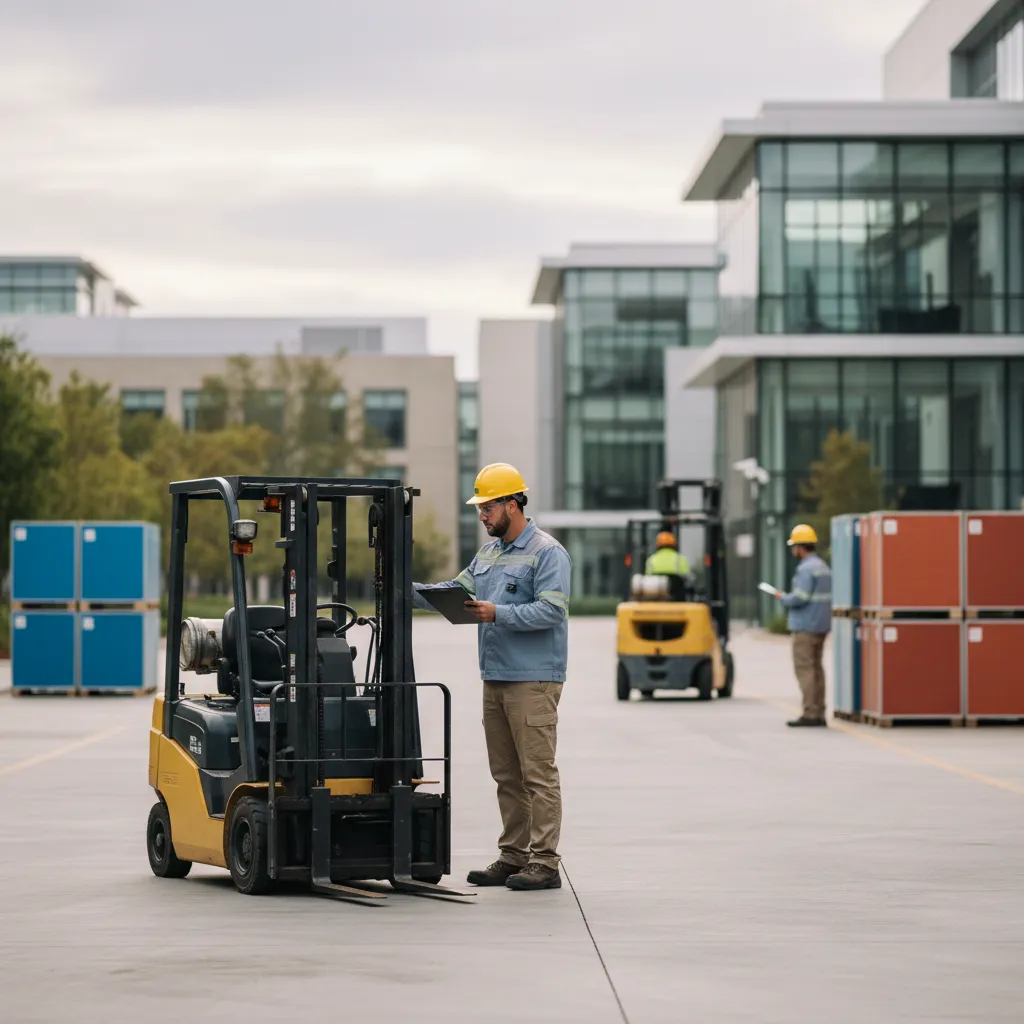
30-Day Forklift certification Certification Study Plan — Pass on Your First Try
Forklift Certification 2026
About the Author
Certified Crane Operator & Skilled Trades Exam Specialist
Ferris State UniversityRobert Martinez is a Journeyman Ironworker, NCCCO-certified crane operator, and forklift trainer with a Bachelor of Science in Construction Technology from Ferris State University. He has 21 years of ironworking, rigging, and heavy equipment operation experience across high-rise and industrial construction sites. Robert prepares candidates for crane operator, rigger, forklift, and skilled trades certification examinations.