
Forklift Brands: Top Manufacturers, Models & Buying Guide 2026 October
📝 Compare top forklift brands, models, and reliability ratings. Find the best forklift rental, electric forklift, and stand up forklift options for your...
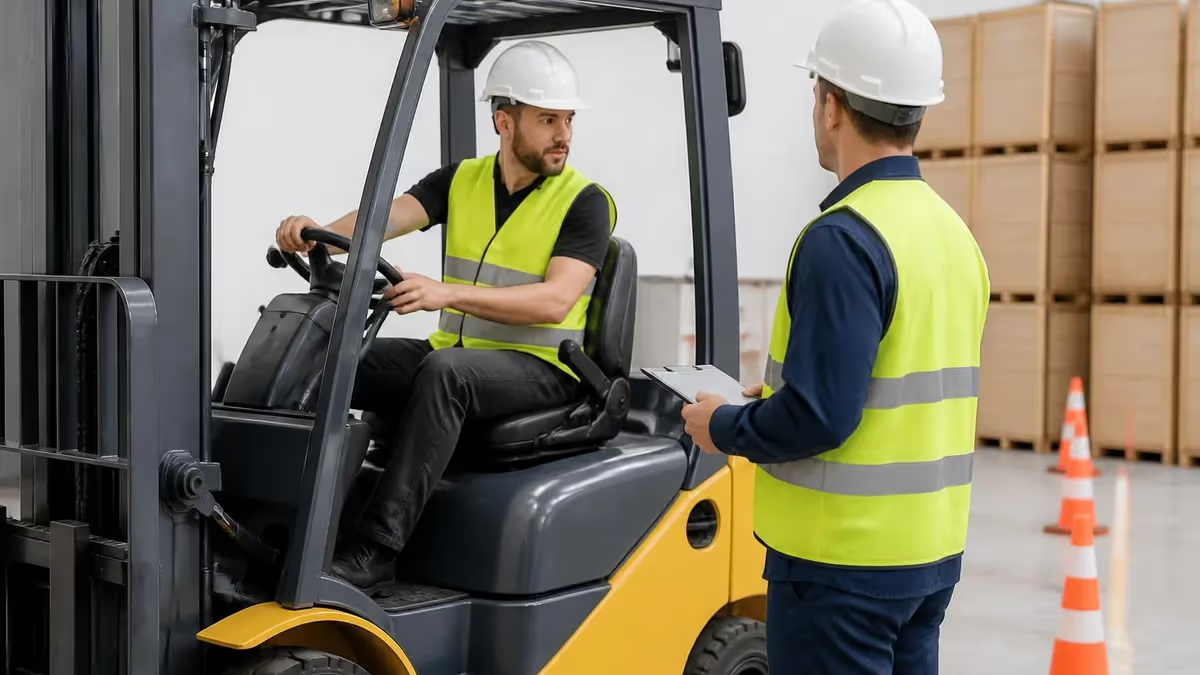
Choosing among the leading forklift brands shapes everything from daily productivity to your long-term maintenance budget, and the market in 2026 looks very different than it did even five years ago. Toyota, Hyster-Yale, KION (Linde and Still), Mitsubishi Logisnet (which includes Cat and Jungheinrich partnerships), Crown, Komatsu, Hyundai, Doosan, Clark, and Raymond now battle for warehouse floor space. Whether you need a heavy-duty diesel for outdoor lumber yards or a compact stand up forklift for cold storage, brand selection drives total cost of ownership more than any single feature.
For most U.S. operations, the conversation starts with three questions: how many hours per shift will the truck run, what fuel type fits the facility, and is rental smarter than purchase? A short-term forklift rental may make sense for seasonal peaks, construction punch lists, or testing a new brand before buying. Long-term leases and ownership become more economical once weekly usage exceeds about 25 hours.
Toyota has held the global number-one sales position for more than two decades, and its 8-Series cushion and pneumatic trucks remain the benchmark for reliability in North American warehouses. KION-owned Linde dominates premium European specs, especially hydrostatic drive technology that operators love for smooth control. Crown, headquartered in Ohio, leads narrow-aisle and reach truck categories with its iconic blue and tan color scheme that is hard to miss in any distribution center.
Electric forklift adoption has accelerated dramatically, with lithium-ion battery options now offered by every major manufacturer. According to ITA (Industrial Truck Association) data, Class I, II, and III electric trucks accounted for roughly 65 percent of new U.S. forklift orders in 2025, up from 58 percent in 2022. Lower fuel costs, zero tailpipe emissions, and opportunity charging during breaks all push fleets toward electric, especially indoors where ventilation requirements for internal combustion units add hidden costs.
Beyond the top tier, value brands like Doosan (now Doosan Bobcat), Hyundai Material Handling, Heli, and Hangcha have grown share by offering similar specs at 15 to 30 percent lower acquisition cost. Parts availability and dealer network density should be checked carefully before committing, because a cheaper sticker price means little if a critical hydraulic component takes three weeks to arrive from overseas.
This guide compares the major forklift brands across reliability, total cost of ownership, dealer support, residual value, and fit for specific applications. We also cover certification requirements, operator training expectations by brand, and how to evaluate a forklift for sale on the used market without inheriting someone else's neglected maintenance history. By the end, you will have a clear framework for matching brand to application instead of just chasing the lowest hourly rental quote.
Operator certification is brand-agnostic under OSHA 29 CFR 1910.178, but each manufacturer publishes specific operator manuals, capacity plates, and pre-shift inspection checklists that must be incorporated into your training program. Brand familiarity matters: an operator certified on a Toyota sit-down counterbalance still needs site-specific evaluation before driving a Raymond reach truck or a Crown order picker. We will walk through how brand selection intersects with your certification of forklift operators throughout this guide.
Forklift Brands by the Numbers (2026)

Top 10 Forklift Brands Ranked for 2026
The global sales leader for 23 consecutive years. Known for the 8-Series, System of Active Stability (SAS), and exceptional residual values. Strongest dealer network in North America with parts typically available within 24 hours.
Premium European engineering with hydrostatic drive on Linde models. Strong in port operations, heavy industry, and high-cycle distribution. Slightly higher acquisition cost offset by lower lifetime maintenance.
Two complementary brands under one roof. Hyster dominates heavy-duty 8,000-100,000 lb capacities; Yale focuses on warehouse and narrow-aisle applications. American-engineered with strong industrial presence.
Ohio-based manufacturer leading the narrow-aisle, order picker, and reach truck categories. Award-winning ergonomics and InfoLink fleet management. Operator favorite for productivity and comfort.
Sold through Mitsubishi Logisnext Americas. Reliable counterbalance and warehouse trucks at competitive pricing. Cat-branded units share the same DNA with rugged construction-grade options.
Going deeper than the rankings, each major brand has distinct engineering philosophies that affect real-world performance. Toyota built its reputation on the Toyota Production System, and that lean manufacturing discipline shows up in tight tolerances, consistent build quality, and parts commonality across model years. A 2018 Toyota 8FGCU25 shares many wear parts with a 2026 unit, which keeps maintenance simple. Their patented System of Active Stability automatically locks the rear axle when sensors detect tip-over risk, a feature operators only appreciate after they have needed it.
Linde's hydrostatic transmission eliminates the traditional torque converter and clutch pack, replacing them with closed-loop hydraulic pumps and motors. The result is infinitely variable speed control, smoother direction changes, and significantly less brake wear because the truck slows hydraulically when the operator eases off the accelerator. Linde owners typically report 30 to 40 percent lower brake-related service costs over a five-year period, though the initial purchase price runs 10 to 20 percent higher than comparable Toyotas.
Hyster and Yale share many components but target different buyers. Hyster trucks lean toward big iron: container handlers, empty container stackers, and high-capacity counterbalance units that you will see at marine terminals from Long Beach to Savannah. Yale focuses on the warehouse side with its MO and MP series electric pallet trucks and reach trucks. Both share Hyster-Yale's strong telematics platform and a deep U.S. dealer network rooted in industrial manufacturing regions.
Crown stands out by manufacturing nearly every major component in-house, from motors and controllers to forks and masts. This vertical integration means fewer supply chain surprises and tighter quality control. Crown's signature Access 1 2 3 control system lets the operator drive, lift, and steer simultaneously with minimal effort, and the brand's ergonomic seating and operator compartment design routinely wins industry awards. Many large 3PLs standardize on Crown specifically for operator retention.
Mitsubishi, Cat, and Jungheinrich (through Mitsubishi Logisnext partnerships) round out the established premium tier. Cat-branded trucks share engineering with Mitsubishi but are sold through a separate dealer channel often co-located with construction equipment dealers, making them a natural fit for mixed industrial fleets. Jungheinrich is the European warehouse specialist increasingly available in U.S. markets, especially for very narrow aisle (VNA) and automated guided vehicle applications.
Operator certification translates across brands because OSHA requires hands-on evaluation regardless of manufacturer. Still, your training program must include brand-specific operator manuals and the actual forklifts your team will run. A new hire certified on a Hyster H50FT at a previous job still needs site-specific evaluation on your Toyota 8FGU25 before they can legally operate it under 29 CFR 1910.178(l)(4)(iii).
Value brands like Doosan, Hyundai, Heli, and Hangcha have closed the quality gap considerably. Doosan trucks now come with three-year, 6,000-hour standard warranties that outpace some premium brands. Hyundai's 9-Series features Cummins or Kubota engines on IC models and AC drive on electrics. The trade-off is dealer density: in Texas or California you may have multiple service locations within 50 miles, but in less populated regions parts wait times can stretch out and erode the savings.

Forklift certification Practice Test Questions
Prepare for the Forklift certification Certification exam with our free practice test modules. Each quiz covers key topics to help you pass on your first try.
Forklift certification Certification Forkl...
Forklift certification Exam Questions covering Certification Forklift certification Maintenance and Repairs. Master Forklift certification Test concepts for certification prep.
Forklift certification Certification Forkl...
Free Forklift certification Practice Test featuring Certification Forklift certification Maintenance and Repairs Questions and Answers. Improve your Forklift certification Exam score with mock test prep.
Forklift certification Certification Forkl...
Forklift certification Mock Exam on Certification Forklift certification Operator Training and Certification Requirements. Forklift certification Study Guide questions to pass on your first try.
Forklift certification Certification Forkl...
Forklift certification Test Prep for Certification Forklift certification Operator Training and Certification Requirements Questions and Answers. Practice Forklift certification Quiz questions and boost your score.
Forklift certification Load Handling and S...
Forklift certification Questions and Answers on Load Handling and Stability. Free Forklift certification practice for exam readiness.
Forklift certification OSHA Regulations an...
Forklift certification Mock Test covering OSHA Regulations and Compliance. Online Forklift certification Test practice with instant feedback.
Forklift certification Pre-Operation Inspe...
Free Forklift certification Quiz on Pre-Operation Inspections. Forklift certification Exam prep questions with detailed explanations.
Forklift certification Refueling and Recha...
Forklift certification Practice Questions for Refueling and Recharging Procedures. Build confidence for your Forklift certification certification exam.
Forklift certification Safe Driving and Ma...
Forklift certification Test Online for Safe Driving and Maneuvering. Free practice with instant results and feedback.
Forklift certification Workplace Hazard Id...
Forklift certification Study Material on Workplace Hazard Identification. Prepare effectively with real exam-style questions.
Forklift certification Forklift Instructions
Free Forklift certification Test covering Forklift Instructions. Practice and track your Forklift certification exam readiness.
Forklift certification Forklift MCQ
Forklift certification Exam Questions covering Forklift MCQ. Master Forklift certification Test concepts for certification prep.
Forklift certification Forklift Employer R...
Free Forklift certification Practice Test featuring Forklift Employer Responsibilities. Improve your Forklift certification Exam score with mock test prep.
Forklift certification Forklift Penalties ...
Forklift certification Mock Exam on Forklift Penalties for Non-Compliance. Forklift certification Study Guide questions to pass on your first try.
Electric Forklift vs IC Power by Brand
Every major brand now offers AC-drive electric forklift models with lithium-ion battery options. Toyota's 8FBE series, Crown's SC and FC lines, Linde's E-series, and Hyster-Yale's J-Series all deliver lift heights, runtimes, and acceleration profiles that match or exceed internal combustion equivalents. Lithium-ion adds opportunity charging during breaks, eliminating the battery-swap requirement that historically limited electric adoption to single-shift operations.
Operating costs run roughly $0.80 to $1.20 per hour for energy on a Class I electric, compared with $3.50 to $5.50 per hour for propane or diesel fuel at 2026 prices. Add zero indoor emissions, reduced ventilation requirements, and quieter operation, and the math overwhelmingly favors electric for indoor warehouse work. Brand choice mostly comes down to dealer service and lithium battery warranty terms, which range from 5 to 10 years.
Premium Brands vs Value Brands: Which Wins?
- +Premium brands (Toyota, Linde, Crown) hold 50-65% residual value at 5 years vs 30-40% for value brands
- +Dense dealer networks mean 24-48 hour parts availability across most of the U.S.
- +Standardized training materials and OSHA-compliant operator manuals in multiple languages
- +Better telematics integration (Toyota T-Matics, Crown InfoLink, Hyster Tracker) for fleet management
- +Higher safety feature standardization including operator presence sensing and stability control
- +Stronger financing programs through captive finance arms and certified pre-owned programs
- +Lower long-term maintenance costs due to component commonality and lean manufacturing
- −Acquisition cost 15-30% higher than comparable Doosan, Hyundai, or Heli models
- −Premium rental rates: $650-900/month vs $450-650 for value brand 5,000 lb electrics
- −Long lead times on custom configurations (6-9 months for some Linde and Jungheinrich specs)
- −Dealer markups on common service parts can be 30-50% above aftermarket equivalents
- −Locked into proprietary diagnostic tools that limit third-party service shop options
- −Replacement attachment compatibility sometimes restricted to OEM hydraulic specifications
- −Premium telematics subscriptions add $25-60 per truck per month to operating cost

Forklift Brand Buying & Rental Evaluation Checklist
- ✓Define application: indoor warehouse, outdoor yard, cold storage, food-grade, or hazardous location
- ✓Calculate weekly operating hours to choose between short-term rental, lease, or purchase
- ✓Confirm capacity at load center accounting for attachments (sideshifter, fork positioner add 200-400 lb deduction)
- ✓Verify dealer service location is within 75 miles for warranty support and rapid parts delivery
- ✓Check OSHA compliance: overhead guard, load backrest, seat belt, capacity plate, and operator manual present
- ✓Request 5-year total cost of ownership quote including financing, maintenance, and battery or fuel costs
- ✓Demand demo units on your floor for at least one full shift with your loads before committing to an order
- ✓Review telematics features and confirm data export compatibility with your WMS or fleet system
- ✓Confirm operator training curriculum updates and brand-specific safety briefings are provided at delivery
- ✓Negotiate residual value guarantees on leases and buyback options on operating lease agreements
- ✓Verify lithium-ion battery warranty terms (5-10 years) and recycling/disposal program availability
- ✓Compare extended warranty packages: powertrain coverage, hydraulic coverage, and electronics coverage tiers
Acquisition cost is only 25% of total ownership cost
Industry studies from MHEDA and Modern Materials Handling consistently show that the original purchase price represents just 20 to 25 percent of total forklift ownership cost over a typical 7-year life. Fuel or electricity, maintenance, tires, operator training, and downtime account for the remaining 75 to 80 percent. A premium brand that costs $5,000 more up front but delivers 20 percent lower maintenance and 95 percent uptime versus 88 percent will save you $15,000 to $30,000 over its lifetime.
Parts availability and service network density often outweigh nameplate prestige when you experience your first major breakdown. Toyota operates approximately 70 authorized dealer locations across North America, with most major metropolitan areas hosting at least one service center stocking common wear parts: forks, chains, hydraulic seals, electrical contactors, drive tires, and battery cables. Same-day or next-day delivery on these items is standard, and Toyota's 360 Support package guarantees response times on critical repairs.
Crown maintains a similar density through its branch network, with company-owned locations rather than independent dealers in most markets. This direct service model produces consistent technician training and standardized billing, but it also means Crown service rates tend to run on the higher end of the industry. Hyster-Yale and KION rely more heavily on independent dealer networks, which produces more pricing variance but also allows aggressive negotiation when multiple dealers compete for your fleet.
For value brands, dealer density varies dramatically by region. Doosan and Hyundai have strong presence on the West Coast, in Texas, and in the Southeast where their North American distribution centers are located. Heli and Hangcha lean on smaller regional distributors and may have only one authorized location per state. Before purchasing a Chinese-built unit, drive the route from your facility to the nearest service center and confirm in writing how parts will be sourced for non-stocked items.
Certified pre-owned (CPO) programs from premium brands offer a middle path between new and used. Toyota Certified Used Forklifts undergo a 130-point inspection and ship with a 6-month or 1,000-hour powertrain warranty. Hyster-Yale's Premium Pre-Owned program is similar. CPO trucks typically cost 40 to 55 percent less than new equivalents while preserving most of the reliability advantage, and they remain eligible for manufacturer extended warranty plans.
Independent service providers fill gaps where dealer networks are thin, especially for older brand models that fall outside dealer support lifecycles. Companies like Forklift Pro, Mid-Atlantic Industrial, and regional players serve mixed-brand fleets with diagnostic tools that work across manufacturers. Their hourly labor rates often beat dealer rates by 20 to 35 percent, though they may lack access to proprietary software updates and warranty-claim authority.
Operator certification of forklift drivers requires familiarity with the specific brand and model in service, so when you change brands or add a new model class, you must conduct refresher training and a documented evaluation. OSHA does not require a full certification reset, but the operator's training record must reflect the new equipment. Most dealers will conduct this training as part of the delivery process, and many include it free for fleet customers.
Warranty terms vary widely and deserve careful comparison. Toyota offers 1-year/2,000-hour standard with extended options up to 5-year/10,000-hour. Crown standard is 1-year/1,500-hour. Doosan stands out with a 3-year/6,000-hour standard warranty that essentially matches premium extended packages at no additional cost. Read the fine print on consumables exclusions: tires, brushes, contactors, and seals are typically not covered even under extended terms.
OSHA 29 CFR 1910.178(l)(3) requires brand and model-specific operator training. A worker certified on a Toyota sit-down counterbalance is not automatically qualified to operate a Raymond reach truck, Crown order picker, or Hyster stand up forklift. Each truck type requires documented hands-on evaluation by a qualified trainer before independent operation. Fines for unqualified operation start at $16,131 per violation in 2026 and rise to $161,323 for willful or repeat offenses.
Matching brand to application is more important than picking a winner overall. For high-cycle distribution centers running three shifts on Class I electric counterbalance trucks, Toyota 8FBE, Crown SC, and Linde E-series are the proven leaders. The decision typically comes down to local dealer responsiveness and lithium battery warranty terms rather than any inherent capability gap. Most large 3PLs we surveyed run mixed fleets of Toyota and Crown to maintain pricing use with both dealers.
Cold storage operations have unique requirements that favor brands with proven sub-zero packages. Crown's RC and RR series include factory cold storage options with heated cabs, condensation-resistant electronics, and arctic hydraulic fluid. Raymond, a Toyota subsidiary specializing in narrow-aisle and reach trucks, dominates frozen food warehouses with its 7400 Series Reach-Fork and 4250 Stand Up Counterbalanced models. Operators searching for forklift rental near me for cold storage should specifically request these cold-rated configurations.
Outdoor lumber yards, scrap yards, and steel service centers demand pneumatic-tire diesel trucks in the 8,000 to 30,000 lb class. Hyster H190-280FT and Cat DP70-100N1 lead this category, with Komatsu FD60-100T and Linde H70-180D as strong alternatives. For these applications, mast lift heights, side-shifting fork positioners, and reinforced overhead guards matter more than telematics. Service interval cost is the dominant variable, and brands with engine commonality to existing fleet equipment win on parts inventory simplification.
Manufacturing plants running mixed indoor-outdoor operations typically standardize on cushion-tire LPG trucks: Toyota 8FGCU25, Hyster H50FT, Cat 2C5000, and Mitsubishi FG25N. These trucks balance maneuverability inside the plant with the ability to handle outdoor staging areas. A used forklift for sale in this category routinely shows up on auction sites at $8,000 to $18,000 for trucks with 6,000 to 12,000 hours, often representing solid value for low-cycle secondary applications.
Construction sites and rough-terrain applications require specialized brands: JCB, Manitou, JLG (formerly Skytrak), Sky Trak, and Genie dominate variable reach telehandlers. Cat and Hyster offer rough-terrain straight-mast forklifts. These are technically a different equipment class (powered industrial trucks with rough-terrain rating) but often part of the same purchasing conversation. Operator certification for rough-terrain requires distinct training under the same OSHA standard.
For new and growing operations, rental presents the lowest-risk path to brand evaluation. Most national rental fleets (United Rentals, Sunbelt Rentals, Toyota Material Handling Rentals, Crown Lift Trucks) carry multiple brands and can deliver a unit within 24-48 hours for monthly rates ranging from $450 for a basic 4,000 lb electric to $1,800+ for high-capacity diesel pneumatic trucks. Try two or three brands over consecutive months before committing to a long-term purchase or lease.
Industry-specific specialists sometimes outweigh general-purpose leaders. Paper and pulp mills favor Taylor and Hoist for clamp truck applications. Beverage and bottling plants often run Big Joe walkie stackers and Hyster ride-on pallet trucks. Auto manufacturing plants standardize on Toyota for body-in-white movement and Crown for tire and parts staging. Talk to operations managers in your specific industry before assuming the top-ranked brand overall is also the top-ranked brand for your niche.
Practical brand evaluation comes down to seven steps you can execute in 30 to 60 days. First, document your application requirements in writing: capacity, lift height, fuel type, aisle width, and shift hours. This document becomes the RFQ baseline that prevents dealer salespeople from steering you toward whatever inventory they need to move. Distribute it to at least three brand dealers and require apples-to-apples quotes including 5-year maintenance contracts.
Second, schedule on-site demos. Every reputable forklift dealer will deliver a demo unit for at least one full shift, and many will leave it for a week. Have your actual operators run the truck through your actual workflows, not a sanitized demonstration loop. Track productivity metrics: pallets per hour, complaint frequency, fatigue at shift end, and any incidents. Operator feedback from this trial is the single best predictor of long-term satisfaction with a brand.
Third, request reference customers. Ask each dealer for three customers in your industry running the same model you are considering, ideally with 2,000+ hours of operation. Call them directly, ask about uptime, parts wait times, dealer responsiveness, and what they would do differently. Reputable dealers welcome this; ones that hedge or stall should be eliminated from consideration. Reference checks routinely uncover patterns that dealers would never volunteer.
Fourth, evaluate trainer support. Brand selection includes the training infrastructure that will keep your operators certified and your insurance carrier happy. Toyota, Crown, Hyster-Yale, and KION all offer factory-developed train-the-trainer programs that produce in-house certified evaluators. This is enormously valuable for medium and large fleets because it eliminates ongoing dependence on third-party training providers and reduces certification renewal costs.
Fifth, compare financing terms. Captive finance arms (Toyota Financial Services, Crown Credit, KION Financial) typically offer better terms than third-party leasing companies because the brand has skin in the game on residual values. Operating leases with $1 buyouts, fair-market-value buyouts, and step-payment structures all have specific tax and accounting implications. Bring your CFO or accountant into the financing conversation before signing.
Sixth, plan for end-of-life. The trucks you buy today will be sold, traded, or scrapped in 7 to 10 years. Brands with strong residual values (Toyota, Crown, Linde) make trade-up cycles less painful because the equity in your fleet partially funds the next generation. Brands with weaker residuals require more cash flow at each replacement cycle, which can disrupt capital planning if you have not modeled it accurately.
Seventh, build your maintenance program around the brand's specific service intervals. Toyota recommends 250-hour PM intervals; Crown specifies 500 hours for some models; Hyster's high-capacity diesel trucks have 250-hour engine service and 1,000-hour transmission service. Loading these schedules into your CMMS at delivery prevents missed services that void warranties and accelerate component wear. Brand-specific service training for your in-house technicians, where applicable, pays back within 18 months for fleets above 10 units.
Sample Forklift certification Practice Questions
Try these questions from our free Forklift certification practice tests. The correct answer and an explanation follow each question.
An operator is using an LPG-powered forklift inside a refrigerated warehouse with limited air circulation. Which of the following represents the MOST significant, yet least obvious, environmental hazard in this situation?
- A. Slippery floors from condensation
- B. Reduced battery efficiency due to the cold
- C. The buildup of carbon monoxide (CO)
- D. Loud noise from the engine echoing in the space
Answer: C. The buildup of carbon monoxide (CO)
Forklifts powered by internal combustion engines, including LPG, produce carbon monoxide (CO), a colorless, odorless, and highly poisonous gas. In poorly ventilated or enclosed areas like a refrigerated warehouse, CO can accumulate to deadly levels without being easily detected.
What is a safe practice when a pedestrian is in the path of your forklift?
- A. Speed up to pass quickly
- B. Sound the horn, slow down, and stop if needed
- C. Continue at the same speed
- D. Raise the forks as a warning
Answer: B. Sound the horn, slow down, and stop if needed
Operators must sound the horn at intersections and blind spots, slow down, and yield to pedestrians who always have the right of way.
Before starting an electric forklift, what should you check on the battery?
- A. Its color
- B. Charge level, connections, and electrolyte
- C. The manufacturer's logo
- D. Only the weight
Answer: B. Charge level, connections, and electrolyte
Electric forklift inspections include verifying charge, secure cable connections, and proper electrolyte levels.
Which of the following actions is most likely to cause a forklift to tip over sideways (lateral tip-over)?
- A. Driving with the load tilted back.
- B. Coming to a sudden stop in a straight line.
- C. Turning too sharply, especially at speed.
- D. Carrying a load that is below the rated capacity.
Answer: C. Turning too sharply, especially at speed.
Making a sharp turn, particularly at an unsafe speed, shifts the forklift's center of gravity outside of the stability triangle. This dynamic force is a primary cause of lateral tip-overs, which are among the most common and dangerous types of forklift accidents.
Forklift Questions and Answers
Forklift Jobs Near Me: Complete Guide to Finding Best Opportunities
Forklift Operation & Equipment Knowledge Practice Test Video Answer
Forklift Inspection & Maintenance Practice Test Video Answer
Forklift Operator Jobs Near Me: Pay, Top Employers, Specialty Roles
30-Day Forklift certification Certification Study Plan — Pass on Your First Try
About the Author
Certified Crane Operator & Skilled Trades Exam Specialist
Ferris State UniversityRobert Martinez is a Journeyman Ironworker, NCCCO-certified crane operator, and forklift trainer with a Bachelor of Science in Construction Technology from Ferris State University. He has 21 years of ironworking, rigging, and heavy equipment operation experience across high-rise and industrial construction sites. Robert prepares candidates for crane operator, rigger, forklift, and skilled trades certification examinations.