
Forklift Jobs Near Me: Complete Guide to Finding Best Opportunities
Forklift jobs near me complete guide to finding the best opportunities — 🆕 OSHA certification, training, equipment types, and warehouse career advancement.
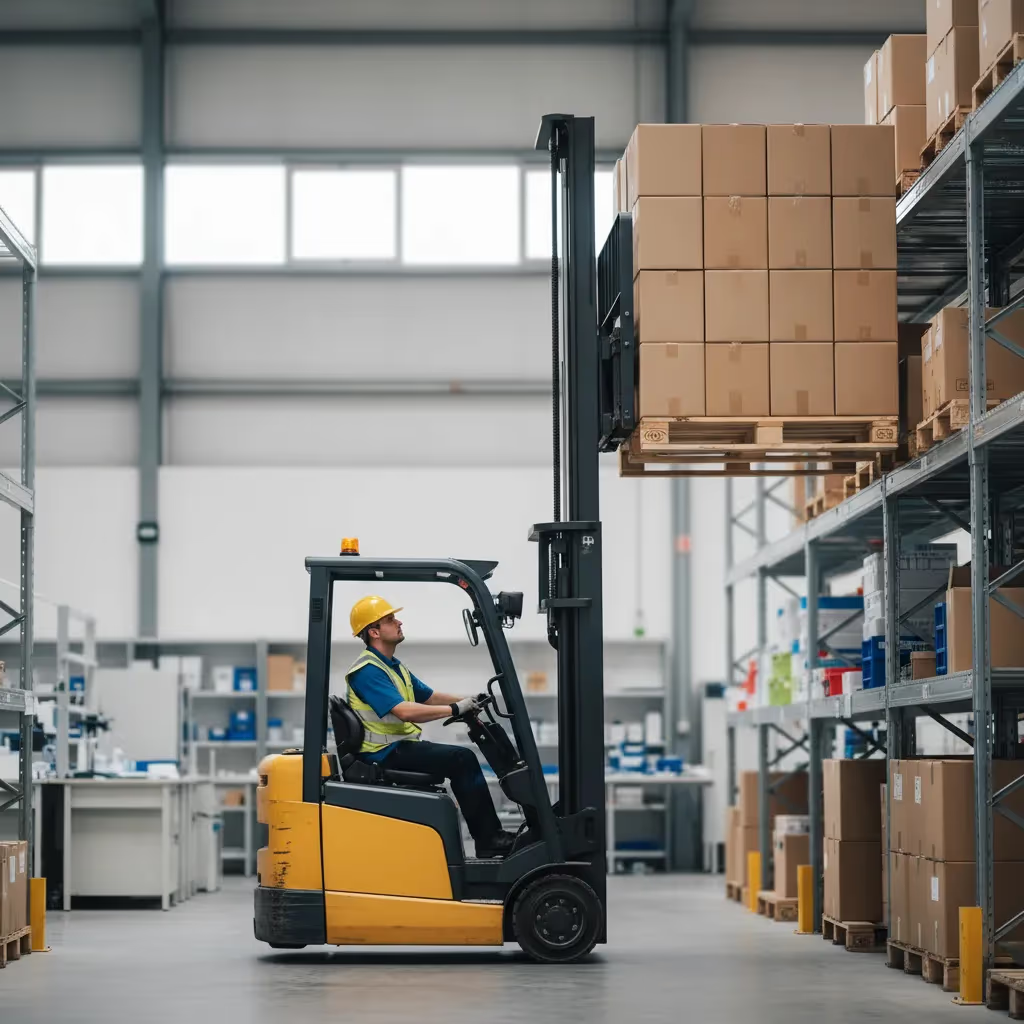
This forklift jobs near me complete guide to finding the best opportunities covers the warehouse, distribution, and industrial sectors where forklift operators are in consistent demand. The first decision: whether you need to rent a forklift for a project, get certified to operate one professionally, or find a forklift operator job.
The forklift rental market generates significantly more search volume than "forklift jobs" but represents a different need. If you're searching for rental, you likely need a forklift for a specific project. If you're searching for jobs or operator training, you need OSHA-mandated forklift certification before any employer will hire you. This page covers both perspectives but focuses on the certification + jobs side.
You'll see how OSHA-mandated forklift training works, the 7 forklift classes (Class I sit-down electric, Class II narrow aisle, etc.), typical wage ranges by region, and where job postings cluster. Most forklift operator jobs require OSHA forklift certification plus on-the-job training specific to each employer's equipment. Wages range from $14-$25/hour at entry level with $20-$35/hour common for experienced specialty operators (high-reach, telehandler, electric stand-up).
If you're already certified and looking for jobs, the test-day checklist near the bottom covers application essentials. If you're earlier in the career planning, the structure cards section maps the path from zero experience to first paid forklift job. By the end of this guide, you'll know how to find, qualify for, and excel in forklift operator positions.
Forklift Industry by the Numbers
The forklift certification requirement is federally mandated by OSHA 29 CFR 1910.178. Every forklift operator must complete formal classroom/practical training plus a performance evaluation before operating equipment unsupervised. Certification is employer-specific — your training and evaluation at one employer doesn't automatically transfer to another. New employers must re-certify you on their equipment and in their facility environment, though much of the underlying knowledge transfers immediately.
The certification of forklift training typically runs 4-8 hours total: classroom/online training covering OSHA standards, equipment knowledge, and operator safety, plus hands-on evaluation where you demonstrate competency on actual forklift equipment. Many employers offer training in-house with internal trainer-evaluators; others use third-party trainers like NCCER, OSHA Education Center, or licensed independent trainers. Cost: $50-$200 if you pay yourself, often free if your employer provides it.
Plan for OSHA recertification every 3 years per federal regulations. Recertification is shorter than initial certification (typically 2-3 hours) and focuses on equipment-specific competencies and any new safety procedures. Some employers run quarterly safety refresher meetings between formal recertifications. Operators with safety violations or accidents typically require immediate re-evaluation before resuming work.
One worth-knowing detail: many third-party logistics employers (XPO Logistics, J.B. Hunt, C.H. Robinson, Echo Global Logistics) hire forklift operators at higher rates than retail employers because the operations are more time-sensitive. Trucking-adjacent warehouse work often pays $19-$24/hour at entry level versus $14-$18 at retail backrooms. The trade-off: 3PL work typically includes more shift rotation, faster pace, and stricter productivity metrics. For wage-focused candidates, target 3PL employers first.
The forklift rental near me queries reflect short-term equipment needs — construction projects, one-time warehouse moves, seasonal inventory work. Major rental companies (United Rentals, Sunbelt Rentals, Hertz Equipment Rental, Home Depot Rental) cover most US markets. Daily rentals run $150-$400 depending on equipment class and capacity. Weekly rates often save 30-50%. Monthly rates save more for projects exceeding 30 days.
The general term certification of forklift operation covers all 7 OSHA forklift classes: Class I (sit-down electric), Class II (narrow aisle electric), Class III (motorized hand trucks/pallet jacks), Class IV (sit-down cushion-tire internal combustion engine), Class V (sit-down pneumatic-tire internal combustion engine), Class VI (electric/IC tractors), Class VII (rough terrain forklifts/telehandlers). Most workplace forklifts are Classes I, IV, or V.
The general forklifts category encompasses huge equipment diversity. Common warehouse forklifts (Class I, IV, V) handle 3,000-10,000 lb capacities. Specialty equipment (telehandlers, narrow-aisle reach trucks, order pickers) handles specific applications. Operator skills vary by equipment — narrow-aisle skills don't transfer perfectly to telehandler operation, for example. Specialty certifications open higher-paying jobs ($25-$35/hour for skilled operators vs $14-$18 for entry-level).
One worth-knowing detail: many third-party logistics employers (XPO Logistics, J.B. Hunt, C.H. Robinson, Echo Global Logistics) hire forklift operators at higher rates than retail employers because the operations are more time-sensitive. Trucking-adjacent warehouse work often pays $19-$24/hour at entry level versus $14-$18 at retail backrooms. The trade-off: 3PL work typically includes more shift rotation, faster pace, and stricter productivity metrics. For wage-focused candidates, target 3PL employers first.
Forklift certification Practice Test Questions
Prepare for the Forklift certification Certification exam with our free practice test modules. Each quiz covers key topics to help you pass on your first try.
Forklift certification Certification Forkl...
Forklift certification Exam Questions covering Certification Forklift certification Maintenance and Repairs. Master Forklift certification Test concepts for certification prep.
Forklift certification Certification Forkl...
Free Forklift certification Practice Test featuring Certification Forklift certification Maintenance and Repairs Questions and Answers. Improve your Forklift certification Exam score with mock test prep.
Forklift certification Certification Forkl...
Forklift certification Mock Exam on Certification Forklift certification Operator Training and Certification Requirements. Forklift certification Study Guide questions to pass on your first try.
Forklift certification Certification Forkl...
Forklift certification Test Prep for Certification Forklift certification Operator Training and Certification Requirements Questions and Answers. Practice Forklift certification Quiz questions and boost your score.
Forklift certification Load Handling and S...
Forklift certification Questions and Answers on Load Handling and Stability. Free Forklift certification practice for exam readiness.
Forklift certification OSHA Regulations an...
Forklift certification Mock Test covering OSHA Regulations and Compliance. Online Forklift certification Test practice with instant feedback.
Forklift certification Pre-Operation Inspe...
Free Forklift certification Quiz on Pre-Operation Inspections. Forklift certification Exam prep questions with detailed explanations.
Forklift certification Refueling and Recha...
Forklift certification Practice Questions for Refueling and Recharging Procedures. Build confidence for your Forklift certification certification exam.
Forklift certification Safe Driving and Ma...
Forklift certification Test Online for Safe Driving and Maneuvering. Free practice with instant results and feedback.
Forklift certification Workplace Hazard Id...
Forklift certification Study Material on Workplace Hazard Identification. Prepare effectively with real exam-style questions.
Forklift certification Forklift Instructions
Free Forklift certification Test covering Forklift Instructions. Practice and track your Forklift certification exam readiness.
Forklift certification Forklift MCQ
Forklift certification Exam Questions covering Forklift MCQ. Master Forklift certification Test concepts for certification prep.
Forklift certification Forklift Employer R...
Free Forklift certification Practice Test featuring Forklift Employer Responsibilities. Improve your Forklift certification Exam score with mock test prep.
Forklift certification Forklift Penalties ...
Forklift certification Mock Exam on Forklift Penalties for Non-Compliance. Forklift certification Study Guide questions to pass on your first try.
Forklift Career Pathways
Entry-level forklift operators work at warehouses, distribution centers, retail backrooms, and manufacturing facilities. Typical wages $14-$18/hour to start, $16-$20/hour after first year. Job titles include Warehouse Associate, Material Handler, Forklift Operator, and Shipping/Receiving Clerk. Major employers (Amazon, Walmart, FedEx Ground, UPS, third-party logistics) hire constantly. Entry positions typically require OSHA certification plus high school diploma equivalent.
The forklift operator career landscape has grown steadily over the past decade. E-commerce expansion (Amazon, Walmart, eBay third-party sellers, Shopify merchants) has created massive distribution center demand. Major distribution metros (Memphis for FedEx, Louisville for UPS, Inland Empire CA for Amazon, Lehigh Valley PA for east-coast distribution) have abundant forklift operator demand year-round. Smaller markets see seasonal spikes (Q4 holiday rush, Q1 New Year inventory).
Quality forklift training happens through multiple channels. Employer-provided training (most common) covers OSHA standards plus equipment-specific operation. Community college programs offer 8-40 hour forklift courses for $200-$800. Online OSHA-compliant courses ($50-$150) supplement in-person practical evaluation. Workforce development programs (state-funded) sometimes offer free forklift training for unemployed candidates. Choose based on your timeline and budget.
Major employers consistently hiring forklift operators include: Amazon (hundreds of US fulfillment centers), Walmart (regional distribution centers), FedEx Ground/Express, UPS, Costco, IKEA, Home Depot DC, Target DC, third-party logistics providers (XPO Logistics, J.B. Hunt, C.H. Robinson). Most post entry-level openings continuously. Application is typically online plus optional walk-in at facility hiring offices.
One worth-knowing detail: many third-party logistics employers (XPO Logistics, J.B. Hunt, C.H. Robinson, Echo Global Logistics) hire forklift operators at higher rates than retail employers because the operations are more time-sensitive. Trucking-adjacent warehouse work often pays $19-$24/hour at entry level versus $14-$18 at retail backrooms. The trade-off: 3PL work typically includes more shift rotation, faster pace, and stricter productivity metrics. For wage-focused candidates, target 3PL employers first.
Path to Your First Forklift Job
Complete OSHA-compliant forklift certification through community college ($200-$800), online course + in-person practical ($50-$200), or workforce development program (often free). Includes classroom training, written test, and hands-on practical evaluation.
Major employers always hiring: Amazon, Walmart, FedEx Ground/Express, UPS, Costco, IKEA, Home Depot DC, Target DC, third-party logistics. Apply online through company career portals. Many also accept walk-in applications at distribution center hiring offices.
After 6-12 months entry-level experience, pursue specialty certifications (reach truck, electric stand-up, order picker, telehandler). Each specialty certification typically adds $2-$5/hour to your earning potential. Most employers provide specialty training to existing operators.
After 3-5 years operator experience, pursue lead operator or supervisor roles. These positions add training, scheduling, and safety oversight duties. Lead roles often pay $25-$35/hour and serve as stepping stones to warehouse management. Some employers offer paid internal training programs.
An electric forklift is the most common warehouse equipment for indoor operations. Electric forklifts run on battery power, produce no emissions, and handle 3,000-10,000 lb capacities. Major brands include Toyota, Caterpillar, Crown, Hyster, Yale, Komatsu, Mitsubishi. Indoor operations heavily prefer electric over internal combustion because of emissions and noise. Operating an electric forklift is broadly similar to other forklift types, with battery management as the unique consideration.
The stand up forklift (Class II narrow aisle reach truck) is a specialty piece of equipment used in tight warehouse aisles. Stand-up operators face different ergonomics than seated operators — sustained standing, frequent forward/backward movement, and high-reach positioning. Wages for stand-up operators typically run $20-$28/hour reflecting the specialty skill required. Training to operate stand-up reach trucks typically requires 8-16 hours beyond basic certification.
The forklift rental near me market serves both construction and warehouse customers. Construction projects use rough-terrain forklifts (Class VII) and telehandlers ($300-$600/day rental). Warehouse customers typically rent Class I or IV/V forklifts ($150-$300/day). Long-term rentals (30+ days) get significantly better pricing. National rental chains (United Rentals, Sunbelt, Hertz) compete with regional independents on price.
One worth-knowing detail: many third-party logistics employers (XPO Logistics, J.B. Hunt, C.H. Robinson, Echo Global Logistics) hire forklift operators at higher rates than retail employers because the operations are more time-sensitive. Trucking-adjacent warehouse work often pays $19-$24/hour at entry level versus $14-$18 at retail backrooms. The trade-off: 3PL work typically includes more shift rotation, faster pace, and stricter productivity metrics. For wage-focused candidates, target 3PL employers first.
Forklift Operator Career: Pros & Cons
- +Strong demand — 861,000+ US forklift operators with consistent annual openings
- +Quick entry — 4-8 hours to OSHA certification, often immediately employable
- +Specialty paths — reach truck, stand-up, telehandler add $2-$5/hour specialty pay
- +Major employers (Amazon, Walmart, FedEx, UPS) constantly hiring
- +Career advancement available to lead, supervisor, and warehouse management
- +Health benefits and 401k common at major employers after probation
- −Physical demands — standing, lifting, climbing on/off forklift all day
- −Shift work common — nights, weekends, and on-call typical at distribution centers
- −Safety risks — OSHA reports 35,000+ forklift-related injuries annually
- −Recertification required every 3 years, often by current employer
- −Wages plateau without specialty skills — entry-level can stay at $16-$18 indefinitely
- −Repetitive motion injuries common over multi-year careers
The forklift certification near me options vary by metro. Major metros (NYC, LA, Chicago, Houston, Dallas, Atlanta, Phoenix) have abundant options — community colleges, private trainers, and employer-provided programs. Smaller metros have fewer options but typically include at least one community college program plus several private trainers. Rural areas may require driving 1-2 hours to the nearest training center.
The cherry picker forklift (also called order picker or man-up vehicle) is a specialty piece of equipment for picking inventory from high warehouse rack positions. Cherry pickers elevate the operator on a platform to working height (15-25 feet typical). Operators wear safety harnesses tethered to the platform. Cherry picker certification is separate from standard forklift certification and requires specific platform-elevation training plus OSHA fall-protection training.
For prospective cherry picker operators, this specialty role earns $19-$26/hour at most warehouse employers — premium over basic forklift operation but still entry-friendly compared to skilled trades. Major e-commerce employers (Amazon, Walmart, Costco) hire cherry picker operators constantly to support order picking operations.
One worth-knowing detail: many third-party logistics employers (XPO Logistics, J.B. Hunt, C.H. Robinson, Echo Global Logistics) hire forklift operators at higher rates than retail employers because the operations are more time-sensitive. Trucking-adjacent warehouse work often pays $19-$24/hour at entry level versus $14-$18 at retail backrooms. The trade-off: 3PL work typically includes more shift rotation, faster pace, and stricter productivity metrics. For wage-focused candidates, target 3PL employers first.
Forklift Operator Job Application Checklist
- ✓Complete OSHA-compliant forklift certification with at least classroom + practical components
- ✓Keep your certification card accessible — employers verify before scheduling first shift
- ✓Bring valid government-issued photo ID for application and onboarding
- ✓Be prepared for physical capability testing (lifting, climbing, sustained standing)
- ✓Pass employer-specific drug testing (most major employers test pre-hire)
- ✓Complete background check authorization — some warehouses require clean records
- ✓Bring or arrange transportation — many distribution centers are in remote suburbs
- ✓Be available for shift work — nights, weekends, and 12-hour shifts are common
- ✓Wear appropriate clothing for hands-on practical evaluation (closed-toe shoes, work clothes)
- ✓Apply at 3-5 employers simultaneously — first-hire offers come from probability of contact
The forklift for sale market includes new equipment ($25,000-$80,000) and used equipment ($5,000-$35,000). Major brands (Toyota, Caterpillar, Crown, Hyster, Yale) hold value better than smaller brands. Used equipment is the price-conscious choice for small businesses or independent contractors. Major dealers (LiftOne, Tyler Distribution, Toyota Industries) carry both new and used. Online marketplaces (MachineryTrader, IronPlanet) offer auctions of used equipment at competitive prices.
The forklifts ecosystem also includes propane tank service, parts/repair suppliers, and training providers. The full ecosystem represents a roughly $20 billion annual US industry. For operators, the industry's size and continued growth means consistent job demand — even during economic downturns, warehouse operations continue at high capacity.
The forklift rentals market complements the purchase market. Smaller businesses rent forklifts for specific projects rather than buying. Construction sites often rent multiple forklifts on long-term contracts. Seasonal businesses (Q4 holiday retail backups, agricultural harvest seasons) use short-term rentals to bridge demand peaks. The rental market is the most flexible entry point for businesses needing forklift capability without capital investment.
One worth-knowing detail: many third-party logistics employers (XPO Logistics, J.B. Hunt, C.H. Robinson, Echo Global Logistics) hire forklift operators at higher rates than retail employers because the operations are more time-sensitive. Trucking-adjacent warehouse work often pays $19-$24/hour at entry level versus $14-$18 at retail backrooms. The trade-off: 3PL work typically includes more shift rotation, faster pace, and stricter productivity metrics. For wage-focused candidates, target 3PL employers first.
Get Certified, Then Apply Everywhere
The fastest path to a paid forklift job: complete OSHA certification (4-8 hours, $50-$200 cost), then apply at 5+ major employers simultaneously. Amazon, Walmart, FedEx, UPS, Costco, and major third-party logistics providers all hire continuously. Apply online plus walk-in at distribution centers. First-hire offers typically come within 2-4 weeks of application. Don't wait for one application to resolve before submitting others — applications cost nothing.
The brand crown forklift (Crown Equipment Corporation) is one of the major US-based forklift manufacturers, headquartered in New Bremen, Ohio. Crown specializes in Class II (narrow aisle), Class III (pallet trucks), and Class I (electric) forklifts. Crown's electric stand-up and reach truck lines are widely used in major warehouse operations. Operating a Crown forklift requires the same OSHA certification as operating any other forklift brand, plus brand-specific familiarity (Crown's controls and ergonomics differ from Toyota or Caterpillar).
The telehandler forklift (Class VII rough-terrain telescopic handler) is the construction industry's preferred lifting equipment. Major brands include JCB, Caterpillar, Genie, Skytrak, and Manitou. Telehandler operators need specific Class VII certification beyond standard warehouse forklift training. Construction-site telehandler operators earn $20-$32/hour reflecting the specialty skill and harsh working conditions.
For job-seekers targeting construction sites specifically, telehandler certification is the highest-leverage credential to pursue. Construction work tends to pay 15-25% above comparable warehouse forklift work due to outdoor conditions, project-specific timing, and rough-terrain skill requirements. Combine OSHA forklift certification with OSHA 30-hour construction safety training for the strongest construction-site qualification profile.
OSHA 29 CFR 1910.178 makes forklift training and evaluation legally required. Untrained operators are explicitly prohibited from operating forklifts in commercial settings. Employers face significant fines for violations, and operators face personal injury risks. Don't skip the training because it seems unnecessary — formal certification is both legally required and personally protective. OSHA reports 100+ forklift fatalities and 35,000+ injuries annually; training prevents most of these.
The used forklifts for sale market is robust because forklifts depreciate slowly when properly maintained. A 5-year-old Class I electric forklift in good condition retails for 40-60% of new value. Hours-of-operation (similar to vehicle mileage) is the key valuation metric — forklifts with under 5,000 hours are considered low-use, while 15,000+ hours are nearing end-of-life. Pre-purchase inspection by a qualified service technician is essential for used equipment buys.
The forklift certified designation on your resume signals to employers that you've completed OSHA-compliant training. List the certification with date and certifying organization (employer-provided or third-party). Some employers prefer specific OSHA-card formats; others accept any compliant certification. Always have your certification documentation accessible — employers verify before scheduling your first shift.
For specific certification renewal, most employers cover renewal training for current operators every 3 years. If you change employers, expect to retake certification on your new employer's equipment even if your prior certification is current. This re-evaluation requirement is OSHA standard practice and shouldn't surprise you. Total time for renewal: 2-3 hours typically.
The phrase forklift truck operators emphasizes the equipment classification — forklifts are also called "lift trucks" or "industrial trucks" in OSHA terminology. The terminology variation matters in industrial settings, where Industrial Truck Operator (ITO) is the formal job title in some employer contexts. For job-search purposes, search both "forklift operator" and "lift truck operator" — different employers use different terms for the same role.
The how to get forklift certified path involves: 1) Choose a training provider (employer-provided, community college, private trainer, or OSHA-approved online course); 2) Complete classroom/online instruction covering OSHA standards and equipment knowledge; 3) Pass the written test; 4) Complete hands-on practical evaluation on actual forklift equipment with a qualified evaluator; 5) Receive your certification card with date and certifying organization. Total time: 4-8 hours typically.
Final tip: schedule your job applications during peak hiring windows. Q4 (October-December) sees massive seasonal hiring across e-commerce distribution centers. Q1 (January-February) sees post-holiday warehouse expansion as retailers process returns and rebuild inventory. May-August sees summer warehouse expansion for back-to-school inventory builds. Time your job search to coincide with employer hiring needs for the highest probability of fast offers.
Forklift Questions and Answers
About the Author
Certified Crane Operator & Skilled Trades Exam Specialist
Ferris State UniversityRobert Martinez is a Journeyman Ironworker, NCCCO-certified crane operator, and forklift trainer with a Bachelor of Science in Construction Technology from Ferris State University. He has 21 years of ironworking, rigging, and heavy equipment operation experience across high-rise and industrial construction sites. Robert prepares candidates for crane operator, rigger, forklift, and skilled trades certification examinations.