
Forklift Certification: OSHA Requirements, Training & How to Get Certified
📗 Prepare for the Forklift Certification: OSHA certification. Practice questions with answer explanations covering all exam domains.
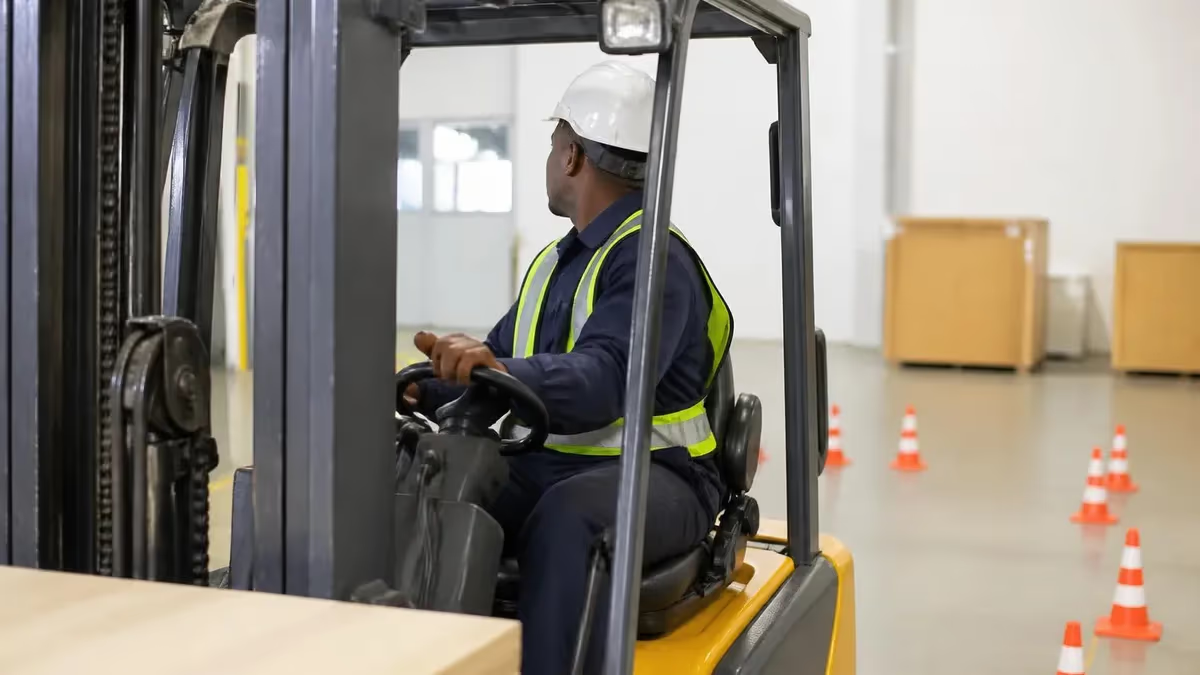
Getting your forklift certification is one of the fastest ways to unlock well-paying warehouse, manufacturing, and logistics jobs. OSHA requires every forklift operator in the United States to complete formal training before they can legally operate powered industrial trucks on the job. Whether you're brand new to forklifts or renewing an expired card, the certification of forklift operation follows a straightforward process -- but you need to understand what's actually required versus what's optional.
If you've been searching for forklift certification near me, you've probably noticed the options range from $50 online courses to $500 in-person programs. The price varies, but the OSHA standard (29 CFR 1910.178) doesn't change. Every legitimate program covers the same core topics: equipment inspection, load handling, pedestrian safety, refueling procedures, and workplace-specific hazards. The real difference between programs comes down to whether they include the hands-on evaluation that OSHA actually mandates.
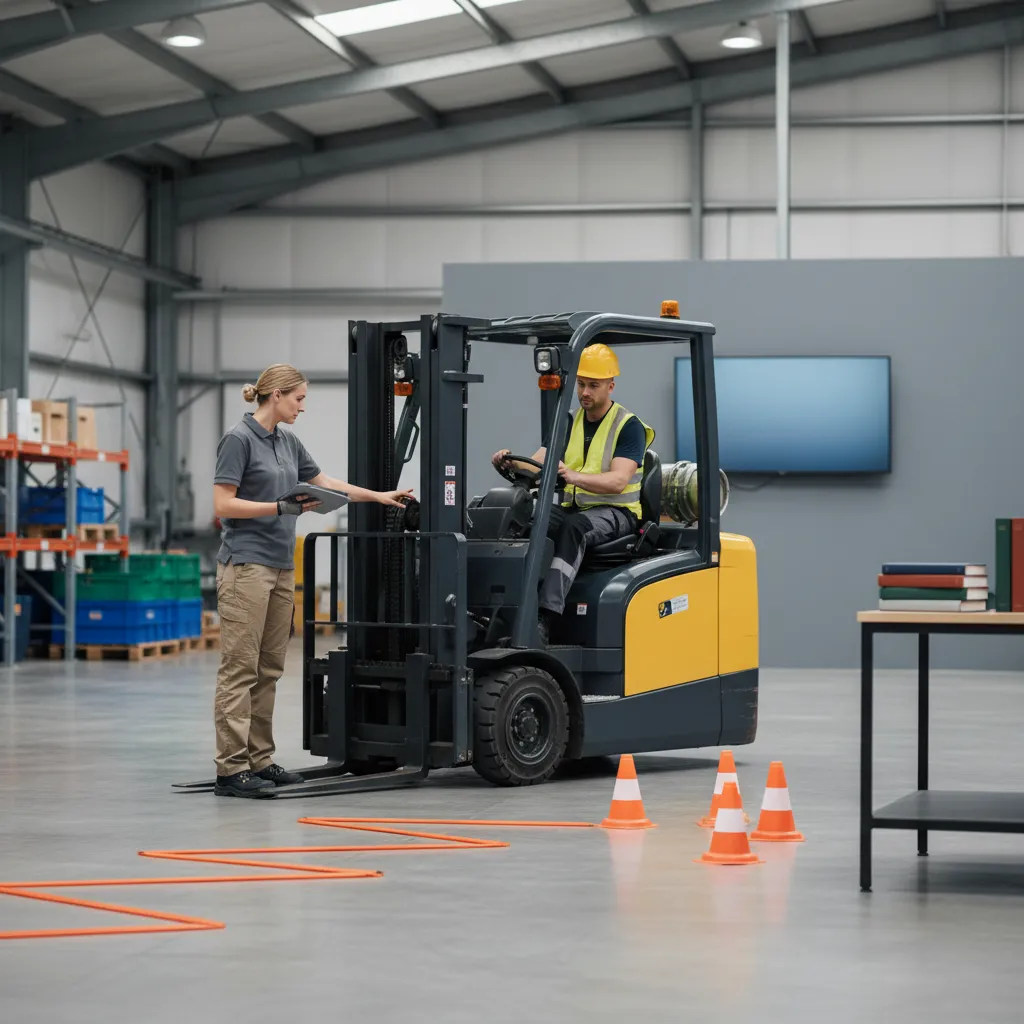
Here's what trips most people up: you can't just take an online course and call yourself certified. OSHA requires a practical evaluation where a qualified trainer watches you operate the specific forklift type you'll use at work. No exceptions. An online course handles the knowledge portion, but someone has to observe you driving a real forklift before that certification counts. This guide walks you through every step -- costs, timelines, training formats, and what employers actually look for when they check your credentials.
When you search for forklift certification near me, you'll find three main types of providers. Community colleges and trade schools offer the most thorough programs -- typically 2-3 days with extensive hands-on time. Employer-provided training is the most common route since OSHA places the training responsibility directly on the employer. Third-party training companies fill the gap for smaller employers who don't have in-house trainers. Each path leads to the same result, but the experience and depth of instruction vary a lot.
Forklift certification training breaks into two mandatory phases. Phase one is classroom instruction (or its online equivalent) covering OSHA regulations, forklift mechanics, stability principles, load charts, and hazard recognition. Phase two is hands-on operation under direct supervision. You can't skip either phase. Some programs compress everything into a single day. Others spread it across a week. The total seat time matters less than the quality of instruction and whether the trainer is genuinely qualified under OSHA's definition.
OSHA doesn't issue forklift licenses or maintain a national database of certified operators. That surprises a lot of people. Your employer certifies you -- not a government agency. The employer keeps the training records, provides the certification card, and takes legal responsibility for your competency. If you switch employers, your new company can accept your existing certification or require you to retrain on their specific equipment and facility layout. Most larger companies retrain regardless.
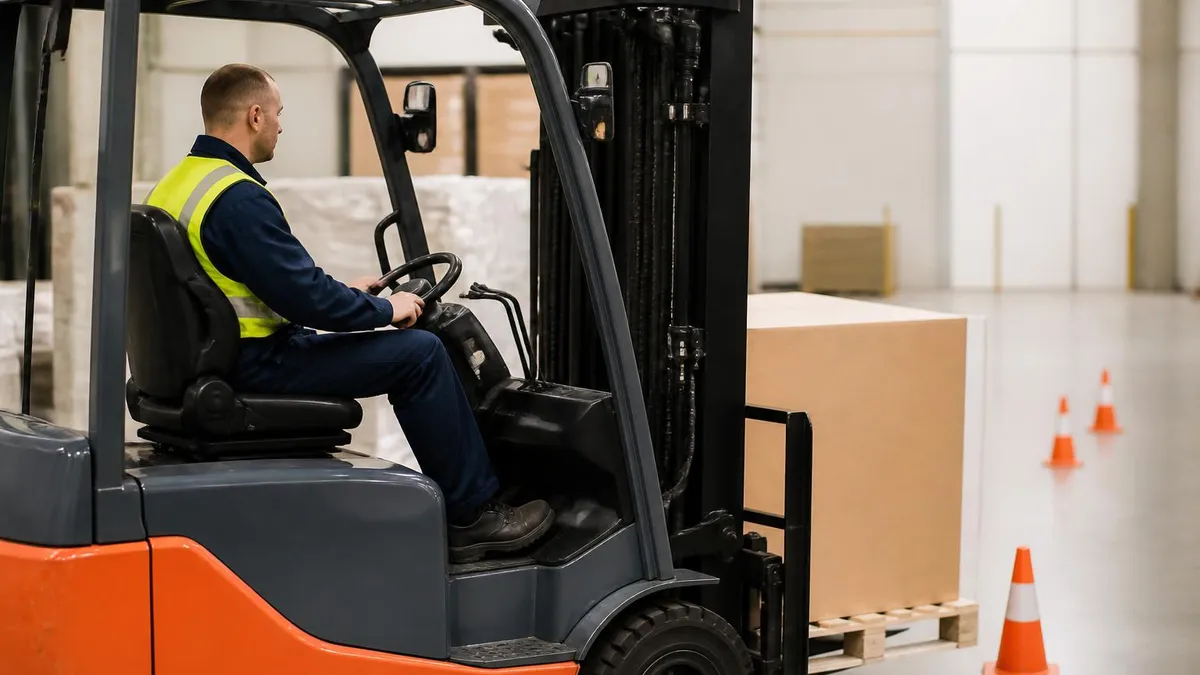
Forklift certification training programs cover seven core topics mandated by OSHA. These include truck-related subjects like operating instructions, controls, steering, and capacity. Then there are workplace-related topics: surface conditions, ramp grades, pedestrian traffic, narrow aisles, and hazardous locations. Forklift training and certification isn't just about driving -- it's about recognizing danger before it becomes an incident. Good trainers spend as much time on hazard awareness as they do on operating technique.
The forklift certification meme culture online actually highlights a real truth: people treat this credential as a rite of passage in warehouse work. The jokes about "forklift certified" being the ultimate achievement have spread across every social platform. But beneath the humor is genuine respect for a skill that prevents injuries and saves lives. Roughly 85 workers die in forklift-related incidents every year in the US, and another 34,900 suffer serious injuries. The memes are funny. The stakes aren't.
What makes a training program legitimate? Look for three things. First, the instructor should be able to demonstrate competency on the equipment -- not just lecture from a manual. Second, the program must cover both your specific forklift type and your actual workplace conditions. Third, there must be a hands-on evaluation at the end. Any program that skips the evaluation isn't OSHA-compliant, no matter how good the classroom material is or how polished their website looks.
OSHA Forklift Training Requirements
The knowledge portion covers operating instructions specific to your forklift type, load capacity and stability principles, refueling and recharging procedures, pedestrian safety, and OSHA regulation 29 CFR 1910.178. This phase can be completed online or in person. Expect 4-8 hours of instruction. You'll take a written test at the end -- most programs require a passing score of 70-80%. Topics include pre-operation inspection checklists, load center calculations, and emergency procedures.
Forklift certification online has become hugely popular -- and for good reason. Online programs let you complete the classroom portion at your own pace, usually in 4-6 hours. You watch videos, read scenarios, and take quizzes that reinforce key concepts. Pricing tends to be lower than in-person classes, often running $50-$150. But here's the catch that online forklift certification providers sometimes bury in fine print: you still need the hands-on evaluation.
An online certificate alone doesn't make you OSHA-compliant. It covers roughly half the requirement. Your employer (or a qualified trainer they designate) must conduct the practical evaluation after you finish the online course. Some online providers partner with local training centers to arrange this step. Others leave it entirely to you and your employer. Before you pay for any online program, confirm whether they help arrange the hands-on portion or whether that's your responsibility.
That said, online training has genuine advantages. You can study during off-hours. You can pause and rewatch tricky sections. The written test at the end can usually be retaken if you don't pass the first time. For experienced operators who just need renewal training, online is often the most efficient option. New operators benefit more from in-person classroom instruction where they can ask questions in real time and learn from other students' mistakes.
Wondering how to get a forklift certification? The process is simpler than most people expect. Step one: talk to your employer. If you're already employed at a warehouse, factory, or distribution center, your company is legally obligated to provide training. Many employers run regular certification classes -- sometimes monthly, sometimes quarterly. If they don't have an in-house program, they'll send you to a third-party trainer. Either way, your employer pays. OSHA places the cost burden on the employer, not the worker.
A forklift certification training course typically runs one to three days. Day one covers classroom material -- OSHA regs, equipment types, stability triangles, load charts, and pre-operation checklists. Day two (and sometimes day three) is all hands-on: driving, stacking, loading trucks, and maneuvering through obstacles. The practical evaluation happens at the end. If you demonstrate safe operation across all required competencies, you get your card. If not, you get additional training time until you can pass. There's no limit on attempts.
For job seekers who aren't currently employed, getting certified before you have a job is trickier. Some community colleges and trade schools offer open-enrollment forklift training and certification courses that anyone can join. These typically cost $150-$400 and include the full program -- classroom, hands-on, and evaluation. Having a certification card in hand gives you a real edge in job applications, even though your new employer might retrain you on their specific equipment.

Forklift Certification: Benefits & Drawbacks
- +Opens doors to warehouse, logistics, and manufacturing jobs paying $18-$28/hour
- +Training takes only 1-3 days -- one of the fastest career credentials available
- +Employers are legally required to cover training costs for current employees
- +Certified operators have significantly lower accident and injury rates
- +Certification is portable across employers (though retraining may be required)
- +High demand -- over 850,000 forklift operator jobs exist in the US
- −Online-only courses don't fulfill OSHA's hands-on evaluation requirement
- −Certification expires every 3 years and requires re-evaluation
- −New employers often require retraining regardless of existing certification
- −Physical demands include sitting for long shifts and repetitive lifting
- −Working in warehouses means exposure to noise, dust, and temperature extremes
- −Some positions require certification on multiple forklift classes/types
Forklift certification cost depends on your situation. If you're employed, your employer foots the bill -- that's OSHA's rule, not a suggestion. Out-of-pocket costs for job seekers range from $50 for a basic online knowledge course (remember, you'll still need the hands-on evaluation separately) to $400-$500 for a full in-person forklift certification course at a trade school. Community colleges often fall in the $150-$250 range and offer the best value for a complete program.
Watch out for pricing tricks. Some providers quote a low price for "certification" but that only covers the online portion. The hands-on training and evaluation cost extra -- sometimes double the initial quote. Others bundle everything into one transparent price. Before you commit, ask exactly what's included: classroom instruction, study materials, hands-on training time, the practical evaluation, and the certification card itself. Get the total number upfront so there are no surprises.
Renewal costs are generally lower than initial certification. A refresher course and re-evaluation typically run $50-$150 since you already have the foundational knowledge. Some employers handle renewals internally at no cost to you. If you're tracking expenses, keep your original certification card and all training records -- they're useful when negotiating with a new employer who might otherwise require you to start from scratch at full price.
Forklift Certification Preparation Checklist
- ✓Review OSHA standard 29 CFR 1910.178 to understand regulatory requirements
- ✓Learn the seven classes of powered industrial trucks and their differences
- ✓Study load capacity charts and understand the stability triangle concept
- ✓Memorize the pre-operation inspection checklist (brakes, tires, mast, hydraulics, controls)
- ✓Practice calculating load center distances and maximum lift heights
- ✓Review refueling and battery charging safety procedures
- ✓Understand pedestrian safety zones and right-of-way rules in the workplace
- ✓Learn proper ramp and grade procedures including traveling with loads
- ✓Study emergency procedures: tip-over protocol, spill response, fire safety
- ✓Take practice tests to identify weak areas before the written exam
Can you get free forklift certification? Sort of. If you're already employed, yes -- your employer must provide and pay for your training. That's genuinely free to you. Some workforce development programs funded by state or local governments also offer no-cost forklift training to unemployed job seekers. Check your local American Job Center (formerly called One-Stop Career Centers) for current offerings. These programs exist specifically to help people get credentials that lead to immediate employment.
The forklift certification memes you see everywhere online -- "I'm forklift certified" with various proud or absurd images -- have turned this credential into a cultural touchpoint. It's become shorthand for having a real, practical skill in a world of abstract credentials. The humor works because there's truth underneath it: being forklift certified actually means something. It means you've trained on heavy equipment that can kill people if operated carelessly, and you passed. That's worth being proud of, memes and all.
Be wary of any program advertising completely free certification with no strings attached. Legitimate training costs money to deliver -- instructors, equipment, insurance, and facility time all have real costs. If a program is truly free, it's likely subsidized by an employer who wants to hire you, a government workforce program with eligibility requirements, or a non-profit with limited slots. "Free" online certificates that skip the hands-on evaluation aren't worth the PDF they're printed on.

You might've seen forklift certification tarkov references if you play the game Escape from Tarkov -- it's an in-game item that's become a collector's joke among gamers. While that's a completely different world from actual OSHA certification, it shows how deeply the concept of forklift certification has embedded itself in popular culture. From memes to video games to TikTok trends, the humble forklift card has become oddly iconic.
For those searching forklift certification in specific locations like Allentown, PA or other cities, your best bet is contacting local community colleges, trade schools, or staffing agencies that specialize in warehouse placement. Many staffing agencies offer free certification as part of their placement services -- they certify you, place you with a client company, and everyone wins. The National Forklift Foundation and your state's OSHA consultation program can also point you toward legitimate local providers.
Regional pricing varies significantly. Training in major metro areas like New York, Los Angeles, or Chicago tends to cost 20-40% more than in smaller cities. Rural areas may have fewer options but lower prices. Don't travel far for training unless you have no local options -- the practical evaluation should ideally happen at or near your actual workplace since OSHA wants you trained on the specific conditions you'll encounter daily.
Any forklift certification program that claims you can complete everything 100% online is not OSHA-compliant. Federal regulations require hands-on training and a practical evaluation conducted by a qualified trainer who directly observes you operating equipment. Online courses can fulfill the knowledge portion only. If a provider guarantees full certification without any in-person component, save your money and find a legitimate program.
Forklift certification price points have stayed relatively stable over the past few years, even as other training costs have climbed. You can still get fully certified for under $200 through many community college programs. OSHA forklift certification online knowledge courses run even cheaper -- $50 to $100 for the classroom portion. Just factor in the cost of arranging your hands-on evaluation separately if the online provider doesn't include it.
Some industries require additional certifications beyond the basic OSHA standard. Construction sites often require OSHA 10 or OSHA 30 certifications on top of forklift training. Cold storage facilities may require specialized training for operating in freezer environments. Hazardous material warehouses add another layer of training requirements. Each additional certification makes you more marketable and typically comes with higher pay. Stack your credentials strategically based on the industry you want to work in.
Insurance companies also influence certification requirements. Many warehouse operators carry liability policies that specify minimum training standards for forklift operators. These standards sometimes exceed OSHA's baseline requirements. You might find that your employer requires 8 hours of classroom training when OSHA technically allows less, simply because their insurer demands it. Don't fight it -- more training means more competence and fewer accidents.
Forklift certification Practice Test Questions
Prepare for the Forklift certification Certification exam with our free practice test modules. Each quiz covers key topics to help you pass on your first try.
Forklift certification Certification Forkl...
Forklift certification Exam Questions covering Certification Forklift certification Maintenance and Repairs. Master Forklift certification Test concepts for certification prep.
Forklift certification Certification Forkl...
Free Forklift certification Practice Test featuring Certification Forklift certification Maintenance and Repairs Questions and Answers. Improve your Forklift certification Exam score with mock test prep.
Forklift certification Certification Forkl...
Forklift certification Mock Exam on Certification Forklift certification Operator Training and Certification Requirements. Forklift certification Study Guide questions to pass on your first try.
Forklift certification Certification Forkl...
Forklift certification Test Prep for Certification Forklift certification Operator Training and Certification Requirements Questions and Answers. Practice Forklift certification Quiz questions and boost your score.
Forklift certification Load Handling and S...
Forklift certification Questions and Answers on Load Handling and Stability. Free Forklift certification practice for exam readiness.
Forklift certification OSHA Regulations an...
Forklift certification Mock Test covering OSHA Regulations and Compliance. Online Forklift certification Test practice with instant feedback.
Forklift certification Pre-Operation Inspe...
Free Forklift certification Quiz on Pre-Operation Inspections. Forklift certification Exam prep questions with detailed explanations.
Forklift certification Refueling and Recha...
Forklift certification Practice Questions for Refueling and Recharging Procedures. Build confidence for your Forklift certification certification exam.
Forklift certification Safe Driving and Ma...
Forklift certification Test Online for Safe Driving and Maneuvering. Free practice with instant results and feedback.
Forklift certification Workplace Hazard Id...
Forklift certification Study Material on Workplace Hazard Identification. Prepare effectively with real exam-style questions.
Forklift certification Forklift Instructions
Free Forklift certification Test covering Forklift Instructions. Practice and track your Forklift certification exam readiness.
Forklift certification Forklift MCQ
Forklift certification Exam Questions covering Forklift MCQ. Master Forklift certification Test concepts for certification prep.
Forklift certification Forklift Employer R...
Free Forklift certification Practice Test featuring Forklift Employer Responsibilities. Improve your Forklift certification Exam score with mock test prep.
Forklift certification Forklift Penalties ...
Forklift certification Mock Exam on Forklift Penalties for Non-Compliance. Forklift certification Study Guide questions to pass on your first try.
Wondering how to get forklift certification as fast as possible? The quickest path is through your current or prospective employer. Tell your supervisor or HR department you want to get certified, and they'll either schedule you for the next training class or connect you with their contracted training provider. Some employers run certification sessions weekly. Others batch them monthly. Express your interest early so you're on the list.
How long does forklift certification last? Three years is the standard OSHA re-evaluation period. But that doesn't mean you're automatically recertified at the three-year mark -- your employer must arrange a new evaluation. And several events can trigger earlier recertification: an accident or near-miss, observed unsafe driving, assignment to a different forklift type, or changes to your work environment (new racking systems, different dock configurations, altered traffic patterns).
Keep your certification card in your wallet and maintain copies of all training records. Some operators laminate their cards. Others photograph them and store digital copies. Whatever method you choose, be able to produce proof of certification on demand. OSHA inspectors can and do ask individual operators for their training documentation during workplace inspections. Having it readily available shows professionalism and keeps your employer out of trouble. Your certification is a career asset -- treat it like one.
Forklift Questions and Answers
About the Author
Certified Crane Operator & Skilled Trades Exam Specialist
Ferris State UniversityRobert Martinez is a Journeyman Ironworker, NCCCO-certified crane operator, and forklift trainer with a Bachelor of Science in Construction Technology from Ferris State University. He has 21 years of ironworking, rigging, and heavy equipment operation experience across high-rise and industrial construction sites. Robert prepares candidates for crane operator, rigger, forklift, and skilled trades certification examinations.