
Forklift Driver: Complete Career Guide 2026 September
🏆 Forklift driver guide — duties, OSHA certification, training, work settings, compensation, career advancement, and safety considerations.
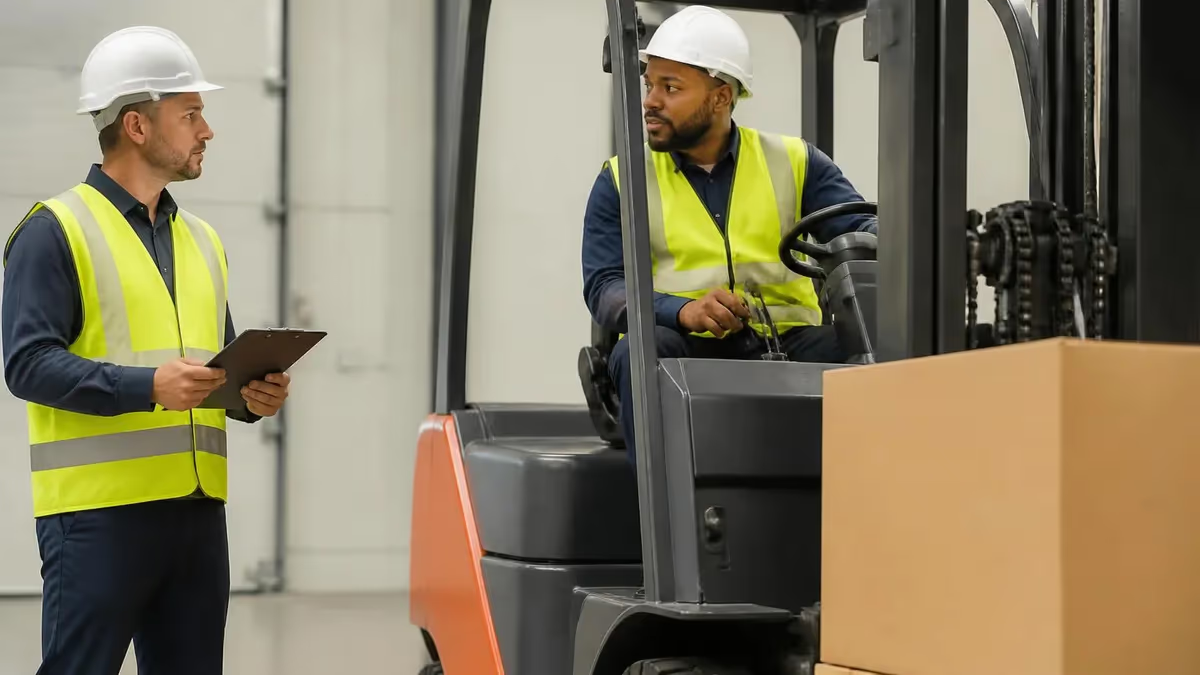
A forklift driver — also called forklift operator or industrial truck operator — operates powered industrial trucks (forklifts and similar equipment) to move, stack, and organize materials in warehouses, distribution centers, manufacturing facilities, and various other industrial settings. The role requires OSHA-mandated certification, hands-on training, and ongoing safety compliance throughout employment. Forklift driving is an entry-level industrial career accessible without college education while offering reasonable compensation and stable employment in the substantial U.S. logistics and warehousing industry that continues growing with e-commerce expansion and supply chain modernization.
This guide walks through the forklift driver role including responsibilities, certification requirements, training options, work settings, compensation, advancement opportunities, and the specific OSHA regulations governing forklift operation. Information here applies broadly across U.S. forklift driver positions with notes about specific regulations and requirements affecting the field. Whether you're considering forklift driving as a career direction, supporting a family member's career planning, or working in warehousing operations needing forklift driver context, this overview covers the essentials of this important industrial role.
The forklift driver role has grown substantially as e-commerce and modern supply chains have expanded warehouse operations. Amazon, Walmart, Target, FedEx, UPS, and various other major employers operate massive distribution networks employing thousands of forklift drivers. Manufacturing facilities employ forklift drivers for material handling within production processes. Construction sites use forklift drivers (often called rough terrain forklifts in this context). Retail receiving areas use forklift drivers for inbound shipment handling. The breadth of employment opportunities reflects how universal forklifts have become in any operation moving substantial physical inventory or materials.

Forklift Driver Quick Facts
Education: Typically high school diploma/GED, no college required. Certification: OSHA-required forklift operator certification through employer-approved training. Training: 1-3 days typical for initial certification including classroom and hands-on. Cost: Often employer-paid as part of hiring; otherwise $50-$300 typical. Median pay: Approximately $36,000-$44,000 annually with regional variation. Job growth: Steady demand with logistics/e-commerce expansion. Settings: Warehouses, distribution centers, manufacturing, construction, retail receiving. Recertification: Every 3 years OSHA requirement, plus performance-based recertification triggers.
The day-to-day work of a forklift driver involves several common activities. Loading and unloading delivery trucks at warehouse docks. Moving pallets between staging areas, storage racks, and shipping zones. Stacking pallets in storage racks at various heights up to 20-30+ feet in some warehouses. Pulling specific items from inventory for order fulfillment in pick operations. Maintaining the forklift through pre-operation inspections and basic care. Communicating with team members, supervisors, and shipping/receiving personnel coordinating material movement. The work involves substantial repetitive task patterns combined with situational awareness for safe operation around other workers and equipment in busy warehouse environments.
OSHA's Powered Industrial Truck standard (29 CFR 1910.178) governs forklift operation in U.S. workplaces. The standard requires employer-provided training before workers operate forklifts, with training covering both general truck-related topics and specific workplace-related topics. Training must include formal instruction (lecture, video, written materials), practical training (demonstration and hands-on practice), and evaluation of operator's performance. Recertification is required every 3 years and after specific events including accidents, near-misses, observed unsafe operation, assignment to new truck type, or workplace condition changes. Each requirement supports operator competence and workplace safety in environments with substantial accident potential.
Forklift Driver Responsibilities
Pick up, transport, and place pallets between locations within facility safely.
Load outbound trucks for shipment and unload inbound deliveries from trucks.
Place pallets in storage racks at various heights using proper stacking technique.
Use forklift to retrieve specific items from storage for order fulfillment operations.
Daily forklift inspection checking brakes, hydraulics, tires, mast, controls before use.
Wear required PPE, follow speed limits, use horn at intersections, watch for pedestrians.
Forklift certification training typically covers several content areas. Forklift operating principles including stability triangle (the geometric concept governing forklift balance), load center calculations affecting safe lifting, mast operation, and various truck-specific operating procedures. Workplace safety including pedestrian safety, intersection rules, speed limits, blind spot awareness, hazardous environment recognition. Pre-operation inspection covering daily checks of forklift systems including brakes, hydraulics, tires, mast, fluid levels. Load handling including secure load placement, proper stacking, weight limits, special load considerations. OSHA regulations covering 29 CFR 1910.178 and various other applicable standards.
Different forklift types require type-specific training under OSHA. Counterbalanced forklifts (most common type) — sit-down rider forklifts with counterweight in rear. Reach trucks for high-rack warehouse storage — operator stands or sits sideways. Order pickers for high-level picking in narrow aisles. Pallet jacks (manual and electric) for ground-level pallet movement. Rough terrain forklifts for construction sites with uneven ground. Each type has specific operational characteristics requiring dedicated training before certification on that type. Operators must be certified for each type they operate; cross-certification doesn't automatically transfer between types.
Forklift accidents remain a significant workplace safety concern despite extensive regulation. OSHA estimates approximately 85-100 fatal forklift accidents annually in U.S. workplaces, with thousands of additional non-fatal injuries. Common accident causes include forklift tipovers (often during turns or with unstable loads), pedestrian struck by forklift, falls from forklift platforms, falling loads, and crushing accidents in narrow aisle situations. Safety procedures including speed limits, horn use at intersections, designated pedestrian walkways, marked traffic patterns, proper load handling all reduce accident frequency though forklift work remains relatively dangerous compared to many other warehouse roles.
1. Verify you meet basic requirements (typically 18+, physical capability, ability to read English for safety materials). 2. Apply to forklift driver positions — many employers hire candidates without prior certification, providing training as part of onboarding. 3. Complete employer-provided OSHA-compliant training including classroom, hands-on practice, and evaluation. 4. Receive certification (specific to that employer and forklift type). 5. Begin work with appropriate supervision until experience accumulates. 6. Maintain certification through 3-year recertification and any triggered re-evaluation events.

Compensation for forklift drivers varies by setting, region, and experience. Median pay nationally is approximately $36,000-$44,000 annually for full-time forklift operators. Entry-level pay typically $14-$18 per hour. Experienced operators earn $18-$24+ per hour. Specialized equipment operators (high-reach, narrow-aisle, cold storage) often earn premium rates. Major metropolitan areas pay 15-25% more than rural markets typically. Union positions in some industries pay substantially more than non-union equivalents. Premium pay for night shifts, weekends, and overtime adds substantially to base compensation in many forklift driving positions.
Working conditions for forklift drivers vary substantially by setting. Climate-controlled warehouses provide comfortable work environment. Cold storage and freezer warehouses operate at sub-zero temperatures requiring substantial cold-weather gear. Outdoor lumber yards, construction sites, and similar settings expose workers to weather conditions. Manufacturing environments may have heat, noise, dust, or chemical exposure depending on production processes. Schedule patterns include standard daytime shifts in some operations, evening/night shifts at distribution centers, weekend work in 24/7 operations. Match work setting to your preferences and tolerances when choosing among forklift driver positions.
Career advancement paths for forklift drivers include several common trajectories. Lead operator positions oversee teams of forklift drivers in larger operations. Forklift trainer positions teach new operators within the facility, often combining training with operations work. Warehouse supervisor positions oversee broader warehouse operations including forklift drivers and various other workers. Specialty equipment positions operate cranes, heavy equipment, or other higher-skilled industrial equipment. Various other warehouse roles (inventory control, shipping coordinator, etc.) build on forklift driver experience. Some operators eventually become warehouse managers with additional education or experience.
Operating a forklift without proper OSHA certification creates serious legal and safety risks. OSHA penalties: Substantial fines for employer if uncertified workers operate forklifts. Personal liability: Worker injuries while operating uncertified can affect workers' compensation and various legal positions. Insurance: Many policies don't cover incidents involving uncertified operators. Best practice: Wait for certification training before operating, even if employer is slow to schedule. Training is typically employer responsibility — don't accept being asked to operate without proper training and certification first. Refuse if asked to operate uncertified — your safety and legal position depend on proper certification.
The certification training itself follows OSHA-specified content requirements. Classroom training covers OSHA regulations, forklift operating principles, stability and load handling, pre-operation inspection procedures, workplace-specific hazards, and various other topics. Practical training involves hands-on equipment operation under supervision including basic operation, loading/unloading, transporting loads, stacking, inspection. Evaluation includes written test demonstrating knowledge plus practical skill demonstration. Documentation of training must be maintained including operator name, training date, evaluator name, date of evaluation, type of equipment certified to operate. Each element supports both legal compliance and actual operator competence development.
For users wanting to maximize their forklift driver career, several strategies help. Develop expertise across multiple forklift types — counterbalanced, reach truck, narrow aisle, etc. — increasing your value across various positions. Pursue specialty certifications in higher-paid equipment areas. Build communication skills supporting team coordination and supervisor potential. Develop computer skills as warehouse management systems become more important. Consider commercial driver license (CDL) for transition from warehouse forklift to truck driving roles paying substantially more. Develop safety leadership reputation supporting trainer and supervisor positions over time. Each strategy contributes to advancement beyond basic forklift driver roles.
For users dealing with the physical demands of forklift driving, several considerations apply. Sitting for extended periods can cause back issues — proper seating posture and stretching breaks help. Repetitive motions of operating controls can affect wrists and shoulders over years of work. Visual fatigue from concentration on operations and surroundings throughout shifts. Stress from working in busy environments with deadline pressure. Physical capabilities including good vision, normal hearing, and reasonable mobility are required. Most healthy adults can perform forklift work successfully though those with specific physical limitations should consult healthcare providers about suitability before pursuing the career.
Becoming a Forklift Driver Action Steps
- ✓Verify basic eligibility (typically 18+, physical capability, English literacy for safety materials)
- ✓Apply to forklift driver positions at warehouses, distribution centers, manufacturers
- ✓Complete employer-provided OSHA-compliant training during onboarding
- ✓Pass written and practical evaluation components
- ✓Receive certification specific to your employer and forklift type
- ✓Begin work with appropriate supervision and gradual independence
- ✓Maintain safety practices consistently to avoid recertification triggers
- ✓Pursue type-specific certifications for additional forklift types over time
- ✓Maintain certification through 3-year recertification per OSHA requirements
- ✓Consider career advancement paths after building experience and reputation
For users without prior forklift experience considering this career path, several entry strategies work. Apply to entry-level positions at warehouses willing to train inexperienced workers — many do given the workforce demand. Temp agencies often place workers in warehouse positions including forklift roles after training. Community college programs in some areas offer forklift certification courses for $50-$300 supporting employment readiness. Individual training programs through commercial providers also available. Even self-paid certification through commercial providers may not transfer between employers — most employers verify their own training regardless of prior certifications, so employer-paid training is typically the more efficient path.
For users wanting to compare forklift driving to similar industrial careers, several alternatives exist. Warehouse worker (without forklift) — lower pay but no certification requirements, broader physical work patterns. Truck driver (CDL required) — substantially higher pay with substantial training investment in CDL. Heavy equipment operator (construction) — higher pay and more variable work but seasonal patterns and weather exposure. Industrial technician (with skills) — much higher pay but requires substantial training. Each alternative has trade-offs around pay, training investment, work conditions, and long-term career trajectories worth considering against forklift driving specifically.
For users dealing with the specific challenge of working at fast-paced warehouses (particularly Amazon and similar large-scale operations), several considerations apply. Production targets can be demanding with significant pressure to meet pace expectations. Repetitive task patterns can become monotonous over time. Time-off policies may be more restrictive than other employers. Compensation may be slightly higher than smaller employers offsetting these challenges. Career advancement opportunities exist within these large operations but competition is substantial. Match employer to your priorities — small employers offer more individualized work but less compensation; large operations offer more compensation but more pressure.

For users considering long-term career sustainability in forklift driving, several factors warrant consideration. Physical demands accumulate over years — many lifelong forklift drivers experience back, neck, shoulder, and joint issues from cumulative stress. Career advancement paths exist but require deliberate development beyond just operating forklifts.
Compensation grows with experience but slowly — major income growth typically requires advancement to supervisor or specialty roles. Industry trends including warehouse automation may affect long-term forklift driver demand though current trends suggest continued strong demand for human operators alongside automation. Plan career trajectory considering both current employment and long-term sustainability across decades of working life.
For users dealing with warehouse automation trends affecting forklift work, several considerations apply. Automated guided vehicles (AGVs) and autonomous mobile robots (AMRs) handle some material movement that forklifts traditionally performed. Automated storage and retrieval systems (AS/RS) handle high-density storage operations. Voice-directed picking and other technology changes operator workflow. Despite automation, human operators remain essential for many operations involving variable loads, complex environments, exception handling, and various other situations where automation isn't yet practical. The trend favors human-automation collaboration rather than replacement, though forklift operator workforce may grow more slowly than overall warehouse activity in coming years.
For users transitioning to forklift driving from other careers, several considerations help. Existing physical work backgrounds (construction, manufacturing) translate well to warehouse environments. Customer service experience supports team coordination aspects of warehouse work. Math skills help with inventory and load calculations. Computer comfort supports increasingly digital warehouse management systems. The transition is generally accessible through entry-level positions with employer-provided training. Most career changers can transition within weeks to months of starting employment though full proficiency develops over months to years of operations experience.
The bottom line on forklift driver careers: they provide accessible entry-level industrial career with reasonable compensation, OSHA-mandated certification through employer training, and stable employment in growing logistics/warehouse industry. Working conditions vary by setting from comfortable climate-controlled warehouses through demanding cold storage or outdoor environments. Career advancement paths exist but require deliberate development.
For those drawn to industrial work without college education requirements, forklift driving offers reasonable career path with meaningful work supporting modern supply chains that essentially every consumer depends on. The role is demanding but provides reliable employment for those who match the work demands and develop solid safety practices throughout their careers.
Forklift Driver Quick Reference
Forklift Types
Most common type. Sit-down rider with counterweight in rear. Used for general warehouse work.
High-reach forklift for narrow aisle warehouses. Operator may stand or sit sideways.
High-level picking forklift in narrow aisles. Operator rises with the platform.
Manual or electric ground-level pallet movers. Lower training requirements.
For construction sites with uneven ground. Typically larger and more powerful.
Reach forklifts with extending boom. Used in construction and agriculture.
For users wanting to understand the safety culture in modern warehousing operations, several patterns matter. Major employers increasingly emphasize safety through detailed safety programs, regular safety meetings, hazard reporting systems, and various other safety culture initiatives. Near-miss reporting (events that could have caused injury but didn't) helps identify hazards before injuries occur.
Pedestrian protection through designated walkways, mirrors at blind corners, audible alarms on equipment all support workplace safety. Despite these efforts, forklift accidents continue occurring — operators must maintain personal vigilance regardless of organizational safety programs. Your safety ultimately depends on your own consistent application of safe operating practices throughout every shift.
For users wanting to understand the regulatory environment beyond OSHA, several agencies and regulations affect forklift driving. State workplace safety agencies (in states with state OSHA programs) provide additional regulation. Insurance requirements affect certification and operation practices. Workers' compensation laws apply to injury management. Department of Transportation regulations apply for forklift drivers transitioning to truck driving careers. Each regulatory layer creates compliance requirements affecting both employers and individual operators in various ways across the workforce employed in this industrial sector.
For users wanting to understand how forklift driving compares with similar warehouse roles in terms of compensation and working conditions, several distinctions matter. Forklift operators typically earn $2-$5 per hour more than non-forklift warehouse workers. Order pickers without forklift typically earn slightly less than forklift drivers. Lead operators and trainers earn premium rates over standard operators. Specialty equipment operators (cranes, heavy equipment) often earn substantially more. Each role within warehouse operations has somewhat different work patterns, physical demands, certification requirements, and compensation. Forklift driver represents reasonable balance of skill requirement, compensation, and demand within the broader warehouse worker category.
Looking forward, forklift driver employment will continue evolving with industry trends. E-commerce growth continues driving warehouse expansion and operator demand. Automation will gradually affect some operator work but human operators remain essential for foreseeable future. Compensation pressure from labor market continues incrementally improving wages. Technology integration in warehouses (warehouse management systems, voice-directed picking, etc.) requires increasing operator computer skills. Stay current with industry trends through trade publications, employer communications, and ongoing learning across your career as the role continues evolving in significant ways throughout coming years.
Forklift Driver Career: Pros and Cons
- +Accessible entry without college education
- +Employer-provided certification training (often free)
- +Reasonable compensation ($36K-44K+ median)
- +Stable employment with strong industry demand
- +Multiple advancement paths from operator role
- −Physically demanding work with cumulative stress
- −Safety risks despite extensive regulation
- −Repetitive task patterns can become monotonous
- −Variable work conditions including cold storage, outdoor
- −Limited near-term career advancement without development efforts
Forklift Questions and Answers
About the Author

Certified Crane Operator & Skilled Trades Exam Specialist
Ferris State UniversityRobert Martinez is a Journeyman Ironworker, NCCCO-certified crane operator, and forklift trainer with a Bachelor of Science in Construction Technology from Ferris State University. He has 21 years of ironworking, rigging, and heavy equipment operation experience across high-rise and industrial construction sites. Robert prepares candidates for crane operator, rigger, forklift, and skilled trades certification examinations.