
Forklift Operator Jobs: Pay, Requirements & Hiring 2026 September
❓ Find forklift operator jobs near you. Learn requirements, average pay, how to get OSHA certified, and where to apply for warehouse forklift work.
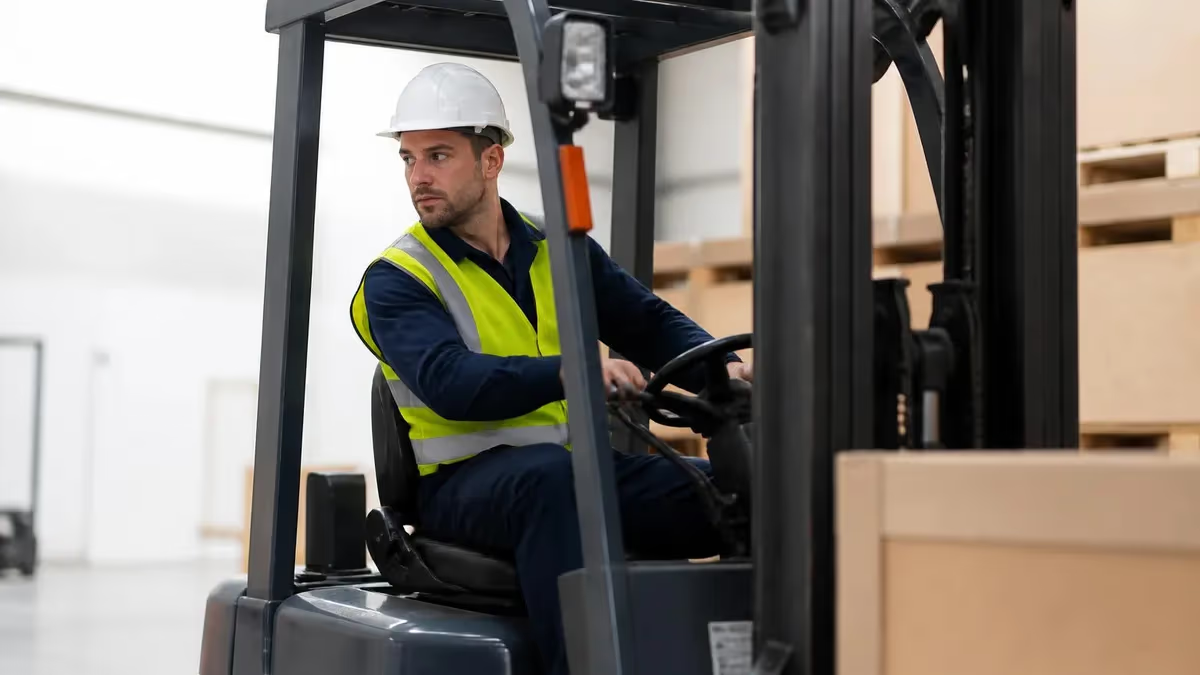
Forklift operator jobs are everywhere — warehouses, distribution centers, manufacturing plants, construction sites, and retail supply chains all depend on licensed operators to keep goods moving. The U.S. Bureau of Labor Statistics classifies forklift operators under "industrial truck and tractor operators," a category with roughly 550,000 positions nationwide. That number has held steady for years, and demand continues to grow as e-commerce expands and supply chains become more complex.
You don't need a college degree to land one of these jobs. What you do need is OSHA-compliant certification of forklift operation, a clean safety record, and the physical capacity to handle a demanding shift environment. Entry-level openings are common, and experienced operators can earn well above $50,000 per year. Operators who build certifications on multiple equipment types and develop WMS systems knowledge can move into lead and supervisory roles faster than almost any other warehouse position.
This guide covers everything you need to know — what the work actually involves, which equipment types pay the most, where to find openings, and how to move up once you're hired. Whether you're starting fresh or looking to advance, here's the full picture.

Forklift Operator Jobs at a Glance
The core job is straightforward: move materials safely and efficiently. In a warehouse setting, that means receiving inbound product, putting it away in racking, pulling outbound orders, loading and unloading trailers, and replenishing pick locations. Each movement is assigned and tracked — often via a handheld scanner or in-cab terminal connected to a warehouse management system (WMS). The pace of that cycle — how quickly you can move from task to task without errors or safety incidents — is what separates a good operator from a great one.
Modern forklift operators are as much technology users as equipment operators. You'll scan barcodes, confirm locations in the WMS, and manage digital pick tickets alongside the physical job of moving loads. Operators who adapt quickly to warehouse software tend to advance faster — supervisors notice who makes fewer errors and who keeps throughput moving.
The physical environment varies significantly by industry. Grocery distribution centers run cold-zone operations at 35°F or colder for full shifts. Outdoor lumber yards mean operating in rain, heat, and uneven terrain. Chemical plants add hazmat awareness protocols. Construction sites use rough-terrain equipment on unstable ground. Know what environment you're applying to — frozen food distribution is a fundamentally different job than standard ambient warehousing, even if both are called "forklift operator."
OSHA's forklift certification standard (29 CFR 1910.178) requires every operator to be trained and evaluated by a qualified person at their specific workplace. It's not a portable credential like a driver's license. When you change employers, your new employer must re-evaluate you at their facility before you can operate independently — even if you've been certified for years. Bring documentation of your prior training to accelerate the process.
There are five main forklift types you'll encounter in job listings, and each requires its own certification. Understanding which ones you're qualified on — and which ones pay more — directly affects your hiring options.
Sit-down counterbalance: The most common type. Used in loading docks, warehouses, and manufacturing. Heavy counterweight at the rear balances the load on the forks. Most entry-level jobs specify this equipment.
Reach truck: A narrow-aisle truck that extends the forks forward into racking rather than lifting a counterbalanced load. Used in high-density storage facilities. Requires different technique — and is listed separately on most distribution center job postings as a required or preferred skill.
Order picker: The operator rides up with the forks to pick from upper rack levels. Requires harness use and strong comfort with heights. Common in e-commerce fulfillment and retail distribution.
Pallet jack (electric ride-on): Lower-lift truck for moving pallets on flat surfaces. Often the entry point for new operators. Technically a powered industrial truck under OSHA but simpler to certify on than a full stand-up or sit-down truck.
Rough terrain: Four-wheel drive with pneumatic tires for outdoor sites — lumber yards, construction, agriculture. Operates on slopes and uneven ground that standard warehouse forklifts can't handle. Certification for forklifts on rough terrain is separate and required by most employers in construction or outdoor materials handling.
Requirements for forklift operator jobs are lower than most people expect. Here's what employers actually look for:
OSHA certification: Required before you operate independently. Your current or most recent employer provides this. If you're new to the field, temp agencies and community college training programs will certify you as part of the process. The training covers pre-start inspections, safe load handling, pedestrian awareness, and refueling or battery-charging procedures depending on the equipment type.
Education: A high school diploma or GED is the standard minimum. No degree required. Some employers don't even enforce the diploma requirement for experienced operators with a strong safety record. What matters far more than your educational background is your demonstrated ability to operate safely and efficiently.
Physical capacity: You'll spend a full shift seated in a confined cab, repeatedly rotating your neck and torso for reverse driving, and climbing in and out of the seat. Pre-employment physicals are common, particularly for reach truck and order picker roles that involve working at height. Operators with pre-existing lumbar or cervical spine issues should consult a physician before applying.
Drug screen and background check: Standard across the industry. Most employers conduct both before the start date.
Basic math and literacy: Calculating load weights, reading pick tickets, confirming inventory quantities — nothing complex, but you'll need functional numeracy.
No formal education beyond a GED is required, which is part of what makes forklift work so accessible. The forklift rental near me market demonstrates how widely these machines are used — the same equipment variety that drives rental demand is exactly what drives job demand in warehousing and logistics.

What You Need to Get a Forklift Job
- ✓OSHA-compliant forklift certification (employer-provided, or from a prior job/training program)
- ✓High school diploma or GED equivalent
- ✓Ability to pass pre-employment drug screen and background check
- ✓Physical capacity for shift-long seated operation and repetitive motion
- ✓Basic math for load weights, pallet counts, and inventory quantities
- ✓Ability to use handheld scanner or in-cab WMS terminal
- ✓Flexibility for shift work — evenings, weekends, overtime during peak seasons
- ✓Documentation of equipment types operated and approximate hours of experience
Indeed, LinkedIn, and ZipRecruiter are the most reliable starting points for job searches. Search "forklift operator," "reach truck operator," or "warehouse associate" in your metro area — at any given moment, hundreds of listings will appear from both direct employers and staffing agencies. Filtering by distance and setting up job alerts for your target equipment types is worth the five minutes it takes to configure.
Amazon fulfillment centers and Walmart distribution centers are the two largest individual employers of forklift operators in the country by headcount. Both hire continuously. Amazon uses a proprietary WMS with strict productivity metrics and a fast-paced pick-pack-ship workflow. Walmart distribution tends to have lower operational tempo and more established union representation in some regions. Home Depot, UPS, Sysco, XPO Logistics, and Target all maintain large forklift operator rosters as well — and all post openings directly on their careers pages, bypassing job board noise entirely.
Staffing agencies are often the fastest entry point for new operators. Firms like Randstad, Kelly Services, Manpower, and Adecco place forklift operators at client facilities on temp or temp-to-hire arrangements. Many facilities use this as an extended interview — 90 days of satisfactory performance leads to a permanent offer with benefits. The upside for new operators: you get certified, build documented hours on multiple equipment types, and develop a resume that justifies direct-hire applications at better pay. It's a genuine on-ramp, not just a stopgap.
Don't overlook direct applications to regional manufacturers, food and beverage distributors, building materials suppliers, and paper or packaging companies. These employers often provide better long-term working conditions — more consistent schedules, lower turnover, and in many cases union wages that significantly exceed fulfillment center pay. The facilities may be less visible on job boards, but a direct inquiry to any building with loading docks and visible forklift equipment is worth the effort.
If you want to know more about equipment options that translate to hiring signals, the forklift rental market covers the major equipment categories used in industry — the same types that appear on job postings as required certifications.
Forklift Operator Salary — Average Pay by Industry
Average forklift operator pay sits between $40,000 and $50,000 per year nationally, with significant variation by industry, geography, and equipment specialization. Entry-level operators at smaller facilities start around $16 to $18 per hour. Experienced operators at large distribution centers and manufacturers regularly earn $22 to $26 per hour. Union operators at ports, automotive plants, and food and beverage facilities can reach $30 to $38 per hour with full benefits packages.
Geography matters a lot. The Los Angeles basin, Chicago metro, Dallas-Fort Worth, and Atlanta warehouse corridors maintain some of the highest base rates in the country because of dense logistics infrastructure and intense competition for qualified operators. Operators in smaller markets who commute to an industrial hub or relocate to a high-demand region can increase base pay by 20 to 30 percent without acquiring additional certifications — it's one of the fastest ways to raise income in this field without changing roles.
Shift differentials add real money over a year. Evening and overnight shifts typically pay one to two dollars more per hour. Operators willing to work nights and weekends consistently and make themselves available during October-through-December e-commerce peaks — when overtime at time-and-a-half is effectively mandatory — can add $5,000 to $10,000 to annual earnings without a promotion. Some experienced operators deliberately choose the night shift for exactly this reason, combining the differential with peak overtime to significantly outpace their day-shift counterparts in annual take-home pay.
Equipment specialization is the most reliable lever for pay increases outside management. Operators certified on reach trucks, order pickers, and turret trucks in addition to standard counterbalance forklifts can command 10 to 20 percent higher hourly rates and qualify for a broader range of postings. Every additional equipment type you can confidently operate reduces your dependency on any single employer and strengthens your negotiating position. The forklifts general reference covers the pre-start inspection and safety protocols that employers use to evaluate new operators across all equipment types.

Forklift Jobs by Sector
The largest segment for forklift jobs. Amazon, Walmart, Target, and third-party logistics operators like XPO, Ryder, and Geodis run facilities with hundreds of forklift operators per building. Work is WMS-driven with productivity tracked per operator. Equipment mix typically includes reach trucks, counterbalance forklifts, and order pickers. Peak seasons (October through January) mean mandatory overtime. Starting pay is competitive — $18 to $22 per hour in most markets — but advancement to supervisor is highly competitive given the large operator headcount.
Career growth from forklift operator follows several paths, and the timelines are realistic. Most operators who stay in the field beyond three years move toward one of these trajectories — and the path you choose determines whether you're optimizing for income, stability, or a completely different type of work.
Lead operator or team lead: The first step up. You'll oversee a small team, handle scheduling coordination, train new hires, and troubleshoot operational issues — while still operating equipment yourself. Lead operators typically earn 10 to 20 percent above standard operator rates. Most facilities promote from within, so reliability and safety records matter more than seniority. Being the person who shows up consistently, follows procedures exactly, and helps new operators without being asked is the fastest way to get noticed.
Warehouse supervisor: Managing a full shift team — 10 to 30 operators — without daily equipment operation. Requires three to five years of floor experience. Involves performance management, production metrics, and coordination with logistics planning. Salary typically ranges from $55,000 to $75,000 depending on facility size and industry. Supervisors who can read WMS data and diagnose throughput problems are in particularly short supply and tend to advance quickly.
Logistics coordinator or fleet manager: A planning and procurement role that develops from supervisor positions. Involves managing equipment contracts, scheduling maintenance, overseeing forklifts fleet utilization, and coordinating with vendors. Some operators reach this role after eight to ten years, particularly those who develop strong WMS and logistics systems knowledge alongside floor experience.
Forklift service technician: A mechanical path for operators who enjoy the equipment itself. Technicians diagnose and repair forklifts — electric, propane, and diesel. Training programs are available from manufacturers (Toyota, Crown, Hyster-Yale) and community colleges. The hands-on equipment experience that forklift operators bring makes them well-suited for the technical training, and it shows in the retention rates these programs see from former operators. Pay at experienced technicians can reach $30 to $40 per hour at dealerships and large fleets.
Types of Forklift Operator Positions
The most common forklift job. Standard four-wheel truck used at loading docks, warehouse floors, and manufacturing. Entry-level roles typically specify counterbalance certification. Solid foundation for building toward other equipment types.
Operates narrow-aisle reach trucks in high-density storage facilities. Forks extend forward into racking rather than relying on counterweight. Listed separately in most distribution center postings — a distinct and higher-paying skill set.
Operator rides up with forks to pick from upper rack levels. Requires harness use, comfort with heights, and strong spatial awareness. Common in e-commerce fulfillment, parts distribution, and retail supply chains.
Ride-on electric pallet jack for moving pallets at ground level. Often the entry point for new operators in grocery, retail, and food and beverage. Simpler certification than stand-up or sit-down trucks but still a powered industrial truck under OSHA.
Operates RT forklifts or telehandlers on outdoor sites — construction yards, lumber facilities, agriculture. Distinct certification from warehouse equipment. Pay tracks mid-to-upper warehouse rates with outdoor exposure and variable terrain as added factors.
Operates container handlers, reach stackers, and heavy lift equipment at ports and rail yards. Highest-paying segment for forklift operators — specialized equipment, union wages, and demanding operational environment. Usually requires significant prior experience.
Pros and Cons of Forklift Operator Work
- +Consistent demand across industries — goods need to move everywhere, year-round
- +No college degree required — accessible with a GED and OSHA certification
- +Equipment specialization creates clear pay increases without management roles
- +Strong overtime availability during peak seasons for operators who want higher annual earnings
- +Career paths to supervisor, logistics coordinator, and service technician roles
- +Temp-to-hire arrangements let you evaluate employers before committing long-term
- −Repetitive physical demands — back, cervical spine, and joint stress over a full career
- −OSHA certification is employer-specific — every new job requires re-evaluation
- −Variable schedules including nights and weekends in 24/7 distribution operations
- −High-throughput fulfillment center work is closely productivity-monitored and can be repetitive
- −Entry pay is modest — significant raises require specializing in multiple equipment types or moving into supervision
- −Seasonal overtime can be mandatory rather than optional at large distribution facilities
When you apply, your resume should list specific equipment types rather than the generic label "forklift operator." Employers scan for terms like counterbalance, reach truck, order picker, turret truck, stand-up, sit-down — and automated job board filters do the same. List your hours on each type if you can estimate them: "1,800+ hours counterbalance, 900+ hours reach truck" adds credibility beyond a certification claim and gives hiring managers a clearer picture of your actual operating experience. It takes two minutes to add and consistently separates applicants who get called from those who don't.
If you've used specific WMS platforms — SAP EWM, Manhattan SCALE, JDA, or proprietary systems like Amazon's — name them explicitly. Systems experience is a meaningful differentiator for experienced operators applying to facilities with specific software environments, and it's often what separates candidates who get called for interviews from those who don't.
Building time with a staffing agency before targeting direct-hire roles makes sense for operators who are new to the field or re-entering after a gap. Three to six months of consistent agency placements provides documented hours across multiple equipment types and facility environments — exactly the resume depth that justifies direct employer applications at better pay with benefits. After 90 days of solid performance at a temp assignment, many operators receive permanent offers directly from the client facility without ever applying through a job board again.
Networking within the industry accelerates job searches in ways online applications can't replicate. Fellow operators at your certification course know about openings at their employers. Forklift dealerships sometimes refer recently certified operators to client companies with open positions. Industry associations like the Warehousing Education and Research Council (WERC) hold local chapters where logistics supervisors and operators connect. A single warm referral from a current employee dramatically improves the odds of getting an interview at facilities that receive hundreds of cold applications every week.
Forklift Operator Jobs Questions and Answers
About the Author

Certified Crane Operator & Skilled Trades Exam Specialist
Ferris State UniversityRobert Martinez is a Journeyman Ironworker, NCCCO-certified crane operator, and forklift trainer with a Bachelor of Science in Construction Technology from Ferris State University. He has 21 years of ironworking, rigging, and heavy equipment operation experience across high-rise and industrial construction sites. Robert prepares candidates for crane operator, rigger, forklift, and skilled trades certification examinations.