
Forklift Rental 2026 September: Cost, Types & Where to Rent Near You
Prepare for the Forklift Rental 2026 September: Cost, Types & certification. Practice questions with answer explanations covering all exam domains. 🎓
Renting a forklift is one of the smartest moves a warehouse manager, construction supervisor, or logistics coordinator can make — especially when demand is seasonal, a project is temporary, or capital budgets are tight. But walking into a rental agreement without knowing the real costs, the right machine type, or the OSHA rules that govern operators can get expensive fast. The forklift rental market has dozens of machine classes, pricing variables, and legal requirements that catch first-time renters off guard.
This guide breaks down everything you need to know about forklift rental in 2026: daily, weekly, and monthly rates, the most common forklift categories, what rental contracts actually cover, and how to pick the right unit for indoor versus outdoor jobs.
How Much Does It Cost to Rent a Forklift?
Forklift rental pricing varies by machine class, lift capacity, fuel type, rental duration, and your location. For a standard sit-down counterbalance electric forklift with a 5,000-lb capacity, you can expect to pay roughly $150 to $250 per day, $500 to $900 per week, or $1,500 to $3,000 per month. Larger capacity machines or specialty units like telehandlers push those numbers higher — sometimes $300 to $500 per day and $4,000 to $6,500 per month.
Delivery and pickup fees are almost always extra — budget an additional $150 to $400 round-trip depending on distance. Fuel charges, damage waivers, and operator training add-ons can inflate a quote by 10% to 20%, so read the fine print before signing.
Types of Forklifts Available for Rent
Not every forklift is built for every job. Choosing the wrong type wastes money and creates safety hazards. Here are the main categories you'll encounter at major rental companies:
Counterbalance Forklift
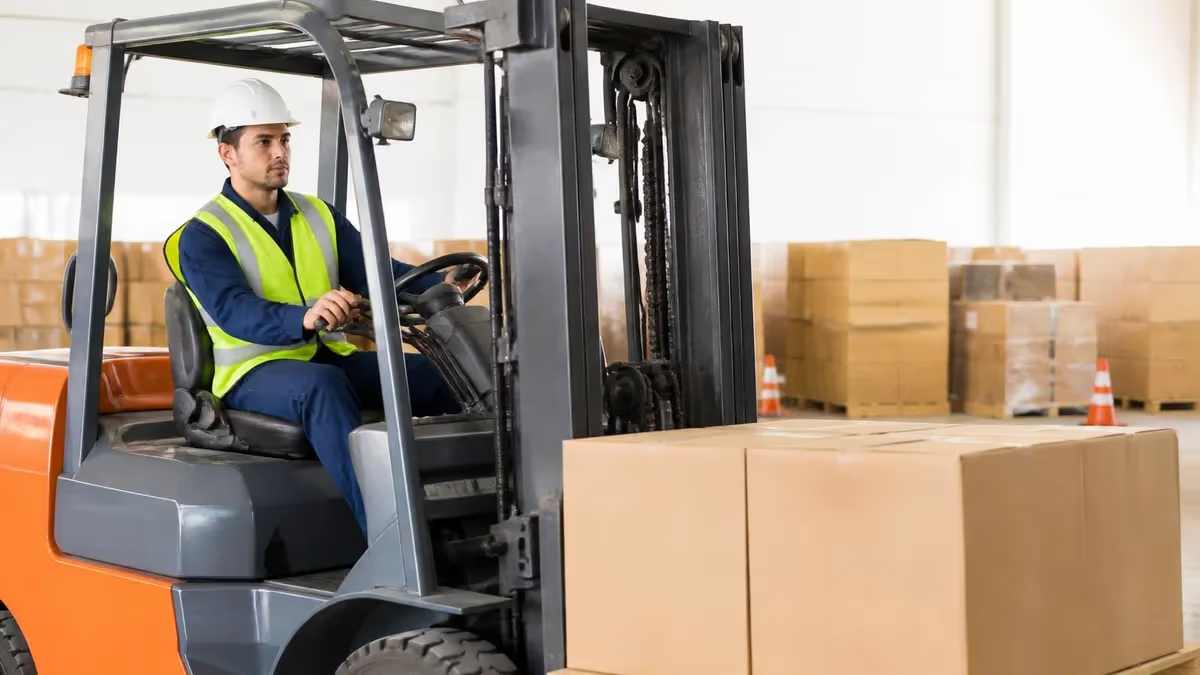
The counterbalance is the workhorse of the forklift world — the classic sit-down unit with forks at the front and a counterweight at the rear. It handles weight capacities from 3,000 lbs all the way up to 36,000 lbs on heavy-duty diesel models. Counterbalance forklifts work on smooth warehouse floors and loading docks. They require a wide turning radius, so tight aisles can be a challenge.
Reach Truck
Reach trucks are designed for narrow-aisle warehousing. The operator sits sideways, and the mast extends forward beyond the front wheels to place loads deep into racking systems. They're almost exclusively electric, best suited for indoor use on flat floors, and typically handle 3,000 to 5,500 lbs with lift heights reaching 30 feet or more.
Order Picker
An order picker lifts the operator — along with the forks — to the pick level. Workers ride the platform up to pull individual items from high shelves. These machines are standard in e-commerce fulfillment centers, electric only, indoor only, and require operators to use a harness. Capacity is generally 2,500 to 3,000 lbs.
Pallet Jack (Walkie or Rider)
Power pallet jacks are motorized versions of the manual hand truck. They lift loads just a few inches off the ground — enough to transport across a floor, but not to rack. Capacity runs from 4,500 to 8,000 lbs. These are the most affordable rental option, perfect for floor-level distribution work.
Telehandler (Telescopic Handler)
Telehandlers look like a rough-terrain forklift crossed with a crane. The telescoping boom extends forward and upward to reach over obstacles or place materials at height on a construction site. They handle 5,000 to 12,000 lbs and can reach 40 to 55 feet. Telehandlers run on diesel, work on unpaved or uneven ground, and are the rental of choice for framing contractors, steel erectors, and agricultural operations.
Rough Terrain Forklift
Four-wheel drive, pneumatic tires, high ground clearance — rough terrain forklifts go where standard warehouse machines cannot. They're diesel or LPG-powered, rated for outdoor use on job sites, and handle loads from 6,000 to 36,000 lbs.

Electric vs. Propane/LPG Forklifts: Which to Rent?
Fuel type is one of the first decisions renters face. Each has real-world trade-offs worth knowing before you call a rental company.
Electric forklifts are quieter, produce zero tailpipe emissions, and cost less per hour to operate. They're the default for indoor food facilities, pharmaceutical warehouses, and any setting with strict air quality requirements. The downside: they need charging time (8 hours of work, 8 hours of charge), and a spare battery may add $50–$100/day to the rental. Most rental companies include a charged battery in the quoted rate. If you're running two shifts, ask about a second battery and a dedicated charging station — otherwise your second shift may be waiting on a depleted unit.
Propane/LPG forklifts can be refueled in minutes, run all day without a charging break, and are versatile for indoor/outdoor use in well-ventilated spaces. LPG is the most popular fuel type in North American manufacturing because of the flexibility it offers across shifts. A single 33-lb propane tank typically fuels 6 to 8 hours of operation. Tank swaps take under 2 minutes — no downtime compared to a multi-hour electric charge cycle.
Diesel forklifts are heavy-duty outdoor machines with high torque for rough terrain. They're never used indoors due to carbon monoxide output. Rental rates are generally the highest in the diesel class, but their durability and power output on job sites justifies the premium.
Indoor vs. Outdoor Forklifts
Before calling a rental company, answer one question: where will the machine operate? Indoor-only machines (electric counterbalance, reach trucks, order pickers) have solid or cushion tires engineered for smooth concrete. Running them outdoors on gravel or uneven asphalt damages the tires and the machine — and the rental company will charge you for it.
Outdoor or dual-use machines have pneumatic tires (filled with air or foam-filled) that handle irregular surfaces. If your site has a mix — a concrete loading dock that transitions to a packed gravel yard — ask for a pneumatic-tire LPG counterbalance. It handles both environments without needing two machines.
Weight Capacity: Matching the Machine to the Load
Every forklift has a rated capacity at a standard load center (usually 24 inches from the face of the forks). Capacity drops as loads extend further forward or the mast is raised. A 5,000-lb forklift carrying a load with its center of gravity at 36 inches may only safely handle 3,500 lbs. Rental companies provide load capacity charts — use them. When in doubt, rent one class higher. Operating a forklift near its rated capacity all day stresses the hydraulics, shortens component life, and slows cycle times. A slightly larger unit gives you performance margin and safety buffer.
OSHA Certification Requirement: Non-Negotiable
Here's the rule that trips up first-time renters: under OSHA standard 29 CFR 1910.178(l), every powered industrial truck operator must be trained and evaluated by their employer before operating a forklift. This applies to rented machines just as much as owned ones. The rule is about the operator, not the equipment — so there's no exemption for short-term rentals. The rental company will hand you the keys — it's your responsibility to ensure the operator is OSHA-certified for the specific type of forklift being rented.
Certification must cover the truck type (a certification on a counterbalance doesn't automatically qualify someone on a reach truck), the workplace hazards specific to your site, and a practical evaluation. Operators must be re-evaluated every three years — or immediately after an accident or near-miss. Getting this wrong exposes your company to OSHA fines that start at $16,131 per violation and climb to $161,323 for willful violations.
OSHA also requires that training be conducted by a person with the knowledge, training, and experience to train operators and evaluate their competence. This means the trainer must themselves be qualified — a peer operator showing someone the ropes doesn't satisfy the requirement. The evaluation must be both written and practical, and records must be kept.
If your operators are not yet certified, get them trained before the rental starts — not after. A forklift certification course covers pre-operational inspection, safe load handling, OSHA rules, and the practical skills tested in a real evaluation. Most programs can be completed in a single business day, so there's no logistical reason to delay scheduling certification before the rental arrives on site.
What's Included in a Forklift Rental Contract?
Standard rental agreements spell out more than just the daily rate. Read these sections carefully before signing to avoid surprise charges at return.

Forklift Rental Contract Checklist
- ✓Rental period and hours — most daily rates assume 8 hours; overtime rates (often 1.5x) kick in past that
- ✓Maintenance and breakdowns — reputable companies cover mechanical failures under normal use at no charge
- ✓Damage waiver — optional add-on (10–15% of daily rate) that limits liability for accidental damage
- ✓Fuel policy — LPG/diesel units: return at same fuel level or pay refueling fee; electric: charge on your power
- ✓Attachments — standard forks included; side-shifters, rotators, and clamps cost $25–$75/day extra
- ✓Insurance — rental companies require you as additional insured; verify your commercial policy covers this first
Top Forklift Rental Companies in 2026
Several national chains dominate the market, supplemented by regional independents that often negotiate better on longer contracts. When comparing companies, look beyond the quoted daily rate — delivery fees, overtime charges, and breakdown response time matter just as much on a tight project timeline.
United Rentals is the largest equipment rental company in North America with more than 1,400 locations. Their forklift fleet includes electric counterbalance, reach trucks, telehandlers, and rough terrain models from brands like Toyota, Crown, and JLG. Online reservations, fleet tracking, and 24/7 breakdown support make them the go-to for large construction and industrial projects.
Sunbelt Rentals operates over 900 locations and carries a broad forklift inventory including cushion-tire electrics and diesel rough terrain units. Their branch network is strong in the Southeast and mid-Atlantic states. Sunbelt often has competitive rates on weekly rentals and a solid fleet of telehandlers for construction work.
Home Depot Tool & Truck Rental offers forklifts at select locations — primarily standard counterbalance and pallet jacks suited for retail and light commercial use. Rates are competitive for short-term, low-complexity rentals near stores. The online booking process is the most accessible for first-time renters who want a straightforward experience without a sales call.
Lowe's Tool Rental similarly offers forklift rental at select locations, with electric models suitable for moving building materials. Coverage is thinner than national rental chains but pricing is straightforward and the process is simple for contractors already shopping at Lowe's.
Regional independents — companies like BlueLine Rental and H&E Equipment Services — often have better rates for long-term rentals and will negotiate on monthly contracts. If you're renting for 3+ months, get quotes from at least two regional companies alongside national chains. The regional players typically have more flexibility on rate and can often deliver faster in their core markets.
Buying vs. Renting a Forklift: The Decision Framework
Renting is almost always smarter when the need is temporary (project under 12 months), maintenance capability is limited, or capital budget is constrained. Buying becomes cost-effective when forklift use exceeds roughly 2,000 hours per year. A new 5,000-lb LPG counterbalance runs $25,000 to $40,000. At $2,500/month in rental fees, you break even in 10 to 16 months. A used unit at $12,000 to $18,000 cuts that to 5 to 7 months. For permanent, high-utilization operations, ownership wins on a long enough timeline. For project-based, seasonal, or uncertain-volume work — rent and preserve your capital.

Forklift Rental by Use Case
Best machines: Electric counterbalance, reach truck, order picker, pallet jack.
Smooth concrete floors, enclosed spaces, and strict air quality rules make electric equipment the default. A standard 5,000-lb electric counterbalance handles most pallet racking operations. Choose a reach truck for aisles under 10 feet wide. Order pickers suit high-density pick operations where workers need to reach shelves above 15 feet. Budget $150–$250/day for counterbalance, $200–$350/day for reach truck.
Forklift certification Practice Test Questions
Prepare for the Forklift certification Certification exam with our free practice test modules. Each quiz covers key topics to help you pass on your first try.
Forklift certification Certification Forkl...
Forklift certification Exam Questions covering Certification Forklift certification Maintenance and Repairs. Master Forklift certification Test concepts for certification prep.
Forklift certification Certification Forkl...
Free Forklift certification Practice Test featuring Certification Forklift certification Maintenance and Repairs Questions and Answers. Improve your Forklift certification Exam score with mock test prep.
Forklift certification Certification Forkl...
Forklift certification Mock Exam on Certification Forklift certification Operator Training and Certification Requirements. Forklift certification Study Guide questions to pass on your first try.
Forklift certification Certification Forkl...
Forklift certification Test Prep for Certification Forklift certification Operator Training and Certification Requirements Questions and Answers. Practice Forklift certification Quiz questions and boost your score.
Forklift certification Load Handling and S...
Forklift certification Questions and Answers on Load Handling and Stability. Free Forklift certification practice for exam readiness.
Forklift certification OSHA Regulations an...
Forklift certification Mock Test covering OSHA Regulations and Compliance. Online Forklift certification Test practice with instant feedback.
Forklift certification Pre-Operation Inspe...
Free Forklift certification Quiz on Pre-Operation Inspections. Forklift certification Exam prep questions with detailed explanations.
Forklift certification Refueling and Recha...
Forklift certification Practice Questions for Refueling and Recharging Procedures. Build confidence for your Forklift certification certification exam.
Forklift certification Safe Driving and Ma...
Forklift certification Test Online for Safe Driving and Maneuvering. Free practice with instant results and feedback.
Forklift certification Workplace Hazard Id...
Forklift certification Study Material on Workplace Hazard Identification. Prepare effectively with real exam-style questions.
Forklift certification Forklift Instructions
Free Forklift certification Test covering Forklift Instructions. Practice and track your Forklift certification exam readiness.
Forklift certification Forklift MCQ
Forklift certification Exam Questions covering Forklift MCQ. Master Forklift certification Test concepts for certification prep.
Forklift certification Forklift Employer R...
Free Forklift certification Practice Test featuring Forklift Employer Responsibilities. Improve your Forklift certification Exam score with mock test prep.
Forklift certification Forklift Penalties ...
Forklift certification Mock Exam on Forklift Penalties for Non-Compliance. Forklift certification Study Guide questions to pass on your first try.
Tips for First-Time Forklift Renters
If this is your first rental, a few steps prevent the most common and costly mistakes renters make.
Measure your site before you call — know your aisle widths, ceiling height, floor type (concrete, asphalt, gravel), and maximum load weight. Share all of this with the rental company so they recommend the right unit. Rental sales reps are helpful, but they're also incentivized to upsell. Walk in with your specs and they'll match the machine to the job rather than the other way around.
Confirm operator certification before delivery day. OSHA doesn't accept "we were going to get them certified" as a defense after an accident. If your operator is already certified on a different forklift class, verify that their certification covers the type you're renting — a cushion-tire counterbalance cert doesn't automatically extend to a pneumatic-tire reach truck.
Inspect the unit at delivery and document any existing damage on the rental agreement before operating. Photos with a timestamp protect you from being charged for pre-existing scratches, dents, or hydraulic leaks. Most rental companies walk the machine with you at delivery — insist on this step even when you're in a hurry to start work.
Understand overtime hours. If your shift runs 10 or 12 hours and the daily rate covers 8, calculate the true daily cost before assuming it beats a weekly rate. On a 10-hour shift at 1.5x hourly overtime for 2 extra hours, a "daily" rental may cost 25% more than the quoted number. Run the math for your actual operation.
Ask about fleet availability in advance — peak construction season (April–October) strains inventory, especially for telehandlers and large-capacity rough terrain units. Reserve at least two weeks out for specialty machines. Electric counterbalance units are generally more plentiful year-round and available on shorter notice.
Finally, negotiate on monthly rentals. A 90-day rental quoted at list price has margin in it. Request a 10–15% discount — most regional companies will grant it for a multi-month commitment with good credit. Get the discount in writing before the rental period starts, not as a credit at return.
One often-overlooked step: read your rental company's damage policy for tire damage specifically. Cushion tires are easily damaged by outdoor use, and the replacement cost can rival the rental rate for a short engagement. If there's any chance the machine will leave a concrete surface, pay the extra per day for a pneumatic-tire model and avoid the dispute entirely.
Renting vs. Buying a Forklift
- +No large upfront capital outlay — preserve cash for operations
- +Maintenance and mechanical breakdowns covered by the rental company
- +Easy to scale up or swap machine type as project needs change
- +Short-term access to specialized units (telehandlers, rough terrain) without ownership cost
- +No depreciation, resale headaches, or storage costs at project end
- −Monthly rental cost exceeds ownership cost after 12–18 months of continuous use
- −Availability constraints during peak season (April–October) for specialty units
- −Overtime hour charges add up quickly on multi-shift operations
- −You're still responsible for OSHA operator certification — rental doesn't include training
- −Delivery and pickup fees add $150–$400 per rental event on top of quoted rates
Forklift Questions and Answers
About the Author

Certified Crane Operator & Skilled Trades Exam Specialist
Ferris State UniversityRobert Martinez is a Journeyman Ironworker, NCCCO-certified crane operator, and forklift trainer with a Bachelor of Science in Construction Technology from Ferris State University. He has 21 years of ironworking, rigging, and heavy equipment operation experience across high-rise and industrial construction sites. Robert prepares candidates for crane operator, rigger, forklift, and skilled trades certification examinations.