
Forklift Rental Rates: Complete 2026 October Pricing Guide for Daily, Weekly, and Monthly Forklift Hire Across the United States
💡 Compare forklift rental rates by capacity, fuel type, and term. Daily, weekly, and monthly pricing plus delivery fees, insurance, and certification tips.
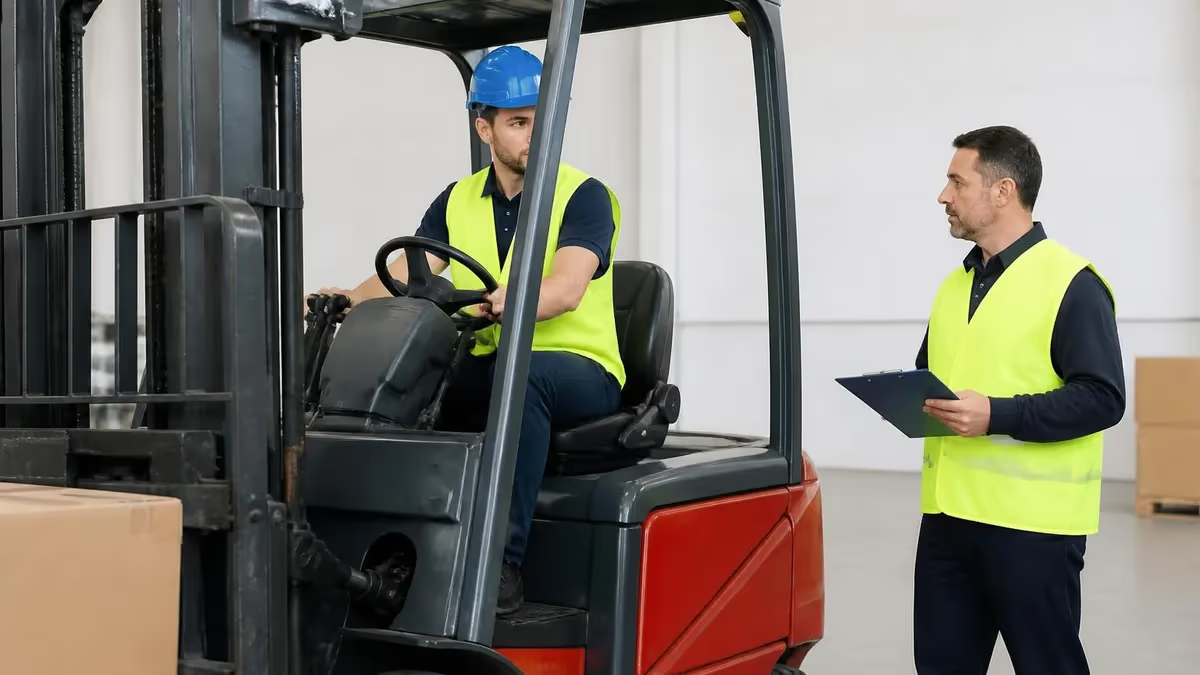
Forklift rental rates have become one of the most searched logistics topics of 2026 because warehouses, construction sites, and seasonal retailers all need flexible lift capacity without absorbing the capital cost of a brand-new unit. Whether you operate a single dock or a regional distribution hub, understanding how forklift rental pricing actually works will save you thousands of dollars per project. This guide walks through daily, weekly, and monthly rates across every common class of truck and explains the hidden fees most rental contracts quietly attach.
The national average for a standard 5,000-pound capacity forklift rental sits between $150 and $250 per day, $450 to $750 per week, and $1,200 to $2,400 per month. Those numbers shift significantly when you move into larger Class IV diesel pneumatic trucks, narrow-aisle reach machines, or telehandlers used on construction sites. Geographic location, delivery distance, and operator certification requirements all play a part in what you ultimately pay at the end of a billing cycle.
Most rental companies also tier their pricing based on engine type. Internal combustion units running on liquid propane, gasoline, or diesel typically cost less per day than comparable electric models because the upfront machine cost is lower, but electric units win on long-term contracts because they consume less energy and require fewer service interruptions. A reputable dealer will quote both options and let you compare total cost of ownership rather than headline daily rates alone.
Before signing any rental agreement, verify the condition of the truck by inspecting tires, forks, mast chains, and overhead guard welds. If you notice damage during pickup, document it with timestamped photos so you are not billed at return. For tire issues mid-rental, contact a forklift repair near me service that the rental company has pre-approved, otherwise you may void the maintenance clause inside the contract and become responsible for full replacement costs.
Rental rates are also influenced by demand cycles. Peak season for forklift rentals runs from August through December, driven by retail inventory buildup, holiday fulfillment, and end-of-year construction deadlines. During this stretch, expect daily rates to climb 15 to 25 percent and availability to tighten dramatically in major metros like Atlanta, Dallas, Chicago, and the Inland Empire. Booking three to four weeks in advance during peak season is no longer optional if you need a specific class of truck.
Finally, the rental industry has been moving steadily toward bundled pricing models that include certified operator placement, telematics monitoring, and on-site preventive maintenance. These bundles raise the sticker price by 20 to 35 percent but reduce downtime risk and OSHA exposure. For companies running thin maintenance teams or short-term projects, the bundled approach often pencils out cheaper than the lowest advertised daily rate once you account for service calls, fuel delivery, and replacement units.
This guide will give you the negotiating use to compare quotes side by side, identify which line items are negotiable, and avoid the common traps that inflate a $200 daily rental into a $400 effective cost. By the end you will know exactly what to ask for, what to refuse, and what a fair forklift rental rate looks like in your market for 2026.
Forklift Rental Rates by the Numbers (2026)

Forklift Rental Rates by Capacity and Truck Class
Standard 3,000 to 6,500 pound electric sit-down trucks rent for $200 to $300 per day and $1,500 to $2,400 per month. Best for indoor warehouse use with smooth concrete floors and consistent shift schedules.
The workhorse rental category. Capacity 3,000 to 8,000 pounds runs $150 to $250 daily, $450 to $750 weekly, and $1,200 to $2,000 monthly. Ideal for dry indoor and dock environments.
Outdoor and lumber yard standard. Capacity 6,000 to 15,000 pounds rents at $225 to $450 per day and $2,200 to $4,500 per month depending on attachments and tire condition.
High-bay storage trucks with extended reach masts cost $280 to $400 per day and $2,400 to $3,800 per month. Operator training is mandatory before rental release in nearly every market.
Construction-grade lifts with 6,000 to 12,000 pound capacity and 30 to 50 foot reach run $400 to $850 per day. Monthly rates range from $4,500 to $8,500 with delivery fees on top.
Daily forklift rentals make sense for projects lasting three days or less, special-event load-ins, emergency replacements during repairs, and short delivery overflow days. The rate you see quoted as daily is almost always for a single eight-hour shift. If your team plans to run two shifts, expect a meter charge of roughly 1.5 times the base rate, and three shifts can trigger nearly double. Always tell the rental desk your intended hours per day so the contract reflects actual usage and not just the advertised single-shift figure.
Weekly forklift rentals deliver the best price-per-hour value for most short-term projects. The typical weekly rate covers 40 hours of meter time, which lines up with one standard shift across five working days. Rent the same machine for two weeks and the per-day price often drops another 8 to 12 percent. This pricing band attracts seasonal warehouses, trade-show riggers, and construction punch-list crews who need certainty but cannot commit to a full monthly contract or a purchased asset.
Monthly forklift rentals are where the real savings emerge. Most national dealers cap monthly meter usage at 176 hours, equivalent to one full-time operator working four weeks. Exceeding that cap triggers an hourly overage rate, usually $4 to $9 depending on truck class. For continuous operations, ask whether the dealer offers an unlimited-hour monthly contract; it typically adds 15 to 20 percent but eliminates the risk of unexpected overage bills at month-end reconciliation.
Many businesses overlook the mid-term rental window of two to six months. This is the sweet spot where dealers compete hardest because the truck is essentially leased without the paperwork of a formal lease. Negotiate a rate at least 25 percent below the standard monthly rate when committing to four or more consecutive months, and ask for the first delivery and final pickup fees to be waived as part of the package. Most account managers have authority to approve both concessions.
Geography drives surprising variation in rental rates. A 5,000-pound LPG forklift that costs $165 per day in Houston can run $235 per day in Boston and $260 per day in San Francisco. Coastal metros and densely populated logistics corridors carry the highest rates because dealer real estate, technician labor, and delivery time all cost more. Inland and Southern markets typically offer the lowest rates, which is why national contractors sometimes truck their own equipment to job sites rather than rent locally in expensive zones.
If your business operates across multiple states, ask about national fleet agreements. Companies like United Rentals, Sunbelt, Toyota Lift, and Crown offer master service agreements that lock in negotiated rates across hundreds of branches. These agreements eliminate the per-location negotiation game and often include 24-hour replacement guarantees if a unit fails on site. For a quick comparison of local availability, search forklift rentals near me and request quotes from three providers before signing anything longer than two weeks.
One overlooked rate driver is delivery and pickup logistics. A truck delivered on a flatbed within a 25-mile radius typically costs $150 to $225 each way. Beyond that radius, expect a per-mile surcharge of $4 to $7. Saturday delivery, after-hours pickup, and tight loading-dock access can all push delivery fees above $400 per leg. Bundling deliveries with multiple machines or scheduling for standard weekday windows is the simplest way to keep this line item under control.

Forklift certification Practice Test Questions
Prepare for the Forklift certification Certification exam with our free practice test modules. Each quiz covers key topics to help you pass on your first try.
Forklift certification Certification Forkl...
Forklift certification Exam Questions covering Certification Forklift certification Maintenance and Repairs. Master Forklift certification Test concepts for certification prep.
Forklift certification Certification Forkl...
Free Forklift certification Practice Test featuring Certification Forklift certification Maintenance and Repairs Questions and Answers. Improve your Forklift certification Exam score with mock test prep.
Forklift certification Certification Forkl...
Forklift certification Mock Exam on Certification Forklift certification Operator Training and Certification Requirements. Forklift certification Study Guide questions to pass on your first try.
Forklift certification Certification Forkl...
Forklift certification Test Prep for Certification Forklift certification Operator Training and Certification Requirements Questions and Answers. Practice Forklift certification Quiz questions and boost your score.
Forklift certification Load Handling and S...
Forklift certification Questions and Answers on Load Handling and Stability. Free Forklift certification practice for exam readiness.
Forklift certification OSHA Regulations an...
Forklift certification Mock Test covering OSHA Regulations and Compliance. Online Forklift certification Test practice with instant feedback.
Forklift certification Pre-Operation Inspe...
Free Forklift certification Quiz on Pre-Operation Inspections. Forklift certification Exam prep questions with detailed explanations.
Forklift certification Refueling and Recha...
Forklift certification Practice Questions for Refueling and Recharging Procedures. Build confidence for your Forklift certification certification exam.
Forklift certification Safe Driving and Ma...
Forklift certification Test Online for Safe Driving and Maneuvering. Free practice with instant results and feedback.
Forklift certification Workplace Hazard Id...
Forklift certification Study Material on Workplace Hazard Identification. Prepare effectively with real exam-style questions.
Forklift certification Forklift Instructions
Free Forklift certification Test covering Forklift Instructions. Practice and track your Forklift certification exam readiness.
Forklift certification Forklift MCQ
Forklift certification Exam Questions covering Forklift MCQ. Master Forklift certification Test concepts for certification prep.
Forklift certification Forklift Employer R...
Free Forklift certification Practice Test featuring Forklift Employer Responsibilities. Improve your Forklift certification Exam score with mock test prep.
Forklift certification Forklift Penalties ...
Forklift certification Mock Exam on Forklift Penalties for Non-Compliance. Forklift certification Study Guide questions to pass on your first try.
Electric Forklift vs Internal Combustion Rental Cost Comparison
An electric forklift rental typically costs 18 to 25 percent more per day than an internal combustion equivalent, but the operating cost can be 40 to 60 percent lower. Electric units have no fuel bill, no exhaust filtration, and significantly fewer wear parts in the drivetrain. For indoor warehouses and food-grade environments, electric is often the only acceptable option due to emissions and air-quality regulations.
Battery management is the biggest variable. Lead-acid batteries require water maintenance and a dedicated charging room, while lithium-ion batteries support opportunity charging during breaks. Ask the rental company which battery chemistry comes with the unit and whether a spare battery or charger is included. Some dealers charge $40 to $90 per day for a backup battery, which can make or break a multi-shift operation.
Should You Rent or Buy a Forklift in 2026?
- +No upfront capital expense — preserves working capital for inventory and payroll
- +Full maintenance and repair coverage usually included in the monthly rate
- +Easy to scale up or down based on seasonal demand without selling assets
- +Access to newer models with current safety features and telematics
- +No depreciation risk or end-of-life resale complications
- +Operator certification and training programs often bundled at preferred rates
- +Flexibility to switch between electric, LPG, and diesel as operations evolve
- −Long-term rentals cost 2 to 3 times more than financed ownership over five years
- −Limited customization — attachments and modifications usually prohibited
- −Availability tightens during peak season, especially in August through December
- −Damage and abuse fees can be substantial if return inspection finds issues
- −Hour overage charges accumulate quickly on continuous operations
- −No equity built up at the end of a multi-year rental period
- −Contract auto-renewal clauses can trap businesses in unfavorable rates
Pros and Cons at a Glance
| Pros | Cons |
|---|---|
| No upfront capital expense — preserves working capital for inventory and payroll | Limited customization — attachments and modifications usually prohibited |
| Full maintenance and repair coverage usually included in the monthly rate | Availability tightens during peak season, especially in August through December |
| Easy to scale up or down based on seasonal demand without selling assets | Damage and abuse fees can be substantial if return inspection finds issues |
| Access to newer models with current safety features and telematics | Hour overage charges accumulate quickly on continuous operations |
| No depreciation risk or end-of-life resale complications | No equity built up at the end of a multi-year rental period |
| Operator certification and training programs often bundled at preferred rates | Contract auto-renewal clauses can trap businesses in unfavorable rates |

Forklift Rental Pre-Delivery Checklist
- ✓Confirm exact truck class, capacity rating, and mast height in writing
- ✓Verify the unit comes with current annual inspection sticker and capacity plate
- ✓Request photos of tires, forks, and overhead guard before delivery
- ✓Get written quote for delivery fee, pickup fee, and per-mile surcharge
- ✓Confirm fuel or battery charge level at delivery and required return level
- ✓Ask whether operator certification or evaluation is included in the rate
- ✓Clarify meter hour cap and overage rate for monthly or extended rentals
- ✓Verify insurance requirements and damage waiver pricing in advance
- ✓Confirm 24-hour service response and replacement unit policy
- ✓Get the rental contract emailed before delivery for legal review
- ✓Document existing damage with timestamped photos at delivery
- ✓Schedule pickup at least 48 hours before contract end to avoid extra days
Always Negotiate Beyond the Daily Rate
The daily rate is only one of seven line items on a typical forklift rental invoice. Delivery, pickup, fuel, insurance, damage waiver, operator certification surcharges, and meter overages combine to add 30 to 55 percent on top of the headline price. Ask for a complete itemized quote in writing and challenge every fee. Rental account managers typically have authority to waive at least two line items to win a competitive bid, especially on contracts longer than two weeks.
Insurance and damage waiver fees are where many renters overspend without realizing it. Most rental companies offer an optional Loss Damage Waiver costing 12 to 18 percent of the base rental rate. This waiver caps your liability for accidental damage to the unit but does not cover third-party property damage, injury, or theft. If your business already carries general liability and inland marine coverage, ask your insurance broker whether your existing policy provides equivalent protection at lower cost than the dealer waiver.
Operator certification is another area where rental contracts can quietly add cost. OSHA requires that anyone operating a powered industrial truck must hold valid certification specific to the class of equipment being used. Some rental companies refuse to release units without proof of certification, and others charge $75 to $200 per operator for on-site evaluation. If you rent frequently, investing in an in-house train-the-trainer program pays for itself within two to three rental cycles and removes a recurring rental friction point.
Delivery and pickup fees deserve the same scrutiny. Many dealers quote attractive daily rates but recover margin on transport. A common trick is quoting delivery as a flat fee while charging a separate pickup fee at the same amount. Always ask whether the quote is round-trip transport or one-way only. For multi-week rentals, negotiate to have either delivery or pickup waived in exchange for signing the contract that same business day. This concession is almost always available but rarely offered unless requested directly.
Fuel and battery charges can also inflate the final bill. Internal combustion rentals usually deliver with a full tank and require return at full, otherwise you pay a premium refill fee that can be double the pump price. Electric rentals require return at minimum 80 percent charge, with a $50 to $150 recharge fee for units returned low. Build the final pre-return checklist into your operator handoff so the truck leaves your facility in compliant condition every single time.
Meter overage charges sneak up on busy operations. A monthly rental capped at 176 hours sounds generous until a two-shift operation hits the cap by day twelve. Once over the cap, you pay a per-hour charge plus accelerated wear-and-tear assessment at return. Track meter hours weekly and alert the rental desk if you project an overage. They will frequently amend the contract mid-term to an unlimited-hour rate, which is typically 18 percent more per month but cheaper than paying overage charges retroactively.
Damage assessment at return is the single largest source of post-rental disputes. Tire wear, fork bending, mast cylinder leaks, and chassis dents are the most common findings. Rental companies use third-party inspection services with documented condition reports, so dispute resolution favors the dealer if you have no contrary documentation. Photograph every angle of the truck at delivery and again at pickup, including the data plate, tire sidewalls, fork heels, and mast assembly. This habit alone has saved fleet managers thousands of dollars in disputed damage charges.
Finally, watch for environmental and regulatory surcharges that vary by state. California, Washington, New York, and several Northeast states add emissions surcharges to internal combustion rentals. Some metros also tack on stormwater, tire disposal, or hazardous material fees. These are legitimate pass-through costs in most cases, but the line items should appear on the original quote, not as surprises at invoice time. Ask the rental coordinator to confirm in writing that no additional surcharges will appear after delivery.
Many monthly rental agreements include automatic renewal language that extends the contract for another full month unless you provide written cancellation notice 10 to 15 days before the term ends. Miss the notice window and you can be locked into an extra month at the original rate even if you only need the truck three more days. Always calendar the cancellation deadline immediately after signing and confirm pickup logistics at least one week before that deadline expires.
Negotiating better forklift rental rates starts with understanding the dealer cost structure. Rental companies finance their fleet through asset-backed loans, recover capital through utilization, and earn margin on parts, service, and consumables. They want predictable revenue and high fleet utilization, which means they reward customers who commit to longer terms, pay on time, and require fewer service calls. Position your business in those three categories and you will consistently receive better rates than walk-in single-day renters.
The most effective negotiation tactic is the multi-quote approach. Get written quotes from at least three local dealers and one national chain before committing. Share competing quote details with each dealer and ask whether they can match or beat the lowest line item. Most account managers have authority to discount up to 15 percent without escalation and another 10 percent with sales manager approval. Polite, factual, and prepared negotiators consistently get those discounts; aggressive or unprepared callers rarely do.
Timing also matters. The last week of every quarter is when rental sales managers push hardest to hit utilization and revenue targets. March, June, September, and especially December offer the biggest concession opportunities. If your project timeline is flexible, schedule the start of a long-term rental in those windows. Dealers will often throw in free delivery, waived damage waivers, or upgraded equipment classes just to close the deal before quarter-end reporting.
Bundling expands your use further. If you need a forklift plus a pallet jack plus a scissor lift, bundle them under one master rental agreement with one delivery and one invoice. Bundling typically saves 8 to 14 percent versus separate contracts because the dealer reduces administrative cost and consolidates delivery logistics. Bundling also makes your account more valuable, which translates to faster service response when you eventually need it for an emergency repair or replacement unit.
Consider exclusivity in exchange for preferred rates. If your business rents forklifts at least eight months out of the year, sign a 12-month master service agreement with one dealer in exchange for a 15 to 25 percent discount versus spot-rental pricing. The dealer benefits from predictable revenue and you benefit from priority allocation when fleet inventory tightens during peak season. Even better, a master agreement typically includes a service level commitment with documented response times for breakdown calls.
Finally, build a maintenance relationship before you need it. If a rental unit goes down mid-shift, your downtime cost is far higher than any rental rate negotiation could ever justify. Establish a relationship with the local service desk by name, learn the technicians who cover your region, and keep the after-hours emergency number posted in your shipping office. For routine tire issues during long-term rentals, the dealer can often dispatch a forklift repair near me partner faster than you can source one independently.
Documentation closes the loop on every successful rental relationship. Keep a binder or shared drive folder with every quote, contract, delivery photo, return photo, invoice, and dispute resolution email. The next time you negotiate, this archive gives you concrete evidence of past rates and dealer behavior. Procurement professionals who maintain this kind of record consistently negotiate 10 to 20 percent below market because they walk into every conversation with data that the dealer cannot dispute.
Practical preparation makes the difference between a smooth rental and a frustrating one. Before you call any dealer, document the exact job specifications: maximum load weight, lift height required, indoor versus outdoor use, floor surface type, and total expected operating hours per day. With those five data points, any rental coordinator can quote you accurately in under ten minutes. Without them, you will receive vague estimates and likely end up with the wrong truck on day one.
Verify operator certification before the truck arrives. OSHA 29 CFR 1910.178 requires that every powered industrial truck operator receive formal training and evaluation specific to the type of equipment they will use. A stand up forklift operator certified only on sit-down counterbalance trucks must complete additional evaluation before legally operating the new class. Schedule recertification before the rental window opens so productivity does not stall on delivery day waiting for evaluator availability.
Prepare the receiving location in advance. Confirm that the loading dock or delivery zone has clearance for the flatbed delivery truck, that someone with signing authority will be on site during the delivery window, and that the operating area is clear of pedestrians and obstructions. Many rental deliveries are delayed or rescheduled because the receiving location was not ready, and those rescheduling fees can run $150 to $300 depending on the dealer and the distance traveled.
Conduct a thorough delivery inspection with the driver present. Walk the entire truck while the driver waits, checking tire condition, fork wear, mast operation, brake response, horn function, lights, backup alarm, and seat belt integrity. Test all hydraulic functions including lift, tilt, side-shift if equipped, and any attachments. If anything is questionable, refuse delivery in writing rather than accepting and disputing later. Refusal at delivery puts the dealer on notice and triggers a same-day replacement obligation in most contracts.
Train every operator on the specific unit before live work begins. Even certified operators benefit from a 15-minute orientation on the rental machine because controls, capacity ratings, and visibility characteristics vary between manufacturers and model years. Have the most experienced operator walk newer team members through controls, blind spots, and emergency shutoff procedures. This small investment dramatically reduces accident risk during the rental window when liability exposure is highest.
Track meter hours and fuel or charge level daily. A simple paper log in the cab works better than a digital system that gets ignored after week one. Note start and end hours per shift, fuel or battery state, any incidents or near-misses, and any unusual noises or performance issues. This log becomes invaluable evidence in any return-day dispute and also helps you forecast meter cap exposure for long-term rentals before overage charges start accumulating quietly in the background.
Plan the return process two business days before the contract ends. Wash off accumulated dirt, refuel to the contracted level, recharge batteries to the required percentage, remove any company property, and stage the truck near the pickup zone. Take a final photo set of every surface and email those photos to the rental coordinator before the truck is picked up. This single habit eliminates more than 90 percent of post-rental damage disputes and protects your deposit from unexpected deductions.
Sample Forklift certification Practice Questions
Try these questions from our free Forklift certification practice tests. The correct answer and an explanation follow each question.
What condition of the forks would make a forklift unsafe to operate?
- A. Slightly dusty surface
- B. Visible cracks or bends
- C. Faded paint
- D. A manufacturer's stamp
Answer: B. Visible cracks or bends
Cracks, bends, or excessive wear on the forks compromise load capacity and safety.
In which situation must an operator be retrained BEFORE continuing to operate a forklift?
- A. When the operator receives a pay raise
- B. When the operator is observed operating in an unsafe manner
- C. When a new employee joins the warehouse team
- D. When the forklift is repainted
Answer: B. When the operator is observed operating in an unsafe manner
OSHA mandates retraining when an operator is observed operating unsafely, involved in an accident, or assigned to a different type of forklift.
Before leaving a forklift unattended, the operator should do all of the following EXCEPT:
- A. Fully lower the forks
- B. Set the parking brake
- C. Leave the engine running for a quick return
- D. Neutralize the controls and shut off power
Answer: C. Leave the engine running for a quick return
An unattended truck must have forks down, controls neutralized, brake set, and power off.
Who is authorized to perform repairs on a forklift according to OSHA standards?
- A. Any warehouse employee
- B. Only trained and authorized mechanics or technicians
- C. The forklift operator on duty
- D. Any supervisor on site
Answer: B. Only trained and authorized mechanics or technicians
OSHA requires that forklift repairs be performed only by trained and authorized personnel to ensure safety.
Forklift Questions and Answers
Forklift Tires: Complete Guide to Types, Sizing, Wear Patterns, and Replacement Costs
Forklift Accessories: Complete Guide to LED Lights, Attachments, Safety Gear, and Productivity Upgrades for 2026
Forklift Operator Duties: Complete Guide to Daily Responsibilities, Safety Tasks, and Career Path for 2026
Forklift License Renewal: Complete Guide to Forklift License Expiry, OSHA Recertification, and Operator Requirements for 2026
Forklift Safety Training: Complete OSHA Compliance Guide for Operators and Employers
About the Author

Certified Crane Operator & Skilled Trades Exam Specialist
Ferris State UniversityRobert Martinez is a Journeyman Ironworker, NCCCO-certified crane operator, and forklift trainer with a Bachelor of Science in Construction Technology from Ferris State University. He has 21 years of ironworking, rigging, and heavy equipment operation experience across high-rise and industrial construction sites. Robert prepares candidates for crane operator, rigger, forklift, and skilled trades certification examinations.