
Forklift License Renewal: Complete Guide to Forklift License Expiry, OSHA Recertification, and Operator Requirements for 2026 October
Forklift license expiry hits every 3 years. Complete guide to OSHA recertification, training requirements, costs, and renewal steps for operators. 📚
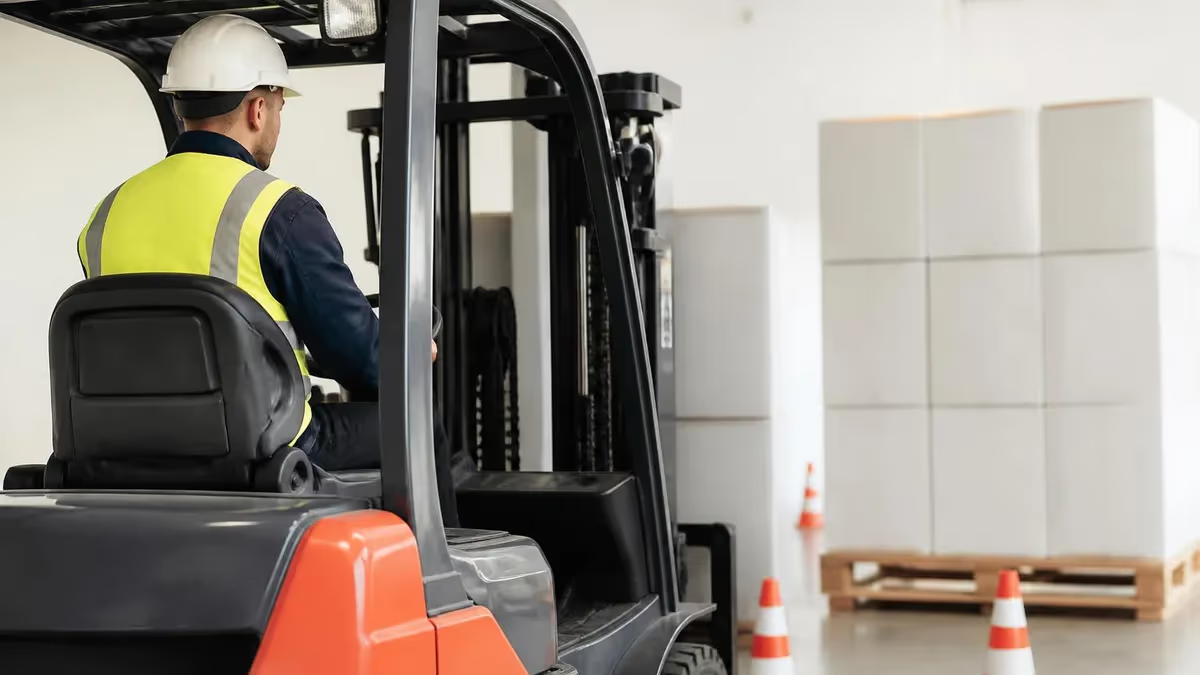
Understanding forklift license expiry is essential for every operator and employer in the United States, because OSHA regulation 29 CFR 1910.178(l) requires recertification at least once every three years. Unlike a driver's license that you renew with the DMV, your forklift operator credential is employer-issued, which means the responsibility for tracking expiration dates, scheduling refresher training, and documenting evaluations falls on both the worker and the company. Letting your certification lapse puts you out of compliance instantly, even if you've operated forklifts safely for two decades.
The renewal process is not just paperwork. OSHA requires a formal evaluation of operator performance, refresher training when specific triggers occur, and a written record that includes the trainer's name, evaluation date, and the operator's name. Many warehouses use forklift rental fleets that include sit-down counterbalance trucks, reach trucks, and pallet jacks, and each truck class requires separate evaluation. A forklift operator certified on a Class IV cushion-tire truck cannot legally operate a Class II narrow-aisle reach truck without additional training and evaluation.
The cost of letting a license lapse is steep. OSHA citations for untrained operators currently run $16,131 per serious violation and up to $161,323 for willful or repeat violations as of 2026. Beyond fines, an uncertified operator involved in an incident exposes the employer to negligence claims, workers' compensation premium increases, and potential criminal liability if a fatality occurs. The National Safety Council reports forklift incidents cause roughly 85 deaths and 34,900 serious injuries annually, and investigators almost always check certification status first.
This guide walks through every aspect of forklift recertification: the legal framework, the three-year cycle, what triggers an early renewal, how to find compliant training, what employers must document, and how to verify a trainer's credentials. Whether you operate an electric forklift in a cold storage facility, a propane-powered counterbalance unit on a construction site, or a stand up forklift in a high-density warehouse, the renewal requirements apply the same way. The truck class changes the training content, but never the legal obligation.
We'll also cover practical scenarios that operators ask about constantly. What happens if you change employers mid-cycle? Does your old certification carry over? How do you handle renewal for a seasonal worker who only operates a forklift four months per year? What documentation should you keep in your personnel file? If you're new to the industry, our companion guide on how to get forklift certified covers the initial certification path before you ever face renewal.
The good news: renewal is faster, cheaper, and easier than initial certification. Most refresher programs run 2-4 hours instead of the 8-hour initial course, cost between $50-$150 per operator, and can be completed online for the formal instruction portion. The hands-on evaluation must still happen in person, on the actual equipment type the operator will use, supervised by a qualified evaluator. Plan your renewal 30-60 days before expiration to avoid any gap in compliance status.
Forklift License Renewal by the Numbers
Key Facts at a Glance
| Item | Value | Details |
|---|---|---|
| OSHA Renewal Cycle | 3 Years | Maximum between evaluations |
| Typical Renewal Cost | $50-$150 | Per operator, per class |
| Refresher Course Length | 2-4 Hours | Versus 8 hours initial |

Forklift License Renewal Timeline
60 Days Before Expiration
30 Days Before Expiration
Renewal Day — Hands-On Evaluation
Documentation Filed
New 3-Year Cycle Begins
OSHA's recertification rules go beyond the standard three-year cycle. Several triggering events require immediate refresher training and re-evaluation, regardless of how recently the operator was certified. Understanding these triggers is critical because many employers assume the three-year clock is the only deadline. Operating an unsafe manner observed by a supervisor, involvement in an accident or near-miss, receiving an evaluation that reveals deficient performance, assignment to a different type of truck, or workplace condition changes that affect safe operation all reset the clock immediately.
The "different type of truck" trigger catches many operators off guard. OSHA recognizes seven distinct powered industrial truck classes, from electric motor rider trucks (Class I) to rough terrain forklift trucks (Class VII). If you're certified on a Class IV internal combustion cushion-tire truck and your employer asks you to run a Class II electric narrow-aisle reach truck for inventory cycle counts, you need additional training and evaluation on that specific class before stepping on it, even if your three-year certification is still valid for the Class IV.
Workplace condition changes also reset the clock. If your facility transitions from primarily pallet handling to handling oversized rolls, drums, or specialty containers, that's a material change requiring refresher training. Similarly, moving from indoor operations to a yard with sloped surfaces, gravel, or dock-to-trailer transitions introduces new hazards. The OSHA standard is performance-based, meaning if conditions change in ways that affect operator safety, the employer must provide additional training, even if it's the same truck.
Many operators don't realize that hyster forklift, Toyota, Crown, Yale, and Raymond brand differences alone don't trigger recertification, as long as the truck class and capacity remain similar. What does trigger recertification is moving between fundamentally different machines: from a counterbalance to a reach truck, from a sit-down to a stand up forklift, from indoor electric to outdoor propane. The deciding factor is whether the operator's required skills and hazard awareness change significantly, not the manufacturer's logo on the cowl.
For employers managing fleets that include rental equipment, this becomes particularly important. A construction site might bring in a hyster forklift rental for two weeks to handle a specific project. If your operators are certified on Toyota counterbalance trucks of similar capacity, they typically don't need full recertification, but they do need familiarization training on the specific controls, capacity plate, and operating characteristics of the rental unit. This familiarization should be documented just like formal training.
The accident-trigger rule is the most serious. Any forklift incident — collision, tip-over, load drop, pedestrian near-miss — automatically requires re-evaluation of the operator involved. This isn't optional and doesn't depend on fault. The logic is that the incident itself indicates a possible training gap, supervisor oversight gap, or operator complacency that must be corrected before the operator returns to work. Skipping this step after an accident is one of the fastest ways to convert an OSHA inspection into a willful violation citation.
Forklift certification Practice Test Questions
Prepare for the Forklift certification Certification exam with our free practice test modules. Each quiz covers key topics to help you pass on your first try.
Forklift certification Certification Forkl...
Forklift certification Exam Questions covering Certification Forklift certification Maintenance and Repairs. Master Forklift certification Test concepts for certification prep.
Forklift certification Certification Forkl...
Free Forklift certification Practice Test featuring Certification Forklift certification Maintenance and Repairs Questions and Answers. Improve your Forklift certification Exam score with mock test prep.
Forklift certification Certification Forkl...
Forklift certification Mock Exam on Certification Forklift certification Operator Training and Certification Requirements. Forklift certification Study Guide questions to pass on your first try.
Forklift certification Certification Forkl...
Forklift certification Test Prep for Certification Forklift certification Operator Training and Certification Requirements Questions and Answers. Practice Forklift certification Quiz questions and boost your score.
Forklift certification Load Handling and S...
Forklift certification Questions and Answers on Load Handling and Stability. Free Forklift certification practice for exam readiness.
Forklift certification OSHA Regulations an...
Forklift certification Mock Test covering OSHA Regulations and Compliance. Online Forklift certification Test practice with instant feedback.
Forklift certification Pre-Operation Inspe...
Free Forklift certification Quiz on Pre-Operation Inspections. Forklift certification Exam prep questions with detailed explanations.
Forklift certification Refueling and Recha...
Forklift certification Practice Questions for Refueling and Recharging Procedures. Build confidence for your Forklift certification certification exam.
Forklift certification Safe Driving and Ma...
Forklift certification Test Online for Safe Driving and Maneuvering. Free practice with instant results and feedback.
Forklift certification Workplace Hazard Id...
Forklift certification Study Material on Workplace Hazard Identification. Prepare effectively with real exam-style questions.
Forklift certification Forklift Instructions
Free Forklift certification Test covering Forklift Instructions. Practice and track your Forklift certification exam readiness.
Forklift certification Forklift MCQ
Forklift certification Exam Questions covering Forklift MCQ. Master Forklift certification Test concepts for certification prep.
Forklift certification Forklift Employer R...
Free Forklift certification Practice Test featuring Forklift Employer Responsibilities. Improve your Forklift certification Exam score with mock test prep.
Forklift certification Forklift Penalties ...
Forklift certification Mock Exam on Forklift Penalties for Non-Compliance. Forklift certification Study Guide questions to pass on your first try.
Forklift Training Delivery Options for Renewal
Online forklift training has become the dominant delivery model for the formal instruction portion of renewals. Programs run 2-4 hours and include video modules on OSHA standards, stability principles, load handling, hazard recognition, and truck-specific operation. Students complete a written knowledge test at the end and receive a certificate of completion. Reputable providers cost $50-$100 per operator and update content annually to reflect rule changes.
The key limitation: online training alone is never sufficient. OSHA explicitly requires hands-on evaluation by a qualified person in the actual workplace, on the actual equipment. Any vendor claiming to provide "100% online certification" is misleading customers. The online portion documents formal instruction completion; the hands-on evaluation by your employer completes the legal requirement. Treat online training as one of two required components, not a standalone solution.

Online vs In-Person Forklift Renewal: Which Is Better?
- +Online refreshers cost 50-70% less than in-person classes
- +Operators complete training on their schedule without travel
- +Content is updated quickly when OSHA standards change
- +Knowledge tests are auto-graded with instant feedback
- +Records and certificates are stored digitally and easy to retrieve
- +Multiple operators can train simultaneously without classroom space
- −Online training alone is not OSHA-compliant — hands-on evaluation still required
- −No live trainer to answer site-specific questions in real time
- −Some operators rush through video content without absorbing it
- −Quality varies significantly between online providers
- −Tech issues can interrupt training or delay completion
- −Hands-on evaluation must still be scheduled and documented separately
Pre-Renewal Forklift Operator Training Checklist
- ✓Verify the exact expiration date on your current certification card
- ✓Identify every truck class you operate and confirm each is covered
- ✓Schedule formal instruction at least 30 days before expiration
- ✓Confirm your chosen trainer meets OSHA's qualified person criteria
- ✓Review your facility's specific hazards before the evaluation
- ✓Complete the written knowledge test with a passing score
- ✓Perform a pre-shift inspection in front of the evaluator
- ✓Demonstrate load handling, stacking, and traveling skills
- ✓Receive written certification documenting all required information
- ✓Set a calendar reminder for your next renewal 30 months out
Your Certification Belongs to Your Employer, Not You
Unlike a CDL, forklift operator certification is workplace-specific and employer-issued. When you change jobs, your new employer must verify your previous training, evaluate you on their equipment in their facility, and issue their own documentation. Never assume a previous certification card is portable — the new employer is legally responsible for your competence on their site.
The financial side of forklift recertification deserves careful planning, because costs vary widely based on training delivery, location, the number of operators, and the truck classes involved. A single online refresher for one operator typically runs $50-$100, while a full-service vendor that comes on-site to train and evaluate a group of 10 operators charges $1,500-$3,000 total, or $150-$300 per operator. The on-site model becomes more economical as group size grows, and it eliminates the burden of scheduling individual evaluations after online instruction.
Employers should treat recertification as a budgeted recurring expense, not a surprise cost. A facility with 25 operators and a three-year renewal cycle should plan for approximately 8-9 renewals per year on a rolling basis, plus 2-3 new hires requiring initial certification, plus occasional trigger-based recertifications after incidents. Building this into the annual safety budget ensures funding is available and operators aren't pulled off renewal because the budget ran out in October.
Documentation is where many employers fail OSHA inspections. The standard requires written certification including the operator's name, the date of training, the date of evaluation, and the identity of the person who performed the training or evaluation. This can be a single document or a combined record, but it must be retrievable on request. Storing certificates in a binder is fine, but a digital system with expiration alerts is far more reliable. Many EHS software platforms offer this for $5-$15 per operator per year.
Beyond the OSHA-required documentation, smart employers also retain the written knowledge test results, the hands-on evaluation scorecard, the truck class covered, the date of any familiarization training on new equipment, and any incident-related recertification records. Retention should be at least the duration of employment plus three years, and longer if the operator is involved in any workers' compensation claim or injury investigation. Document destruction policies should explicitly exclude active operator training files.
One area where employers often save money inadvertently and then pay heavily later is by skipping documentation of "informal" familiarization training. When a rental forklift arrives for a two-week project, the supervisor walks the operator around it, shows the controls, and lets them get to work. That walk-around is training, and OSHA expects it documented. A simple form noting the date, the operator, the equipment serial number, the supervisor's name, and the topics covered takes five minutes and provides crucial legal protection if anything goes wrong.
Operators benefit from keeping their own copies of certifications, even though the employer holds the official record. Carry a wallet-sized card or digital photo of your certificate. When you change jobs, your new employer is required to verify and re-evaluate, but having documentation of previous training accelerates the process. It also helps in disputes about whether you were trained on a specific truck class or whether your most recent evaluation occurred within the three-year window.

If your forklift certification has lapsed by even one day, you must stop operating immediately. OSHA treats an expired credential the same as no credential at all. Resuming operation before completing renewal training and evaluation exposes both the operator and employer to citations of $16,131+ per violation, and personal liability if an incident occurs during the lapse period.
Employer liability in the forklift recertification context goes far beyond OSHA fines. Civil lawsuits stemming from forklift incidents frequently exceed $1 million in damages, and plaintiff attorneys routinely subpoena training records as their first step. An employer who can produce complete, current certification documentation for every operator dramatically reduces their exposure. An employer with gaps — missing evaluation dates, untrained operators on the floor, expired certifications that weren't renewed — faces compounding liability that often exceeds insurance coverage limits.
The qualifications of the person performing training and evaluation also matter. OSHA requires that the trainer have "the knowledge, training, and experience to train powered industrial truck operators and evaluate their competence." There is no formal OSHA-issued trainer license, but the trainer must be able to demonstrate their qualifications if challenged. A supervisor with 15 years of forklift experience who has completed a train-the-trainer program qualifies. A new hire with a community college safety certificate but no operating experience generally doesn't, even if they're trying to be helpful.
Multi-site employers face additional complexity. A regional warehouse company might have 12 facilities with different equipment fleets, different trainers, and different evaluation standards. Standardizing the renewal process across sites is essential. Companies that handle this well develop a master training matrix listing every operator, every truck class they're authorized on, their last evaluation date, and their next due date. This matrix is reviewed monthly by site safety leads and rolled up quarterly to corporate EHS.
Insurance carriers increasingly scrutinize forklift training records during policy renewals. Many workers' compensation and general liability insurers now require attestation that all powered industrial truck operators are current on OSHA-compliant training, and some require copies of certificates as part of the underwriting file. A facility with poor recertification compliance can see premiums increase 15-40%, and in extreme cases, lose coverage entirely. Maintaining clean training records protects the bottom line beyond just avoiding citations.
For employers that rely on temporary or staffing-agency workers, the responsibility lines blur but never disappear. OSHA's joint-employer doctrine generally holds that the host employer is responsible for site-specific training and evaluation, while the staffing agency is responsible for general orientation. In practice, the host employer should treat every temp operator as a new operator: verify any prior training documentation, conduct a workplace-specific familiarization, and document an evaluation before allowing independent operation. community forklift programs in many cities offer baseline training that staffing agencies can fund as a recruiting benefit.
Finally, the moral case for thorough recertification matters too. Forklift incidents devastate families. The operator who tips over a stand up forklift in a narrow aisle and crushes a pedestrian doesn't recover from that — neither does the pedestrian's family. Treating recertification as a box-checking exercise misses the point. The three-year cycle exists because skills and hazard awareness erode over time, and refresher training restores them. Employers and operators who approach renewal seriously protect lives, not just compliance records.
Practical preparation for your forklift recertification evaluation makes the difference between passing on the first try and needing remediation. Start by re-reading your facility's operating procedures and safety rules. Most evaluations include questions about site-specific hazards: pedestrian routes, dock procedures, blind corners, load capacity limits in specific zones, and how to respond to common incidents. Reviewing this material the day before the evaluation puts site-specific knowledge fresh in your mind alongside the general OSHA principles from your refresher training.
Practice the pre-shift inspection until it's second nature. Evaluators almost always ask the operator to perform a complete pre-shift inspection of the truck they'll be tested on. This includes tires, forks, mast chains, hydraulic hoses, hoses for leaks, horn, lights, backup alarm, parking brake, service brake, steering, fluid levels (engine, hydraulic, coolant, fuel/battery), seat belt, and overhead guard. Operators who skip the inspection or perform it superficially get marked down even if their actual driving skills are excellent.
For the hands-on driving portion, focus on smooth, controlled movement. Evaluators look for operators who travel at appropriate speeds for the area, sound the horn at intersections and blind corners, look in the direction of travel (including backward when reversing), maintain proper load position with forks tilted slightly back, and approach pallets squarely before lifting. Common failure points include traveling with the load too high, taking turns too fast, not sounding the horn, and failing to set the parking brake when dismounting.
Battery and fuel handling is increasingly tested on renewal evaluations as electric forklift adoption grows. If your facility uses electric trucks, you should be able to explain proper charging procedures, battery handling safety (acid-resistant PPE, no smoking, ventilation requirements), and what to do if a battery is damaged. If you use propane, demonstrate the proper procedure for changing cylinders, including checking for leaks before connecting and tightening fittings to specification. These specialty skills are often weighted heavily in evaluations.
Pedestrian and traffic awareness deserves dedicated mental rehearsal. Most fatal forklift incidents involve pedestrian struck-by scenarios, and OSHA has emphasized this in recent enforcement initiatives. Be prepared to explain how you'd handle a worker on foot entering your operating area, how you respond to someone walking under a raised load, and what you do when you can't see around a load. The expected answer is always: stop, sound horn, make eye contact, and never assume the pedestrian sees you.
Finally, treat the evaluator with respect and engage genuinely. Evaluators are looking for operators who take safety seriously, not just operators who can pass a checklist. Ask questions about facility-specific concerns. If you've encountered a tricky situation in the past, mention it and ask for guidance. Evaluators consistently report that operators who engage thoughtfully receive higher scores and benefit more from the renewal experience. The goal isn't just to pass — it's to be a safer operator for the next three years.
Sample Forklift certification Practice Questions
Try these questions from our free Forklift certification practice tests. The correct answer and an explanation follow each question.
How often must a forklift operator inspect the truck according to OSHA?
- A. Once per week
- B. Before each shift or when it is used
- C. Once per month
- D. Only when a problem is noticed
Answer: B. Before each shift or when it is used
OSHA requires forklifts to be examined at least daily, or after each shift when used around the clock.
How often must OSHA require that each forklift operator's performance be evaluated?
- A. Every 6 months
- B. At least once every 3 years
- C. Every 5 years
- D. Only after an accident
Answer: B. At least once every 3 years
OSHA requires an operator evaluation at least once every three years.
An employee has been operating the same counterbalanced forklift safely for five years. Workplace conditions and the type of forklift have not changed. According to OSHA 29 CFR 1910.178(l)(4), what is the MAXIMUM interval at which this operator must receive refresher training and an evaluation?
- A. Every year.
- B. Only after an accident or near-miss.
- C. Every five years.
- D. At least once every three years.
Answer: D. At least once every three years.
OSHA standard 1910.178(l)(4)(iii) mandates that all forklift operators must be evaluated at least once every three years to ensure their skills are current. Refresher training is also required sooner if the operator is involved in an accident, is observed operating unsafely, is assigned to a different truck, or if workplace conditions change.
An operator must leave a forklift to speak with a supervisor who is 30 feet away, but the forklift remains in the operator's direct line of sight. According to OSHA 29 CFR 1910.178(m)(5), the forklift is considered 'unattended'. What specific actions must the operator take?
- A. Lower the forks, set the parking brake, and keep the engine running.
- B. Set the parking brake and turn on the hazard lights.
- C. Neutralize controls, lower the forks, set the brake, and shut off the power.
- D. Lower the forks to the ground and place the controls in neutral.
Answer: C. Neutralize controls, lower the forks, set the brake, and shut off the power.
OSHA defines a forklift as 'unattended' when the operator is 25 feet or more away, or out of sight. The regulations require that when a truck is left unattended, the load engaging means (forks) must be fully lowered, controls neutralized, power shut off, and brakes set.
Forklift Questions and Answers
Forklift Tires: Complete Guide to Types, Sizing, Wear Patterns, and Replacement Costs
Forklift Accessories: Complete Guide to LED Lights, Attachments, Safety Gear, and Productivity Upgrades for 2026
Can a Forklift Enter a 26 ft Box Truck? Complete Guide to Loading, Operations, and Equipment Selection
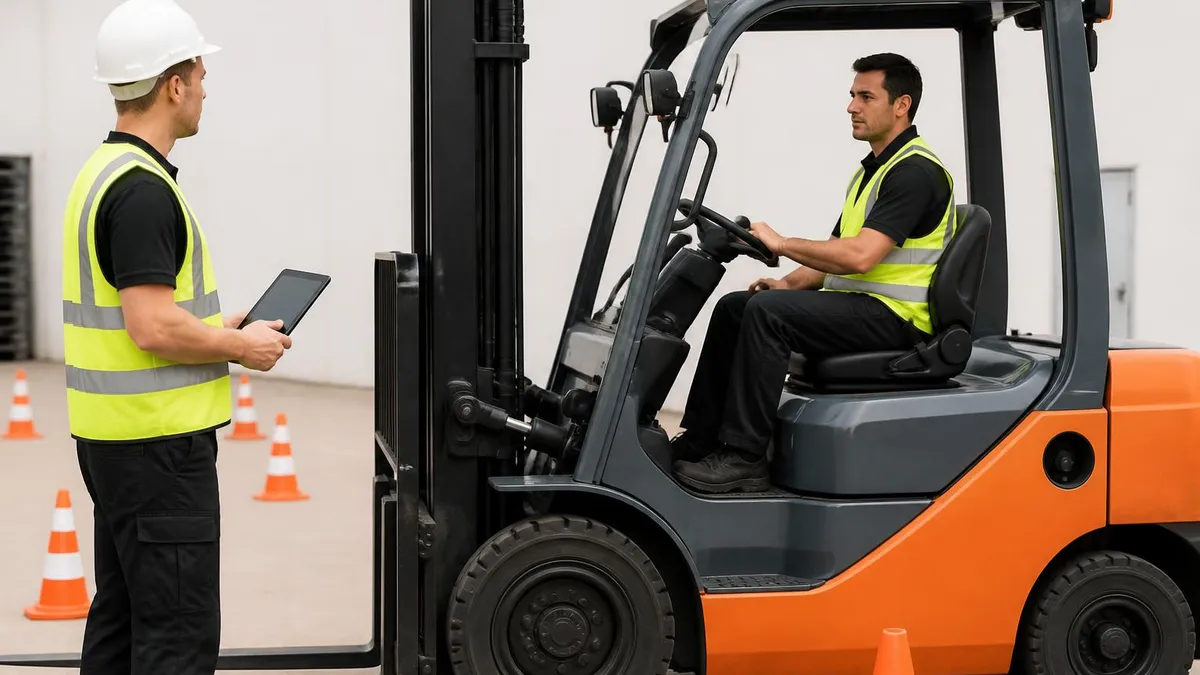
Forklift Safety Training: Complete OSHA Compliance Guide for Operators and Employers
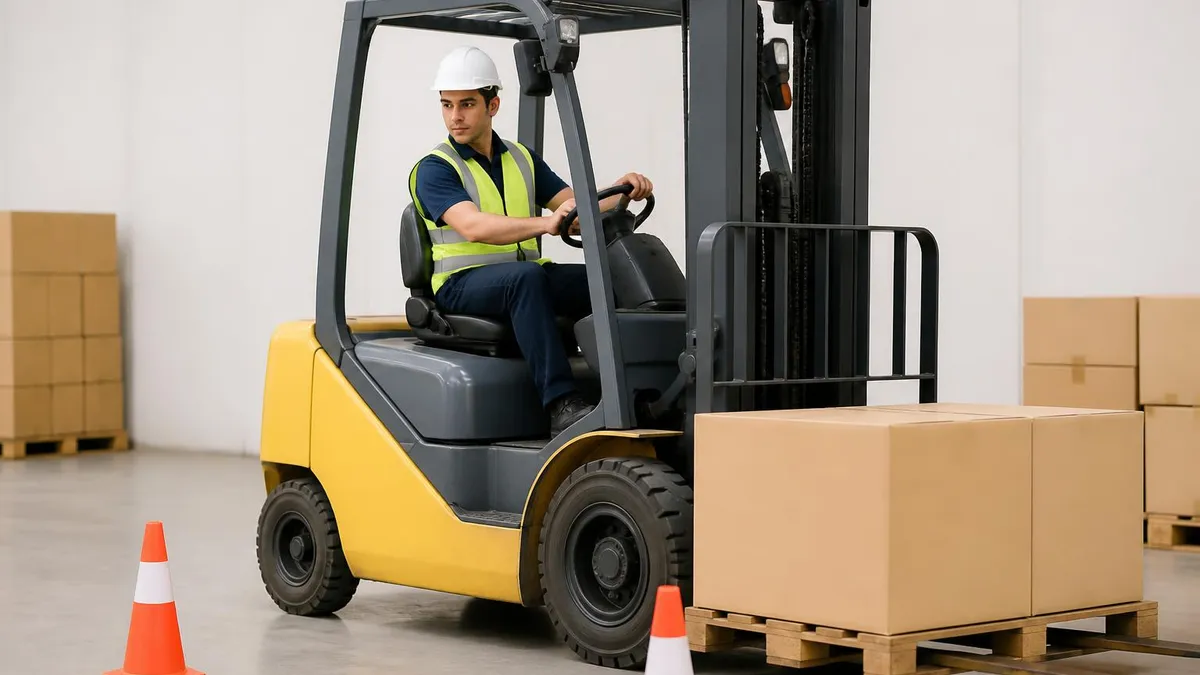
Forklift Repair Service: Complete Guide to Costs, Common Repairs, and Choosing the Right Technician
About the Author

Certified Crane Operator & Skilled Trades Exam Specialist
Ferris State UniversityRobert Martinez is a Journeyman Ironworker, NCCCO-certified crane operator, and forklift trainer with a Bachelor of Science in Construction Technology from Ferris State University. He has 21 years of ironworking, rigging, and heavy equipment operation experience across high-rise and industrial construction sites. Robert prepares candidates for crane operator, rigger, forklift, and skilled trades certification examinations.