
Can a Forklift Enter a 26 ft Box Truck? Complete Guide to Loading, Operations, and Equipment Selection
✅ Can a forklift enter a 26 ft box truck? Learn forklift rental options, operator clearances, ramp specs, and safe loading techniques for box trucks.
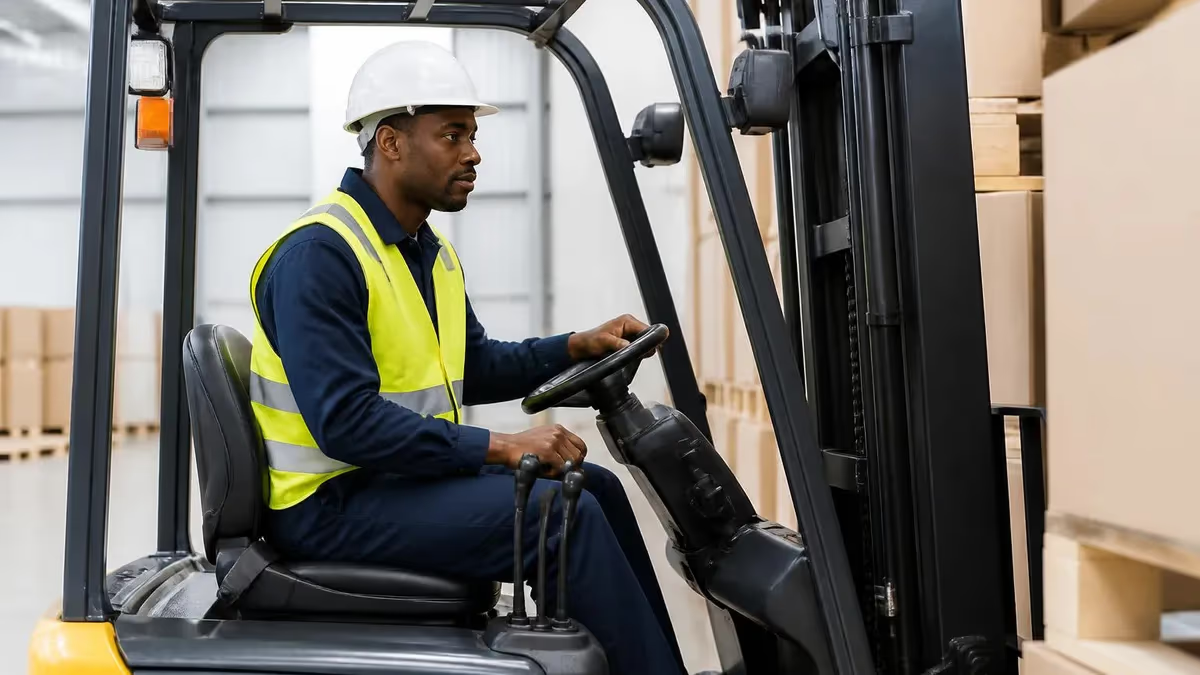
Can a forklift enter a 26 ft box trucks cargo area safely, or is it a recipe for crushed roofs and bent forks? This question pops up constantly on loading docks, in warehouse meetings, and during forklift rental conversations, and the answer depends on truck height, forklift mast collapsed dimensions, axle weight ratings, and floor reinforcement. A standard 26 ft box truck typically has an interior height of 96 to 102 inches and a floor rated for 12,000 to 26,000 pounds gross vehicle weight, which directly limits which forklifts can enter.
The short answer is yes, certain forklifts can enter a 26 ft box truck, but only specific models built with low collapsed mast heights and lightweight construction. Walk-behind electric pallet jacks, narrow-aisle electric stackers, and some compact three-wheel electric forklifts under 80 inches tall fit comfortably. Full-size 5,000-pound capacity sit-down counterbalanced units almost never fit, and trying to force one inside risks puncturing the roof, breaking the dock plate, or collapsing the truck floor under concentrated wheel loads.
Forklifts come in dozens of configurations, and choosing the wrong one for box truck loading wastes money and creates serious safety hazards. Most operators tackle this problem with a forklift rental from a local dealer rather than buying outright, because box truck loading is often a temporary or seasonal need. Renting also lets you match the exact spec to the truck dimensions without locking in a permanent equipment purchase that may not suit future workloads.
Operator certification of forklift skills under OSHA 29 CFR 1910.178 is mandatory before anyone drives equipment into an enclosed trailer or box truck. The confined space, limited visibility, and risk of carbon monoxide buildup from propane or diesel units make box truck loading one of the highest-risk forklift operations in any facility. Electric forklift models eliminate the exhaust hazard and are strongly preferred for indoor and enclosed-trailer work, which is why warehouses transitioning to box truck delivery routes are rapidly switching fleets.
This guide walks through every dimension, weight rating, ramp specification, and operator technique you need to load a 26 ft box truck efficiently and safely. We cover forklift selection, dock equipment, ramp angles, floor loading limits, OSHA compliance, and the realistic alternatives when no forklift can fit. Whether you operate one truck or a fleet of fifty, understanding these constraints prevents expensive damage and protects your operators from preventable injuries on the loading dock.
You will also see how forklift training programs address box truck loading specifically, what an OSHA-compliant pre-shift inspection looks like before entering an enclosed space, and how to evaluate crown forklift models against competitors when shopping for compact units. By the end, you will know exactly which equipment to rent, how to brief your driver, and which loading shortcuts to avoid. Let us start with the numbers that make or break the operation.
26 ft Box Truck Loading by the Numbers

Box Truck Dimensions and Forklift Compatibility
A 26 ft box truck typically measures 96 to 102 inches interior height, which means the forklift mast collapsed height plus operator overhead must stay under that ceiling.
Most 26 ft box truck floors support 10,000 to 12,000 pounds distributed, but concentrated forklift wheel loads of 8,000+ pounds in one spot can crack plywood subfloors.
Roll-up rear doors usually open 92 to 96 inches wide. Narrow forklifts under 36 inches wide pass easily, but standard counterbalanced units at 42-48 inches barely clear.
Loading dock ramps must stay under a 7-degree incline for safe forklift entry. Steeper ramps cause load shifting, mast contact with the truck roof, and rear tip-over.
Forklifts entering box trucks concentrate weight on rear axles. Position the truck on level ground with parking brake set and wheel chocks to prevent shifting during loading.
Selecting the right forklift for box truck loading starts with understanding the four main categories of equipment that can physically fit inside the cargo area. Compact electric three-wheel sit-down models with 78 to 82 inch collapsed mast heights represent the most common choice for facilities that load box trucks daily. These units typically carry 3,000 to 4,000 pounds, weigh 6,500 to 8,500 pounds themselves, and operate quietly on lead-acid or lithium-ion battery packs that produce zero emissions inside the enclosed truck body.
Stand up forklift models, sometimes called reach trucks or stand-up riders, offer another excellent option because they often have lower overall heights when the operator stands rather than sits. A stand up forklift gives the driver better visibility for tight maneuvering and lets them step off quickly if something goes wrong inside the truck. Crown, Raymond, and Toyota all manufacture stand-up units specifically marketed for trailer and box truck loading, with rated capacities from 3,500 to 5,000 pounds.
Walk-behind electric pallet jacks remain the most popular tool for box truck loading because they easily fit through any roll-up door, weigh only 800 to 1,200 pounds empty, and pose minimal floor stress. The downside is limited lift height, usually only 5 to 8 inches, which means pallets must already be at floor level. For deeper stacking inside the truck, walkie stackers with 130 to 150 inch lift heights bridge the gap between pallet jacks and full forklifts.
Internal combustion forklifts, including propane and diesel units, should almost never enter an enclosed box truck because exhaust gases accumulate quickly in the unventilated space. OSHA carbon monoxide limits of 50 ppm time-weighted average are easily exceeded within minutes of running an LPG forklift inside a closed trailer. Even cushion-tire indoor propane models that work fine in warehouses become dangerous the moment they cross the dock plate into the truck body, so electric forklift selection is the only responsible choice.
Hyster, Toyota, Crown, and Yale all publish specific guidance on which of their models are rated for trailer entry. The hyster forklift J30-40XNT series, for example, is specifically marketed as a trailer-loading unit with a 78-inch collapsed mast and tight turning radius. Toyota 8FBE15U and Crown FC 5200 series compete in the same category. Spec sheets list collapsed height, overall length, and minimum aisle width, which are the three numbers that determine box truck compatibility.
Used forklift for sale listings often advertise units as trailer-rated, but verify the actual mast collapsed dimension against the box truck interior height before purchasing. A unit listed at 80 inches collapsed height seems fine for a 96-inch interior, but mast tilt, overhead guard projection, and load backrest can add 6 to 10 inches in operation. Always measure with the operator seated and the mast at full tilt forward, which is how the unit actually moves through the truck during real loading.
Many fleet managers solve the box truck loading problem by maintaining one dedicated electric forklift just for trailer work and using larger propane units for outdoor and yard operations. This split-fleet strategy keeps the trailer-loader clean, charged, and ready while letting heavier-duty equipment handle pallets in the warehouse aisles. Forklift rental contracts can cover the trailer unit on a month-to-month basis, which works well for seasonal businesses that only run box truck routes during peak periods like the holiday shipping season or summer construction months.

Forklift certification Practice Test Questions
Prepare for the Forklift certification Certification exam with our free practice test modules. Each quiz covers key topics to help you pass on your first try.
Forklift certification Certification Forkl...
Forklift certification Exam Questions covering Certification Forklift certification Maintenance and Repairs. Master Forklift certification Test concepts for certification prep.
Forklift certification Certification Forkl...
Free Forklift certification Practice Test featuring Certification Forklift certification Maintenance and Repairs Questions and Answers. Improve your Forklift certification Exam score with mock test prep.
Forklift certification Certification Forkl...
Forklift certification Mock Exam on Certification Forklift certification Operator Training and Certification Requirements. Forklift certification Study Guide questions to pass on your first try.
Forklift certification Certification Forkl...
Forklift certification Test Prep for Certification Forklift certification Operator Training and Certification Requirements Questions and Answers. Practice Forklift certification Quiz questions and boost your score.
Forklift certification Load Handling and S...
Forklift certification Questions and Answers on Load Handling and Stability. Free Forklift certification practice for exam readiness.
Forklift certification OSHA Regulations an...
Forklift certification Mock Test covering OSHA Regulations and Compliance. Online Forklift certification Test practice with instant feedback.
Forklift certification Pre-Operation Inspe...
Free Forklift certification Quiz on Pre-Operation Inspections. Forklift certification Exam prep questions with detailed explanations.
Forklift certification Refueling and Recha...
Forklift certification Practice Questions for Refueling and Recharging Procedures. Build confidence for your Forklift certification certification exam.
Forklift certification Safe Driving and Ma...
Forklift certification Test Online for Safe Driving and Maneuvering. Free practice with instant results and feedback.
Forklift certification Workplace Hazard Id...
Forklift certification Study Material on Workplace Hazard Identification. Prepare effectively with real exam-style questions.
Forklift certification Forklift Instructions
Free Forklift certification Test covering Forklift Instructions. Practice and track your Forklift certification exam readiness.
Forklift certification Forklift MCQ
Forklift certification Exam Questions covering Forklift MCQ. Master Forklift certification Test concepts for certification prep.
Forklift certification Forklift Employer R...
Free Forklift certification Practice Test featuring Forklift Employer Responsibilities. Improve your Forklift certification Exam score with mock test prep.
Forklift certification Forklift Penalties ...
Forklift certification Mock Exam on Forklift Penalties for Non-Compliance. Forklift certification Study Guide questions to pass on your first try.
Electric Forklift vs Propane vs Stand Up for Box Truck Work
Electric forklift models are the gold standard for box truck loading because they produce zero emissions, run quietly, and weigh less than equivalent internal combustion units. A 3,000-pound capacity electric three-wheel sits at about 6,800 pounds with battery, compared to 8,500 pounds for a propane unit of the same capacity. The lower weight matters when entering trailer floors that may flex under concentrated loads.
Battery runtime on modern lithium-ion electric forklifts reaches 8 to 10 hours per charge, with opportunity charging during breaks extending operations indefinitely. Lead-acid still dominates the used forklift for sale market at lower prices, but lithium has become standard for new fleet purchases focused on trailer loading and indoor warehouse work.
Forklift Rental vs Purchase for Box Truck Operations
- +No upfront capital expenditure required for rental
- +Maintenance and repairs included in monthly rate
- +Easily swap models if loading needs change
- +Forklift rental near me dealers deliver and pick up
- +Tax-deductible operating expense rather than capital depreciation
- +Replacement unit provided if equipment breaks down
- +Trial period to evaluate equipment before committing
- −Long-term rental costs more than purchasing over 5+ years
- −Limited customization or attachment options
- −Hour usage limits may apply with overage charges
- −Damage liability still falls on the renting company
- −Less control over operator familiarity with specific unit
- −Availability constraints during peak season for forklift rental
Pros and Cons at a Glance
| Pros | Cons |
|---|---|
| No upfront capital expenditure required for rental | Limited customization or attachment options |
| Maintenance and repairs included in monthly rate | Hour usage limits may apply with overage charges |
| Easily swap models if loading needs change | Damage liability still falls on the renting company |
| Forklift rental near me dealers deliver and pick up | Less control over operator familiarity with specific unit |
| Tax-deductible operating expense rather than capital depreciation | Availability constraints during peak season for forklift rental |

Pre-Loading Safety Checklist for Box Truck Entry
- ✓Measure box truck interior height and compare to forklift collapsed mast dimension
- ✓Verify floor weight capacity exceeds forklift weight plus rated load
- ✓Set truck parking brake and chock both rear wheels
- ✓Inspect dock plate or ramp for cracks, proper anchoring, and weight rating
- ✓Confirm operator holds current certification of forklift skills for the truck class used
- ✓Switch to electric forklift if available to eliminate exhaust hazards inside the truck
- ✓Check overhead clearance with mast at full forward tilt and load backrest extended
- ✓Verify lighting inside the box truck cargo area for clear operator visibility
- ✓Test horn, brakes, lift function, and tilt before entering the trailer
- ✓Brief the operator on emergency exit procedure if equipment fails inside truck
Always Measure Twice Before Entry
The single most expensive mistake in box truck loading is driving a forklift inside without verifying the collapsed mast height clears the ceiling with safety margin. Operators routinely punch holes through trailer roofs by misjudging by just 2 to 3 inches. Always measure the truck interior at the lowest point, which is often the mid-trailer ceiling where lights or roof bows hang lower than the door opening suggests.
Forklift rental rates for box truck loading equipment vary widely based on capacity, region, rental duration, and whether the unit is electric or internal combustion. Expect to pay $150 to $250 per day for a 3,000-pound electric three-wheel suitable for box truck entry, $700 to $1,100 per week, or $2,200 to $3,800 per month with full maintenance included. Daily rentals usually require a 4-hour minimum and include delivery within a 25-mile radius of the dealer.
Searching forklift rental near me on Google typically returns major national chains like United Rentals, Sunbelt, and Herc Rentals, plus regional specialists who often carry better-spec equipment for trailer loading. Local dealers know which models actually fit common box truck dimensions and can recommend specific units based on your truck make and year. Penske, Ryder, and Enterprise also rent box truck loading equipment alongside their truck rental fleets, which simplifies logistics for single-event moves.
Long-term rental contracts of 12 months or more drop the monthly rate to $1,800 to $2,800 for the same equipment, often with options to purchase at lease end. This rent-to-own structure makes sense for businesses that have proven their box truck loading volume justifies a permanent equipment investment but want to spread the cash outlay. Most dealers credit 50 to 70 percent of paid rent toward the purchase price if you decide to buy after 6 to 12 months of rental experience.
Forklifts for sale in the used market typically run $8,000 to $18,000 for a serviceable 3,000-pound electric three-wheel with 6,000 to 12,000 hours on the clock. New units of the same capacity cost $28,000 to $42,000 depending on brand, battery type, and configuration options. Battery replacement alone runs $4,000 to $9,000 for lead-acid and $12,000 to $25,000 for lithium-ion, which is why used unit shoppers must verify battery condition with a load test before purchase.
Forklift repair service costs accumulate quickly on owned equipment, with typical annual maintenance budgets of $1,200 to $2,800 per unit for parts and labor. Hydraulic seal failures, mast chain replacement, brake adjustments, and tire replacement dominate repair invoices. Knowing how to get forklift certified technicians on call or under a service contract prevents extended downtime when a critical loading unit breaks down mid-shift during peak shipping periods.
Insurance and liability coverage add another $400 to $1,200 annually per forklift owned, while rental contracts typically include damage waiver and liability coverage in the base rate. This bundled coverage is one of the strongest financial arguments for renting rather than buying, especially for operations with infrequent box truck loading needs. Damage waivers usually cover up to $2,500 in repair costs per incident with the renter responsible for deductibles and excess damage.
For seasonal businesses, forklift rentals on a month-to-month basis during peak periods like Q4 holiday shipping, summer agricultural harvest, or construction season balance cost and availability. Lock in equipment 60 to 90 days before peak season because dealer inventory disappears quickly when every warehouse manager in the region needs trailer-loading units simultaneously. Booking early also lets you negotiate better rates than the walk-in customer paying full daily list price during the busy week.
Operating any internal combustion forklift inside an enclosed box truck creates immediate carbon monoxide poisoning risk. OSHA documented multiple operator fatalities and dozens of serious injuries from CO exposure during trailer loading operations. Always use electric forklift equipment for box truck entry, or refuse the task if only propane units are available.
Operator training and certification of forklift skills for box truck loading goes beyond basic OSHA 29 CFR 1910.178 requirements because the enclosed space creates unique hazards that general warehouse training does not cover. Comprehensive forklift training programs include 8 to 12 hours of classroom instruction, 4 to 8 hours of hands-on practice, and a documented evaluation by a qualified trainer before a forklift operator can independently load box trucks. The trainer must observe the new operator entering, maneuvering, and exiting an actual trailer or box truck, not just driving in open warehouse aisles.
OSHA requires certification renewal every three years, plus immediate re-evaluation whenever an operator is involved in an accident, near-miss, or operates equipment unsafely. Box truck loading triggers re-evaluation more often than general warehouse work because the confined space amplifies the consequences of any operator error. Many employers conduct annual refresher training specifically focused on trailer entry techniques, dock plate inspection, and emergency procedures if equipment fails inside the truck.
Local training providers offering forklift training near me typically charge $150 to $350 per operator for initial certification of forklift skills, with refresher training at $75 to $150 per renewal. Larger employers often run in-house training programs led by certified train-the-trainer staff, which spreads the per-operator cost down to $40 to $80 once trainer salaries and materials are amortized across the workforce. Online-only training does not satisfy OSHA requirements because the standard mandates hands-on evaluation.
Certification must specify which OSHA forklift classes the operator is authorized to drive. Class I covers electric counterbalanced trucks, Class II covers narrow-aisle electric trucks including stand-up reach units, Class III covers walkie pallet jacks and walkie stackers, and Class IV through VII cover various internal combustion and rough-terrain configurations. An operator certified on Class I cannot legally drive a Class II stand-up unit without additional training and evaluation specific to that class.
Documentation requirements include the operator name, training date, evaluation date, evaluator name, and equipment type. Many employers use digital certification platforms that store records in cloud databases accessible during OSHA inspections. Paper certificates work fine for compliance but get lost more easily than electronic records, especially in companies with high operator turnover or multiple facilities. Either format satisfies the standard as long as the documentation can be produced within reasonable time during an OSHA visit.
Box truck loading certification should specifically address dock plate inspection, wheel chock placement, truck driver communication, and the buddy system for confined-space operations. Some employers require a spotter outside the truck during all forklift entry, while others rely on horn signals and rear-view cameras mounted on the forklift. Both approaches work, but the spotter system catches more potential incidents and is the safer default for operators new to trailer loading work.
The most experienced trainers add modules on load weight verification, pallet stability checking, and what to do when a load shifts inside the truck. Operators must know how to safely back out of a partially loaded box truck if a pallet falls or shifts, which is a different skill from normal warehouse driving. Practice scenarios using empty pallets in a dedicated training trailer help new operators build muscle memory before they handle valuable freight in a real loading dock environment.
Practical loading techniques separate the experienced forklift operator from the new hire who damages trailers every other week. Always enter the box truck slowly at walking pace, with the load tilted slightly back against the load backrest and lifted just 4 to 6 inches off the ground. This position keeps the load stable, minimizes mast height, and lets the operator see the truck floor and walls clearly through the load and the mast carriage uprights without obstruction.
Position the first pallet at the front bulkhead of the box truck, leaving 2 to 4 inches of clearance from the front wall to prevent crushing damage during transit when the truck brakes. Subsequent pallets should butt tightly against the previous load to prevent shifting. Standard 48 by 40 inch GMA pallets fit two across in most 96-inch wide box trucks, with about 8 inches total clearance distributed between pallets and the trailer walls.
Back out of the box truck in a straight line whenever possible, with the load lowered to the floor and the mast tilted forward to minimize ceiling contact. Turning inside the truck increases the risk of striking walls, ceiling lights, or roof bows. If a turn is unavoidable, perform it in the front quarter of the truck where width is usually slightly greater than at the rear roll-up door area, and always with the load fully lowered.
Dock plate or leveler condition makes or breaks box truck loading safety. Inspect the plate for cracks, bent edges, loose hinges, and proper anchoring before every shift. Hydraulic dock levelers should rise smoothly to meet the truck floor with no more than 4 inches of vertical mismatch. Portable dock plates rated for 10,000 to 16,000 pounds work for most box trucks, but verify the rated capacity exceeds the forklift weight plus maximum load before driving across.
Communication between the forklift operator, the truck driver, and the dock supervisor prevents accidents. The truck driver should remain in the cab or in a designated safe zone away from the loading dock during forklift entry, never standing at the rear doors or inside the truck body. Hand signals, two-way radios, or dedicated dock lights all work for communication, but every facility should standardize on one system and train all operators consistently on the chosen approach.
Emergency procedures matter because forklifts do break down inside box trucks occasionally. Train operators to set the parking brake, lower the forks, exit the truck on foot, and call for backup rather than attempting field repairs inside the confined space. Pulling a stuck forklift out of a box truck usually requires a second forklift with chains or a flatbed tow operator, both of which take time to arrange but cause less damage than attempting to muscle the unit free with brute force.
Finally, document every load with photos showing pallet placement, load straps, and door closure. Modern smartphones make this trivially easy and provide invaluable evidence in claims disputes when freight arrives damaged at the destination. Many trucking insurance carriers now require photo documentation as a condition of cargo coverage, and operators who routinely take photos before closing the rear door create a defensive paper trail that protects both themselves and their employer from preventable liability claims.
Sample Forklift certification Practice Questions
Try these questions from our free Forklift certification practice tests. The correct answer and an explanation follow each question.
Which set of Personal Protective Equipment (PPE) is most appropriate when watering or charging an electric forklift battery?
- A. Leather gloves, safety glasses, and a hard hat.
- B. Cotton coveralls, steel-toed boots, and a dust mask.
- C. Acid-resistant face shield, goggles, neoprene gloves, and an apron.
- D. Welding helmet, hearing protection, and reflective vest.
Answer: C. Acid-resistant face shield, goggles, neoprene gloves, and an apron.
Forklift batteries contain sulfuric acid, which is highly corrosive. OSHA recommends specific PPE to protect against chemical splashes and burns. This includes an acid-resistant face shield, chemical splash goggles, acid-resistant gloves (like neoprene or rubber), and an acid-resistant apron.
In order to move the forklift between locations, you will be operating it onto a transporter. This loading operation is quite important. Who is in charge of it?
- A. You, the forklift operator
- B. The driver of the transporter
- C. The banksman
- D. The vehicle marshal
Answer: B. The driver of the transporter
When loading a forklift onto a transporter for relocation, the driver of the transporter is typically in charge of the overall loading operation. This is because they are responsible for the safe transport of the vehicle and must ensure it is correctly positioned, secured, and within the transporter's weight and dimension limits. While the forklift operator performs the driving, the transporter driver oversees the entire process to ensure compliance and safety.
What personal protective equipment is commonly required when operating a forklift?
- A. Only a hard hat
- B. Hi-visibility vest, safety shoes, and hard hat as required by the site
- C. No PPE is needed inside a cab
- D. Only gloves
Answer: B. Hi-visibility vest, safety shoes, and hard hat as required by the site
Sites typically require hi-vis clothing, safety footwear, and head protection depending on the environment.
While operating near a loading dock, an operator notices that a truck has pulled away, leaving the dock door open with no barrier in place. This situation primarily creates a severe risk of:
- A. A forklift falling off the dock edge.
- B. Unauthorized personnel entering the facility.
- C. Cargo being exposed to weather.
- D. Poor lighting conditions for the next truck.
Answer: A. A forklift falling off the dock edge.
An unguarded loading dock edge is one of the most dangerous hazards in a warehouse. A forklift can easily be driven off the edge, leading to a fall of several feet, which often results in serious injury or fatality for the operator.
Forklift Questions and Answers
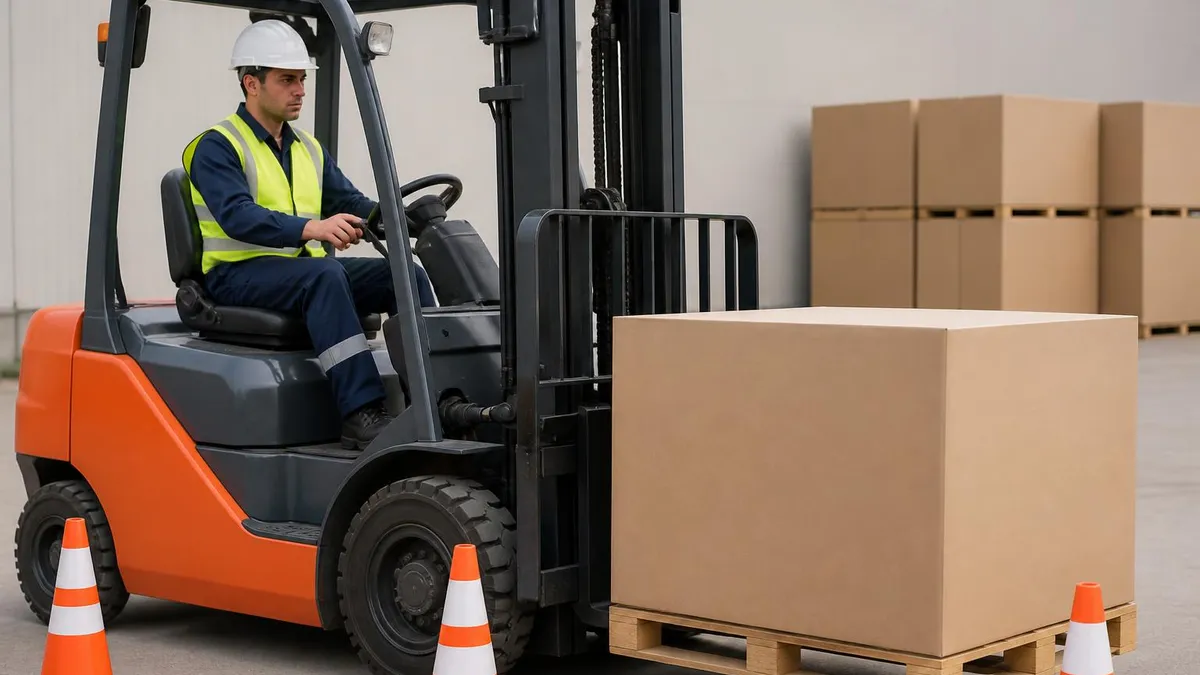
Forklift Tires: Complete Guide to Types, Sizing, Wear Patterns, and Replacement Costs
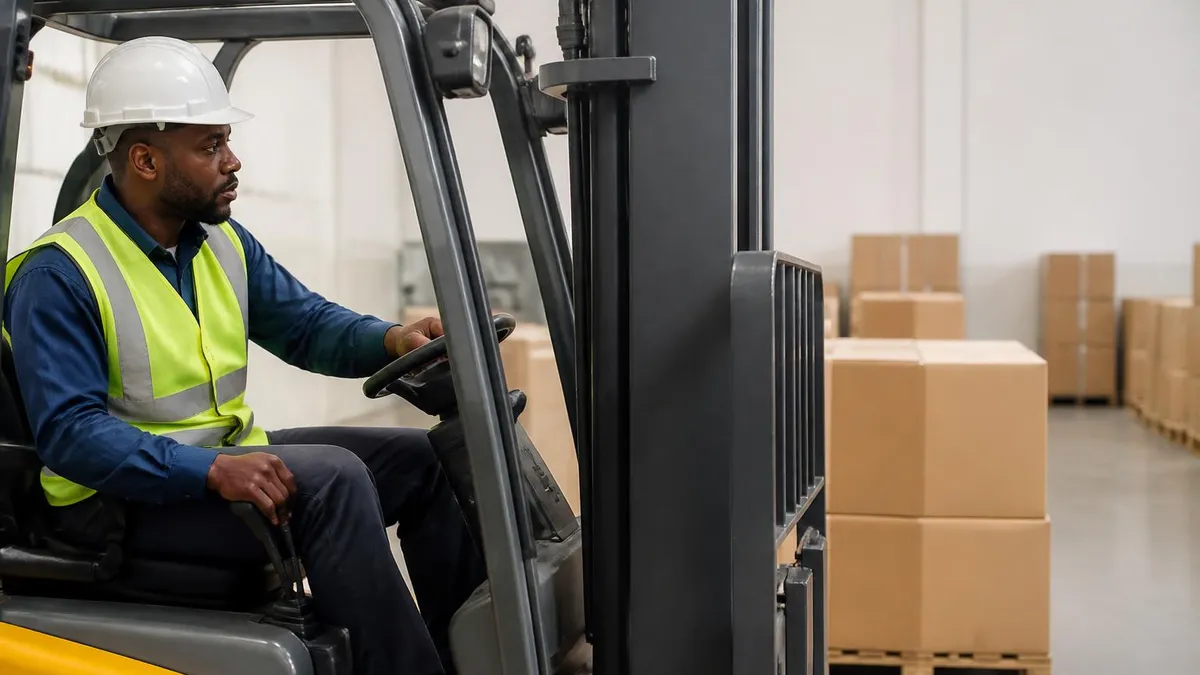
Forklift Accessories: Complete Guide to LED Lights, Attachments, Safety Gear, and Productivity Upgrades for 2026
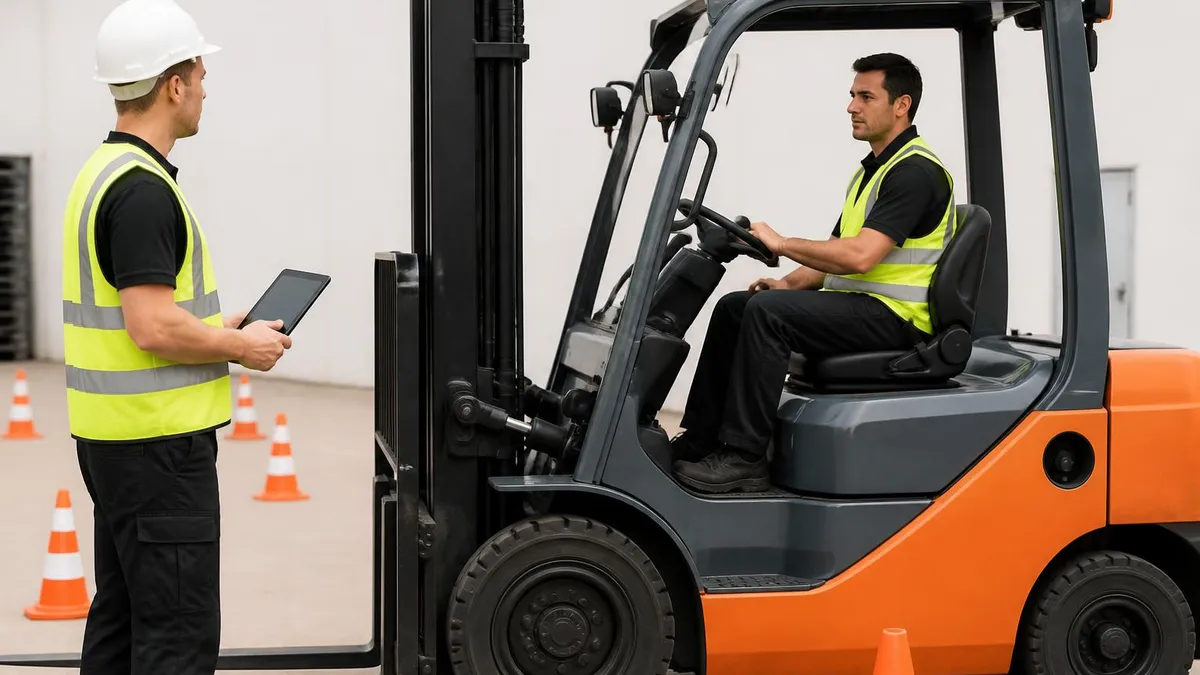
Forklift Safety Training: Complete OSHA Compliance Guide for Operators and Employers
Forklift Repair Service: Complete Guide to Costs, Common Repairs, and Choosing the Right Technician
Forklift Price Guide 2026: New, Used, Rental, and Total Cost of Ownership Breakdown
About the Author

Certified Crane Operator & Skilled Trades Exam Specialist
Ferris State UniversityRobert Martinez is a Journeyman Ironworker, NCCCO-certified crane operator, and forklift trainer with a Bachelor of Science in Construction Technology from Ferris State University. He has 21 years of ironworking, rigging, and heavy equipment operation experience across high-rise and industrial construction sites. Robert prepares candidates for crane operator, rigger, forklift, and skilled trades certification examinations.